

The Carbon Conundrum: Why Measurement is the New Corporate Mandate
The global economy is running a fever. The World Meteorological Organization (WMO) has confirmed the past decade was the warmest on record, a direct symptom of atmospheric CO2 concentrations breaching 420 parts per million, a level unseen in human history. For the corporate world, this stark scientific reality has finally triggered an unavoidable economic one.
The old management maxim, “You can’t manage what you can’t measure,” has been resurrected and redeployed for the climate crisis. For decades, corporate emissions were an afterthought, relegated to a few vague pages in an annual corporate social responsibility (CSR) report. That era is definitively over.
We are at an inflection point where carbon measurement is shifting from a voluntary, “nice-to-have” public relations gesture to a mandatory, auditable, and data-driven business function. It is, in essence, the new financial accounting. This article explores the powerful forces driving this transformation and the critical role of technology in making it possible.
The New Rulebook: Regulation Gets Real
The most immediate catalyst forcing boardrooms to pay attention is a wave of stringent, non-negotiable government regulation. For years, reporting was fragmented and voluntary. Now, a new, binding rulebook is being written.
In the European Union, the Corporate Sustainability Reporting Directive (CSRD) is a seismic event. This is not a simple “check-the-box” exercise. The directive mandates that nearly 50,000 companies provide detailed, third-party-audited data on their environmental and social impact, including granular emissions data from their entire value chain.
Across the Atlantic, while facing legal hurdles, the U.S. Securities and Exchange Commission’s (SEC) climate disclosure rule signals the same trend. The rule aims to treat certain climate-related disclosures with the same gravity as material financial risks, requiring public companies to report on their emissions and climate risks. The message from regulators worldwide is clear: climate data is now financial data.

Following the Money: Investors Equate Carbon with Risk
If regulation is the stick, global capital is both the carrot and an entirely different, heavier stick. Investors, from massive asset managers to retail shareholders, now fundamentally equate high carbon emissions with high financial risk.
Larry Fink, the CEO of BlackRock, the world’s largest asset manager, has crystallized this sentiment in his influential annual letters to CEOs. He has repeatedly argued that climate risk is investment risk, and that companies failing to plan for a low-carbon transition will be left behind. Investors are no longer just asking if a company has a climate plan, they are demanding the data to prove it works.
This sentiment is backed by hard research. The global disclosure nonprofit CDP, which runs a platform for environmental reporting, has consistently shown that companies with the highest levels of transparency and action on climate change (their “A-List”) often secure a lower cost of capital and outperform their peers on the stock market.
The Great ‘Bullwhip Effect’ of Supply Chains
The third, and perhaps most powerful, driver is the supply chain itself. This is creating a “bullwhip effect” for decarbonization. A few global giants are leveraging their immense purchasing power to force carbon accounting deep into the economy.
Apple, for example, has mandated that its global suppliers transition to 100% renewable energy to remain in its value chain. This single decision forces thousands of manufacturing partners in Asia and beyond to suddenly measure, manage, and report their energy use.
Similarly, Walmart’s Project Gigaton is an ambitious initiative to avoid one billion metric tons (a gigaton) of greenhouse gases from its global value chain by 2030. This program pressures tens of thousands of Walmart suppliers to report on their own footprints.
This triple-driver—regulation, investors, and supply chains—has created an urgent, massive, and complex data problem. Companies suddenly need to count carbon with the same precision they count cash. They lack the expertise and tools to do so, creating a critical vacuum that a new generation of sophisticated SaaS platforms, which we will explore next, is racing to fill.
The Science of Carbon Accounting: A Primer on the GHG Protocol
Before a single ton of carbon can be managed, it must be measured. Yet, without a universal, rigorous standard, any such measurement would be chaotic, subjective, and rife with “greenwashing.” To prevent this, the global economy has coalesced around a single, powerful standard.
This “gold standard” is the Greenhouse Gas (GHG) Protocol. Think of it as the Generally Accepted Accounting Principles (GAAP) for emissions. Just as GAAP ensures that a dollar of profit is calculated consistently across companies, the GHG Protocol ensures that a ton of CO2 is, too.
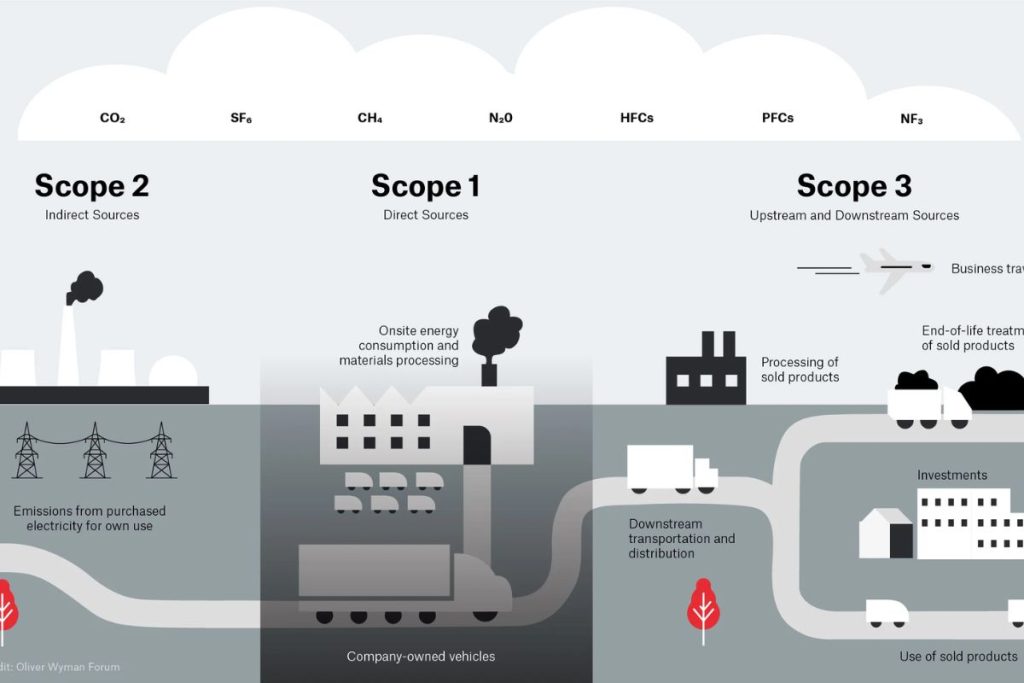
Figure of three scope GHG Protocol
This comprehensive framework was not created overnight. It is the product of a long-standing collaboration between the World Resources Institute (WRI) and the World Business Council for Sustainable Development (WBCSD). Today, it provides the scientific and accounting basis for what to measure and how to measure it. The sophisticated SaaS tools we will explore are, at their core, powerful engines built to execute the rules of this protocol.
The Protocol’s most critical contribution is its division of all corporate emissions into three distinct “Scopes.” Understanding these Scopes is the key to understanding modern carbon accounting.
Scope 1: Direct Emissions
First is Scope 1, which covers all direct emissions from sources that a company owns or controls. This is the most straightforward category, the “smoke from your own chimneys.” Examples include the emissions from fuel burned in company-owned vehicles, natural gas combusted in a factory boiler, or fugitive emissions from on-site chemical processes.
Scope 2: Indirect Emissions from Purchased Energy
Next is Scope 2, which accounts for indirect emissions from the generation of purchased energy. While a company doesn’t own the power plant, it is responsible for the emissions associated with the electricity, steam, heating, or cooling it buys. The GHG Protocol even mandates two methods for this calculation: a “location-based” method (using your region’s average grid emissions) and a “market-based” method (reflecting specific renewable energy contracts a company may have).
Scope 3: The “Final Frontier” of Carbon Data
Finally, and most importantly, there is Scope 3. This is the “final frontier” of carbon data, encompassing all other indirect emissions that occur in a company’s complete value chain, both upstream and downstream. If Scope 1 is your car and Scope 2 is your power bill, Scope 3 is everything else.
This category is vast. It includes emissions from the raw materials a company purchases, the business flights its employees take, their daily commutes, the transportation and distribution of its goods, the waste it generates, and even the emissions from the use and disposal of its products by the end consumer.
The scale of this category is staggering. Research from global disclosure platforms like CDP consistently shows that for most companies, particularly those in manufacturing or retail, Scope 3 emissions represent 80-90% of their total footprint. For an automaker, the emissions from their factory (Scope 1) are minuscule compared to the emissions from the steel they buy and the gasoline their cars will burn (Scope 3).
Herein lies the central problem for the modern corporation. The complexity, sheer volume, and lack of direct control over Scope 3 data have made it an accountant’s nightmare. It is this monumental challenge, the need to find, aggregate, and analyze millions of data points from a global supply chain, that the new generation of SaaS tools was built to solve.
The Decarbonization Toolkit: 10 Leading SaaS Platforms
The massive, complex data problem created by regulatory pressure and supply chain demands has triggered a boom in technological innovation. A new category of software, Sustainability Management or Carbon Accounting SaaS (Software-as-a-Service), has emerged to provide the “picks and shovels” for the low-carbon transition.
These platforms are the engines that run the GHG Protocol. They connect to a company’s financial systems, utility providers, travel platforms, and supplier networks to automate the painful process of data collection. Market research firms like Gartner and Verdantix now track this burgeoning field, which is moving from niche reporting to mission-critical business intelligence.

What follows is an analysis of 10 leading platforms, selected for their adherence to scientific protocols, data integration capabilities, and innovative approaches to solving the Scope 3 challenge.
1. Watershed
Watershed has rapidly gained prominence by focusing on granular, audit-ready carbon data. Its strength lies in moving companies beyond industry-average estimates to actual data from their value chain.
The platform provides a “Watershed Supply Chain” feature, a collaborative tool designed to actively engage suppliers. Rather than just guessing a supplier’s footprint, Watershed helps its customers pull real energy and emissions data from them, dramatically improving the accuracy of Scope 3 reporting and making decarbonization a joint effort.
2. Persefoni
Persefoni was designed from the ground up to be the “auditor’s choice,” treating carbon accounting with the same rigor as financial accounting. Its co-founders include Certified Public Accountants (CPAs), and its platform is built to provide “investment-grade” data that can withstand regulatory and investor scrutiny.
It particularly excels in the financial sector. Persefoni’s platform is one of the few capable of tackling Scope 3, Category 15 (“Financed Emissions”), allowing banks, private equity firms, and asset managers to measure the enormous carbon footprint of their own investment portfolios.
3. Salesforce Net Zero Cloud
Salesforce leverages its dominant position as the world’s #1 Customer Relationship Management (CRM) provider to embed carbon accounting directly into business operations. The Net Zero Cloud is not a standalone silo, it integrates with a company’s existing customer and supplier data.
This approach makes carbon a daily Key Performance Indicator (KPI). A business manager can see the carbon footprint of a specific supplier right next to their contract value. This integration transforms carbon from a once-a-year sustainability report into an actionable, real-time metric for the entire organization.
4. Microsoft Cloud for Sustainability
Microsoft’s strategy is one of data unification. The Microsoft Cloud for Sustainability is less a single tool and more an ecosystem built on the Azure cloud platform. Its “Common Data Model” acts as a universal translator for sustainability data.
It is designed to connect and normalize information from a huge array of disconnected sources, from enterprise financial systems and IoT sensors on factory floors to utility bills. By leveraging Microsoft’s Power BI visualization tools, it creates a single, unified source of truth for an enterprise’s entire environmental footprint.
5. Normative
Based in Sweden, Normative tackles the Scope 3 problem head-on with a powerful, AI-driven approach. It helps companies get a fast, comprehensive baseline by integrating with their financial systems.
The platform’s engine maps every single business transaction, from purchasing paper clips to booking flights, against a vast database of over 400 million emissions factors. This “spend-based” analysis quickly identifies a company’s biggest emissions “hotspots” in its supply chain, allowing them to focus their reduction efforts where they will have the most impact.
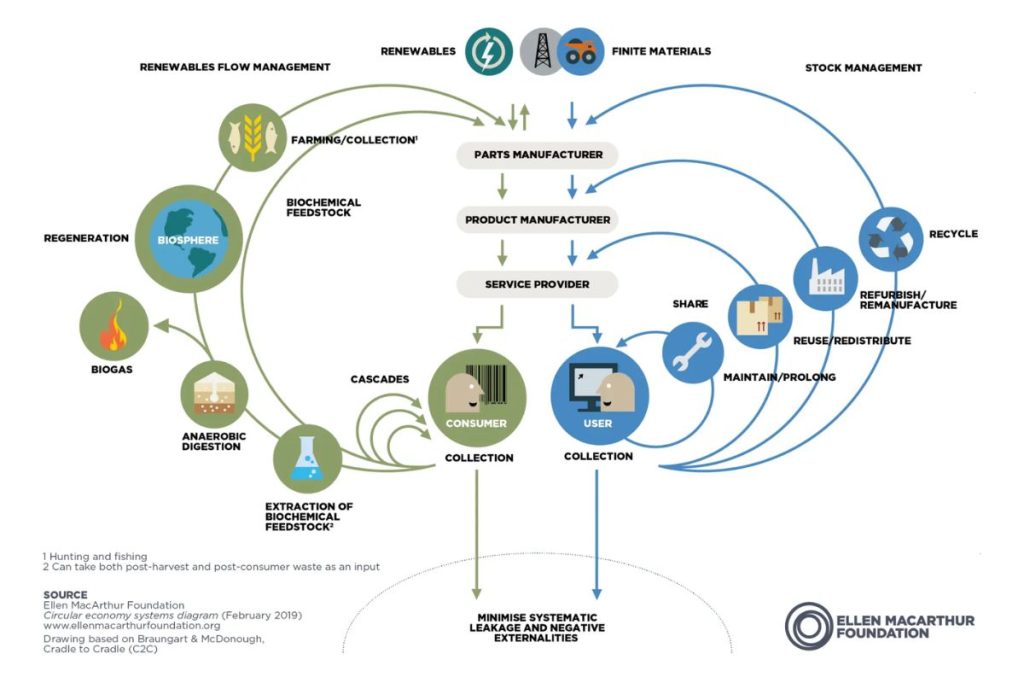
Figure of model of Circular Economy
6. Plan A
Plan A is a leading European platform with a strong focus on the “Measure, Reduce, Report” lifecycle. Its software is scientifically grounded and heavily aligned with strict EU regulations, including the CSRD, and scientific methodologies like the Science Based Targets initiative (SBTi).
The platform goes beyond simple measurement. It uses a company’s data to model future decarbonization scenarios, helping businesses build a scientifically valid roadmap to net-zero. This dual focus on rigorous accounting and actionable reduction planning has made it a favorite for companies navigating complex European climate policy.
7. Envizi (An IBM Company)
Now part of IBM, Envizi has deep roots in energy management and is a powerhouse for asset-heavy industries like real estate, utilities, and manufacturing. While many platforms start with financial data, Envizi starts with the physical asset.
It excels at capturing high-granularity data directly from buildings, factories, and utility meters. This makes it incredibly powerful for calculating complex Scope 1 and Scope 2 emissions, allowing companies to manage the performance of their physical operations and buildings in minute detail.
8. SAP Sustainability Control Tower
For the thousands of global corporations that run on SAP for their core finances and logistics, the SAP Sustainability Control Tower is a game-changer. It is not a bolt-on solution, it is designed to be embedded within the core Enterprise Resource Planning (ERP) system.
This integration allows for “green ledger” accounting. It can track the carbon footprint of individual products as they move through the supply chain or even the emissions associated with a single financial transaction. This embeds carbon data into the very financial DNA of the company.
9. Sweep
Sweep is a platform built for collaboration within complex, decentralized organizations. It recognizes that in a global company, carbon data is not owned by one person but by hundreds of managers across different business units, factories, and countries.
Its “network” approach allows a sustainability manager in France and a factory manager in Vietnam to each manage their own data within the same platform. This data then “sweeps” up into a single, coherent, and auditable report, making it ideal for conglomerates and multinational corporations.
10. Greenly
Greenly focuses on making carbon accounting accessible, fast, and automated for Small-to-Medium Enterprises (SMEs). This is a critical piece of the puzzle, as these SMEs make up the bulk of the “supply chain” for large corporations.
The platform is designed for non-experts, often integrating directly with accounting software like QuickBooks or Xero. By automating the data collection, Greenly provides the tools for smaller businesses to meet the decarbonization demands of their large corporate customers, democratizing access to carbon measurement.
From Measurement to Management: A Case Study in Action
Collecting “investment-grade” carbon data is a monumental achievement, but it is only the first step. A SaaS platform, no matter how sophisticated, is fundamentally a diagnostic tool. It is the high-tech X-ray that reveals the fracture, but it does not set the bone.
That data, by itself, does not remove a single ton of CO2 from the atmosphere. This creates the critical “data-action gap.” The software can tell a CEO that 30% of their emissions come from “Scope 3, Category 5: Waste Generated in Operations,” but it cannot physically build the recycling plant or manage the local waste streams. It identifies the “what” and “where,” leaving companies searching for the “how.”
This is precisely where the digital world of SaaS must connect with the physical world of on-the-ground action. This synergy is exemplified by the work of organizations like Earth5R, an environmental organization specializing in tangible, community-based sustainability and circular economy projects.
Earth5R acts as the “implementation partner” that translates a data point on a dashboard into a real-world, carbon-reducing project. Their focus is on creating local, closed-loop systems and generating value from waste, a key and complex Scope 3 challenge.
Let’s use a concrete example. A large consumer goods company, using a platform like Envizi, discovers a major emissions hotspot: post-consumer plastic packaging waste in a city like Mumbai. The software has done its job.
The company can then partner with an organization like Earth5R, which has extensive, research-backed case studies in this exact area. Earth5R has run successful waste management programs across Indian cities, mobilizing local communities and training informal-sector waste collectors.

This partnership effectively “closes the loop.” The SaaS platform continues to measure and verify the reduction in waste tonnage, while Earth5R executes the collection, segregation, and recycling, turning the waste from a carbon liability into a community resource.
This symbiotic model is the future of effective decarbonization. The technology provides the map, and the on-the-ground partners execute the journey. It allows a corporation to bridge the gap, turning a line item in their carbon ledger into a tangible, auditable, and impactful environmental project.
Conclusion: The Future of Carbon Accounting
The emergence of sophisticated carbon accounting SaaS is not an endpoint. It is the beginning of a rapid and profound technological evolution. As companies master the basics of measurement, the demand is shifting from broad estimation to granular, auditable precision.
This demand is pushing the next frontier of innovation, which will be defined by three powerful trends: artificial intelligence, mandatory audits, and deep operational integration.
The Rise of AI and Predictive Accounting
Artificial Intelligence is being deployed to solve the most complex and data-intensive part of the carbon puzzle: Scope 3. New AI-driven platforms can now scan and analyze millions of supplier invoices, procurement data, and logistics manifests in real-time.
This technology allows companies to move beyond static, industry-average “emissions factors.” Instead, AI can assign dynamic, specific carbon footprints to individual products or services. This will allow a purchasing manager to see the actual emissions difference between two steel suppliers, making carbon a tangible procurement metric.
From “Audit-Ready” to “Audit-Mandatory”
The second major trend is the move from “investment-grade” as a marketing slogan to a non-negotiable legal requirement. As regulations like the EU’s Corporate Sustainability Reporting Directive (CSRD) mandate third-party assurance, carbon reports are being held to the same high standard as financial reports.
This means “audit-ready” is no longer a simple feature, it is the entire foundation. Platforms that cannot produce a transparent, verifiable, and immutable data trail for auditors will be rendered obsolete. The “Big Four” accounting firms like Deloitte and PwC are already rapidly building “sustainability assurance” practices to meet this demand.
The “Disappearing” of Carbon Accounting
Perhaps the most profound long-term trend is integration. The ultimate goal is for carbon accounting to “disappear” entirely, becoming a seamless, automated, and invisible layer within a company’s core operating systems.
We are already seeing this happen. Platforms like SAP are embedding emissions data directly into the core financial ledger, allowing a CFO to see the profit and the carbon footprint of a single transaction. Similarly, Salesforce is adding carbon data to customer and supplier accounts, integrating it with the CRM.
The New Infrastructure for Business
The digitization of carbon is no longer a future concept, it is a present-day reality. The tools and platforms evolving today are more than just clever reporting software. They represent the essential data infrastructure for the 21st-century economy.
These SaaS solutions are the “picks and shovels” for the global transition to a low-carbon future. They provide the critical, real-time business intelligence required to navigate regulation, meet investor demands, and, ultimately, manage our planet’s most urgent and material financial risk.
Frequently Asked Questions
Why is measuring carbon footprints suddenly so important for businesses?
It’s driven by a “triple-driver”: 1) New, strict regulations like the EU’s CSRD, 2) Immense pressure from investors who now equate high carbon with high financial risk, and 3) “Bullwhip” pressure from major corporations like Apple and Walmart, which are mandating that their entire supply chains report emissions.
What is the GHG Protocol?
The Greenhouse Gas (GHG) Protocol is the global “gold standard” or universal rulebook for carbon accounting. It’s the framework that defines how companies should measure and report their emissions, ensuring data is consistent and comparable.
How is the GHG Protocol similar to GAAP in finance?
Just as Generally Accepted Accounting Principles (GAAP) ensure every company calculates a dollar of profit the same way, the GHG Protocol ensures every company calculates a ton of CO2 the same way. Both are standardized frameworks that create trusted, auditable data.
What are Scope 1 emissions?
These are direct emissions from sources a company owns or controls. The easiest way to remember this is “smoke from your own chimneys,” such as the fuel burned in company-owned vehicles or natural gas used in a factory boiler.
What are Scope 2 emissions?
These are indirect emissions from the energy a company purchases. This includes the electricity, steam, heating, or cooling it buys from a utility provider. While the company doesn’t own the power plant, it is responsible for the emissions generated on its behalf.
What are Scope 3 emissions?
These are all other indirect emissions in a company’s entire value chain. This is the largest and most complex category, including everything from the raw materials a company buys to its employees’ commutes, business travel, and even the emissions produced when customers use its products.
Why is Scope 3 the most difficult and important category to measure?
For most companies, Scope 3 accounts for 80-90% of their total footprint. It’s difficult because this data lies outside the company’s direct control, hidden deep within its global supply chain, business partners, and customer behaviors.
What is the main purpose of a carbon accounting SaaS platform?
These platforms are designed to solve the massive data problem of carbon accounting. They automate the process of collecting, calculating, and reporting emissions (especially complex Scope 3 data) according to the GHG Protocol, making it possible to manage and reduce a company’s footprint.
How do these platforms get their data?
They integrate directly with a company’s other digital systems. They can connect to financial software (like SAP or QuickBooks), utility bills, travel booking platforms, and supplier management systems to automatically pull and analyze data.
How do tools like Persefoni help banks and investors?
They are specially designed to calculate “financed emissions” (Scope 3, Category 15). This allows a bank or asset manager to measure the carbon footprint of its own investments, which is a massive and complex financial risk.
What does it mean for a tool like Salesforce or SAP to “integrate” carbon data?
It means carbon data doesn’t live in a separate report. It’s embedded directly into the core business software. A manager can see the carbon footprint of a supplier right next to its cost, or the emissions of a product right in the financial ledger, making carbon a daily business metric.
Are these tools only for large corporations, or can small businesses use them?
While many tools are built for large enterprises, platforms like Greenly are specifically designed for small-to-medium enterprises (SMEs). They often automate the process by linking to accounting software, making it easier for smaller companies (who are part of the larger supply chain) to report their emissions.
How does a platform like Normative calculate a footprint so quickly?
It uses an AI-driven, “spend-based” approach. By integrating with a company’s financial system, it maps every single transaction (e.g., “purchase of 100 laptops”) to a vast database of emissions factors, which quickly generates a comprehensive baseline of the company’s supply chain emissions.
What is the “data-action gap” in carbon management?
This is the gap between knowing your carbon footprint and doing something about it. A SaaS tool can tell you what the problem is (e.g., “high emissions from waste”), but it doesn’t physically implement the solution (e.g., build the recycling program).
How do organizations like Earth5R work with these SaaS tools?
They act as the “implementation partner” to close the “data-action gap.” If a SaaS tool identifies waste as a problem, an organization like Earth5R provides the on-the-ground solution, such as creating a circular economy or community-based waste management project that physically reduces those emissions.
What role will Artificial Intelligence (AI) play in the future of carbon accounting?
AI is crucial for improving the accuracy of Scope 3. It can scan millions of data points from invoices and logistics reports to move beyond industry averages and assign dynamic, highly specific carbon footprints to individual products or suppliers in real-time.
Why is “audit-ready” data becoming so important?
New regulations like the CSRD mandate that sustainability reports be audited by a third party, just like financial reports. If a company’s carbon data isn’t transparent, verifiable, and “audit-ready,” it will face legal and financial penalties.
What does it mean for carbon accounting to “disappear”?
This is the ultimate long-term trend where carbon measurement is no longer a separate, manual process. It will become a fully automated and invisible data layer embedded within a company’s core financial and operational software, like a “green ledger” that tracks carbon alongside cost.
What is the Corporate Sustainability Reporting Directive (CSRD)?
The CSRD is a mandatory, legally binding rule from the European Union. It requires nearly 50,000 companies (including many non-EU companies that do business in Europe) to provide detailed, third-party-audited reports on their environmental and social impacts, including their full Scope 1, 2, and 3 emissions.
How do carbon emissions equal financial risk for investors?
Investors see carbon in two ways: 1) Transition Risk: Companies with high emissions will face higher taxes (e.g., carbon taxes), operational costs, and potential loss of customers. 2) Physical Risk: Extreme weather events driven by climate change can physically destroy a company’s assets and disrupt its supply chain. Both of these directly threaten profitability.
~Authored by Abhijeet Priyadarshi