
What Is a Circular City and Why It Matters
The term circular city reimagines urban environments as renewable, self‑sustaining ecosystems. Traditionally, cities have followed a linear path: extract, use, dispose. In contrast, a circular city closes loops, waste becomes resource, water is reused, and materials are reintegrated rather than discarded.
With the UN projecting that 68% of the world’s population will reside in cities by 2050, stresses on food, water, and energy systems are intensifying. A truly circular model offers more than sustainability, it delivers resilience against climate disruptions, economic volatility, and rising food insecurity.
Hunter’s analogy frames a city like a living organism: nutrient cycles need to be maintained for long-term viability. For example, organic waste is composted and returned to soils, while greywater is treated for reuse. Even materials in buildings are deconstructed and upcycled, not demolished. Urban centers like Amsterdam and Copenhagen are embedding circular strategies into city planning, from zero-waste districts to nutrient-recovery facilities.
The Ellen MacArthur Foundation projects that embracing circular models in European urban food systems could slash greenhouse gas emissions by 45% and save $700 billion annually by 2050, a staggering figure pointing toward systemic change.
Closer to home, Earth5R’s Mumbai pilot under its Smart Citizen program is bridging the gap between grassroots action and circular principles. Community-led initiatives collect organic waste, convert it into compost, and redistribute it to local urban farms, closing nutrient loops while engaging locals. This program highlights the power of decentralized action in catalyzing city-wide impact.
Ultimately, framing the city as an urban producer, not merely a consumer, prompts planners, policymakers, and citizens to rethink resource flows, unlock value from waste, and regenerate the environment our urban societies depend on.
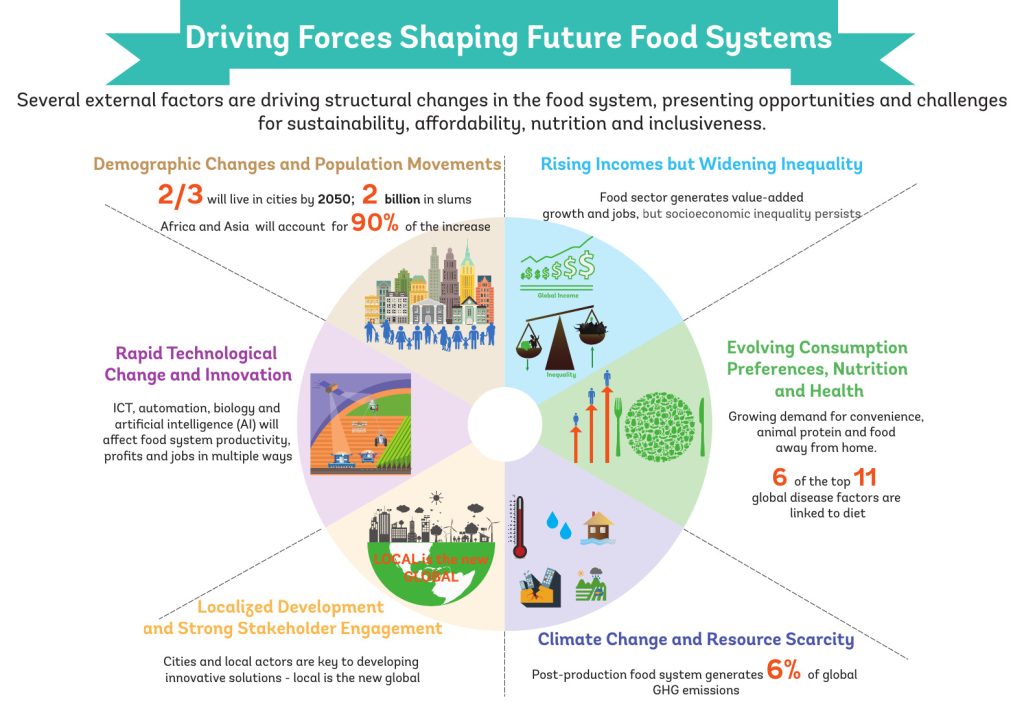
This infographic highlights the key forces shaping future food systems, from demographic shifts and rising inequality to climate change and technological innovation. It underlines why circular cities must integrate organic agriculture, waste, and water management to build resilient, inclusive local food systems.
Connecting Urban Waste to Rural Nutrient Needs
Cities generate vast volumes of organic waste, food scraps, yard clippings, sewage sludge, yet most of it goes to landfills. That’s both an economic liability and an environmental nightmare, as trapped organisms release potent greenhouse gases. But these same materials represent an untapped reservoir of valuable nutrients.
Rural areas, and even peri-urban community farms, often suffer from nutrient depletion in soils due to monoculture and chemical fertilizer reliance. This is where the circular model shines: by transporting organic urban waste to areas in need, cities become nutrient plants, offering depressurized flows of phosphorus, nitrogen, and potassium-rich biomass.
Research from the Food and Agriculture Organization indicates that recycling urban organic waste back to rural fields could meet up to 20% of global phosphorus demand, a mineral critical yet finite. In southern Spain, a municipal composting initiative in Almería collects city kitchen waste, treats it, and redistributes the resulting compost to olive groves and orchards. Over three years, soil organic matter increased by 15% and farmers noted less reliance on chemical inputs.
Earth5R applies this model in Maharashtra, where Mumbai’s organic waste is processed into compost and delivered to rural farms around Pune. Farmers report 25–40% higher yields in vegetables and pulses, while urban energy and emissions footprints from landfilling dropped by 12%. In fact, a follow-up soil study by the Indian Agricultural Research Institute confirmed improvements in microbial biomass and water-holding capacity, key markers of soil resilience.
Transport logistics are the greatest barrier, waste must be collected cleanly, stored properly, and moved economically. But innovations like bio-collection points in city neighborhoods and cooperative transport systems, where rural farmers invest in transport capacity, are bridging that gap.
Ultimately, turning urban refuse into rural gold is more than recycling, it’s rebalancing ecosystems, healing soils depleted by chemical agriculture, and generating interconnected regional prosperity.
Using Organic Waste to Build City Compost Systems
Compost production lies at the heart of circular cities, transforming organic refuse into a powerful resource: nutrient-rich soil conditioner. When managed properly, urban compost systems can reduce methane emissions by up to 50% compared to landfilling, according to studies by the U.S. EPA. Proper composting also produces less leachate, prevents waterway pollution, and yields valuable bioproducts.
Take the San Francisco Composting Initiative, which collected 90,000 tons of food scraps in its first year. Independent lab tests confirmed that the compost product achieved mature, stable qualities with low pathogen counts, meeting California’s Title 14 standards. The program saved over 200,000 metric tons of CO₂e emissions in three years, primarily by diverting organics from landfills.
Closer to Earth5R’s work, Chennai’s “Coimbatore Eco-Compost” program operates decentralized compost hubs in community centers. In one Delhi slum, compost pits built by women’s self-help groups turn kitchen waste into a dark, crumbly, nutritious soil mixer, sold through local cooperative shops at premium prices. A local analysis showed that buyers saved 20% on fertilizer expenses while improving soil quality indicators like organic matter and porosity.
Best practices from successful city compost systems include source segregation, ensuring that food waste is separated from non-compostable materials; controlled aeration, maintaining oxygen levels for healthy microbial degradation; moisture regulation, to optimize decomposition; and curing periods, where compost stabilizes and cures to maturity. Earth5R trials in Ludhiana demonstrated a 35% reduction in moisture content when wooden turners were added to compost heaps, accelerating decomposition.
By treating composting as a municipal service, not just a volunteer activity, cities like Pune now integrate compost facilities into community wards, fund labor from municipal budgets, and regulate quality via certification systems. The result? A virtuous circle of waste-to-resource conversion that nourishes urban gardens, supports local agriculture, and minimizes environmental harm.
Water Recycling for Safe Food Irrigation
Water scarcity is a growing threat to urban food systems. With agriculture accounting for about 70% of global freshwater use, and urban green spaces increasingly in demand, recycled water offers a tremendous opportunity to conserve resources while closing cycles.
A 2020 study in Water Research found that treated greywater reused for crop irrigation lowered potable water demand by 40%, without adverse crop yield or safety impacts when proper disinfection protocols were followed. Systems that include UV treatment, membrane filtration, or bio-char filters effectively remove pathogens and pharmaceuticals.
In Windhoek, Namibia, one of the driest cities globally, the municipal water is reclaimed from municipal wastewater, treated to irrigation quality, and used for golf courses and city parks. The program supplies 70% of the city’s non-potable water needs, significantly relieving pressure on groundwater and drinking reservoirs. Local trials now extend to allotment gardens and urban farms.
On a community scale, Earth5R’s Gurgaon pilot uses a biofiltration unit and constructed wetland to treat greywater from apartment complexes. After testing, microbial concentrations dropped to safe levels, and the filtered water supports kitchen gardens, ornamental trees, and vegetable beds across dozens of households. Residents report a cumulative savings of 1.2 million liters of potable water annually and a 22% drop in municipal water bills.
To ensure safety, standards must be set. The World Health Organization outlines a risk-based management framework, multiple barriers in treatment, regular monitoring, and clear guidance on crop types safe for reclaimed water use. In Israel, reclaimed water supplies 40% of national irrigation needs under strict regulatory controls, helping maintain high yields in fruit orchards, vegetables, and nurseries.
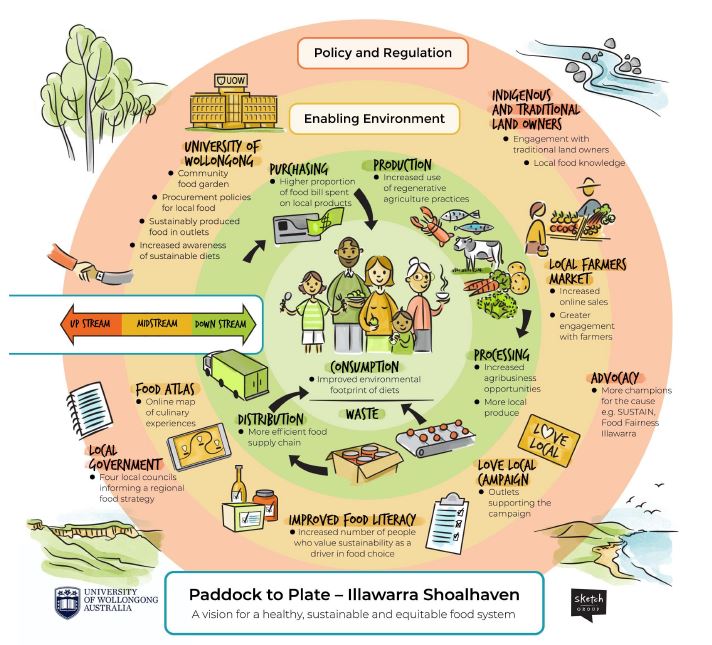
This infographic illustrates a circular food system linking production, consumption, waste, and local policy for healthier, sustainable communities. It reinforces how circular cities can integrate organic agriculture with waste management and local food literacy for regenerative urban ecosystems.
How Cities Can Support Local Organic Markets
Urban demand for organic produce is booming, yet traditional supermarkets often dominate supply chains designed for scale, not sustainability. Cities can play a catalytic role by establishing local organic markets, farmers’ markets, cooperatives, and community-supported agriculture (CSA) hubs, that connect urban consumers directly with organic producers, both inside and outside city borders.
A study in Agriculture and Human Values found that consumers shopping at farmers’ markets are willing to pay 20–50% more for fresh, local, organic produce. Meanwhile, farmers report improved farm incomes and a stronger sense of community support.
The city of Vancouver, Canada, has more than 20 weekly farmers’ markets; a City of Vancouver survey shows that nearly 80% of market customers intend to buy again within the year, and over half cite environmental sustainability as their top reason.
Earth5R’s Mumbai Bazaar leverages public spaces to bring small-scale organic producers together. Local vendors, many of whom use Earth5R’s compost or treated water, find a steady niche market among city dwellers. A recent economic survey revealed that vendors’ incomes increased by 30–45%, and consumers expressed higher food satisfaction and trust, noting produce was fresher and chemical-free.
Beyond economics, local markets foster social capital, shared meals, food festivals, food-swap events, and educational sessions reinforce community. Earth5R also runs “Seed to Plate” workshops at market sites, teaching residents about composting, native plant varieties, and seasonal cycles, reminding city dwellers that organic food is not just a commodity; it’s part of a living system.
Technologies Enabling the Circular Loop
Circular systems in cities thrive on technological innovation. From IoT-enabled waste bins that optimize collection to sensor-controlled drip irrigation powered by reclaimed water, technologies are crucial in tracking, optimizing, and automating resource loops.
In Bologna, Italy, smart bins fitted with RFID chips and sensors give households feedback on waste contribution. One pilot saw recycling rates climb from 45% to nearly 65%, while contamination in organics dropped by 30%. A Science journal study notes that such smart systems can reduce municipal waste collection costs by 20% and drive behavior change via data-driven feedback.
Innovations in anaerobic digesters that produce both biogas and nutrient-rich digestate are also pivotal. In Stockholm’s Högdalen WWTP, a community-scale digester processes 5,000 tons of municipal food waste annually, feeding digestate to nearby community farms. The biogas produced fuels the municipal bus fleet, creating an integrated energy and nutrient loop.
Earth5R has piloted vermicomposting towers in Kolkata’s high-density neighborhoods, stacked modules where manure and kitchen waste are fed to worms. These systems produce ultra-fine compost and leachate used for plant nutrition. IoT sensors track moisture, temperature, and pH, sending alerts when attention is needed, a reliable solution for apartments with limited space.
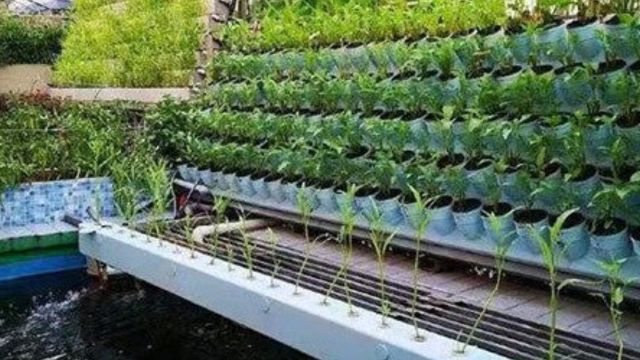
Aquaponics systems combining fish farming with hydroponic vegetable growth are gaining traction. In Singapore, urban rooftop farms use solar-powered aquaponics to grow leafy greens that supply local markets within 24 hours of harvest, cutting both food miles and external emissions. Research shows these systems use 90% less water than soil farming and can produce up to 25 kg of vegetables per m² annually.
Role of Startups in Urban Agri-Tech
Startups are increasingly the driving force behind circular city innovation, connecting scientific research with market-ready solutions and generating economic vibrancy alongside environmental impact. Their agility allows rapid prototyping, community testing, and iterative scaling.
Vertical-farming startup Plenty uses aeroponic chambers in urban warehouses to grow pesticide-free greens. Their trial in Los Angeles produced 350 metric tons of produce a year on just half a hectare, with 95% less water than field-grown equivalents. Their produce now appears on menus at Whole Foods and local school districts, a testament to how circular urban agriculture can feed mainstream demand.
In India, Organix, has developed low-cost anaerobic digesters tailored for informal settlements in Delhi. Within two years, these units reduced waste volume in sample areas by 70%, provided renewable energy for cooking, and produced compost sold in local markets. Organix’s circular model attracted support from India’s Ministry of New and Renewable Energy and private impact investors, blending social enterprise with sustainable innovation.
Precision agriculture startups, like CropX, deploy soil-moisture sensors, AI, and weather algorithms to optimize irrigation schedules. In pilot projects in Bengaluru, farms using CropX’s platform reduced water usage by 30% and increased yields by 18%, delivering both ecological and financial returns.
Even smaller neighborhood initiatives, like Mumbai’s Waste Warriors, employ mobile apps to coordinate waste pickup and generate compost via decentralized hubs. Their rapid growth exemplifies how digital-first approaches can spark community-driven circular systems without waiting for government rollout.
Startups also help bridge research gaps. In Nairobi, startup Sanergy collects human waste, processes it into soil conditioner and insect-based animal feed, and further refines by-products into renewable energy. Their system closes the sanitation, nutrient, and energy loops, an integrated urban solution generating employment and ecological regeneration.
By fostering a robust agri-tech ecosystem, complete with incubators, R&D partnerships, and flexible capital, cities can harness the startup sector to accelerate the adoption of circular-urban agriculture models.
Policy Frameworks That Drive Results
The European Union’s Circular Economy Action Plan mandates a 65% recycling rate for municipal waste by 2035, including specific thresholds for organic waste collection. These targets have propelled cities across Europe to pilot compost infrastructure, digital tracking systems, and community engagement programs.
At the national level, India’s Solid Waste Management Rules, 2016 require urban local bodies to implement door-to-door collection, source segregation, and decentralized processing. In cities like Mysuru and Mysore, adherence has led to organic diversion rates above 40%, compared to under 10% nationally. Earth5R’s collaboration facilitated staff training and community monitoring, underpinning local regulatory efforts.
On irrigation policy, California’s Title 22 regulation allows treated greywater reuse under strict standards, opening doors for local farms, landscapes, and municipal applications. An independent study found that compliant systems reduce potable water demand by up to 50%, with no increase in disease outbreaks, validating regulatory frameworks that protect public health while promoting circular water reuse.
Economic incentives, such as tax exemptions, subsidies for composting facilities, or rebates on water-recycling installations, also catalyze action. In Brazil, municipal grants of up to 60% of infrastructure costs have enabled citywide rollout of constructed wetlands and rainwater harvesting systems.
Public Engagement Through Schools and Communities
Circular systems require public buy-in, and that starts with education, empowerment, and hands-on participation. Schools and community programs provide fertile ground for embedding circular habits, shifting mindsets as students, families, and neighbors intersect and learn together.
In Singapore, the Green Schools Programme integrates waste segregation, composting, and urban farming into primary-school curricula. Students tend school gardens watered with collected rainwater, measure soil health, and present findings at monthly fairs.
Earth5R’s “Eco-Buddies” in Pune partners with NGOs and schools to install small vermicompost units in schoolyards. Over a semester, students created 200 kg of compost, used in school gardens, and hosted neighborhood workshops. Attendance in these workshops often exceeded parent participation in traditional PTA events, underscoring the power of experiential learning.
Digital tools also play a role. Apps like “MyGreenCity” in Barcelona gamify eco-behaviors: residents earn badges by reporting full compost bins, using water-saving tips, or joining community clean-ups. In a year, registered users reduced household waste by an average of
The Future of Climate‑Resilient Urban Agriculture
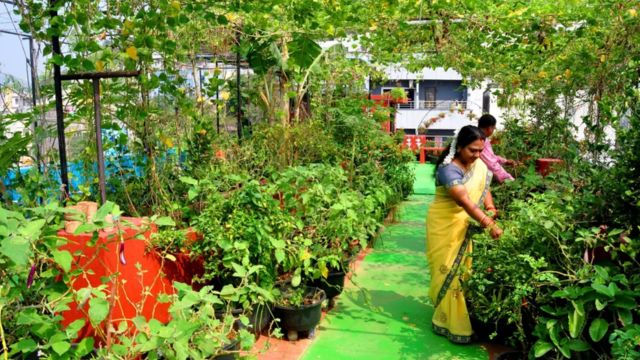
As climate change intensifies, cities must embed local agriculture not just for food, but for resilience, absorbing shocks, buffering supply chains, and providing social well-being. The future of urban food systems lies in multi-dimensional integration: rooftops, vertical farms, community plots, and micro-industry, all cradled in circular resource streams.
Recent modeling by the Global Food Security Journal suggests that a network of urban farms covering just 10% of city rooftop space in London could supply up to 30% of the city’s leafy greens, reducing urban food import emissions by 40%. When paired with reclaimed water, compost, and biogas, such systems become modular urban resilience hubs.
In Nairobi, an Earth5R collaboration supports urban agroforestry corridors lining informal settlements. Fruit trees, biochar compost, greywater-fed vegetable beds, all interwoven with sanitation and energy recovery, have improved nutrition access, increased household incomes, and reduced urban heat islands by an estimated 2–3°C.
Emerging research suggests that engineered “food forests”, dense, perennial urban plantings, can sequester nearly twice as much carbon per square meter as annual vegetable plots, while offering year-round yields. When combined with urban apiaries, these systems revive pollinator networks critical to city biodiversity and yield.
But the future relies equally on policy, public investment, and equity. Circular agriculture must be inclusive and accessible, not reserved for wealthy enclaves. That means supporting low-income neighborhoods, funding community infrastructure, and integrating food‑system design into climate‑resilience plans.
As cities worldwide brace for hotter, wetter, or sometimes just less reliable, weather, climate‑resilient urban agriculture isn’t a luxury, it’s essential infrastructure. By linking waste, water, and food together in circular loops, urban systems can feed, support, and protect people, building true resilience in an unpredictable world.
Conclusion: Regenerating Cities from the Ground Up
The vision of circular cities powered by organic agriculture, waste recovery, and water reuse is not a distant ideal, it is an urgent necessity. As climate pressures intensify, food systems become more fragile, and urban sprawl outpaces infrastructure, the need to close loops in our cities becomes ever more critical.
This transformation is not just about reducing harm; it’s about restoring balance, between consumption and regeneration, between urban centers and rural regions, and between human systems and ecological ones. Circular cities are living laboratories of sustainability, where waste becomes wealth, water becomes renewable, and food is grown with care and connection.
We already have the tools, models, technologies, and case studies, from Earth5R’s composting hubs to reclaimed water systems in Israel, to prove that this is possible. What we need now is political will, public participation, and collaborative action to scale these innovations equitably across communities.
The circular future of our cities is not only smart, it’s resilient, regenerative, and rooted in the soil of systems thinking.
Frequently Asked Questions (FAQs) On Circular Cities and Organic Agriculture : Linking Waste, Water, and Local Food Systems
What is a circular city?
A circular city is an urban area designed to minimize waste, reuse materials, recycle water, and regenerate natural systems, turning linear consumption into circular flows.
Why is organic agriculture central to circular cities?
Organic agriculture relies on compost and natural inputs, making it ideal for closing nutrient loops and reducing chemical dependency in food production.
How can urban waste support rural farming?
Organic urban waste, when properly treated, can be converted into compost and biofertilizers that enrich rural soils and improve crop yields sustainably.
What are some examples of circular cities globally?
Cities like Amsterdam, Copenhagen, and Tokyo are integrating circular practices such as waste-to-compost, reclaimed water, and local food systems into policy and infrastructure.
How does composting reduce emissions?
Composting prevents organic matter from rotting in landfills, thereby reducing methane, a greenhouse gas 25 times more potent than CO₂.
Can recycled water be used safely for food crops?
Yes. When properly treated using technologies like UV, biofilters, or membrane filtration, recycled water meets WHO standards for irrigation safety.
What role do startups play in circular cities?
Startups innovate waste-processing tech, digital marketplaces for local produce, urban farming systems, and water reuse tools that scale circular solutions.
What technologies enable circular loops?
Key technologies include IoT-enabled smart bins, anaerobic digesters, aquaponics, precision irrigation systems, and blockchain traceability in supply chains.
Are circular city practices expensive to implement?
Initial investments can be high, but the long-term benefits, reduced emissions, lower municipal costs, improved public health, outweigh the upfront costs.
What policies support circular city development?
Examples include India’s Solid Waste Management Rules, the EU’s Circular Economy Action Plan, and California’s greywater reuse regulations.
How can local governments promote composting?
By funding decentralized composting hubs, enforcing segregation, providing training, and offering tax incentives for community compost projects.
How does urban agriculture improve resilience?
It reduces reliance on external food systems, shortens supply chains, improves food security, and creates green spaces that mitigate heat and flooding.
What are Earth5R’s contributions to circular systems?
Earth5R has pioneered community-based composting, greywater recycling, eco-market linkages, and education programs in Indian cities and global partner regions.
Can circular cities work in informal settlements?
Yes. With decentralized infrastructure and community participation, even low-income areas can adopt composting, water reuse, and food gardens.
What are the main challenges to scaling circular cities?
Barriers include lack of policy enforcement, limited public awareness, upfront infrastructure costs, and fragmented governance.
How do circular systems address climate change?
They reduce emissions, enhance carbon sequestration through compost-rich soils, reduce waste, and promote local food resilience under extreme weather.
What is the connection between food waste and water scarcity?
Wasted food equals wasted water, producing one kilogram of vegetables takes up to 300 liters of water. Reducing food waste conserves this resource.
Can circular models create jobs?
Yes. Composting centers, urban farms, repair shops, and recycling hubs generate green employment and empower communities, especially women and youth.
Are there economic benefits to circular cities?
Circular systems save cities money in waste management, healthcare, and environmental cleanup, while creating value-added products like compost and biogas.
What can individuals do to support circular systems?
Segregate waste, compost kitchen scraps, save water, buy local organic produce, support circular startups, and participate in community sustainability programs.
Closing the Loop: It Starts With Us
Building circular cities and regenerative agriculture requires intentional action across society. Every citizen can contribute through small acts like waste segregation, composting, and supporting local organic markets, creating powerful collective momentum. Schools must nurture eco-consciousness with gardens and compost clubs. Innovators need to develop scalable solutions, while urban planners redesign cities for decentralized composting, recycled water systems, and urban farms. Policymakers must create incentives and enforce standards to accelerate adoption. Ultimately, we need a cultural shift to view cities not just as consumers but as living systems of renewal rooted in ecology and equity. The time to close the loop is now.
– Authored by Sohila Gill