

Why the Global South Matters in the Organic Trade
The rise of organic consumption in Europe, North America, and East Asia has triggered a surge in demand for certified organic produce globally. However, what often goes unnoticed is that the backbone of this booming market lies in the Global South—regions like India, Africa, and Latin America that produce the bulk of organic commodities ranging from spices and coffee to quinoa and cocoa.
According to the Research Institute of Organic Agriculture (FiBL) 2023 report, developing countries account for over 80% of global organic producers, even though their domestic consumption remains low. India alone has over 1.3 million organic farmers, the highest in the world, primarily cultivating cotton, tea, spices, and pulses for export markets.
Similarly, Uganda and Tanzania are leading organic exporters in Africa, supplying sesame, coffee, and tropical fruits to Europe and Asia. In Latin America, countries like Paraguay and Bolivia have become global leaders in organic quinoa and soy exports, enabling smallholder farmers to access premium markets and increase incomes.
The significance of the Global South extends beyond production volume. These regions possess traditional low-input farming practices and biodiversity-rich agroecosystems that align naturally with organic principles. For instance, Earth5R’s research in Indian tribal regions shows how communities have historically used natural pest control methods like neem extracts and cow dung manure, reducing transition costs for certification.
Similarly, smallholder farmers in Peru’s Andean highlands cultivate quinoa organically by default, supported by community norms and high-altitude pest resistance, making organic certification economically viable with minimal external inputs.
However, despite their central role, Global South producers often remain at the lower end of the organic value chain, receiving only a fraction of retail prices due to power asymmetries in global trade, certification bottlenecks, and logistical barriers. This structural imbalance resembles the historical commodity trade patterns where cocoa farmers in Ghana earned less than 6% of final chocolate bar prices, while European chocolatiers captured most of the value.
Recognising the Global South’s pivotal role in organic supply chains is thus not merely an economic necessity for importers but an ethical imperative to ensure fair trade, inclusive growth, and environmental justice. As global organic markets are projected to cross USD 500 billion by 2030, integrating India, Africa, and Latin America as equitable partners rather than just suppliers is crucial for building resilient, transparent, and sustainable organic supply chains worldwide.
Certification and Traceability Gaps in the South
Certification remains one of the biggest hurdles for organic farmers in the Global South. While Europe and North America have well-established certification bodies with streamlined processes, farmers in India, Africa, and Latin America often face fragmented, costly, and complex certification pathways. According to FiBL’s World of Organic Agriculture report 2023, over 75% of organic farmers globally are smallholders, many cultivating less than two hectares, making per-farmer certification economically unviable.
In India, the National Programme for Organic Production (NPOP) provides export certification standards, but farmers still struggle with bureaucratic delays and high costs. Community-led alternatives like Participatory Guarantee Systems (PGS) are recognised for domestic markets but remain limited in acceptance internationally. For instance, an Earth5R project in the Nashik district enabled over 200 farmers to gain PGS certification collectively, reducing costs by 70% and building buyer trust in local markets.
In Africa, certification gaps are even more stark. Ugandan organic farmers exporting coffee to Europe often rely on external certification agencies, with fees exceeding annual household incomes. The IFOAM Africa Network highlights that such costs limit market access for many farmers, perpetuating inequality in global trade. Similarly, in Latin America, small quinoa farmers in Bolivia face traceability barriers due to fragmented supply chains and a lack of digital monitoring systems, despite their produce being inherently organic by traditional practices.
Traceability is another critical issue. With rising concerns over food fraud and contamination, European and American buyers demand end-to-end digital traceability. However, most Global South supply chains remain paper-based, manual, and poorly integrated, increasing transaction costs and reducing market competitiveness. For example, India’s organic spice exports have faced rejections in EU ports due to documentation inconsistencies, undermining farmer incomes and national credibility.
Addressing these certification and traceability gaps requires investment in community-based certification, digital traceability platforms, and government-supported subsidies to make certification accessible, credible, and scalable for millions of small organic farmers across the Global South.
Logistics Challenges and Innovations
Logistics remains another formidable barrier in building resilient organic supply chains from the South. Organic products are often perishable, requiring cold chains and minimal transit time to retain freshness and certification integrity. However, transport infrastructure in many parts of India, sub-Saharan Africa, and Latin America is inadequate, leading to post-harvest losses that can exceed 30-40%, as reported by the Food and Agriculture Organization.
For instance, Indian organic mango exporters in Uttar Pradesh face high rejection rates due to poor cold storage facilities, forcing them to sell at local mandis at conventional prices despite organic certification. Similarly, Ethiopian organic coffee farmers struggle with unreliable rural roads that delay transport to central processing units, affecting bean quality and international buyer contracts.
However, innovations are emerging. In Latin America, the “Agro-Logistics Hubs” in Peru have integrated collection centres, cold storage, and quality testing within farming clusters, reducing logistics costs by up to 50% for smallholder organic producers. In India, Earth5R’s Urban Organic Markets model connects peri-urban farmers to urban consumers through hyperlocal mandis, cutting transport distances and reducing carbon footprints while ensuring farmers get better prices.
Africa too is witnessing innovation with mobile cold storage units deployed by startups like Koolboks in Nigeria, which use solar power to store perishable produce, enhancing shelf life and reducing spoilage. These decentralised innovations bypass traditional logistics bottlenecks, making organic supply chains more resilient and inclusive.
Yet, for these solutions to scale, governments and international development agencies must invest in infrastructure, decentralised storage, efficient port handling systems, and climate-resilient transport networks. Without such systemic investments, Global South organic supply chains will remain fragmented, limiting their ability to capture fair value in global markets despite their vast production potential.

Farmer Aggregation and Cooperative Structures
In the Global South, where smallholder farming dominates, aggregation is the key to organic success. The average farm size in India is less than 1.1 hectares, in sub-Saharan Africa, around 2 hectares, and in Latin America’s indigenous organic belts, often under 5 hectares. Without collective action, these farmers remain fragmented, unable to meet bulk export requirements or invest in certification and logistics infrastructure.
Cooperatives and farmer producer organisations (FPOs) have proven effective in bridging this gap. In India, Amalsad Mango Cooperative in Gujarat aggregates organic mango farmers to collectively process, grade, and export to Europe and the Middle East, reducing per-unit costs while improving bargaining power. Similarly, in Andhra Pradesh, Earth5R worked with organic farmer groups to create Participatory Guarantee Systems combined with cooperative branding, enabling them to sell directly to urban organic markets, raising their net incomes by 30-40%.
In Africa, the Kilimohai Organic Farmers’ Cooperative in Tanzania provides a successful model. By uniting over 5,000 small organic farmers under one umbrella, it ensures standardised training, certification, and market contracts with European buyers. This cooperative structure has increased farmer incomes by providing stable prices, reducing dependence on middlemen, and enhancing community investments in schools and health centres.
Latin America’s quinoa boom is also rooted in strong farmer associations. The ANAPQUI cooperative in Bolivia connects over 2,000 organic quinoa farmers, providing collective certification, storage, and processing facilities, which allows them to negotiate export prices directly with European buyers (ANAPQUI Bolivia). Without such aggregation, individual farmers would struggle to comply with international organic standards or achieve price premiums.
However, cooperatives often face operational challenges, including leadership disputes, limited financial literacy, and inadequate working capital. Strengthening them requires targeted capacity building, transparent governance mechanisms, and access to low-interest finance tailored for organic value chain development. Only then can farmer aggregation become a powerful engine driving the Global South’s organic trade ambitions.
Organic Input Access and Quality Control
While organic farming is rooted in traditional low-input practices, access to certified organic inputs remains a challenge in many parts of the Global South. In India, a National Academy of Agricultural Sciences study highlighted that over 60% of organic farmers struggle with reliable bio-fertiliser and biopesticide supplies, forcing them to either revert to chemical inputs or compromise on certification standards.
Africa faces similar bottlenecks. In Uganda, organic coffee farmers often lack access to neem-based biopesticides or microbial bio-fertilisers due to poor distribution networks and import dependence. According to IFOAM Africa, local production of organic inputs is insufficient to meet scaling needs, creating vulnerability in supply chains.
Latin America shows mixed outcomes. While Peru and Ecuador have developed thriving organic input industries, smaller countries like Paraguay rely heavily on imports, increasing production costs for smallholders. Additionally, quality control remains a concern. Inconsistent input quality can lead to crop failures, pest infestations, or rejection of produce in international markets due to residue contamination.
Innovations are emerging to address these challenges. In Maharashtra, Earth5R trained peri-urban farmers to produce their bio-inputs such as Jeevamrut and vermicompost using locally available cow dung, urine, and crop residues, reducing input costs by up to 80% and improving soil health and yields. In Africa, startups like Safi Organics in Kenya produce carbon-negative organic fertilisers using rice husk biochar, improving crop productivity while enhancing soil carbon sequestration.
Quality control remains critical. Without a robust testing infrastructure and regulatory oversight, substandard bio-inputs can damage both crops and the credibility of organic labels. India’s Jaivik Bharat initiative is working to streamline organic input certification standards to address this gap.
To build strong global organic supply chains, the Global South must invest in local organic input industries, enforce stringent quality standards, and integrate farmer-led bio-input production models. Only then can organic farming scale sustainably without dependence on costly imports or risking food safety breaches in international markets.
Cross-Country Collaboration Models
Cross-country collaboration has become a defining feature in strengthening organic supply chains across the Global South. Historically, South-South cooperation focused on technology transfer and trade in conventional commodities, but in recent years, organic agriculture has emerged as a strategic collaboration area to achieve food security, rural livelihoods, and environmental goals simultaneously.
One powerful example is the India–Africa agricultural partnership, where India has provided training on organic certification systems, bio-input production, and sustainable farming practices through initiatives like the India–Africa Forum Summit agricultural programmes. Indian organisations such as Earth5R have contributed to knowledge transfer, training African community leaders on participatory guarantee systems (PGS) and decentralised composting during collaborative organic farming workshops.
Latin America has also emerged as a key actor in fostering South-South organic partnerships. Under the Inter-American Institute for Cooperation on Agriculture (IICA), countries like Costa Rica and Peru have shared organic pest management innovations with African cocoa and coffee cooperatives. Such collaborations focus on low-cost, scalable solutions, including neem-based pesticides, biochar soil amendments, and community-led certification models.
A promising recent development is the BRICS organic agriculture dialogue, where Brazil, India, China, and South Africa have explored ways to harmonise organic standards to boost intra-BRICS organic trade (BRICS Agricultural Cooperation). Harmonisation would reduce transaction costs, facilitate cross-border certification recognition, and open new organic market corridors within the Global South.
However, these models often remain project-based rather than systemic. To scale, there is a need for regional organic knowledge hubs, integrated South-South certification frameworks, and pooled investments in logistics and storage infrastructure. Analogous to ASEAN’s integrated rice trade corridors, South-South organic supply chains must evolve from bilateral projects to robust multilateral frameworks that can withstand global market shocks and enhance food sovereignty for developing nations.

This infographic highlights the global state of organic agriculture in 2017, showing the growth in organic farmland, producers, and markets worldwide. It reflects how regions like India, Africa, and Latin America play a crucial role in expanding organic supply chains to meet rising global demand.
Building South–South Export Corridors
While organic exports from the Global South primarily flow to Europe and North America, there is an emerging opportunity to build South–South export corridors. These corridors can help countries diversify markets, reduce dependence on Western buyers, and capture greater value within regional economies.
For example, India exports organic spices, pulses, and teas mainly to the US and EU. However, recent trade data from APEDA (Agricultural and Processed Food Products Export Development Authority) shows rising organic exports to the Gulf Cooperation Council (GCC) countries, driven by growing middle-class demand for chemical-free foods. Similarly, India has begun exploring organic rice exports to African nations, leveraging its robust basmati organic production systems.
In Africa, countries like Uganda and Tanzania are looking to expand organic coffee and sesame trade within East Africa and to India and the Middle East, creating regional trade routes that reduce freight costs and delivery times. The East African Organic Product Standards (EAOPS) initiative is working to harmonise standards across the region to facilitate such intra-African organic trade.
Latin America also presents opportunities. Paraguay and Bolivia, which export organic soy and quinoa predominantly to Europe, are exploring markets in Brazil, Argentina, and Mexico to develop regional organic supply chains. The Mercosur Organic Strategy aims to integrate organic trade within the South American economic bloc, promoting certification equivalence and logistical coordination.
Earth5R has advocated for building Blue Cities organic export corridors that link peri-urban organic clusters in India with African and Middle Eastern urban markets, combining climate adaptation, food security, and economic diplomacy in a single framework. Such corridors can be climate-smart, leveraging short sea shipping, decentralised storage, and digital trade platforms to reduce carbon footprints and enhance supply chain resilience.
To build sustainable South–South export corridors, countries need to invest in harmonised standards, digital trade facilitation, cold chain infrastructure, and regional policy coordination. By doing so, the Global South can not only meet its development goals but also reposition itself as an independent powerhouse in the global organic economy, reducing historical trade dependencies and building food sovereignty.
Policy Support for International Organic Trade
Robust policy frameworks are crucial for positioning the Global South as a competitive player in international organic markets. Currently, many countries in the South have policies focused on domestic organic promotion but lack a comprehensive export-oriented organic trade strategy. This policy gap limits farmers’ and exporters’ ability to leverage the rapidly growing global demand for organic products, projected to reach over USD 500 billion by 2030, according to FiBL statistics.
India’s National Programme for Organic Production (NPOP) has laid a strong foundation for certification and exports, making India one of the top organic exporters of spices, tea, and cotton. However, experts argue that integration of organic into mainstream trade agreements remains weak. For example, organic produce is rarely prioritised in bilateral trade negotiations, resulting in non-tariff barriers like residue testing protocols and certification equivalence remaining unresolved.
Africa faces similar challenges. While Uganda, Tanzania, and Ethiopia are significant organic exporters, their policies primarily target smallholder domestic certification with limited export facilitation mechanisms. The African Union’s Continental Strategy for Organic Agriculture (2011-2025) aims to strengthen this through harmonised certification standards and capacity building, but implementation has been slow .
Latin America demonstrates more integrated policy models. Costa Rica, Peru, and Paraguay have embedded organic farming within national export strategies, enabling them to tap into premium markets in the US and EU. Peru’s National Organic Plan 2025 links organic farming targets with market development, training, and international trade promotion, increasing its organic export revenues by over 40% in the last five years.
Earth5R’s policy recommendations emphasise that for effective South-South and South-North organic trade, policies must integrate subsidies for certification, export credit lines, research on international market trends, and diplomatic efforts to harmonise standards. Without such targeted support, organic trade from the South risks remaining supply-driven rather than market-responsive, perpetuating low farmer incomes despite high global demand.
Tech Platforms for Trade, Quality, and Price Transparency
Technology is rapidly transforming global agricultural trade, and organic supply chains from the Global South are no exception. Digital platforms have emerged as crucial tools for traceability, quality assurance, market access, and fair pricing, addressing long-standing transparency gaps in organic trade.
In India, the Jaivik Kheti portal, developed by the Ministry of Agriculture, connects organic producers with buyers through an e-commerce interface, providing certification verification, farmer profiles, and real-time market prices. While adoption remains limited to certified farmer groups, it represents a significant step towards democratising organic trade.
Africa is witnessing innovations like M-Farm in Kenya, which enables organic and conventional farmers to access market prices, buyer contacts, and product quality requirements via SMS, enhancing transparency for smallholders without smartphones. Similarly, AgUnity in Uganda and Tanzania uses blockchain to record organic produce transactions, ensuring traceability and reducing middlemen exploitation.
In Latin America, Agrosmart Brazil offers digital farm management and traceability solutions for organic coffee and cocoa cooperatives, helping them meet stringent EU and US import standards while improving yields through AI-based agronomic advice. Such technologies strengthen farmer bargaining power by providing credible data on input use, harvest practices, and quality parameters, building buyer confidence in competitive markets.
Earth5R’s Digital Sustainability Platform integrates citizen data on soil health, compost quality, and organic farm practices to build transparent, verified supply chains for urban organic markets. By combining traceability with environmental data, it ensures buyers not only get chemical-free produce but also understand its climate and ecological benefits.
However, digital divides remain. Limited smartphone access, poor internet connectivity, and low digital literacy in rural areas restrict scaling. To overcome this, policy and development agencies must invest in last-mile connectivity, mobile-based interfaces, and farmer digital training programmes, ensuring no farmer is left behind in the emerging digital organic economy.
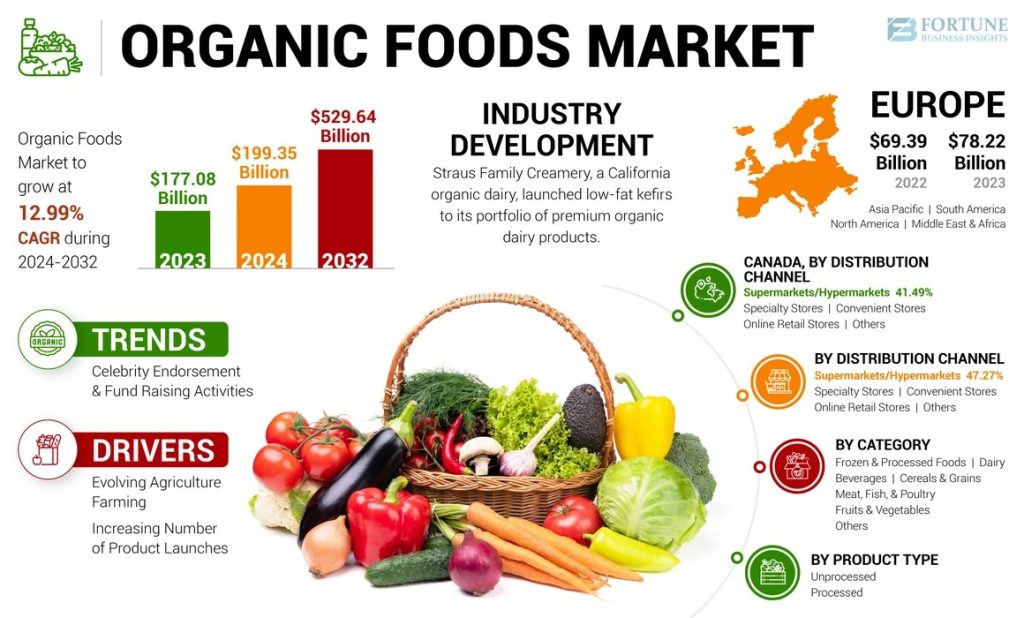
This infographic shows the booming organic foods market, projected to reach over $529 billion by 2032, driven by evolving agriculture and product launches. It underscores the growing opportunity for India, Africa, and Latin America to strengthen their role in global organic supply chains.
How to Position the Global South as an Organic Leader
For the Global South to evolve from being a supplier of raw organic commodities to becoming a leader in global organic markets, a strategic shift is needed. Currently, India, Africa, and Latin America provide most of the world’s organic raw produce, yet capture only a small fraction of the market value, which remains concentrated in European and North American processing and retail corporations.
The first step is moving up the value chain. Countries like Peru provide an example by branding their organic cacao and quinoa internationally as premium superfoods, capturing higher margins through origin labelling, direct marketing, and strategic trade missions. Similarly, in India, Earth5R’s Blue Cities Organic Initiative has demonstrated that when peri-urban organic clusters are linked with direct city markets and branded under a verified sustainability framework, farmers’ net incomes can rise by 30-40%, while cities meet health and climate goals.
Second, investment in research and innovation tailored for tropical organic systems is critical. Much of organic research globally has been driven by temperate country universities, focusing on crops like wheat, barley, and potatoes. The Global South needs research that addresses tropical soil fertility, indigenous pest management, and climate-resilient organic cropping systems. Initiatives like ICAR’s Organic Farming Research Centres in India and IICA’s organic research collaborations in Latin America are steps in this direction.
Third, building strong South-South trade corridors will reduce overdependence on Western markets. As explored earlier, intra-Africa, South Asia–Africa, and Latin America–Asia organic trade corridors can diversify markets, reduce transport emissions, and build regional food sovereignty. Organisations like IFOAM Organics International advocate for South-South certification harmonisation to enable this.
Fourth, the Global South must establish a strong unified voice in international organic policy forums. Currently, standards are dominated by European and US agencies, often overlooking the socio-economic realities of tropical smallholders. Collaborative blocs within WTO’s Committee on Agriculture and Codex Alimentarius can advocate for fair trade rules, realistic residue thresholds, and inclusion of participatory certification systems recognised globally.
Finally, building a public narrative that reframes the Global South as a knowledge and sustainability leader rather than merely a supplier is crucial. Campaigns that celebrate indigenous organic knowledge systems, farmer-led innovations, and climate resilience can reposition countries as ethical, reliable, and innovative partners in global organic trade. Earth5R’s training modules emphasise this by empowering communities to see their traditional practices not as outdated but as globally relevant sustainability solutions.
In essence, the pathway to leadership requires integrated action across branding, research, market development, policy advocacy, and narrative building. If implemented cohesively, India, Africa, and Latin America can transform global organic supply chains from extraction-based trade models to equitable partnerships rooted in sustainability, health, and shared prosperity.

Reimagining Organic Trade from the South
The future of global organic trade rests on empowering the Global South not just as a supplier of raw produce but as an innovative leader shaping sustainable, equitable supply chains. By investing in farmer aggregation, certification systems, logistics, research, and South-South market corridors, countries like India, African nations, and Latin America can transform organic farming into a pathway for food sovereignty, climate resilience, and inclusive growth. The world’s health and environmental future depend on this reimagining.
FAQs On Building Global Organic Supply Chains from the South: The Role of India, Africa, and Latin America
Why is the Global South important for organic trade?
The Global South produces over 80% of the world’s organic commodities, including spices, cocoa, coffee, and quinoa, making it central to meeting global organic demand.
Which countries lead organic farming in the Global South?
India leads in farmer numbers, while Uganda, Tanzania, Peru, and Bolivia are major organic exporters of coffee, sesame, cacao, and quinoa.
What is the main challenge in organic certification for small farmers?
High costs, complex paperwork, and lack of access to internationally recognised certification bodies make certification difficult for smallholders.
What is Participatory Guarantee System (PGS)?
PGS is a community-based organic certification approach recognised for domestic markets in India and some other countries, reducing certification costs through collective assurance.
How do logistics affect organic trade from the South?
Inadequate cold chains, poor rural roads, and high transport costs lead to post-harvest losses and reduced competitiveness in global organic markets.
What is Earth5R’s contribution to organic supply chains?
Earth5R has developed models like Blue Cities Organic Markets and community PGS clusters that integrate farmers with urban markets while ensuring sustainability and fair pricing.
Why is traceability important in organic supply chains?
Traceability ensures product authenticity, quality, and compliance with international standards, building buyer trust and preventing food fraud.
How does farmer aggregation help organic trade?
Aggregation through cooperatives or FPOs enables smallholders to achieve export quantities, reduce per-unit costs, and negotiate better prices with buyers.
What are South–South export corridors?
These are trade routes between Global South countries that promote organic trade within regions like Africa–Asia or Latin America–Asia, reducing dependency on Western markets.
Which technological innovations are transforming organic trade in the South?
Platforms like Jaivik Kheti in India, AgUnity in Africa, and Agrosmart in Latin America provide digital traceability, market access, and quality verification for farmers.
How does policy impact organic exports?
Policies that integrate organic farming into export strategies, reduce certification costs, and negotiate international standards improve market access and farmer incomes.
What lessons can be learned from Latin America’s organic policies?
Countries like Peru link organic farming with national branding and export promotion, increasing revenues and positioning themselves as premium suppliers.
Why is access to organic inputs a problem in the Global South?
Limited local production, poor distribution networks, and inconsistent quality control make organic inputs expensive or unavailable for many smallholders.
How are cooperatives in Africa supporting organic farmers?
Cooperatives like Kilimohai in Tanzania aggregate thousands of farmers for certification, training, and export marketing, improving incomes and community development.
What role does research play in positioning the South as an organic leader?
Research tailored to tropical organic systems enhances productivity, pest management, and market competitiveness, reducing reliance on imported solutions.
How can the Global South capture more value in organic trade?
By processing, branding, and marketing organic products directly, countries can earn higher margins instead of exporting raw commodities.
What is South-South certification harmonisation?
It refers to aligning organic standards among Global South countries to facilitate regional trade without multiple certifications and high compliance costs.
How does organic farming promote climate resilience?
Organic practices improve soil health, water retention, and biodiversity, making farming systems more resilient to climate extremes.
Why is digital literacy important for organic farmers?
Without digital skills, farmers cannot access traceability platforms, market prices, or online certification systems that are increasingly essential for trade.
What is the future of Global South organic supply chains?
With strategic investments in certification, technology, market development, and South-South cooperation, the Global South can become a global organic leader while ensuring sustainability and equity.
Join the Movement: Build a Fair Organic Future
The Global South stands at the heart of the world’s organic supply, yet its farmers remain undervalued in global markets. As consumers, policymakers, and professionals, we must advocate for policies that prioritise fair trade, invest in farmer cooperatives, and support digital innovations that empower smallholders. By choosing organic products sourced ethically from India, Africa, and Latin America, and by amplifying their voices in global forums, we can transform organic trade into a tool for equity, sustainability, and shared prosperity. Now is the time to build an organic movement that uplifts the very communities that nourish the world.
-Authored by Pragna Chakraborty