
Bridging Forests and Farms for a Resilient Future
In the age of climate uncertainty, soil degradation, and food insecurity, India stands at a crucial crossroads. The country’s ecological and nutritional future hinges on how well it can balance economic development with environmental sustainability. At the heart of this transformation lies an age-old but newly relevant practice—agroforestry. By integrating trees with crops and livestock, agroforestry offers a regenerative land-use solution that heals the soil, sequesters carbon, and provides food and income security to communities living on the edge of modern agriculture.
This model holds particular promise for India’s tribal communities, who have long practiced traditional forms of forest-based agriculture rooted in ecological harmony. As mainstream agricultural systems struggle with over-dependence on chemical inputs, monocultures, and water-intensive practices, indigenous communities offer a time-tested alternative—a system where forests and farms thrive together, not in competition but in collaboration.
India is home to over 104 million tribal people, many of whom reside in ecologically sensitive regions such as the Western Ghats, the Eastern Himalayas, and the central Indian tribal belt. These regions are not only biodiversity hotspots but also repositories of rich cultural and agricultural knowledge. As global conversations around nature-based solutions and climate-smart agriculture gain traction, it’s becoming increasingly clear that the path forward may, in fact, lead us back—to the wisdom of the forests.
Agroforestry is more than an agricultural technique—it is a resilient, community-driven framework for restoring degraded land, increasing biodiversity, ensuring food and nutritional security, and empowering marginalised groups. It aligns with global goals such as the UN Sustainable Development Goals (SDGs), particularly those focused on zero hunger, climate action, and life on land.
This article explores how tribal communities across India, with support from organisations like Earth5R, are reimagining agroforestry not just as a livelihood option, but as a blueprint for sustainable development. By bridging the divide between forests and farms, India can pave the way for a resilient, inclusive, and regenerative food system—one deeply rooted in both tradition and transformation.
What is Agroforestry? A System Rooted in Synergy
Agroforestry is a land-use system that blends the cultivation of trees, crops, and sometimes livestock in a carefully managed, synergistic arrangement. It is more than the mere planting of trees on farmland—it is the intentional design of diverse, productive landscapes that mimic natural ecosystems while fulfilling multiple human needs. According to the Food and Agriculture Organization (FAO), agroforestry contributes to sustainable land management, improves biodiversity, sequesters carbon, and enhances resilience to climate change.
This practice is deeply embedded in India’s agrarian roots. For centuries, communities have grown fruit-bearing trees, medicinal plants, and fuelwood species alongside staple crops. Species like neem, mango, tamarind, ber, bamboo, and amla have been part of traditional agro-ecologies, especially in tribal and rainfed regions.
These systems were inherently multifunctional—trees provided shade, fodder for livestock, fuelwood for cooking, fruits for nutrition, and medicinal resources for healthcare, all while protecting the soil and conserving water. This holistic integration of trees with crops and animals not only diversified livelihoods but also created resilient ecosystems capable of withstanding climatic and economic shocks.
Tribal Wisdom and Agroecology: A Natural Alliance
Across India’s forested heartlands, tribal communities have cultivated a unique, symbiotic relationship with their natural surroundings. Their agricultural systems—rooted in agroecological principles long before the term became mainstream—blend biodiversity conservation, soil health, and climate adaptation in ways modern agriculture still strives to replicate.
Unlike industrial farming, which often seeks uniformity and control, tribal agriculture thrives on diversity and ecological balance. Practices like mixed cropping, shifting cultivation (jhum), and natural composting are not just cultural customs but ecological strategies that enhance soil fertility, conserve water, and build resilience against erratic weather.
According to the National Institute of Agricultural Extension Management, many tribal groups in states like Odisha, Jharkhand, Chhattisgarh, and the Northeast have practiced community farming that incorporates wild edibles, medicinal plants, and multi-tiered cropping systems—all of which align with the principles of agroforestry and sustainable land use.
Their deep ethnobotanical knowledge, passed down through generations, enables them to identify hundreds of wild plants not only for consumption but also for healing and soil regeneration. This aligns closely with global movements promoting traditional ecological knowledge (TEK) as a valuable component of sustainable agriculture, as emphasized by FAO and IPBES.
Take the Kondh tribe of Odisha, for example. They cultivate millet on hill slopes while maintaining sacred groves that serve as seed banks and biodiversity hubs. The Baiga tribe in Madhya Pradesh interweaves forest stewardship with farming by allowing natural regeneration of tree species in their fields. These are not isolated cases—they reflect a broader worldview where agriculture is embedded within ecosystems, not imposed upon them.
By recognizing and elevating tribal agroecology, India has an opportunity to reframe food production as a community-led ecological practice, rather than a commodity-driven industry. The fusion of tribal wisdom with modern scientific support could provide a resilient model to navigate the challenges of food security, biodiversity loss, and climate instability.
Reviving Nutrition Through Forest-Farm Integration
Agroforestry is not just about planting trees alongside crops—it’s about cultivating health, especially in regions most vulnerable to malnutrition and food insecurity. Forest-farm integration helps revive traditional, nutrient-dense diets that tribal communities have relied on for centuries. As modern food systems become increasingly homogenized and calorie-dense but nutrient-poor, tribal agroforestry presents a diversity-rich alternative.
India’s tribal regions—home to 8.6% of the population—continue to report disproportionately high levels of undernutrition, anemia, and micronutrient deficiencies. Yet, these communities also inhabit some of the most biodiverse landscapes, rich in wild fruits, leafy greens, mushrooms, roots, nuts, and pulses. Forests, when managed sustainably, can supplement agricultural produce with a wide range of edible resources that significantly improve diet diversity.
Studies by the (ICAR) and Bioversity International show that communities engaged in integrated agroforestry have greater dietary diversity, improved immune responses, and reduced dependence on market-purchased food. Crops like millets, pigeon pea, jackfruit, tamarind, and amla thrive in these forest-farm ecologies and are naturally high in iron, calcium, vitamin C, and fiber.
An illustrative case comes from Maharashtra’s Gadchiroli district, where Korku and Madia tribes have revitalized indigenous food systems by reintroducing wild vegetables and millet varieties lost during the Green Revolution era. Earth5R-supported initiatives in the region have helped document and replant forgotten crops, enabling communities to reclaim nutritional sovereignty while improving land health.
Agroforestry systems also contribute indirectly to nutrition by stabilizing incomes, thus improving access to healthcare and education. Trees like moringa (drumstick) and tamarind not only add to the food plate but are also income sources when processed and sold as value-added products.
Ultimately, reviving nutrition through agroforestry is about restoring ecosystems and food systems in tandem. It is a radical shift from calorie-centric models to ones that value seasonality, locality, and diversity, all rooted in ecological wisdom and community resilience.
Earth5R Case Studies: Empowering Tribal Communities Through Agroforestry
Agroforestry may be rooted in ancient wisdom, but its revival in India is increasingly being powered by community-driven innovation and grassroots partnerships. One of the key players in this movement is Earth5R—a global environmental organization based in India that works at the intersection of ecological restoration, livelihood development, and climate resilience. Through its BlueCities Model and rural sustainability programs, Earth5R has actively collaborated with tribal communities to develop regenerative agroforestry systems that uplift both ecosystems and economies.
Case Study 1: The Bhil Community in Maharashtra
In the drought-prone tribal districts of Nandurbar and Dhule, where land degradation and economic migration have long plagued rural life, Earth5R launched an initiative to train Bhil tribal farmers in sustainable agroforestry. The project involved the reintroduction of native species such as amla, custard apple, tamarind, and moringa, along with soil-enhancing crops like tur (pigeon pea) and millets. Using organic compost, bioenzymes, and natural pest control methods, farmers restored fertility to their degraded lands.
With ongoing training in value addition, and market access, several households began producing dried amla powder, herbal syrups, and seed oils, sold through local cooperatives and Earth5R’s community market platforms. The integration of perennial trees with food crops improved both ecological resilience and dietary diversity, while offering a steady source of income, reducing their dependence on seasonal wage labor.
Case Study 2: Rewilding Land and Livelihoods in Chhattisgarh
In Bastar district, home to the Gond and Muria tribes, Earth5R partnered with local self-help groups (SHGs) to transform abandoned farmland into multi-layered agroforestry plots. Using a layered planting approach, the project incorporated mahua, sal, and bamboo trees alongside seasonal vegetables and minor forest produce (MFP) species like tendu and charoli.
One highlight of the project was the community-led construction of biofences—living hedges of thorny and medicinal shrubs that protect crops from grazing animals and double as phytomedicinal buffers. This not only cut costs on synthetic fencing but also enhanced biodiversity and reduced human-wildlife conflict. The success of this intervention was amplified through peer-to-peer learning, where trained tribal women from one village mentored others, creating a ripple effect of knowledge sharing and local ownership.
Case Study 3: Women-led Agroforestry Microenterprises in Jharkhand
In the Santhal Parganas of Jharkhand, Earth5R facilitated the formation of women-led collectives focused on agroforestry-based microenterprises. These collectives were trained in vermicomposting, seed saving, and the creation of eco-products like natural compost, leaf plates, and wild honey-based balms. Women cultivated mango, jackfruit, and neem trees interspersed with seasonal pulses and greens, allowing for multi-seasonal harvests and nutrient-rich diets.
The Earth5R team also introduced a mobile education module, using solar-powered tablets loaded with content on permaculture, climate action and sustainable harvesting techniques in tribal languages. As a result, these collectives not only became environmental stewards but also emerged as economic leaders, significantly enhancing household incomes while reducing reliance on exploitative forest contractors.
Through these diverse case studies, it’s clear that Earth5R’s agroforestry interventions go beyond ecological goals. They are designed to be socially inclusive, culturally sensitive, and economically transformative. By equipping tribal communities with the tools, knowledge, and autonomy to regenerate their lands, Earth5R is fostering a new narrative of empowerment—where conservation and livelihoods grow hand-in-hand.
Livelihoods from the Land: Forest Produce as Economic Backbone
For millions of tribal families across India, the forest is more than a sacred space—it is a lifeline. Forests provide food, fuel, medicine, construction materials, and most crucially, income.
Over 275 million people in India, including a significant proportion of tribal communities, depend on non-timber forest products (NTFPs) for their livelihoods, according to the Ministry of Tribal Affairs. These include a wide variety of items—tendu leaves, mahua flowers, sal seeds, honey, bamboo, lac, tamarind, and wild herbs—all of which form the economic backbone of tribal economies.
Despite this potential, the contribution of forest produce to rural livelihoods has historically been undervalued, often restricted by exploitative middlemen, lack of market access, and limited value addition. This is where agroforestry offers a game-changing opportunity—by blending NTFP collection with deliberate forest cultivation and microenterprise development, tribal communities can transition from extractive to regenerative models of income generation.
Agroforestry as Economic Diversification
In an agroforestry setup, tree crops and forest species are purposefully integrated into farming systems to generate multi-seasonal income. For instance, a single plot may host amla for medicinal use, bamboo for handicrafts, tamarind for condiments, and pulses or millets for subsistence and sale. This diversification not only boosts economic resilience but also reduces dependency on erratic seasonal farming.
Initiatives by organizations like TRIFED (Tribal Cooperative Marketing Development Federation of India) and Van Dhan Yojana have been critical in strengthening NTFP value chains, especially through tribal SHGs (self-help groups) and cooperatives. These initiatives enable forest gatherers to process, package, and market their products at better prices, turning low-value raw materials into high-value eco-products.
Examples from the Field
In Chhattisgarh, tribal women have begun processing sal seed oil, which is in demand in the cosmetic and confectionery industries. In Odisha, tribal cooperatives produce and export organic tamarind pulp, generating sustainable incomes while promoting forest regeneration through responsible harvesting. Similarly, mahua, traditionally used in brewing, is now being processed into health drinks, soaps, and herbal remedies, thanks to support from NGOs and CSR programs.
Earth5R has also documented the emergence of circular microeconomies around forest produce. In Jharkhand, women engaged in agroforestry programs have created enterprises around leaf-plate production, natural balms, and bioenzymes, using leaves, herbs, and forest waste. These products are sold in local green markets and through Earth5R’s own sustainable product networks, generating employment, dignity, and ecological impact.
A Natural Hedge Against Climate and Market Shocks
Forest-based livelihoods are also more climate-resilient. Unlike monoculture crops that fail under drought or flood conditions, NTFPs like wild mushrooms, tubers, and minor fruits can survive and sustain families during lean periods. Moreover, agroforestry systems improve soil structure, retain moisture, and reduce erosion, all of which ensure long-term land productivity—a crucial factor in tribal regions prone to land degradation and climate vulnerability.
By tapping into forest wisdom and pairing it with modern processing, storage, and marketing tools, India can turn its tribal communities into green entrepreneurs, where the preservation of nature and the generation of income go hand in hand. Agroforestry doesn’t just provide a livelihood—it nurtures a living economy rooted in diversity, dignity, and sustainability.
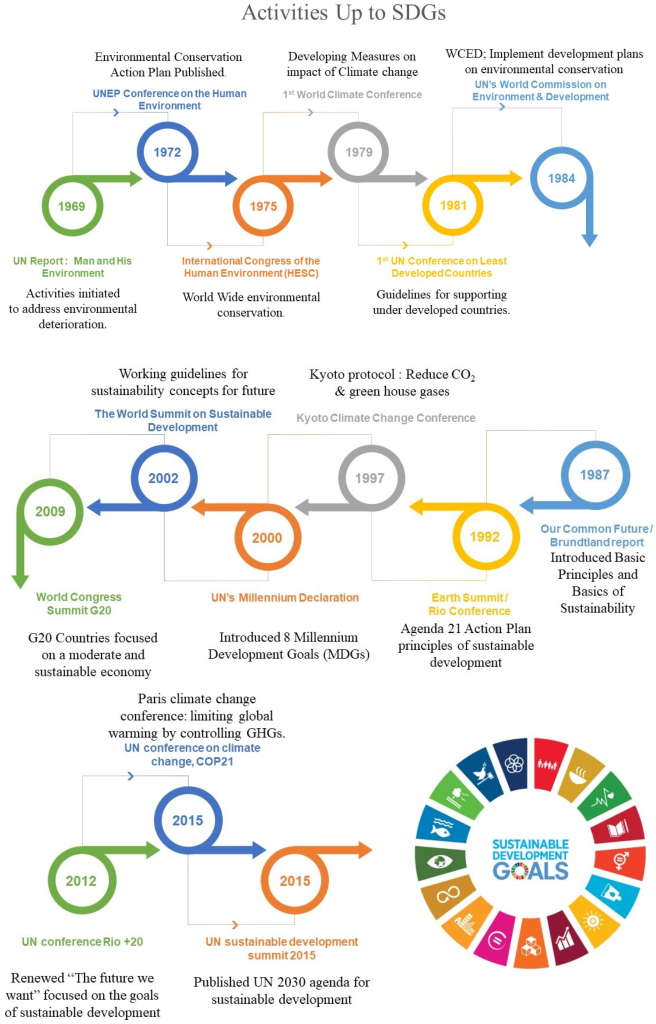
This infographic traces key global milestones that shaped the path toward the UN Sustainable Development Goals (SDGs), highlighting the evolution of climate and sustainability action. It provides crucial context for understanding how tribal communities today contribute to these global goals through grassroots environmental stewardship and sustainable food systems.
Women of the Forest: Guardians of Sustainability
In tribal India, the sustainability of agroforestry systems owes much to the quiet yet powerful stewardship of women. Often the primary caregivers, food producers, and knowledge keepers, tribal women play an indispensable role in forest conservation, biodiversity management, and household food security. Their traditional knowledge of wild edibles, medicinal plants, seed preservation, and land-use patterns forms the bedrock of sustainable agroecology in forested regions.
According to UN Women and India’s Ministry of Tribal Affairs, women in tribal communities are often the first to respond to ecological changes, such as deforestation, water scarcity, or soil degradation. They do so not as observers but as active managers of land and resources. This makes them natural leaders in agroforestry, where the blending of food crops, trees, and forest species requires deep ecological literacy and adaptive management.
Seed Keepers and Knowledge Bearers
Tribal women are often the custodians of seed diversity, selecting, storing, and exchanging seeds of indigenous varieties based on season, soil, and household needs. In the Koya tribe of Telangana and Baiga women of Madhya Pradesh, women manage community seed banks, protecting vanishing varieties of millets, pulses, and leafy greens that have sustained their communities for generations. These heirloom seeds, adapted to local climatic and soil conditions, form the core of resilient agroforestry systems.
Women also hold in-depth knowledge of wild foods and medicinal plants—an area that modern agriculture has overlooked. A study by Bioversity International showed that tribal women in India can identify and use over 120 wild species for nutrition, healing, and household utility. By integrating these plants into agroforestry systems, they contribute to both biodiversity conservation and nutrition security.
Entrepreneurs of the Forest Economy
With growing support from NGOs, cooperatives, and programs like NRLM (National Rural Livelihoods Mission) and Van Dhan Yojana, tribal women are now emerging as eco-entrepreneurs. They are forming self-help groups (SHGs) that harvest and process non-timber forest produce (NTFPs) like mahua, tamarind, seeds, and herbs into value-added eco-products—such as oils, herbal balms, soaps, and leaf plates.
Earth5R has worked with women’s collectives in Jharkhand and Maharashtra to train them in vermicomposting, natural farming, and agroforestry design. These women have become trainers and community leaders, conducting workshops for others and participating in local governance related to land use and environmental protection. Such initiatives have not only improved household incomes but also strengthened women’s agency in traditionally patriarchal spaces.
Resilience Builders in a Changing Climate
Women’s leadership in agroforestry also makes communities more climate-resilient. A report by the Intergovernmental Panel on Climate Change (IPCC) highlights that gender-inclusive adaptation strategies result in more effective environmental outcomes. Tribal women intuitively practice risk-spreading strategies—such as planting multiple species, conserving water, and rotating crops—that buffer households against droughts, floods, and pest outbreaks.
In many regions, they are also leading efforts to restore degraded land through plantation drives, soil bunding, and community forest management. Their ability to organize collectively—whether through forest rights committees or eco-farming groups—has become a force for both ecological renewal and social transformation.
In the tribal agroforestry landscape, women are not just participants—they are visionaries. They protect diversity, restore land, nourish families, and power rural economies. Empowering them is not just a matter of gender justice; it is a strategic imperative for climate resilience and sustainable development. As guardians of the forest, tribal women hold the keys to a future where food systems are not only productive but also just, inclusive, and ecologically balanced.
Challenges and Threats: Land Rights, Deforestation, and Climate Change
Despite its potential, tribal agroforestry in India faces deep-rooted structural challenges that threaten its sustainability and scale. At the heart of these issues lie contested land rights, rampant deforestation, and escalating climate-related risks. For tribal communities, whose identity and survival are intrinsically linked to land and forests, these challenges are not just environmental—they are existential.
Land Tenure Insecurity
One of the most pressing concerns is the lack of secure land tenure. Although the Forest Rights Act (FRA) 2006 was enacted to recognize the rights of forest-dwelling communities over land and forest resources, its implementation has been fraught with delays, bureaucratic hurdles, and resistance from forest departments. According to the Ministry of Tribal Affairs, over 1.8 million claims under FRA have been rejected, often due to minor procedural gaps, leaving many tribal families in a state of uncertainty.
Without legal ownership or access, communities cannot invest confidently in long-term agroforestry systems. This discourages both ecological stewardship and livelihood development. Insecure tenure also exposes tribal land to encroachment, corporate acquisition, and infrastructure development, often without free, prior, and informed consent.
Deforestation and Ecosystem Degradation
India lost nearly 2.33 million hectares of forest cover between 2001 and 2020, according to Global Forest Watch. Much of this loss has occurred in tribal regions, driven by mining, plantation agriculture, urban expansion, and logging. As forest ecosystems degrade, so too do the sources of wild food, medicinal herbs, and moisture retention critical to agroforestry success.
Fragmented forests also disrupt traditional wildlife corridors, leading to increased human-wildlife conflict—a problem that tribal farmers often face without institutional support. The degradation of sacred groves, buffer forests, and community-managed lands further erodes the cultural and spiritual connection that underpins tribal agroforestry practices.
Climate Variability and Shocks
Tribal communities are disproportionately vulnerable to climate change, despite contributing the least to its causes. Irregular rainfall, prolonged droughts, unseasonal hailstorms, and temperature spikes have increased both crop failure and forest stress. According to NITI Aayog, over 50% of India’s tribal population lives in areas highly susceptible to climate-induced displacement and agricultural distress.
Agroforestry can mitigate these impacts by enhancing ecological resilience—but only if supported with knowledge, infrastructure, and risk mitigation tools like community insurance, early warning systems, and water harvesting technologies.
Policy and Partnership: Creating Enabling Ecosystems for Tribal Agroforestry
Scaling agroforestry among tribal communities requires more than good intentions—it calls for policy coherence, multi-stakeholder partnerships, and targeted investment. Fortunately, India already has a policy foundation on which to build.
Existing Policy Frameworks
The National Agroforestry Policy 2014—the first of its kind globally—recognizes agroforestry as a critical strategy for climate resilience, biodiversity, and rural livelihoods. It calls for convergence between agriculture, forestry, and rural development sectors to promote tree-based farming systems. However, its implementation has largely focused on commercial species like eucalyptus, often neglecting ecologically integrated tribal agroforestry models.
Similarly, the National Mission for Sustainable Agriculture (NMSA) and Green India Mission provide platforms for integrating agroforestry into watershed development, climate adaptation, and biodiversity protection. Yet, these programs require greater emphasis on tribal participation, gender inclusivity, and traditional knowledge integration.
The Role of Panchayats and Local Governance
Empowering Gram Sabhas and Joint Forest Management Committees (JFMCs) under the Panchayats (Extension to Scheduled Areas) Act or PESA, 1996 is critical. These bodies can democratically decide land-use plans, prevent illegal diversion of forest land, and approve agroforestry schemes that are culturally and ecologically appropriate.
Earth5R, for example, has facilitated community-level planning where local leaders co-create agroforestry layouts based on land gradients, water availability, and traditional land-use patterns, ensuring community buy-in and accountability.
Public-Private-Community Partnerships
A robust ecosystem for tribal agroforestry depends on partnerships that pool technical expertise, financial support, and market access. Initiatives like CSR-backed agroforestry projects, UNDP-supported rural livelihoods programs, and Earth5R’s regenerative economy model exemplify how diverse actors can co-create solutions.
Private sector involvement, when done ethically, can bring in value-chain development, branding of tribal products, and fair-trade certification—all of which enhance income while ensuring ecological sustainability. Digital platforms can also empower tribal youth through e-learning, climate literacy, and mobile-based agroforestry advisory services.
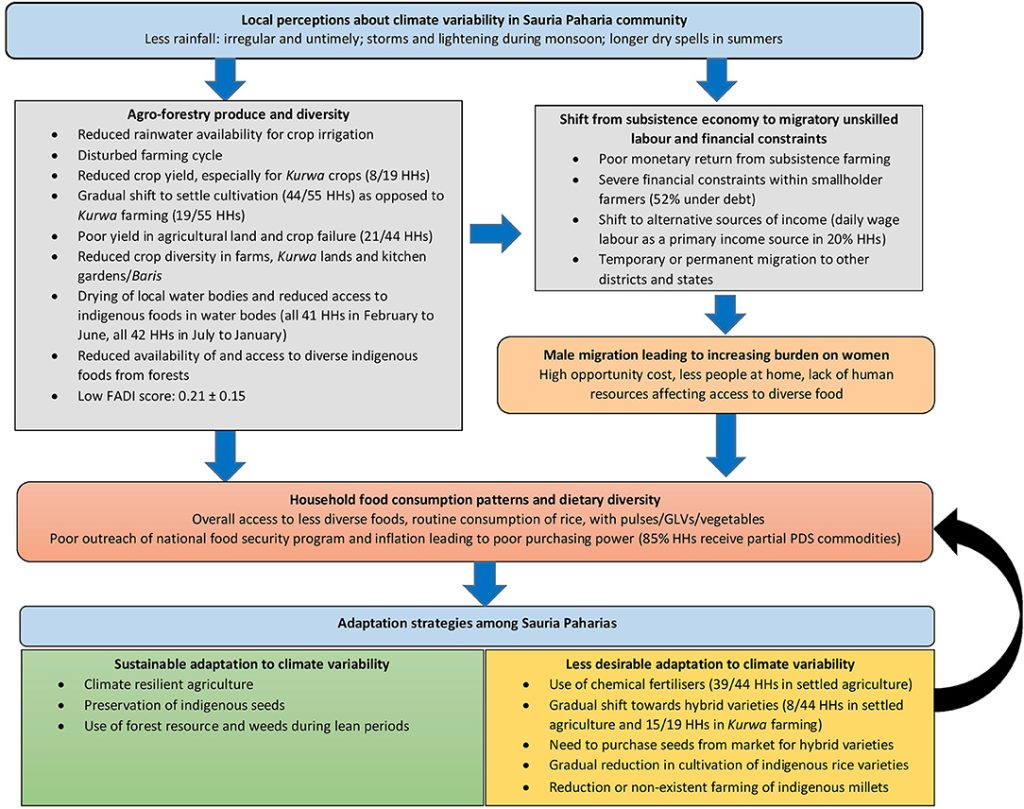
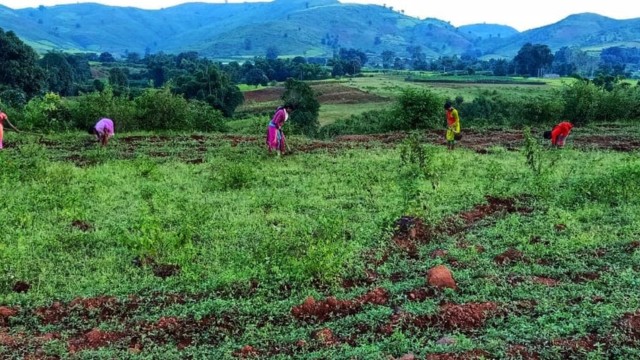
This infographic illustrates how climate variability impacts the Sauria Paharia tribal community’s food systems, prompting shifts in agriculture, livelihoods, and migration. It also contrasts sustainable and less desirable adaptation strategies, underscoring the critical need for climate-resilient, community-led solutions.
Reimagining India’s Food Future from Its Forest Roots
India’s path to a sustainable and climate-resilient food system lies in its forests and the indigenous wisdom of its tribal communities. Tribal agroforestry is not just an alternative—it’s a regenerative model that restores ecosystems, supports livelihoods, and preserves cultural heritage.
With the right support, tribal communities can lead the transition toward just and resilient food systems. It’s time to shift focus—from industrial agriculture to community-led, ecologically balanced practices rooted in tradition. The future of India’s food security may well lie in the forest—where people and planet thrive together.
FAQs on Agroforestry Reimagined: Tribal Communities at the Forefront of India’s Sustainable Food Future
What is agroforestry and how is it different from traditional farming?
Agroforestry integrates trees, crops, and sometimes livestock on the same land, unlike traditional monoculture farming. It mimics natural ecosystems for ecological and economic benefits.
Why is agroforestry important for tribal communities in India?
It aligns with tribal communities’ traditional ecological knowledge, enhances food and income security, and helps regenerate degraded forest landscapes.
How does agroforestry support biodiversity?
By combining diverse plant species and trees, agroforestry creates habitats for birds, insects, and animals, fostering rich biodiversity.
What role does traditional tribal knowledge play in agroforestry?
Tribal communities have practiced integrated forest-farm systems for generations, using indigenous techniques that conserve soil, water, and biodiversity.
Which regions in India are most active in tribal agroforestry?
Tribal agroforestry is prominent in Odisha, Chhattisgarh, Jharkhand, Maharashtra, the Northeast, and parts of Madhya Pradesh.
What are non-timber forest products (NTFPs) and why are they important?
NTFPs like honey, bamboo, tamarind, and medicinal herbs are collected sustainably and provide essential income and nutrition for tribal families.
How does agroforestry improve nutrition?
It promotes dietary diversity through access to wild edibles, fruits, leafy greens, and pulses, rich in micronutrients often missing from commercial diets.
How are tribal women involved in agroforestry?
Women are seed savers, foragers, and primary caregivers of agroforestry systems. They also lead SHGs that produce and sell eco-products from forest resources.
Can agroforestry help mitigate climate change?
Yes, agroforestry sequesters carbon in biomass and soil, increases resilience to extreme weather, and reduces deforestation pressures.
What challenges do tribal agroforestry initiatives face?
Key challenges include land tenure insecurity, poor market access, bureaucratic hurdles in Forest Rights Act implementation, and climate variability.
What is the Forest Rights Act (FRA), and how does it affect tribal agroforestry?
The FRA 2006 grants legal land rights to forest-dwelling communities. When implemented, it empowers tribes to sustainably manage and regenerate their lands.
How is Earth5R supporting tribal agroforestry in India?
Earth5R facilitates regenerative agroforestry projects by training tribal communities, creating SHGs, and promoting eco-entrepreneurship through value-added forest products.
What government schemes support tribal agroforestry?
Schemes like Van Dhan Yojana, National Agroforestry Policy, and NRLM provide institutional support for forest-based livelihoods and agroforestry development.
How can agroforestry help prevent economic migration in tribal regions?
By improving income through diversified, year-round harvests, agroforestry reduces dependence on seasonal labor and discourages migration to urban centers.
What are some examples of tribal agroforestry success stories?
The Bhil farmers of Maharashtra, Gond communities in Chhattisgarh, and women-led SHGs in Jharkhand have transformed degraded lands into productive agroforestry plots.
Are agroforestry products marketable?
Yes, processed NTFPs like amla powder, mahua oil, herbal balms, and bamboo crafts can be sold in local and urban markets, sometimes even exported.
How does agroforestry empower women in tribal communities?
Agroforestry provides women with leadership roles in eco-enterprises, improves nutrition for families, and gives them financial independence.
What role do Gram Sabhas and Panchayats play in agroforestry governance?
Under PESA, Gram Sabhas can make decisions on land use, forest rights, and sustainable development, enabling community-led planning.
Is agroforestry scalable across India?
Yes, with proper policy support, secure land rights, and training, agroforestry can be scaled as a nature-based solution for climate, food, and livelihood challenges.
How can I support or get involved in tribal agroforestry initiatives?
Support can include volunteering, donating to organizations like Earth5R, promoting eco-products, or advocating for policy reforms that empower forest communities.
Act for the Forest, Stand with the Tribes
Join the movement to reimagine India’s food future—rooted in forests, powered by tribal communities, and sustained by agroecological wisdom. Support, share, and stand up for a regenerative model that nourishes both people and the planet.
-Authored By Pragna Chakraborty