
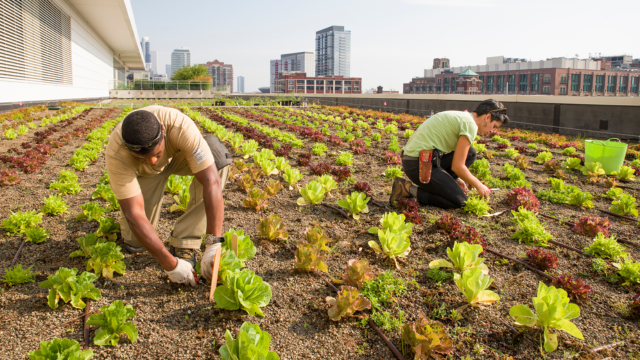
Concrete to Crops: The Rise of Rooftop Agriculture in Urban India
Rooftop farming is gaining ground as urbanization in India eats into farmland, creating food security risks. Cities like Mumbai, Delhi, and Bengaluru are turning rooftops into productive spaces. With India’s population expected to reach 1.5 billion by 2030, rooftop farming is fast becoming an urban necessity. This reflects the wider green cities movement shaping sustainable urban planning.
Climate uncertainty adds urgency, as extreme weather disrupts conventional agriculture. Rooftop gardens use simple terrace farming techniques to grow vegetables and herbs close to home. Studies by FAO show local production reduces reliance on unstable supply chains and cuts waste. Rooftop farming thus aligns with sustainability goals, helping cities secure fresh food while adapting to climate risks.
Earlier, food for cities came largely from peri-urban belts, but rising land costs shifted focus skyward. In Chennai, terrace gardens now offset soaring vegetable prices. Global networks like RUAF show how rooftops create resilient food hubs in dense cities. International examples like Brooklyn Grange in New York prove that urban farming can thrive on massive rooftops. These cases inspire scalable Indian models.
The benefits extend well beyond food security. Rooftop gardens improve air quality, lower carbon emissions, and foster urban biodiversity. Research highlights positive impacts on mental well-being, as urbanites reconnect with nature. Even resident welfare associations promote terrace farming for community resilience. These overlapping benefits make rooftop agriculture both practical and transformative.
Economically, rooftop agriculture reduces food bills while creating green job opportunities. In Bengaluru, startups sell hydroponic kits to apartment residents eager for organic food. Restaurants adopting farm-to-table models now source produce from rooftops. With India’s middle class demanding chemical-free diets, the potential market is rapidly growing. Rooftop farming fuses affordability, health, and entrepreneurship.
Organizations like Earth5R are embedding rooftop farming into circular economy models that include composting and water reuse. Such integration supports urban resilience strategies, with citizens driving the change. From housing blocks to corporate terraces, cities are reimagining rooftops as productive ecosystems. This shift transforms “concrete deserts” into fertile zones, offering climate adaptation, food security, and healthier lifestyles.
Why Cities Need Sky Farms: Tackling Food Miles and Freshness
Modern cities rely heavily on long-distance supply chains, where fruits and vegetables travel thousands of kilometers before reaching homes. This concept, called food miles, adds carbon emissions and reduces freshness. In India, much of the produce consumed in metros comes from distant rural belts, raising costs and spoilage rates. Rooftop farming offers an immediate alternative by producing food within the city itself, minimizing waste.
The nutritional value of food also declines with distance, as vitamins degrade during transport. According to Harvard T.H. Chan School of Public Health, fresher produce carries higher nutrient density and better taste. Rooftop farms in cities like Bengaluru ensure vegetables are consumed the same day they are harvested. Studies by FAO confirm that local cultivation improves both food safety and household nutrition.
Food miles also contribute heavily to greenhouse gas emissions, as refrigerated trucks and air freight burn significant fuel. In countries like India, where cities already face air pollution crises, reducing transport emissions is critical. By adopting rooftop farming, residents cut their carbon footprints dramatically while ensuring reliable food access. This simple shift supports broader climate change mitigation goals for urban areas.
Globally, cities such as Singapore have pioneered urban farming to reduce dependency on imports. Singapore imports over 90% of its food but offsets this through vertical and rooftop farms. Indian cities can replicate this approach, especially as climate risks disrupt supply from agricultural heartlands. Reports by UNEP highlight urban agriculture as a key element of sustainable food systems.
In addition to climate benefits, rooftop agriculture directly supports food security in rapidly growing cities. With population density rising, dependence on external sources creates vulnerabilities. Locally grown food reduces pressure on rural farmers while providing affordable options for urban consumers. For households, rooftop farming guarantees reliable produce free from pesticides, often at lower cost.
Economically, localized food systems lower costs linked to storage, packaging, and long-haul distribution. Studies by World Bank emphasize how urban food initiatives cut inefficiencies that drive up prices. Restaurants adopting farm-to-table practices often source directly from rooftop farms, reducing logistics. This supports local economies while boosting demand for chemical-free produce.
Rooftop farming also strengthens community resilience by decentralizing food supply. Instead of relying solely on wholesale markets, neighborhoods can grow and share harvests, especially during crises like pandemics. During COVID-19 lockdowns, disruptions in food transport highlighted the fragility of centralized systems. Rooftop farms ensured access to essential vegetables when supply chains faltered.
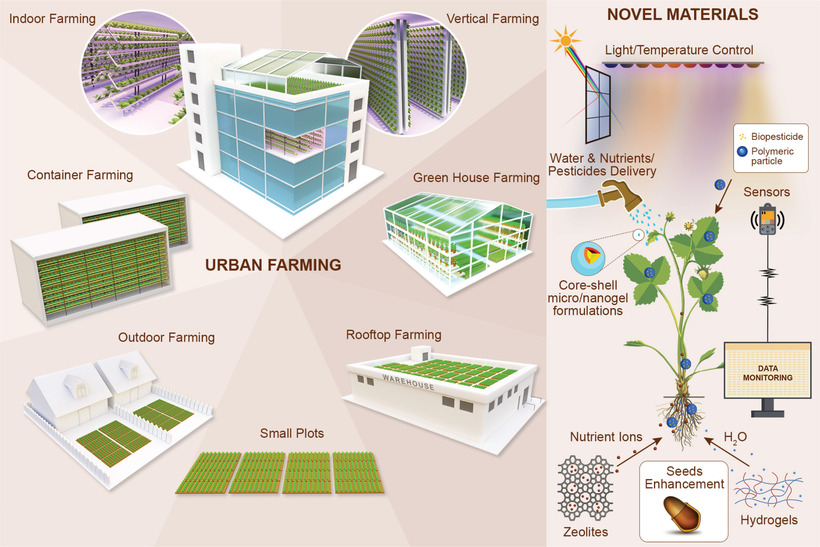
This infographic illustrates different methods of urban farming such as rooftop, container, vertical, and greenhouse farming.
It also highlights novel materials and technologies like sensors, hydrogels, and nanogels that enhance plant growth and sustainability
Designing the Perfect Rooftop Farm: Space, Soil, and Sunlight
The first step in rooftop farming is assessing structural suitability. Roofs must meet load-bearing requirements to support soil, planters, and water systems safely. Waterproofing is critical to prevent leaks, and terrace coatings ensure durability. Urban farmers must also consider accessibility and safety, particularly in apartment complexes. Proper planning at this stage prevents costly mistakes and maximizes long-term productivity.
Sunlight exposure determines the success of rooftop crops. South-facing terraces generally receive maximum sunlight for leafy greens and fruiting plants. Shade-tolerant varieties can be placed where direct sunlight is limited. Tracking seasonal sun path diagrams helps plan plant placement efficiently. Even small adjustments in orientation or planter height can significantly improve yields.
Soil selection is crucial for rooftop agriculture. Lightweight potting mixes reduce strain on structures while providing essential nutrients. Adding organic compost improves fertility and water retention. Raised beds or container systems allow flexibility and prevent root compaction.
For urban gardeners, soil depth of 12–18 inches supports most vegetables and herbs. Combining soil amendments and proper drainage creates a stable, high-yield growing environment.
For limited space, modular and vertical setups optimize production. Using stacked planters or trellises allows climbing plants like beans or tomatoes to thrive. Hanging pots or railing-mounted boxes further extend usable areas. Small-scale hydroponics can complement soil beds for leafy greens.
Rooftop vertical systems maximize output per square foot while keeping maintenance manageable. Proper design ensures the farm grows both horizontally and vertically.
Crop selection must match local climate, sunlight, and rooftop conditions. Leafy greens, herbs, and short-duration vegetables thrive in most urban rooftops. Seasonal planting guides help rotate crops effectively. Companion planting reduces pest problems and improves yield. For larger terraces, fruiting plants like chili, tomato, or dwarf vegetables can supplement production. Thoughtful crop planning ensures consistent harvests throughout the year.
Water management and irrigation are central to rooftop success. Lightweight drip irrigation saves water while delivering nutrients directly to roots. Rainwater harvesting can supplement irrigation needs. Smart systems with moisture sensors optimize watering schedules automatically. Efficient water use prevents roof overloading and maintains plant health. Integrating water solutions completes the ideal rooftop farm design.
Tech on the Terrace: Hydroponics, Aeroponics, and Smart Irrigation
Urban rooftops are increasingly using technology to boost efficiency. Hydroponics allows plants to grow in nutrient-rich water, eliminating the need for heavy soil. This system is ideal for space-limited terraces, as it reduces weight and maximizes yield. Many Indian startups offer compact hydroponic kits suitable for apartments. Hydroponics also minimizes water use compared to traditional soil gardening, making it sustainable.
Aeroponics takes soil-less farming further, with roots suspended in mist enriched with nutrients. Systems like Tower Garden or DIY setups allow high-density planting. This technique accelerates growth and enhances nutrient absorption. Aeroponics is ideal for leafy greens, herbs, and small vegetables in urban conditions. It also reduces pest incidence and allows year-round cultivation, increasing overall productivity.
Smart irrigation is transforming rooftop agriculture. Sensors monitor soil moisture and trigger automated watering when needed. Drip irrigation systems with timers deliver precise water amounts to plant roots. Apps and IoT-enabled controllers provide real-time data on plant health, water usage, and growth patterns. Urban gardeners can manage multiple terraces efficiently without constant manual intervention, saving time and resources.
Vertical farming technology complements traditional terrace setups. Stackable hydroponic units or multi-tier racks increase the number of plants per square foot. LED grow lights can supplement sunlight in shaded areas or during low-light seasons. These modular systems allow city dwellers to grow a variety of crops in minimal space. Vertical tech solutions make rooftop farming scalable and commercially viable.
Data-driven management optimizes input use and yield. IoT devices measure nutrient levels, pH, temperature, and humidity in real time. Platforms like GrowLink integrate data analytics to recommend adjustments. By combining traditional knowledge with precision agriculture tools, urban farmers can reduce waste and improve plant quality. Technology thus transforms simple terraces into high-tech farms.
Investing in tech also improves economics and sustainability. Hydroponic and aeroponic setups produce faster yields, supporting farm-to-table supply. Water-saving systems and energy-efficient lighting reduce operational costs. Smart terraces serve as demonstration models for schools, communities, and corporates. Technology ensures that rooftop farming is not just green, but profitable and resilient.
Earth5R’s Role in Mainstreaming Urban Rooftop Farming
Earth5R plays a pivotal role in promoting urban rooftop agriculture across Indian cities, turning unused terraces into productive spaces. Their initiatives guide residents on design, crop choice, and sustainable practices.
By combining hands-on training with community engagement, Earth5R empowers citizens to participate actively in sustainable urban farming. Their approach aligns with global trends in green infrastructure and urban resilience, making rooftops a key solution to city food challenges.
Schools are central to Earth5R’s programs, where campuses become hands-on learning labs for terrace gardening. Students learn planting, composting, and water management while understanding urban ecology. These workshops instill eco-conscious habits from a young age. Schools also inspire families to adopt similar practices at home. By integrating education with practical farming, Earth5R nurtures the next generation of urban farmers.
Earth5R collaborates with apartment societies to create community rooftop gardens that supply fresh produce and strengthen neighborhood bonds. Residents share responsibilities for planting, maintenance, and harvesting. This collective model reduces individual effort and maximizes output. Community farms also promote health, nutrition, and sustainability. Shared rooftops become hubs for social interaction and environmental learning.
Corporate partnerships further scale Earth5R’s impact by integrating rooftop farms into CSR initiatives. Companies sponsor terraces, provide resources, and engage employees in hands-on farming. This encourages environmental responsibility while mitigating urban heat through added green cover.
Rooftop gardens on corporate buildings serve as demonstration models, showing how private sector support accelerates sustainable urban agriculture adoption.
Technology is a key component of Earth5R’s programs, with training modules covering hydroponics, IoT irrigation, and vertical farming techniques. Participants learn to optimize yields, water usage, and nutrient management. These tech-driven approaches make rooftop farming efficient, resilient, and appealing for urban dwellers. Integrating modern tools ensures long-term productivity and sustainability, even in space-constrained environments.
Finally, Earth5R links rooftop farming with broader circular economy strategies, including composting, rainwater harvesting, and waste reuse. Terrace farms become part of larger urban ecosystems that address food security, pollution, and heat islands. By mainstreaming rooftop agriculture, Earth5R demonstrates how cities can grow food locally, involve citizens, and enhance environmental resilience.
Community Harvests: Rooftops as Shared Food and Learning Spaces
Rooftop farms can transform urban spaces into community hubs where residents grow, share, and learn together. Shared gardens in apartment complexes or schools encourage participation across age groups. These spaces provide fresh produce, reduce household expenses, and strengthen social bonds. By engaging neighbors in planting, watering, and harvesting, communities create stronger ties while promoting sustainable urban living.
Shared rooftop farms also serve as informal learning centers for children and adults. Students can experience hands-on agriculture, while adults learn composting, crop rotation, and pest management. These spaces foster intergenerational knowledge exchange. Gardens become classrooms where sustainability, nutrition, and ecology are taught through practice.
Community harvests help reduce dependency on external food sources. By growing vegetables, herbs, and fruits locally, neighborhoods cut food miles and associated carbon emissions. Residents enjoy fresher, more nutritious produce, while surplus harvests can be shared or sold within local markets. This system supports both environmental sustainability and economic resilience, especially in densely populated urban areas.
Rooftop gardens also encourage social cohesion and collective responsibility. Shared maintenance schedules and workshops foster collaboration and accountability. Residents develop a sense of ownership and pride in their urban green spaces. Community involvement extends beyond harvesting to decision-making on crop choices and sustainability practices. These collective efforts create resilient and engaged neighborhoods.
Through community programs, rooftop farms integrate cultural and recreational activities. Festivals, cooking workshops, and gardening competitions encourage participation while teaching healthy eating habits. These events make urban agriculture more accessible and enjoyable. Gardens become multifunctional spaces promoting both wellness and environmental awareness.
Finally, organizations like Earth5R facilitate community rooftop initiatives to scale impact. By providing training, resources, and technical support, they help residents convert unused terraces into productive farms. Programs often link rooftop gardening with circular economy practices, rainwater harvesting, and waste composting.
This holistic approach ensures that community farms are productive, sustainable, and socially engaging, creating thriving urban ecosystems.
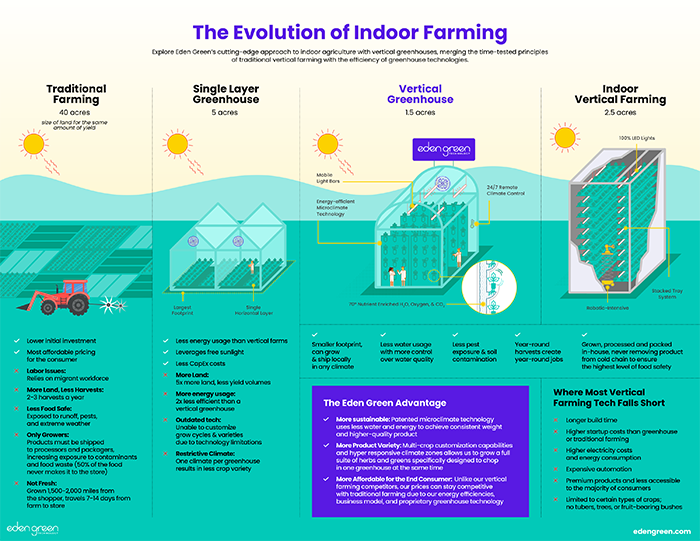
This infographic explains the evolution of indoor farming, comparing traditional methods with advanced vertical farming technologies. It highlights land use, energy efficiency, yield, and sustainability across different farming approaches.
Cooling the City: How Green Roofs Combat Urban Heat Islands
Urban heat islands (UHIs) make cities hotter than surrounding areas due to concrete and asphalt surfaces. Rooftop greenery can mitigate this by providing natural insulation and reducing ambient temperatures. Plants absorb sunlight, evapotranspire water, and shade roofs, lowering energy demands for cooling.
Cities like Singapore and Tokyo have successfully integrated green roofs to combat heat, proving the effectiveness of urban vegetation.
Green rooftops also improve air quality by filtering dust and pollutants. Plants trap particulate matter and release oxygen, mitigating smog in densely populated areas. Cooler rooftops reduce building energy consumption for air conditioning, cutting carbon emissions. Combined, these benefits enhance both environmental health and human comfort. Urban farming rooftops thus serve dual purposes of food production and climate mitigation.
Water management further enhances cooling effects. Green roofs retain rainwater, reducing stormwater runoff and preventing urban flooding. Moist soil and plant surfaces cool surrounding air through evapotranspiration. Rooftop gardens act as microclimates, moderating temperatures on hot days. Integrating water-efficient irrigation ensures sustainability while maximizing the cooling benefits for buildings and neighborhoods.
Rooftop farms contribute to biodiversity by providing habitats for insects, birds, and pollinators. Urban ecosystems often lack green spaces, so terraces become safe havens for flora and fauna. Pollination improves crop yields while enhancing ecological balance. Green roofs thus support both human and environmental health, linking rooftop agriculture to broader sustainability goals.
The economic benefits of cooling rooftops are significant. Reduced energy consumption lowers electricity bills for households and commercial buildings. Studies by C40 Cities indicate that widespread green roofs in urban areas can reduce peak summer temperatures by several degrees. Combined with rooftop farming, these installations provide both nutritional and financial returns.
Finally, organizations like Earth5R promote green rooftops as a climate adaptation strategy. Their programs train citizens to combine urban agriculture with heat-mitigation techniques, like reflective coatings and plant selection. By integrating rooftop farming into urban design, Earth5R demonstrates a scalable solution to heat islands, pollution, and food insecurity. Green terraces are thus critical for resilient, sustainable, and livable cities.
Earth5R’s Citizen Training Programs for Rooftop Agriculture
Earth5R offers comprehensive training programs to equip urban residents with rooftop farming skills. Participants learn soil preparation, crop selection, and seasonal planting. Workshops combine hands-on activities with theory, ensuring practical understanding. By educating citizens, Earth5R promotes self-sufficient urban communities. These programs are designed to make rooftop farming accessible, scalable, and sustainable across city rooftops.
Courses cover modern techniques like hydroponics and vertical farming. Participants gain insights into nutrient management, space optimization, and water-efficient systems. These innovations make terrace farming productive even in limited spaces. Training also emphasizes using low-cost, locally available materials. This approach ensures that urban agriculture is feasible for all socio-economic groups.
Earth5R integrates smart irrigation and IoT tools in their programs to teach efficient water use. Sensors, drip systems, and automated timers reduce water wastage while maximizing crop yields. Participants monitor soil moisture and adjust irrigation schedules accordingly. By embracing technology, rooftop farms become more resilient to climate variability. This tech-driven approach enhances productivity and sustainability in urban farming.
Citizen programs also emphasize composting and organic practices. Trainees learn to convert kitchen and garden waste into nutrient-rich compost. This reduces dependency on chemical fertilizers while promoting soil health. Waste management practices link rooftop farms to broader urban sustainability goals. By closing the nutrient loop, communities grow healthier crops and reduce environmental impact.
Workshops often include community projects, turning rooftops into collaborative spaces for learning and social engagement. Residents participate in planting, maintenance, and harvesting together. These projects strengthen neighborhood ties while spreading awareness about urban farming. Shared responsibility ensures continuity and fosters a culture of sustainability. Community farms also serve as demonstration hubs for visitors and policymakers.
Finally, Earth5R links training with policy and funding support to help citizens scale their farms. Programs guide participants on government incentives and private sponsorship opportunities. Access to resources, technical assistance, and expert mentorship ensures long-term success. By combining education, technology, and support, Earth5R empowers urban communities to integrate rooftop agriculture into everyday life.
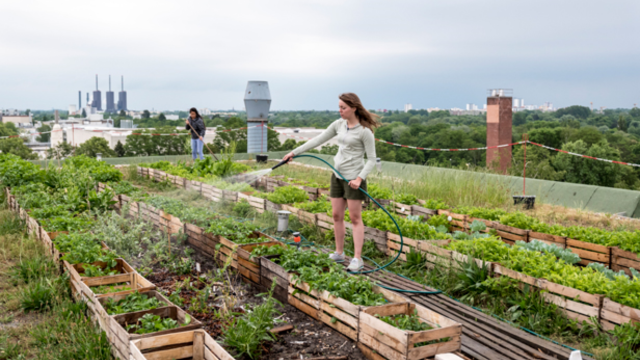
Policy Support and Incentives for Sky-High Farming
Urban rooftop farming thrives when supported by government policies that promote green infrastructure. Many cities in India and abroad offer incentives for green roofs and urban agriculture. These include tax rebates, grants, and technical guidance. Policy backing reduces initial setup costs, encouraging residents and businesses to convert terraces into productive farms.
Financial incentives are crucial for wider adoption. Cities like Singapore provide subsidies for hydroponic systems and rooftop retrofitting. Local governments may fund seed distribution, training programs, and irrigation solutions. These measures lower barriers for individuals and apartment complexes. Affordable access makes urban farming a feasible option for diverse communities, boosting food security and sustainability.
Urban planning frameworks increasingly integrate green rooftops into city design. Municipalities include rooftop gardens in zoning codes and building regulations to promote environmental resilience. These frameworks define safe weight limits, structural requirements, and water management practices. By institutionalizing rooftop agriculture, cities encourage developers and residents to participate actively.
Tax breaks and recognition programs motivate private sector participation. Commercial buildings adopting rooftop farming may receive green building certifications and incentives. Companies gain reputational benefits while contributing to sustainability. Public-private partnerships also foster innovation in urban agriculture. Collaborative approaches scale rooftop initiatives, combining environmental, economic, and social benefits in city planning.
Governments also support rooftop farms through educational campaigns and citizen programs. Public institutions provide training resources and workshops to spread awareness. Municipal support connects rooftop farmers to urban farming networks, technology providers, and market opportunities. Policy-backed education ensures long-term adoption and skill development among residents.
Finally, organizations like Earth5R work with policymakers to expand rooftop farming incentives. They advocate for streamlined approvals, funding access, and technical guidance. By bridging communities and governments, Earth5R helps create scalable rooftop agriculture models.
Strong policy frameworks, combined with citizen engagement and technical support, ensure that urban agriculture contributes meaningfully to food security, climate resilience, and city livability.
The Skyline of Tomorrow: Cities as Self-Sustaining Food Ecosystems
Urban rooftops are transforming cities into self-sustaining food ecosystems. By integrating vertical gardens, rooftop farms, and hydroponics, cities can produce fresh food locally. This reduces dependency on long supply chains, lowers carbon footprints, and enhances food security. Residents gain direct access to nutritious produce while urban areas benefit from cooler, greener spaces.
The integration of smart technology allows city rooftops to optimize production efficiently. Sensors monitor soil moisture, nutrient levels, and environmental conditions. Automated irrigation and climate control ensure crops thrive with minimal resource wastage. Data-driven farming helps maximize yield per square meter, demonstrating the potential for high-density urban agriculture. Technology also enables predictive analytics for seasonal planting.
Community engagement is essential for sustainable urban food systems. Rooftop farms serve as shared learning spaces, connecting residents with food production practices. Community gardens increase social cohesion, encourage collaboration, and provide hands-on education. School programs and volunteer initiatives expose children and adults to farming techniques.
Policy support reinforces urban food ecosystems by providing incentives and guidelines. Municipal programs offer grants for rooftop retrofitting, technical assistance, and urban farming startups. Cities incorporating rooftop agriculture into zoning codes and environmental strategies foster participation among developers and citizens. Streamlined approvals and recognition programs encourage widespread adoption.
Environmental benefits are significant, including enhanced biodiversity, reduced stormwater runoff, and lower urban temperatures. Rooftop farms create habitats for pollinators, birds, and beneficial insects. Green roofs mitigate urban heat islands and improve air quality. By transforming concrete spaces into green oases, cities achieve environmental resilience. Rooftop agriculture thus combines food security with climate adaptation.
Finally, organizations like Earth5R play a pivotal role in scaling urban agriculture. They provide training, technical support, and community programs to mainstream rooftop farming. By linking residents, technology, and policy, Earth5R enables cities to evolve into self-sufficient food ecosystems.
The skyline of tomorrow envisions urban landscapes where every rooftop contributes to sustainable food production, climate resilience, and vibrant community living.
Conclusion: Rooftop Agriculture – Reimagining Urban Landscapes
Rooftop agriculture is redefining how cities approach food security, climate resilience, and urban sustainability. By converting unused rooftops into productive farms, cities reduce food miles and improve access to fresh produce. Integrating vertical gardens and hydroponic systems ensures high yields even in limited spaces. These practices not only feed urban populations but also enhance environmental quality and community well-being.
Community involvement and citizen training are central to successful urban farming. Programs by Earth5R and local initiatives empower residents with skills in composting and sustainable crop management. Rooftop farms act as shared spaces for learning, collaboration, and social engagement.
Policy frameworks and incentives accelerate the rooftop agriculture movement. Government grants, tax rebates, and zoning regulations encourage adoption of green roofs and hydroponic systems. Recognition programs and support for urban farming startups foster innovation and scalability.
With robust policy backing, cities can transform rooftops into productive, climate-resilient landscapes that align with sustainability goals and modern urban planning strategies.
The skyline of tomorrow envisions cities as self-sustaining food ecosystems, where every rooftop contributes to local nutrition, climate adaptation, and biodiversity. Technology, community engagement, and policy converge to optimize resource use and enhance crop yields.
Organizations like Earth5R bridge these elements, ensuring urban agriculture is accessible, scalable, and impactful. Together, rooftops become the green lifelines of future cities, feeding people and the planet.
Frequently Asked Questions: Farms Beneath the Skyline: Rooftop Agriculture as the Next Urban Food Revolution
What is rooftop agriculture?
Rooftop agriculture involves growing crops, vegetables, and sometimes fruits on the roofs of urban buildings, using soil-based or soilless systems like hydroponics or aeroponics.
Why is rooftop farming important in cities?
It reduces food miles, improves access to fresh produce, enhances urban biodiversity, and helps cities mitigate heat island effects.
What types of crops can be grown on rooftops?
Leafy greens, herbs, tomatoes, peppers, strawberries, and small root vegetables are ideal. Some rooftops also grow fruit trees and medicinal plants.
How much space is needed for a rooftop farm?
Even small terraces of 10–20 square meters can support container gardening or hydroponic setups, making urban agriculture scalable to any building.
What is the difference between hydroponics and aeroponics?
Hydroponics grows plants in nutrient-rich water, while aeroponics suspends plants in air and sprays roots with nutrients, using less water overall.
Are rooftop farms structurally safe?
Yes, with proper load assessment and engineering. Lightweight growing mediums, raised beds, and hydroponics minimize weight on rooftops.
How do rooftop farms help reduce urban heat?
Green roofs provide insulation, reduce heat absorption by concrete, and lower surrounding air temperatures, mitigating the urban heat island effect.
What role does technology play in rooftop agriculture?
Sensors, automated irrigation, climate monitoring, and data-driven analytics optimize growth, reduce waste, and improve yields.
Can apartment complexes adopt rooftop farming?
Yes, many cooperative housing societies and commercial buildings convert shared rooftops into communal gardens and learning spaces.
What are the environmental benefits of rooftop farming?
It improves air quality, enhances urban biodiversity, reduces stormwater runoff, and lowers carbon footprints through local food production.
How do policies support rooftop agriculture?
Governments may provide grants, tax incentives, zoning approvals, and technical guidance to encourage rooftop farming initiatives.
What is Earth5R’s role in urban farming?
Earth5R provides citizen training, technical guidance, community programs, and advocacy to mainstream rooftop agriculture.
Can rooftop farms generate income?
Yes, surplus produce can be sold locally, or farms can serve restaurants, grocery stores, and farmer’s markets.
How much water do rooftop farms require?
Water needs depend on the crop type and system used. Hydroponics and aeroponics significantly reduce water usage compared to soil-based farming.
Are rooftop farms suitable for all climates?
With the right design, including shade, irrigation, and protective structures, rooftop farms can thrive in most urban climates.
How do rooftop farms strengthen communities?
Shared gardens foster social interaction, learning, collaboration, and hands-on experience with sustainable food production.
Can schools and educational institutions implement rooftop farms?
Yes, they can integrate rooftop agriculture into curriculums, offering practical lessons in biology, sustainability, and nutrition.
What are the challenges of rooftop farming?
Challenges include structural limitations, initial costs, pest management, water access, and maintenance requirements.
How does rooftop farming impact food security?
It increases local production of fresh, nutritious food, reduces reliance on supply chains, and enhances urban resilience during crises.
What is the future of rooftop agriculture in cities?
The trend is toward integrated urban food ecosystems combining technology, community engagement, policy support, and sustainable practices.
Call to Action: Transform Your City, One Rooftop at a Time
Urban rooftops are untapped spaces with the potential to feed communities, reduce carbon footprints, and improve city resilience. By adopting rooftop farming, you can contribute to sustainable food systems and healthier neighborhoods. Every terrace garden planted is a step toward greener, more self-reliant cities.
Join community programs and training sessions to learn modern urban farming techniques, from hydroponics to smart irrigation. Platforms like Earth5R provide resources and guidance to get started quickly and efficiently. By engaging, you empower yourself and your neighbors to grow local food sustainably.
Encourage local policies and initiatives that support green roofs and rooftop farms. Advocate for urban agriculture incentives and city planning measures that make rooftop farming accessible for all. Collective action ensures that rooftops evolve from idle spaces into productive, climate-resilient assets.
Start small, think big, and share your harvest with your community. Rooftop farms can become shared learning spaces, social hubs, and green lungs of your city. Together, we can turn concrete skylines into thriving food ecosystems and inspire the urban agriculture revolution.
~Authored by Barsha Sharma