
The Silent Hunger: Understanding Hidden Malnutrition
Hidden hunger, often overlooked in food security debates, affects more than 2 billion people worldwide. Unlike visible starvation, it develops when diets lack essential vitamins and minerals.
This deficiency causes stunted growth, weakened immunity, and impaired brain development. In India, over 50% of women suffer from anemia, highlighting that calories cannot replace nutrient diversity. Reports by the FAO stress how malnutrition silently undermines public health and economic productivity.
The consequences of micronutrient deficiencies extend far beyond individuals to reduce economic productivity and hinder development. Children deprived of iron or zinc show lower educational outcomes, limiting opportunities later in life. In areas where diets rely mostly on rice or wheat, nutrients like vitamin A and iodine are missing. Data from UNICEF shows that hidden hunger drives intergenerational poverty.
One alarming feature of hidden hunger is its invisible nature. Families may eat enough calories yet lack essential micronutrients, making the problem difficult to identify until illnesses emerge. The Global Nutrition Report reveals that undernutrition contributes to almost half of child deaths worldwide. Public health experts argue that focusing only on calories misses vital nutrient gaps highlighted in WHO guidelines.
Tackling hidden hunger requires more than distributing supplement tablets. Supplementation programs help but rarely reach remote regions consistently. A sustainable approach involves promoting nutrient-rich crops and diversified diets. Findings from the Lancet Nutrition Series show that diet quality matters more than calorie count.
Addressing the issue also requires considering food preferences rooted in local traditions, ensuring culturally appropriate nutrition interventions.
In low-income regions, most income goes to staple foods, leaving little for nutrient-dense diets that include vegetables, pulses, and fruits. Research from Harvard shows climate change reduces nutrient levels in cereals, worsening deficiencies. Lack of diversity increases vulnerability to infectious diseases, especially among children.
Evidence from the World Food Programme suggests that balanced diets strengthen resilience, improve overall health, and lower healthcare burdens in poor communities.
The urgency to act is clear, as the National Family Health Survey highlights widespread micronutrient deficiencies in India. Beyond health, hidden hunger reduces economic stability by weakening workforce productivity. Initiatives like the Scaling Up Nutrition movement emphasize collaborative, multi-sector action.
Long-term solutions must integrate bio-fortification strategies with community nutrition programs, helping families access healthier diets. Addressing hidden hunger today can secure a healthier future generation.
Why Empty Plates Are Not the Only Problem
When people think of hunger, they often imagine empty stomachs, but the reality is more complex. Many families consume enough calories yet lack essential nutrients, leading to hidden malnutrition. Diets dominated by rice or wheat fail to deliver micronutrients necessary for health. This nutritional gap fuels anemia among women and stunting in children. According to the Global Hunger Index, calorie sufficiency alone cannot solve malnutrition.
The problem lies in dietary diversity, which determines nutrient intake and overall health. Communities relying solely on staples miss out on iron, zinc, and vitamin A. Such deficiencies weaken immunity and make populations vulnerable to infectious diseases. Studies by the World Bank show that nutrition gaps reduce labor productivity. The FAO warns that without addressing nutrient needs, hunger reduction goals will remain incomplete.
Even when food availability improves, poor quality diets persist, particularly in low-income households. Research by IFPRI reveals that families spend most of their budget on cereals, with little left for pulses or vegetables. The World Food Programme stresses that nutrient-rich foods remain unaffordable for millions. Harvard studies also show climate change reduces the nutritional value of staple crops.
The effects are particularly severe for children, whose growth and learning depend on nutrient intake. According to UNICEF, iron deficiency lowers cognitive performance and delays development. Deficiencies in iodine or zinc affect memory and school readiness, as shown by the Global Partnership for Education. The Global Nutrition Report confirms that poor diet quality is the top cause of ill health worldwide.
Women face an additional burden, as nutritional gaps during pregnancy harm both mother and child. The Lancet Maternal and Child Nutrition series links maternal deficiencies to low birth weight and premature births. Data from the National Family Health Survey shows high rates of maternal anemia in India. The WHO emphasizes that maternal nutrition influences lifelong health outcomes
The challenge, therefore, is not just filling plates but filling them wisely. Global initiatives like the Scaling Up Nutrition movement call for dietary diversification and fortification strategies. Programs promoting bio-fortified crops show promise in addressing micronutrient gaps sustainably.
The FAO links nutrient-rich agriculture directly to achieving Zero Hunger. To fight malnutrition, solutions must focus on quality as much as quantity, ensuring people receive both calories and nutrients.
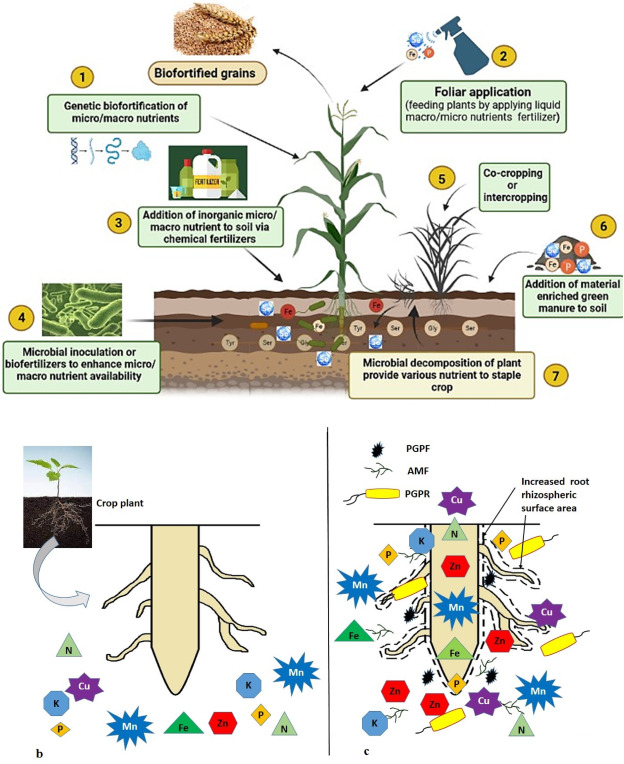
This infographic illustrates different strategies for biofortifying grains, including genetic biofortification, foliar application, chemical fertilizers, biofertilizers, and intercropping. It emphasizes how soil enrichment, microbial activity, and nutrient management enhance the availability of essential micro- and macronutrients to crop plants.
Seeds of Change: What Are Bio-Fortified Crops?
Bio-fortification is a process of improving the nutrient content of staple crops through breeding, ensuring better nutrition without changing eating habits. Unlike genetically modified organisms, bio-fortification uses traditional breeding methods to enhance minerals and vitamins. Programs led by HarvestPlus have introduced nutrient-rich rice, wheat, and maize across Asia and Africa.
According to the FAO, these crops directly target hidden hunger. WHO identifies bio-fortification as a cost-effective strategy for long-term nutrition.
The development of bio-fortified crops involves selective breeding to increase nutrients like iron, zinc, and vitamin A. Research by the International Food Policy Research Institute shows that bio-fortified varieties significantly improve dietary intake. For example, zinc-enriched wheat has been widely distributed in India.
The Global Alliance for Improved Nutrition supports scaling these crops to reach vulnerable populations. According to the World Bank, bio-fortification offers higher returns than supplementation programs.
One of the most recognized success stories is the introduction of orange-fleshed sweet potatoes in Africa, rich in vitamin A. These crops have reduced childhood blindness and improved maternal health outcomes. Similarly, iron-rich beans in Rwanda have shown measurable reductions in anemia.
A Lancet review highlights bio-fortification’s impact on maternal and child nutrition. By addressing deficiencies directly through food systems, it offers a sustainable alternative to pills and syrups.
The strength of bio-fortification lies in its ability to integrate with local diets. Since families already consume staples like rice, maize, and cassava, enriching them with nutrients makes adoption easier. UNICEF stresses that integrating bio-fortified crops into school feeding programs can improve child health. Studies by ICRISAT show farmers adopting bio-fortified crops experience both health and income benefits.
Beyond health, bio-fortified crops also support agricultural resilience. Many varieties are bred to withstand droughts, pests, and climate stress, as noted by CGIAR. This makes them crucial for farmers adapting to climate change. By improving both yields and nutrition, they contribute to food security at multiple levels. According to FAO, bio-fortification aligns with climate-smart agriculture strategies.
Global recognition of bio-fortification is growing, with governments and NGOs including it in nutrition policy. India’s National Biofortification Program supports wide-scale adoption of zinc and iron-rich staples. The Scaling Up Nutrition movement identifies bio-fortified crops as vital for achieving food security goals. Reports by the Global Nutrition Report emphasize their role in tackling hidden hunger.
Smart Seeds for a Stronger Future
Across India, bio-fortified crops are emerging as powerful tools against malnutrition. Varieties like zinc-rich rice, iron-rich pearl millet, and orange sweet potatoes provide essential nutrients without changing eating habits. These smart seeds address deficiencies linked to hidden hunger.
Research from the Indian Council of Agricultural Research confirms their impact on reducing anemia and stunting. Farmers adopting them also report improved yields and resilience.
Iron-rich varieties are particularly significant, given India’s widespread anemia crisis. Studies show that consuming iron-rich beans and fortified millets reduces iron deficiency effectively. The Global Nutrition Report highlights their role in improving maternal health. UNICEF stresses that iron deficiency limits child development and school performance.
By integrating iron-rich crops into midday meals, governments can address both education and nutrition challenges simultaneously.
Zinc-fortified crops are another breakthrough in tackling child health issues. According to the World Bank, zinc deficiencies weaken immunity and increase vulnerability to infections. The introduction of zinc-enriched wheat has already shown positive results in northern India. Data from IFPRI shows zinc bio-fortification improves child survival rates. With FAO backing, these crops are being scaled as part of global nutrition strategies.
Vitamin A bio-fortified crops are critical for reducing childhood blindness and boosting immunity. The orange-fleshed sweet potato is one of the most successful examples, widely distributed in Africa and Asia. Research from HarvestPlus confirms its effectiveness in cutting vitamin A deficiencies. The Lancet emphasizes that Vitamin A is essential for maternal health and child survival.
Bio-fortified millets hold special promise for India, where traditional grains are part of daily meals. The government promotes nutri-cereals like pearl millet and sorghum for their iron and zinc content. The National Institute of Nutrition supports their inclusion in community feeding schemes.
According to WFP India, millets can enhance both food security and nutrition. By combining cultural acceptance with high nutritional value, bio-fortified millets are gaining widespread adoption.
Looking ahead, bio-fortified crops are more than just seeds—they are solutions for future generations. The Scaling Up Nutrition movement recognizes them as vital for ending hidden hunger. Reports by FAO and Global Nutrition Report highlight their role in achieving SDG 2. With support from Earth5R, communities are not only eating healthier but also building sustainable food systems.
The Earth5R Model: Nutrition Through Community Empowerment
Earth5R tackles malnutrition by linking bio-fortified crops with community-led initiatives, ensuring that nutrition reaches households sustainably. Its programs focus on building local food systems instead of temporary relief. By working directly with farmers, women’s groups, and urban communities, Earth5R addresses both food security and livelihoods. According to the World Bank, such grassroots models are essential for long-term nutritional impact.
The organization uses citizen participation as its foundation, encouraging residents to co-create solutions. Through community workshops, locals learn about nutrition, sustainable farming, and waste reduction. This participatory model builds ownership and accountability, echoing strategies promoted by the Scaling Up Nutrition movement. Research from IFPRI shows community involvement improves adoption of bio-fortified crops.
Nutrition is addressed not only at the farm level but also within households. Earth5R trains families on cooking with nutrient-rich crops to maximize benefits. Programs highlight the role of midday meals and local schools in providing balanced diets. According to WFP, integrating fortified foods in education schemes boosts both health and learning. By targeting families and children simultaneously, Earth5R closes critical nutrition gaps.
Women are central to the Earth5R model, recognized as primary caregivers and food providers. By empowering self-help groups, the program ensures women lead nutrition awareness and farming practices. Studies by UN Women show that investing in women improves household nutrition outcomes. FAO stresses that women farmers produce up to 80% of food in some regions.
Beyond education, Earth5R integrates nutrition with livelihood programs, ensuring families earn while eating healthier. Farmers trained in bio-fortification access new markets, improving income and resilience. The Global Nutrition Report highlights that linking nutrition to livelihoods reduces poverty cycles.
According to UNDP, this dual approach strengthens community well-being. Earth5R bridges the gap between nutrition security and economic empowerment.
By aligning with the Sustainable Development Goals, Earth5R positions nutrition at the core of sustainable urban and rural transformation. Its initiatives support SDG 2: Zero Hunger, while also contributing to health, gender, and climate goals. Collaborations with local governments and NGOs scale these models further.
As WHO emphasizes, ending malnutrition requires multi-sectoral action. Earth5R’s approach demonstrates how communities can be empowered to fight hidden hunger effectively.
From Farms to Families: Building Local Food Security
Earth5R ensures bio-fortified crops travel from fields to kitchens by strengthening local food systems. Working with farmers and families reduces reliance on external supply chains and increases resilience. Studies from WFP show that community systems protect nutrition during crises. HarvestPlus and UNICEF confirm bio-fortified staples cut hidden hunger sustainably.
Distribution is central, as poor households often lack reliable access to fortified foods. Earth5R builds networks with farmer producer organizations and local markets to boost supply. Research by IFPRI shows community circulation reduces costs. According to the Global Nutrition Report, decentralized food systems outperform centralized distribution models in tackling malnutrition.
Schools serve as vital platforms for strengthening child nutrition and learning outcomes. Through midday meal programs, Earth5R integrates bio-fortified crops into daily diets. The World Bank links such feeding schemes to higher school performance. The FAO notes that school-based nutrition policies close critical dietary gaps effectively.
Community kitchens and women-led initiatives extend nutrition beyond individual households. Supported by Earth5R and NABARD, self-help groups provide fortified meals at scale. UN Women highlights how women improve nutrition resilience. FAO research shows that collective kitchens foster food access, shared learning, and empowerment simultaneously.
Resilient farming is central to sustainable nutrition access for vulnerable communities. Earth5R trains farmers in climate-smart agriculture, promoting nutrient-rich, drought-tolerant crops. CGIAR confirms bio-fortified varieties improve yields under stress. Studies from Harvard show climate change reduces nutrients in cereals, making bio-fortification urgent.
From production to families, Earth5R demonstrates a seamless cycle of food and health security. Efforts align with SDG 2, ensuring nutrition, livelihoods, and resilience converge. UNDP underscores that local ecosystems must drive this impact. The Global Nutrition Report reinforces that community-owned food systems deliver lasting success.
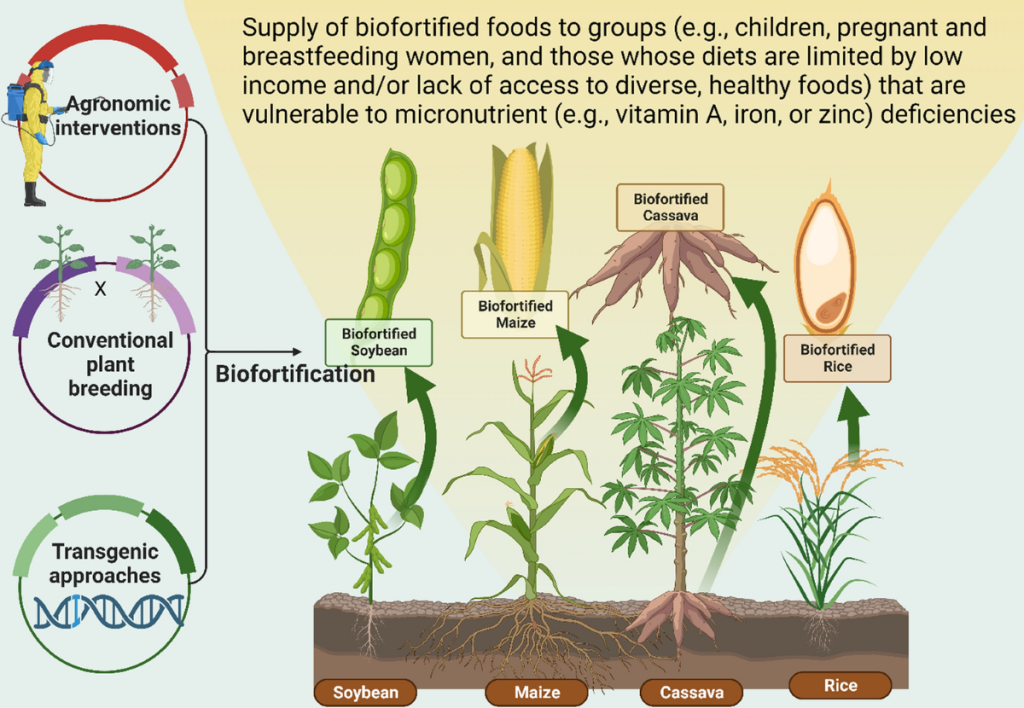
This infographic explains biofortification methods—agronomic interventions, conventional breeding, and transgenic approaches—to improve the nutrient content of staple crops like soybean, maize, cassava, and rice. It highlights the importance of supplying biofortified foods to vulnerable groups such as children and pregnant women.
Women as Nutrition Leaders
Women play a central role in community nutrition, often managing both household food choices and farming. UN Women emphasizes that empowering women improves food security for entire families. Earth5R builds programs where women lead nutrition education in villages. FAO confirms that female leadership reduces malnutrition more effectively than male-only models.
Through self-help groups, women become champions of bio-fortified crops and local kitchens. NABARD supports these groups with financial resources to strengthen community outreach. IFPRI studies reveal that households led by women diversify diets more rapidly. With HarvestPlus, Earth5R promotes nutrient-rich recipes. UNICEF highlights how this directly improves child growth outcomes.
Women farmers also take leading roles in cultivating smart seeds across regions. CGIAR documents that women-led farms adopt bio-fortified varieties faster. FAO notes women adapt quickly to climate-smart practices. Programs supported by World Bank strengthen women’s access to farming resources. With Earth5R, these efforts ensure women drive nutrition from soil to plate.
In many communities, women are also the primary educators about food and health. UNESCO highlights the value of women-led literacy programs on nutrition awareness. Earth5R trains them to run local workshops on diet diversity and fortified foods. Global Nutrition Report confirms women-led knowledge sharing reduces deficiencies. WHO further stresses that female-led education boosts community health outcomes.
Economic empowerment of women reinforces their role as nutrition leaders at scale. ILO shows women’s incomes directly enhance family diets. Microfinance from Grameen Bank and SEWA boosts women’s food initiatives. UNDP notes that economic autonomy improves long-term food choices. Earth5R integrates women into income-linked nutrition programs that ensure sustainability.
Women-led leadership creates intergenerational change by influencing children’s habits. UNICEF reports that women shape early-life nutrition, preventing deficiencies later in life. With Earth5R, women establish models where health knowledge passes between generations. FAO confirms this cycle strengthens resilience. WFP shows that female-led approaches consistently outperform male-dominated nutrition strategies worldwide.
Measuring Impact: Tracking Malnutrition Reduction
Tracking outcomes is critical for proving the effectiveness of bio-fortified crop programs. WHO recommends monitoring micronutrient levels across vulnerable groups. Earth5R collects baseline and follow-up nutrition data from partner communities. UNICEF highlights that continuous measurement ensures accountability. Global Nutrition Report confirms evidence-driven tracking accelerates progress.
Household surveys are key to assessing dietary improvements from smart seeds. FAO stresses the importance of capturing food diversity data. Earth5R works with IFPRI frameworks to map nutritional changes. World Bank studies show household tracking guides better policy interventions. HarvestPlus confirms diet surveys help measure impact at grassroots levels.
Earth5R also uses digital tools to track nutrition progress across urban and rural clusters. UNDP highlights how mobile platforms increase transparency. Data dashboards built with FAO help communities visualize results. CGIAR notes digital monitoring reduces reporting gaps. WFP confirms technology speeds up community-based feedback loops.
Health screenings strengthen data collection by directly measuring deficiencies in target groups. WHO guidelines recommend anemia and growth monitoring in children. Earth5R collaborates with local health centers for regular screenings. UNICEF confirms clinical assessments identify at-risk families early. World Bank notes integration with healthcare boosts nutrition outcomes.
Evaluation reports help policymakers and funders understand impact on community nutrition. OECD stresses rigorous program evaluation for accountability. Earth5R develops case studies for NITI Aayog and other planning bodies. Global Nutrition Report shows evaluations shape long-term strategies. IFPRI confirms documented impact helps secure future funding.
Ultimately, tracking progress builds community trust and drives further participation. FAO emphasizes that transparent monitoring encourages adoption of fortified foods. UNDP confirms inclusive tracking strengthens shared ownership. WFP reports show that transparent data builds resilience. With Earth5R, measurable results prove that malnutrition reduction is not just possible but scalable.
Partnerships for Scalable Nutrition Programs
Scalable nutrition solutions require strong partnerships between governments, NGOs, and citizens. FAO emphasizes that collaborative food systems accelerate malnutrition reduction. Earth5R aligns with UNICEF to scale fortified food distribution in communities. WFP highlights that joint programs expand coverage. Global Nutrition Report confirms partnerships drive lasting nutrition progress.
Public-private partnerships also bring innovation into the nutrition ecosystem. World Bank notes that businesses can scale affordable fortified foods. Earth5R engages with HarvestPlus and food startups for seed innovation. UNDP stresses private-sector input strengthens local supply chains. CGIAR shows research collaborations improve seed resilience. Such partnerships deliver both scale and sustainability.
Local governments are crucial allies in sustaining nutrition programs long-term. NITI Aayog integrates Earth5R’s models into state-level nutrition strategies. Ministry of Women and Child Development supports fortified food inclusion in anganwadi centers. UNESCO stresses linking local governance with education-based nutrition. FAO research confirms decentralized governance improves dietary access. Local policy support ensures scale beyond pilot projects.
Academic and research institutions provide evidence that strengthens nutrition programs. IFPRI studies help Earth5R design measurable interventions. Harvard T.H. Chan School of Public Health documents bio-fortification’s role in reducing deficiencies. CGIAR offers seed trials and agricultural innovations. WHO confirms research partnerships strengthen global nutrition standards. Evidence-based inputs ensure credibility and replicability.
Community-based organizations act as the last-mile partners in reaching households. SEWA and women-led groups integrate fortified crops into community kitchens. NABARD supports financing for local cooperatives distributing smart seeds. UN Women confirms grassroots partnerships empower women leaders. WFP notes that engaging communities sustains ownership. Local anchors ensure scalability and adoption.
Ultimately, nutrition partnerships succeed when diverse actors unite around common goals. SDG 2: Zero Hunger provides the framework for joint efforts. UNDP highlights that multistakeholder collaboration achieves measurable outcomes. Global Nutrition Report stresses partnership alignment prevents duplication. With Earth5R, alliances create models where food, health, and resilience grow together.
The Future of Nutrition: Scaling Earth5R’s Model Globally
Scaling Earth5R’s nutrition model worldwide offers a pathway to address hidden hunger. WHO highlights that malnutrition persists even in middle-income nations. UNICEF stresses the urgency of reaching children with fortified foods. FAO confirms bio-fortification is scalable across regions. Global Nutrition Report calls for replicable grassroots-driven models.
Global partnerships are key to replicating Earth5R’s success across borders. WFP emphasizes international collaboration to strengthen food security. UNDP notes south-south cooperation accelerates adoption. HarvestPlus offers global seed-sharing networks for fortified crops. World Bank highlights international funding as essential for scaling. Such alliances ensure equitable nutrition delivery.
Technology will play a transformative role in scaling nutrition access worldwide. CGIAR explores bio-fortified seed innovations tailored to diverse climates. FAO confirms digital monitoring platforms strengthen accountability. UNESCO stresses digital literacy helps communities adopt new practices. Earth5R integrates citizen-driven apps for tracking nutrition. Technology bridges knowledge, access, and scale seamlessly.
Cultural adaptation is critical when scaling programs across nations. UNESCO highlights respecting local food traditions for better adoption. FAO research shows diet diversity must match community habits. UN Women stresses women’s role in cultural integration. WFP notes context-specific strategies prevent resistance. Earth5R tailors models to fit community identities.
Policy frameworks will determine how fast global nutrition models expand. OECD stresses aligning national budgets with nutrition priorities. NITI Aayog offers India’s example of integrating nutrition into development plans. WHO confirms policies must mandate fortified food access. UNDP highlights policy-driven financing accelerates scale. Earth5R advocates policy dialogues across regions.
The future of nutrition lies in community-driven, globally supported, and evidence-based solutions. SDG 2: Zero Hunger anchors the global fight against malnutrition. Global Nutrition Report stresses that local-to-global scaling is essential. Earth5R demonstrates how citizen-led action achieves measurable change. With collaboration, innovation, and resilience, nutrition equity can become a global reality.
Conclusion: Nourishing Communities, Transforming Futures
Earth5R’s work with bio-fortified crops shows that malnutrition can be tackled through community-driven innovation. By integrating local food systems, strengthening women leaders, and empowering farmers, the model ensures resilience. UNICEF confirms that early-life nutrition transforms lifelong health outcomes. With scalable solutions, communities can thrive beyond hunger.
Nutrition security requires building bridges across sectors and scaling proven models worldwide. Global Nutrition Report highlights the importance of evidence-based scaling strategies. Partnerships with WFP and local governments ensure resources reach those most in need. UNDP reinforces that inclusive strategies create measurable impact.
Technology, research, and cultural adaptation remain pillars for expanding Earth5R’s model globally. CGIAR supports crop innovations, while FAO provides global nutrition monitoring frameworks. UNESCO stresses integrating education ensures communities sustain adoption. Together, these elements make nutrition solutions both scalable and sustainable.
Ultimately, achieving SDG 2: Zero Hunger requires bold, community-led actions supported by global collaboration. Earth5R proves that citizen engagement drives real and lasting change. WHO confirms that addressing hidden hunger transforms public health. With shared commitment, bio-fortified crops can nourish generations and build healthier futures.
Frequently Asked Questions: How Bio-Fortified Crops Are Fighting Malnutrition with Earth5R’s Community Nutrition Programs
What are bio-fortified crops?
Bio-fortified crops are staple food varieties bred to contain higher levels of essential vitamins and minerals such as iron, zinc, and vitamin A. They are developed through conventional plant breeding or modern agricultural methods to fight malnutrition naturally.
Why are bio-fortified crops important in addressing malnutrition?
They directly target hidden hunger by improving nutrient intake in daily diets. Unlike supplements or industrial fortification, bio-fortified crops integrate nutrition into foods people already eat regularly, ensuring long-term sustainability.
How do Earth5R’s community nutrition programs work?
Earth5R connects farmers, women leaders, and local institutions to grow, distribute, and consume bio-fortified foods. The model integrates education, kitchens, schools, and markets to make nutrient-rich foods accessible at the grassroots.
What role do women play in these nutrition programs?
Women are key decision-makers in food preparation and child care. By leading self-help groups, managing kitchens, and spreading awareness, they become the backbone of community nutrition strategies and intergenerational change.
How does bio-fortification differ from food fortification?
Food fortification adds nutrients during industrial processing, while bio-fortification develops nutrient-rich crops during cultivation itself. Bio-fortification is cost-effective, sustainable, and especially suited for rural and low-income communities.
Which nutrients are most commonly improved in bio-fortified crops?
Common enhancements include iron in beans, zinc in rice and wheat, and vitamin A in sweet potatoes and maize. These nutrients address widespread deficiencies that affect child development and overall health.
Are bio-fortified crops safe to consume?
Yes, they are developed using traditional breeding methods without altering the natural structure of food. They undergo rigorous testing to ensure safety, quality, and nutritional effectiveness before distribution.
How do schools benefit from introducing bio-fortified foods?
Integrating bio-fortified grains and vegetables into school meals improves child nutrition, enhances learning capacity, and reduces absenteeism. Early introduction also creates healthy food habits that last into adulthood.
What challenges exist in distributing bio-fortified crops?
Challenges include lack of awareness, limited distribution channels, cultural preferences, and affordability issues. Earth5R addresses these by working with farmer groups, markets, and women-led networks to ensure accessibility.
How does Earth5R measure the impact of its nutrition programs?
Earth5R uses surveys, health screenings, and digital tools to track nutrient intake and health outcomes. Data-driven evaluations help demonstrate progress, ensure accountability, and guide program expansion.
What role do partnerships play in scaling these programs?
Partnerships with governments, research institutions, NGOs, and private players provide funding, innovation, and policy integration. Collaborative action is essential to scale nutrition access from local to global levels.
Can bio-fortified crops withstand climate challenges?
Many bio-fortified varieties are bred to be resilient against drought, pests, and changing weather patterns. This makes them crucial for both food security and nutrition in climate-vulnerable regions.
How do Earth5R’s programs contribute to the Sustainable Development Goals (SDGs)?
The initiatives align strongly with SDG 2: Zero Hunger, while also supporting SDG 3 on health, SDG 5 on gender equality, and SDG 13 on climate action, making the impact multidimensional.
What makes Earth5R’s approach unique?
Earth5R combines environmental action, citizen engagement, and nutrition improvement in one model. Unlike top-down programs, it relies on community ownership and grassroots leadership for sustainability.
How do community kitchens enhance nutrition security?
Community kitchens run by women’s groups prepare affordable meals using fortified crops, ensuring vulnerable families get daily access to nutrition while fostering knowledge-sharing and solidarity.
What role does technology play in Earth5R’s nutrition initiatives?
Earth5R uses mobile apps, dashboards, and digital reporting to monitor progress and engage citizens. Technology helps improve transparency, participation, and real-time feedback across regions.
Are bio-fortified crops affordable for poor households?
Yes, they are designed to be cost-effective and integrated into existing diets. By building local supply chains and farmer networks, Earth5R ensures affordability without relying on expensive supplements.
How do farmers benefit from cultivating bio-fortified crops?
Farmers access new markets, earn higher incomes, and strengthen resilience against climate challenges. Training in climate-smart agriculture ensures they produce nutrient-rich crops sustainably.
Can Earth5R’s model be scaled globally?
Yes, it is adaptable across cultures and geographies. By combining bio-fortified seeds, local partnerships, and community-led strategies, the model can be replicated to fight hidden hunger worldwide.
What is the long-term vision of Earth5R’s nutrition programs?
The vision is to create resilient, community-owned food systems where no family suffers from hidden hunger. By empowering citizens, scaling partnerships, and promoting sustainability, Earth5R aims to make nutrition equity a global reality.
Call to Action: Join the Movement for Nutrition Equity
The fight against malnutrition cannot be won by organizations alone—it requires the power of communities, individuals, and collective action. Every household, school, and workplace has a role to play in creating healthier food environments and spreading awareness.
By supporting bio-fortified crops and community-led initiatives, you can directly contribute to improving nutrition security. Small choices—like advocating for nutrient-rich meals or supporting local farmers—create ripples that strengthen resilience across entire societies.
Together, we can build a future where no child goes to bed hungry, and every family has access to nutritious, affordable food. Empowering women, educating communities, and strengthening local systems will pave the way for lasting change.
This is your moment to act. Join hands with citizen-led programs, support sustainable farming, and make nutrition equity a shared mission. The future of healthier generations depends on the steps we choose to take today.
~Authored By Barsha Sharma