
Rajesh Exports · ESG Disclosure Integrity
Rajesh Exports and the Governance Half of ESG: An Expert Analysis
What disclosure integrity — read from public filings before the headlines — reveals about ESG risk in India’s listed market.
In June 2026, the gold and jewellery company Rajesh Exports became the subject of one of the largest alleged revenue-misstatement matters in Indian capital-market history, putting the Rajesh Exports ESG profile under fresh scrutiny. For ESG and risk professionals, the more useful question is not what the regulator found. It is why the warning signs were sitting in plain sight, in public disclosure, long before anyone looked. This is an analysis of that question, and of what disclosure integrity can tell an investor, a lender, a board, or an advisory team before a problem becomes material.
Figures at a glance. The SEBI figure is an allegation under an interim order the company denies; the TERRA readings are Earth5R’s analysis of public disclosure.
01What SEBI has alleged
According to the Securities and Exchange Board of India’s interim order dated 3 June 2026, Rajesh Exports may have misrepresented around 15.15 lakh crore rupees of revenue — roughly 160 billion US dollars — across the financial years 2021 to 2025. SEBI’s interim findings indicate that the large majority of the group’s reported revenue was recognised through an overseas subsidiary, and the regulator has barred the promoter from dealing in the company’s securities pending further forensic examination. Press reports add that the matter began with a shareholder complaint regarding long-outstanding trade receivables, and that the findings have been referred for review of the statutory auditors. Together these events form the backdrop to the Rajesh Exports ESG assessment that follows.
02The half of ESG that gets the least scrutiny
ESG is most often discussed as carbon and community: emissions targets, net-zero pledges, social programmes. Yet beneath all of it sits a prior question, and it is the first question, not the last. Can the disclosure be trusted at all?
That question is governance — the G in ESG — and in practice it receives the least rigour. Conventional ratings tend to reward the volume and confidence of disclosure rather than its honesty. A company with a polished narrative scores well. A quieter, better-governed business can score worse. The incentive runs backwards. Environmental and social performance built on disclosure that cannot be trusted is not performance. It is presentation.
03What the Rajesh Exports ESG filings showed
Consider the operational footprint behind the Rajesh Exports ESG profile, as the company itself disclosed it. The listed entity reports a workforce of about 124 people — roughly 76 employees and 48 workers. That is the human scale of the Indian listed company.
Set that against the financial scale. The Indian standalone entity reports revenue of about 7,085 crore rupees, close to 750 million US dollars. The consolidated group, including its overseas subsidiary, reported revenue of roughly 2.36 lakh crore rupees — about 25 billion US dollars — for the quarter ending March 2026 alone. SEBI’s interim observation is that almost all of the group’s reported revenue sat inside that overseas subsidiary rather than in the Indian operation that investors were buying.
Infographic 1 · The scale divergence
A second document is worth reading closely. In its clarification to the exchanges, the company stated that its revenues are correct and that there appears to be a communication gap with the regulator. That is a narrative claim. The interim order is the quantitative challenge to it. The distance between the two is precisely what governance analysis exists to measure.
Environmental and social performance built on disclosure that cannot be trusted is not performance. It is presentation.
04What Earth5R TERRA showed about Rajesh Exports ESG
Earth5R TERRA is a proprietary ESG intelligence framework that scores more than 1,200 Indian listed companies from public disclosure and ground-verified field data. On that framework, the Rajesh Exports ESG score was 32.0 out of 100, placing it in the Below Average band, calibrated against the full universe of peers across FY2023, FY2024 and FY2025.
TERRA Platform · Rajesh Exports company scorecard
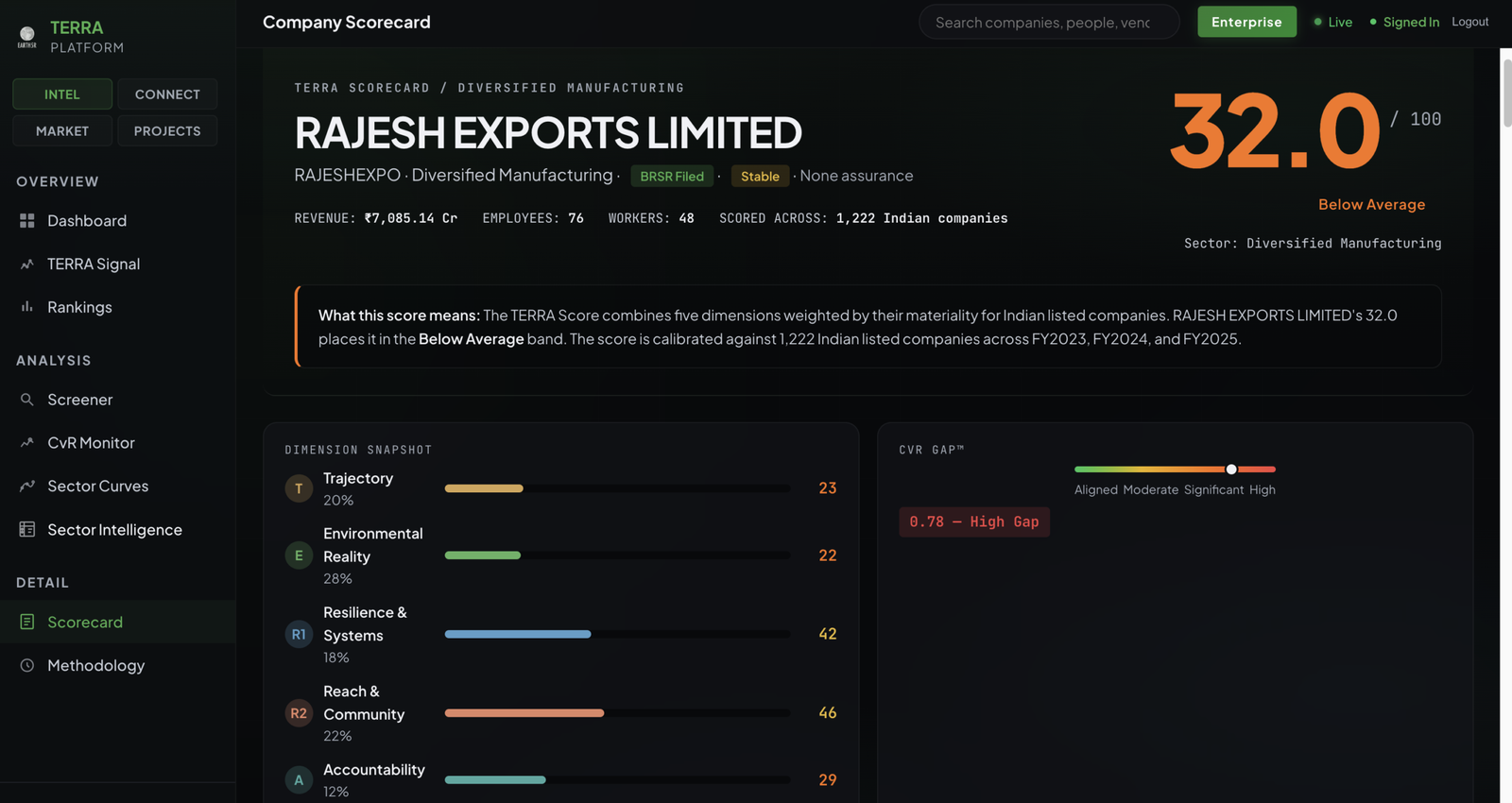
What Earth5R TERRA does, and does better than a desk-based rater, is detect divergence. It is not a financial auditor, and it makes no claim on the alleged revenue matter, which is the regulator’s to settle. What it reads is something different, and for risk and assurance teams more useful: how far a company’s narrative has pulled away from its own disclosed numbers.
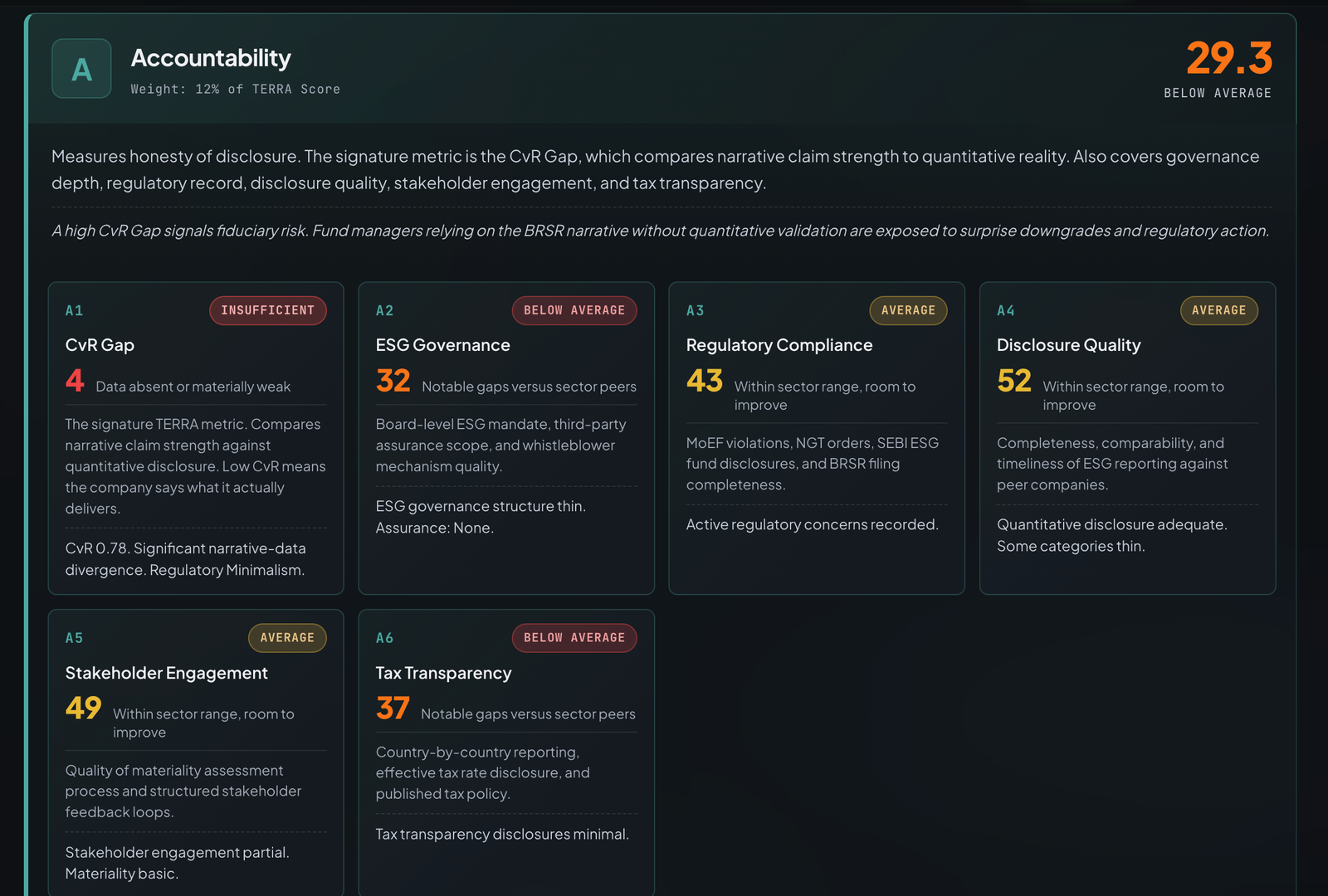
The signature metric is the CvR Gap, which compares the strength of a company’s narrative claims against its quantitative disclosure. On Rajesh Exports it read 0.78, the highest exposure band, with the engine’s note recording significant narrative-data divergence and regulatory minimalism. A high CvR Gap is not an accusation. It is a risk reading. It signals that a company’s story and its substance have separated, which is precisely where surprises tend to live.
Within the Accountability dimension, the Rajesh Exports ESG pattern is consistent rather than incidental. ESG governance scored 32, with third-party assurance recorded as none. Tax transparency scored 37. Disclosure quality and regulatory compliance sat in the middle bands. This is not a single weak indicator. It is thin disclosure running through the dimension that measures honesty itself.
TERRA Platform · Accountability dimension detail
| Metric | Reading | Band / Note |
|---|---|---|
| Overall TERRA Score | 32.0 / 100 | Below Average |
| CvR Gap (Claim vs Reality) | 0.78 | High Gap |
| 3-year score change | −17.5 pts | Declining, decelerating |
| Trajectory — 3-yr Δ | −28.6 | Pledge-to-progress alignment weakened |
| Environmental Reality — 3-yr Δ | −29.2 | Load rising faster than efficiency gains |
| Resilience & Systems — 3-yr Δ | −3.8 | Structural risk exposure up |
| Reach & Community — 3-yr Δ | +0.5 | Broadly stable |
| Accountability — 3-yr Δ | −25.6 | Narrative-data divergence widened |
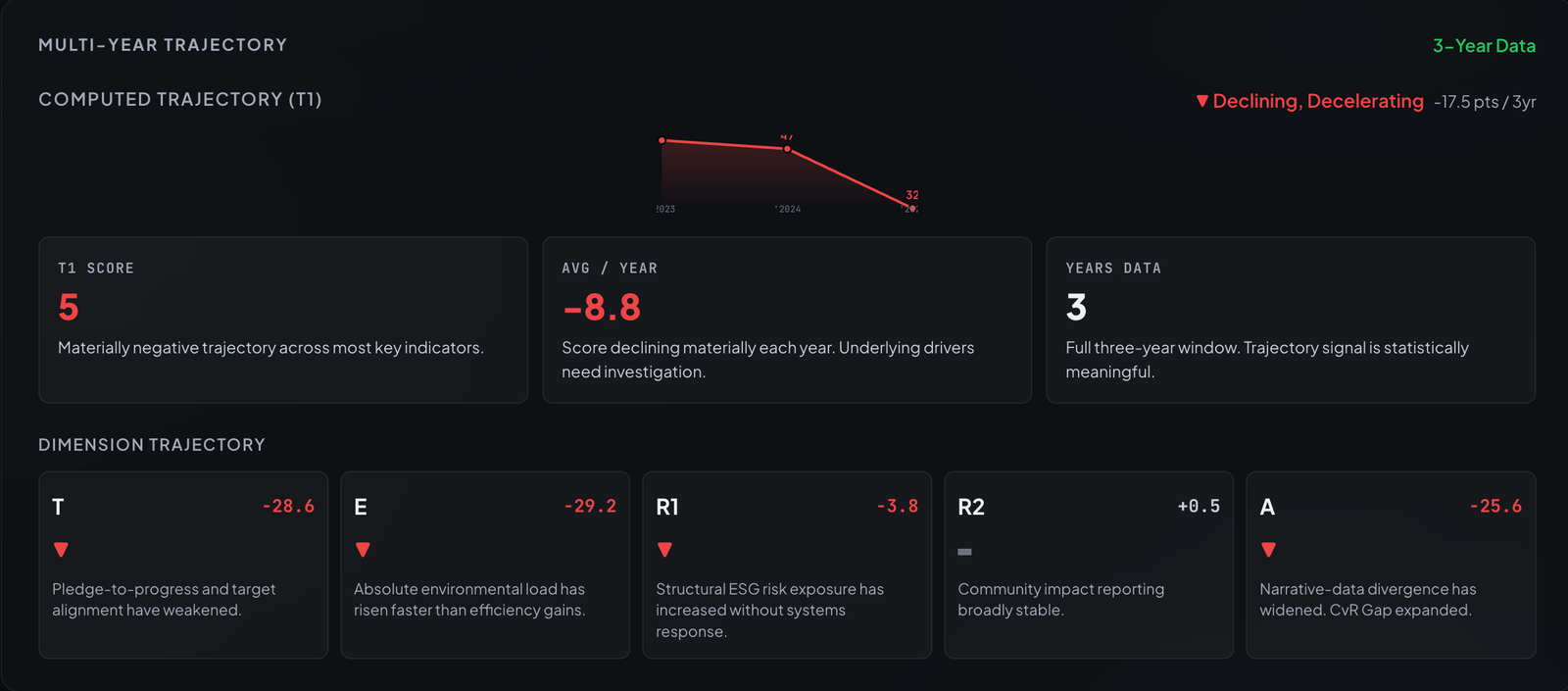
The trajectory view matters most for early warning. Earth5R TERRA does not score a company once and stop. It tracks the slope across years. Over the three-year window the score fell by 17.5 points, with the steepest drop in the most recent year. The dimension trajectories moved in the same direction, while the framework’s own note recorded that narrative-data divergence had widened and the CvR Gap had expanded. The signal was not a single snapshot. It was a trend, visible and deepening, well before the matter reached the news.
TERRA Platform · Multi-year trajectory
05How the Earth5R TERRA framework works
A score is only as useful as the method behind it. Earth5R TERRA evaluates every company across five dimensions, each weighted by its materiality for an Indian listed business. Beneath these sit 34 sub-indicators built on a 91-column data schema, each scored from public disclosure and, where available, ground data. Every score is calibrated against more than 1,200 Indian listed companies, so a number carries meaning the way a credit score does — relative to a real population rather than in the abstract.
Infographic 2 · The five TERRA dimensions, weighted by materiality
The design is built to resist the ways companies present better than they perform:
- Emissions are normalised by revenue and by physical output, not revenue alone, so a company cannot appear cleaner simply by raising prices — a common artefact that flatters intensity metrics without changing a single tonne of actual emissions.
- Water consumption is weighted by local water stress, the way one adjusts a salary for cost of living, so a plant in a water-scarce district is not scored as if it sat beside a river with abundant supply.
- Social impact is weighted by who is actually reached through a Vulnerability Depth Index — the way a bank risk-weights its book rather than counting every rupee of exposure the same, so reach into genuinely underserved groups counts for more.
- The CvR Gap is produced by a two-pass engine that reads the quantitative disclosures and the narrative separately, then scores the distance between them — isolating presentation from substance instead of blending the two into one flattering number.
The structural advantage is the ground-truth layer. Earth5R operates a field network that has gathered 2.4 billion geo-tagged environmental data points with a community of 2.5 million people across more than 150 Indian cities. That capability is why Google placed Earth5R’s modelling among its Top 15 for sustainability in India — the only organisation from the sustainability sector on that list. Anyone can read a company’s claims. Very few can independently verify them at scale, and that verification is the scarce half of the equation.
06What the Rajesh Exports ESG case means for each stakeholder
Disclosure integrity is not an abstract virtue. The Rajesh Exports ESG reading lands differently on each desk that has to act on it, and the same TERRA signal carries a distinct meaning for an allocator, a lender, a board and an assurance team.
- Investors and asset managers — disclosure integrity is fiduciary exposure. When a name carries a wide narrative-data divergence, the risk is a sudden re-rating that the narrative gave no warning of, and reported institutional holdings in this case underline how that exposure reaches ordinary savers through pooled funds.
- Banks and lenders — the exposure is twofold: as credit risk on the loan book, and, for the authorised-dealer banks that processed overseas investment and certified annual filings, as the institutions now asked to reconcile those filings against audited foreign accounts. A borrower-integrity screen sits upstream of both.
- Boards and company secretaries — the governance lessons are concrete: verify large subsidiary revenues independently, scrutinise long-outstanding receivables, monitor related-party flows continuously, and demand transparent disclosure of overseas operations. A disclosure-integrity score tells you which names warrant that scrutiny first.
- Assurance and advisory teams — the value is triage. No practice can run a deep forensic review on every name in a portfolio, so a cheap, scalable first pass that flags where narrative and numbers have drifted apart is exactly where pre-scored intelligence earns its place, replacing the manual benchmarking that consumes the early hours of an engagement.
07Why disclosure integrity is a sustainability issue
It would be easy to file this under accounting. That misses the point. Trust in disclosure is the foundation on which environmental and social performance rests. A carbon figure that cannot be trusted is worth nothing. A community-impact claim that cannot be verified is worth nothing. Measuring the reality behind the claim — not only the claim itself — is the core of credible sustainability analysis, and it is the reason Earth5R built a ground-verification capability rather than a desk-based one.
08Key takeaways
- Start with the G. ESG analysis should begin with disclosure integrity — the governance question of whether a company’s reporting can be trusted — before moving to carbon or community metrics, because every downstream number depends on it.
- The CvR Gap is a signal, not a verdict. It measures narrative-data divergence and functions as a risk reading. On the Rajesh Exports ESG profile it read 0.78, the highest exposure band, and had been widening for three years before the matter surfaced.
- TERRA is not a financial auditor. It makes no claim on the regulator’s interim case, which the company denies. It reads disclosure integrity from public data across 1,200+ Indian listed companies, calibrated to a real peer population.
- The early-warning value lies in trajectory. A deteriorating disclosure-integrity signal is visible in public data well before it becomes a market or regulatory event — which is exactly when it is most useful to the people who have to act on it.
09Frequently asked questions
What has SEBI alleged about Rajesh Exports?
Did Earth5R TERRA predict the Rajesh Exports fraud?
What is the CvR Gap?
What is disclosure integrity in ESG, and why does it matter?
How does Earth5R TERRA score companies?
About Earth5R TERRA
Earth5R TERRA is the ESG intelligence layer for India’s listed market, scoring more than 1,200 companies on disclosure integrity, environmental reality, resilience, community reach and accountability. It is built on a ground-verification capability that no desk-based rater holds.
If you run a portfolio, a loan book or an assurance practice, divergence like this almost certainly sits somewhere in your names. The question is whether you can see it before the market does. To see where your own universe sits, get in touch with the Earth5R team.
Request a TERRA portfolio review →Note: dollar conversions use an approximate rate of 95 rupees to the US dollar as of June 2026. This article is an analysis of public disclosure and is not investment advice or a comment on the merits of any ongoing regulatory matter.