
The Indian stock market has been buzzing in recent days as Advance AgroLife Ltd’s Initial Public Offering (IPO) witnessed a remarkable subscription surge. From institutional investors to retail participants, the IPO was oversubscribed multiple times, highlighting the confidence that financial markets are placing in India’s agriculture-linked industries. But for those of us who track sustainability, the story of Advance AgroLife is not merely about financial growth, it is about how agriculture, sustainability, and market forces are increasingly interwoven. At Earth5R, we view such developments as vital signposts of how the future of farming and environmental responsibility is being shaped.
The company, which has built its reputation over more than two decades, sits at the intersection of chemical inputs, sustainability ambitions, and farmer livelihoods. This raises important questions: Can companies like Advance AgroLife balance profitability with ecological responsibility? Can shareholder gains translate into better resilience for small farmers? And how does this connect with India’s long-term sustainability goals?
Who is Advance AgroLife?
Before we dive into the market frenzy surrounding the IPO, it is important to understand the journey of the company itself. Founded in 2002 by the late visionary Mr. Hanuman Sahai Ji, Advance AgroLife positioned itself as one of India’s leading agro-input manufacturers with a clear goal of assisting farmers through better productivity and profitability. The company is headquartered in Jaipur, Rajasthan, and has built three state-of-the-art manufacturing facilities that are certified by the Ministry of Science & Technology.
- Advance AgroLife manufactures a broad spectrum of agrochemical products including insecticides, fungicides, herbicides, and plant growth regulators. These are marketed under both proprietary and in-licensed brands, allowing the company to serve diverse farming needs.
- With over 22 years of expertise, the company has emerged as one of the world’s largest sulphur-based formulation manufacturers, producing over 50,000 metric tonnes annually. This specialization in sulphur-based products is significant because sulphur plays a crucial role in crop enhancement and soil health, making it an important area of sustainable inputs.
- The company has secured more than 400 regulatory registrations, covering a wide array of products across herbicides, fungicides, insecticides, and stimulants. Such a strong regulatory position ensures it has credibility not only in India but also in global markets.
- Advance AgroLife’s mission and vision statements emphasize sustainability, eco-friendly chemistry, and integrated pest management practices , principles that resonate strongly with the broader goals of sustainable agriculture.
The foundation of Advance AgroLife, therefore, lies in being both a commercial entity and a solutions provider, which makes the IPO more than just a financial event; it becomes a barometer for how seriously markets are rewarding companies with sustainability-linked narratives.

Why This IPO Matters for Indian Agriculture
The oversubscription of Advance AgroLife’s IPO is not just about investors betting on a profitable company. It reflects a deeper market sentiment about the role of agriculture in India’s economy and its intersection with sustainability. The demand indicates that agriculture is no longer being viewed as a stagnant or risk-heavy sector, but as a space of opportunity where innovation, technology, and eco-friendly practices can unlock new growth.
- Agriculture as an investment magnet: For decades, agriculture was treated as a low-return sector with limited financial appeal. However, the success of Advance AgroLife’s IPO demonstrates that agriculture-related companies, especially those with innovation and scale, are now attracting mainstream financial attention. This represents a shift in perception that agriculture can deliver competitive returns while also addressing critical societal needs.
- Sustainability as a driver of valuation: Investors are increasingly rewarding companies that position themselves as environmentally responsible. Advance AgroLife’s emphasis on sustainable practices and eco-friendly chemistry aligns with global ESG (Environmental, Social, and Governance) expectations. Such alignment is becoming a key factor in determining valuations and market trust.
- Farmer impact as a growth lever: India has over 100 million smallholder farmers, and companies that can deliver cost-effective, productivity-enhancing solutions stand to capture enormous market share. The strong investor response indicates recognition of this growth potential, but it also comes with expectations of accountability toward farmer wellbeing.
Sustainability Commitments and the Earth5R Lens
Every IPO pitch includes sustainability as a buzzword, but the real test lies in whether these commitments are implemented at scale. Advance AgroLife’s communication highlights a strong focus on eco-friendly chemistry, integrated pest management, and compliance with environmental regulations. From an Earth5R perspective, this deserves both appreciation and critical scrutiny.
- Eco-friendly chemistry: Advance AgroLife has positioned its formulations as being safer and more environmentally aligned, particularly in areas such as sulphur-based products. However, the challenge lies in ensuring that eco-friendly claims are backed by rigorous monitoring and transparent reporting, especially given global concerns about overuse of agrochemicals.
- Integrated pest management (IPM): The company emphasizes practices that integrate pest and chemical management, which is a positive step toward reducing over-reliance on harmful pesticides. For farmers, IPM can lower costs while reducing long-term soil degradation. For ecosystems, it means biodiversity protection and improved resilience.
- Compliance and certifications: With ISO 9001:2015 and ISO 14001:2015 certifications, Advance AgroLife has put systems in place for quality management and environmental standards. While these certifications are valuable, stakeholders must still evaluate how consistently practices on the ground match stated policies.
Sustainability here is not just a branding exercise; it is a necessity. If companies like Advance AgroLife genuinely integrate sustainability into their operations, they can become catalysts for transforming India’s agriculture into a globally competitive and environmentally resilient sector.
The IPO Numbers: What Investors Saw
While Earth5R’s focus remains on sustainability, it is worth unpacking the numbers that created such investor enthusiasm.
- The IPO was priced at ₹95–100 per share, with a lot size of 150 shares, making it accessible for retail investors while attractive for institutional buyers.
- The issue size was ₹192.86 crore, entirely fresh equity, which means the capital raised will go directly toward business expansion and not toward existing shareholders.
- On the final day, the IPO was oversubscribed more than 50 times, showing overwhelming investor interest. Subscription levels like these reflect both financial confidence and strong marketing of the company’s narrative.
- Analysts estimate grey market premiums (GMP) at around ₹115 per share, suggesting expectations of 15%+ listing gains. For short-term investors, this provides a quick upside, but for long-term sustainability watchers, the real question is whether this growth will align with sustainable outcomes.
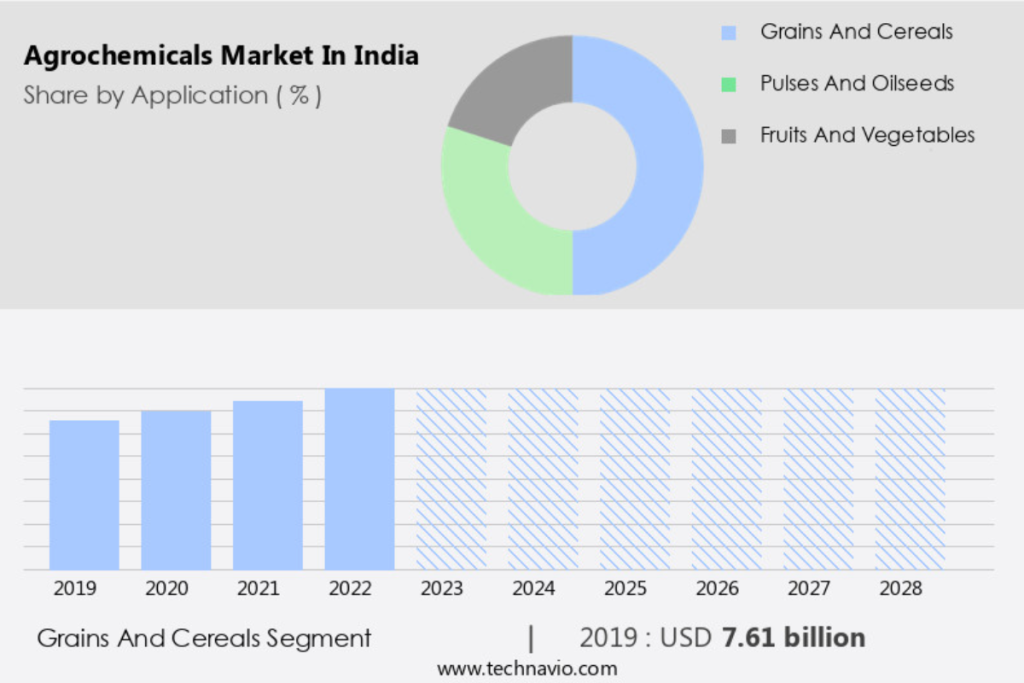
A look at the market share and projected growth of the Indian agrochemical sector, with a focus on the key Grains and Cereals segment.
Opportunities Ahead for Sustainable Agriculture
Advance AgroLife’s success brings to light some important opportunities that extend beyond one company. It signals a broader shift in how India can merge agriculture with sustainability and profitability.
- Strengthening farmer resilience: If capital raised through IPOs is channeled into R&D, training, and farmer support programs, companies can play a transformative role in building resilience against climate shocks and price fluctuations.
- Accelerating sustainable input adoption: Companies with scale and financial strength can make eco-friendly inputs more affordable and widely available, encouraging farmers to adopt practices that safeguard soil and water resources.
- Export leadership: India can position itself as a global hub for sustainable agri-inputs, building on companies like Advance AgroLife. This can boost foreign exchange earnings while contributing to global food system resilience.
- Public-private collaboration: Successful IPOs open opportunities for partnerships between government, private sector, and NGOs to integrate sustainability goals into mainstream agriculture.
Risks and Cautions to Keep in Mind
While optimism runs high, Earth5R emphasizes the importance of also acknowledging risks that come with such developments. Long-term sustainability cannot be achieved if risks are overlooked in pursuit of short-term financial gains.
- Chemical dependency: Even with eco-friendly chemistry, reliance on chemical-based inputs carries risks of overuse and ecosystem damage. Farmers need education and balanced solutions that combine organic, regenerative, and chemical inputs responsibly.
- Equity for small farmers: If products remain expensive or inaccessible for marginal farmers, the benefits of such IPO-driven growth may bypass those who need them most. Inclusivity must be central to the business model.
- Transparency gap: Investors and communities will increasingly demand transparent reporting on sustainability outcomes, not just financial metrics. Companies that fail to provide this risk reputational setbacks.
- Global ESG pressure: As global funds pour into Indian markets, scrutiny on ESG compliance will intensify. Companies like Advance AgroLife must be prepared to meet international expectations.
Looking Ahead: The Real Test Lies in Delivery
The Advance AgroLife IPO is undoubtedly a financial success, but the true impact will be determined over the coming years. For India’s agriculture to thrive sustainably, companies must balance profitability with ecological responsibility, shareholder returns with farmer wellbeing, and expansion with transparency.
For Earth5R, the rise of companies like Advance AgroLife underscores the urgent need for sustainable models that protect natural resources while enabling economic growth. If Advance AgroLife can deliver on its promises, it may set an example for how Indian agri-businesses can align financial markets with planetary health.
As global conversations on climate, food security, and sustainable development intensify, IPOs like this remind us that markets are paying attention. Now, the responsibility lies in execution, and the world will be watching closely.
~Authored By Abhijeet Priyadarshi