

Introduction: The Twin Crises of Complexity and Climate
The latest reports from the Intergovernmental Panel on Climate Change (IPCC) have delivered a stark and unambiguous message. The window of opportunity to secure a liveable and sustainable future for all is rapidly closing. As global temperatures continue their relentless climb, the call for radical, immediate, and intelligent action has never been more urgent.
But the climate crisis is not merely an environmental challenge, it is fundamentally a data problem of unimaginable scale. The Earth’s climate is a deeply complex system, an intricate web of billions of interacting variables from ocean currents and atmospheric carbon levels to polar ice alchemy and solar radiation. Human analysis alone is proving insufficient to accurately model, predict, and mitigate the cascading effects of this complex system.
This is where Artificial Intelligence (AI) enters the fray, not as a magical silver bullet, but as an indispensable analytical tool. At its core, AI, particularly the field of Machine Learning (ML), excels at precisely what the climate challenge demands: finding meaningful patterns, optimising complex systems, and making accurate predictions from vast and chaotic datasets. It offers a way to navigate the noise and find the signal.
This article explores the critical intersection of AI and climate action. We will move beyond the theoretical to provide scientific context for AI’s role and, most importantly, profile the pioneering startups that are translating this potential into tangible solutions. These companies are building the intelligent infrastructure needed to decarbonise our world, one data point at a time.
The Scientific Backbone: How AI is Decoding the Climate Crisis
To understand the role of AI startups, we must first appreciate the scientific capabilities they are leveraging. Artificial Intelligence is not a single technology, but a diverse toolkit that, when applied to climate science, acts as a powerful analytical engine. It is fundamentally changing how we process environmental data and, more importantly, how we make decisions based on it.
Enhanced Climate Modeling and Prediction
For decades, scientists have used supercomputers to run complex climate simulations. While powerful, these models are computationally intensive and can struggle to capture localized, short-term phenomena. AI, particularly deep learning, offers a paradigm shift by processing immense and varied datasets, from high-resolution satellite imagery from NASA to real-time ocean sensor readings, with unprecedented speed.
Think of it as upgrading our planetary vision from standard definition to 8K. AI algorithms can detect subtle patterns in ice shelf fractures, ocean temperature anomalies, or soil moisture changes that precede extreme weather events. This is improving the resolution of our climate foresight, allowing for more accurate and timely warnings for hurricanes, droughts, and wildfires. Cutting-edge methods like Physics-Informed Neural Networks (PINNs) even integrate the fundamental laws of physics into the AI model, ensuring its predictions are not just data-driven but also scientifically sound.
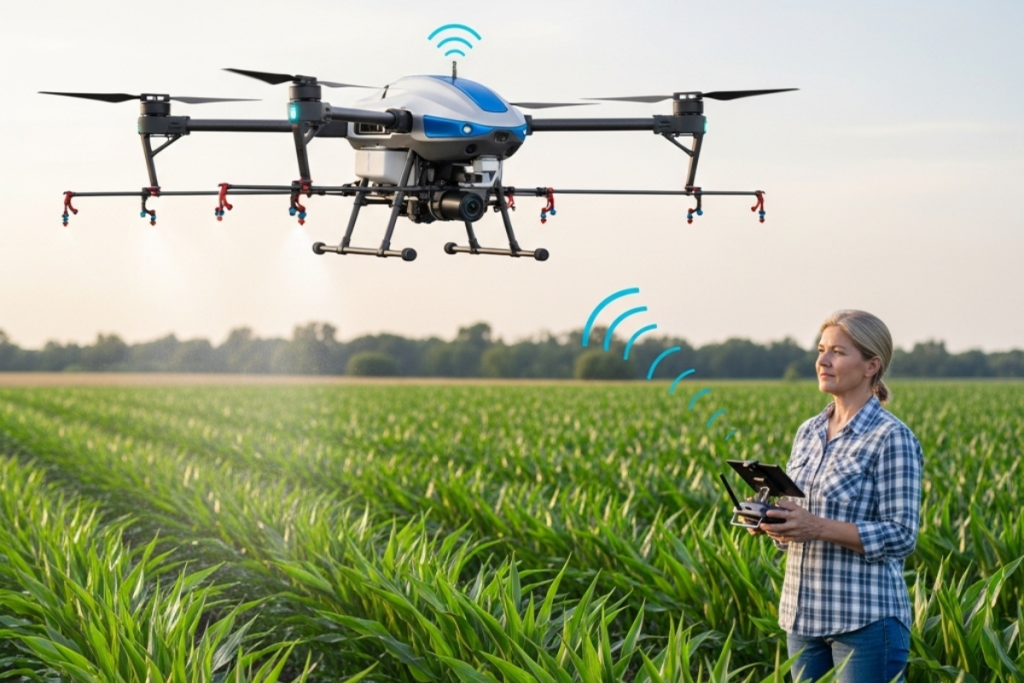
System-Level Optimization
One of the greatest challenges in the energy transition is managing the variability of renewables. The sun doesn’t always shine, and the wind doesn’t always blow. AI-powered optimization algorithms offer a solution. They can act as an expert air traffic controller for electrons on a national or even continental electricity grid.
By analysing weather forecasts, consumer demand patterns, and energy prices in real-time, AI can intelligently route power, deciding precisely when to store excess solar energy in batteries and when to release it. This dynamic balancing act, as detailed by research from institutions like the National Renewable Energy Laboratory (NREL), reduces our reliance on fossil fuel “peaker” plants, cuts energy waste, and enhances overall grid stability, making a 100% renewable grid a more achievable reality.
Accelerating Scientific Discovery
Perhaps AI’s most profound impact lies in its ability to accelerate the discovery of new materials crucial for climate technology. The traditional process of developing new compounds for batteries, solar panels, or carbon capture catalysts is slow, expensive, and often reliant on serendipity.
AI models can change this by rapidly screening millions of potential molecular structures to identify candidates with the desired properties. Instead of a chemist manually testing thousands of options, a generative AI can propose novel materials designed for maximum efficiency and stability. This approach is compressing decades of painstaking research and development into years or even months, speeding up the arrival of next-generation batteries, more efficient solar cells, and novel catalysts to pull CO2 directly from the air.
The Vanguard: AI Startups Turning Code into Climate Action
While the scientific principles are compelling, the true measure of AI’s impact is found in its application. Across the globe, a new generation of technology companies is moving beyond theory, deploying sophisticated algorithms to tackle the climate crisis head-on. These startups are the vanguard, creating tangible, scalable solutions in the sectors that matter most.
Sector A: Decarbonizing Energy and Industry
The energy and industrial sectors remain the largest sources of global greenhouse gas emissions. Decarbonizing this complex web of power plants, grids, and factories is a monumental task, but AI is proving to be a powerful lever for change.
One of the most significant challenges is managing the modern electricity grid. Startups like Myst AI are tackling this by building forecasting platforms that help energy companies more accurately predict everything from electricity demand to the power output of a wind farm. Using AI, their systems analyse historical data and weather patterns to create highly accurate forecasts, acting as a highly skilled conductor for the complex orchestra of a renewable-powered grid. This precision allows utilities to reduce their reliance on backup fossil fuel power plants, thereby cutting costs and emissions simultaneously.
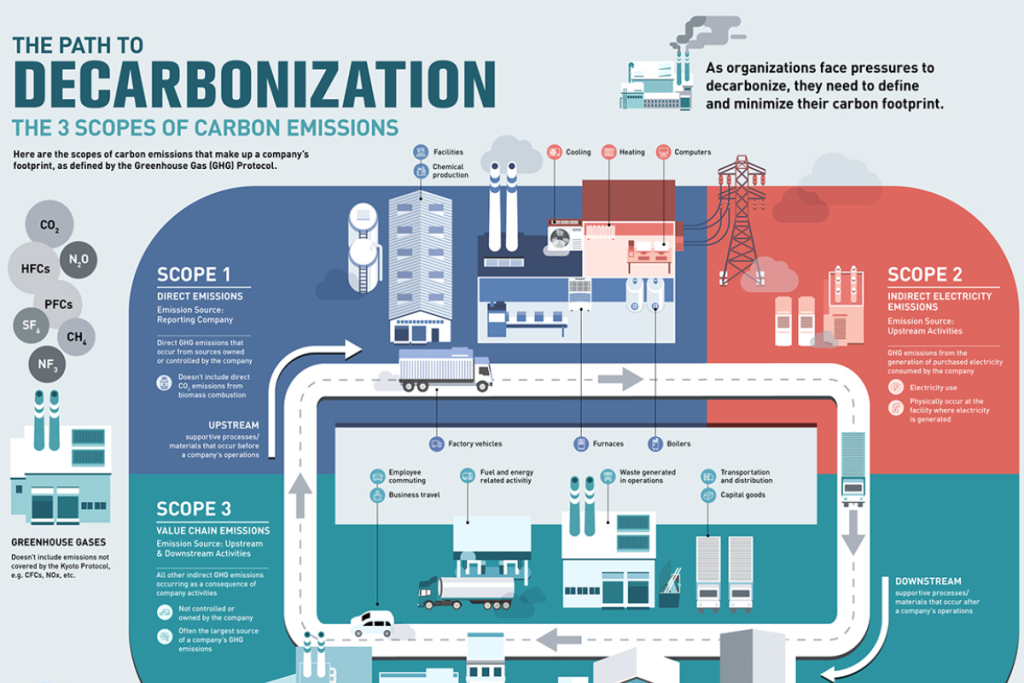
This infographic illustrates the three scopes of carbon emissions, providing a clear framework for how organizations measure their complete carbon footprint from direct operations to their broader value chain.
Beyond the grid, a major climate threat comes from methane, a greenhouse gas over 80 times more potent than carbon dioxide in the short term. Invisible leaks from oil and gas infrastructure are a primary source. Kuva Systems provides a critical solution with its AI-powered continuous monitoring platform. Their cameras use infrared imaging to “see” methane, and a computer vision algorithm analyses the feed 24/7. When a leak is detected, an alert is automatically sent to operators, turning invisible threats into actionable data for immediate repair.
Sector B: Revolutionizing Agriculture, Forestry, and Land Use
The world’s farms and forests hold a dual role in the climate story, they are both a source of emissions and a potential massive carbon sink. AI is helping to tilt this balance toward the latter, making land use more sustainable and accountable.
For nature-based solutions like reforestation to be effective, they need to be credible. Pachama is building that credibility by using AI to act as a digital auditor for nature. The company’s platform analyses vast amounts of satellite imagery and LiDAR data to accurately measure the carbon stored in forests. This brings unprecedented transparency to the carbon offset market, ensuring that companies investing in conservation are supporting high-quality projects with verifiable climate benefits.
Meanwhile, farmers are on the front lines of a changing climate, facing increasing volatility from droughts and extreme heat. San Francisco-based ClimateAI provides a climate intelligence platform that gives agribusinesses and farmers a clearer view of the future. Their AI models forecast climate-driven risks seasons in advance, allowing farmers to make better decisions on what crops to plant, how to manage water resources, and where to source their supplies from, ultimately building a more resilient global food system.
Sector C: Building a Circular Economy and Managing Waste
Our linear “take-make-waste” economy is a major driver of emissions and resource depletion. AI is accelerating the shift towards a circular model where resources are reused and waste is minimised.
A key bottleneck in the circular economy is the sorting of materials for recycling, a task that is often slow, costly, and inefficient when done manually. AMP Robotics is revolutionising this process. The company’s AI-powered robotic systems use computer vision to identify and sort different materials like plastics, paper, and metals from a conveyor belt with superhuman speed and accuracy. This technology is dramatically improving the economics and efficiency of recycling, making it possible to recover more valuable materials and reduce landfill waste.
Food waste is another enormous challenge, generating significant methane emissions as it decomposes in landfills. Afresh Technologies is tackling this problem at the source: the grocery store. Their AI platform helps stores optimise their fresh food inventory by precisely predicting demand. By knowing exactly how many avocados or bunches of bananas to order, retailers can significantly reduce spoilage, which not only cuts waste and emissions but also improves their profitability.

Sector D: Climate Finance, Risk, and Adaptation
As the physical impacts of climate change become more severe, businesses, investors, and governments need to understand their exposure. AI is becoming an essential tool for quantifying this new and complex category of risk.
Companies like Jupiter Intelligence specialise in physical climate risk analytics. Their platform uses AI to model the future probability of floods, wildfires, heatwaves, and other perils for any given location on Earth, down to the level of an individual building or power plant. They are effectively translating complex climate science into the language of financial risk. This allows asset managers, insurers, and urban planners to make smarter, more climate-resilient decisions about where and how to invest for the long term.
From Grassroots to Grid: An AI-Powered Case for Community Action
Advanced technology risks remaining a theoretical novelty unless it can connect with and amplify real-world, on-the-ground efforts. The work of environmental organizations provides a crucial lens through which to see how high-tech AI can solve tangible, local problems, particularly in the complex landscape of waste management.
The social enterprise Earth5R, with extensive projects in Indian cities like Mumbai and Delhi, highlights a core challenge in the quest for a circular economy. Their work focuses on community training and solid waste management, directly confronting the difficulty of achieving efficient waste segregation at scale in densely populated urban environments. Despite tireless awareness campaigns, the reality is that mixed waste often overwhelms manual sorting capabilities.
This is where the grassroots problem meets the high-tech solution. The efforts of Earth5R to educate citizens and improve collection are the vital “upstream” part of the process. However, the “downstream” sorting of this collected waste is often a bottleneck that limits the effectiveness of the entire system. This is precisely where technology from a startup like AMP Robotics can act as a powerful force multiplier.
Imagine a scenario where the waste collected through an Earth5R community drive is sent to a Material Recovery Facility (MRF) equipped with AI-powered sorting robots. Even if the initial segregation by residents is imperfect, these intelligent systems can rapidly identify and separate various plastics, papers, and metals with over 99% accuracy. The AI doesn’t replace the community action, it validates and enhances it. By ensuring that a much higher percentage of collected material is actually recycled, AI makes the entire circular economy model, which is the ultimate goal of Earth5R’s work, far more efficient and economically viable. This synergy turns community passion into measurable environmental impact.
A Tool, Not a Panacea: The Challenges Facing AI in Climate Action
While the potential of AI is immense, it is crucial to approach its application with a clear-eyed view of its limitations and risks. To champion AI as a climate solution without acknowledging its challenges would be both naive and counterproductive. True progress requires addressing these issues head-on.
One of the most significant paradoxes is that the process of training powerful AI models carries its own significant energy and carbon footprint. Research has shown that the computations required to train a single large deep learning model can emit as much carbon as several transatlantic flights. This issue, sometimes called “Red AI,” necessitates a push toward more efficient algorithms and, critically, a commitment to powering the data centers that run these models with 100% renewable energy.
Furthermore, AI is only as unbiased as the data it is trained on. This creates a serious risk of algorithmic bias that could exacerbate global inequalities. The vast majority of high-quality climate and environmental data originates from the Global North. An AI model trained primarily on this data might develop excellent solutions for agriculture in Europe but fail to account for the unique soil conditions and weather patterns in Southeast Asia, rendering it ineffective or even harmful where it is needed most. Ensuring data equity is therefore a central challenge for developing globally effective climate solutions.
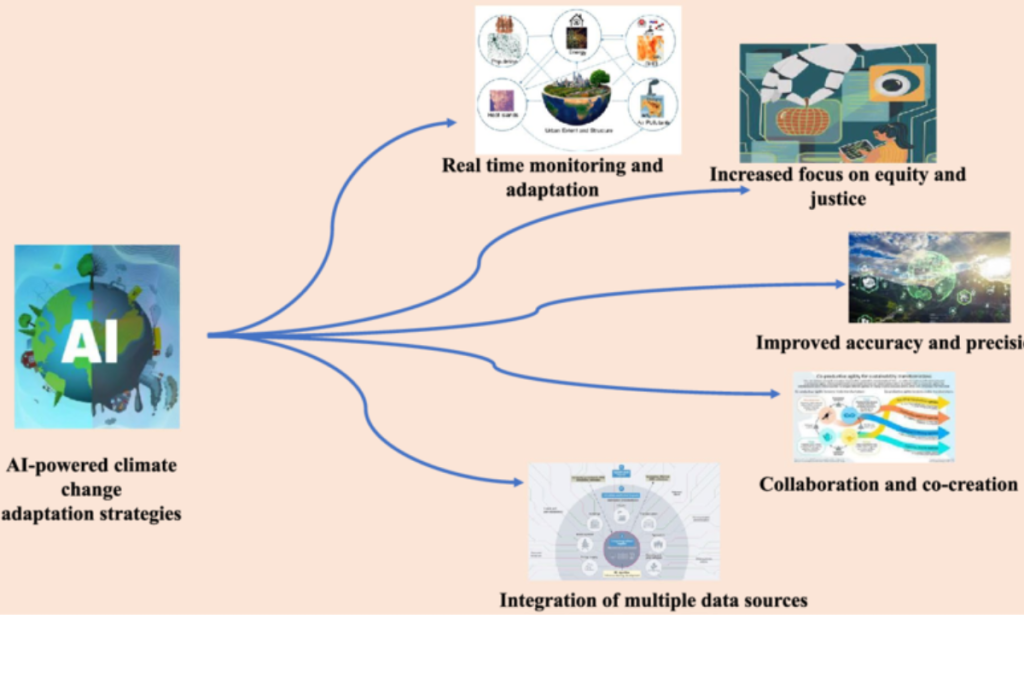
This diagram outlines how AI-powered strategies are applied to climate action, leading to key benefits such as real-time environmental monitoring, improved predictive accuracy, and the integration of diverse data sources.
Finally, the excitement surrounding artificial intelligence has created the danger of “AI greenwashing.” This occurs when companies use the “AI” label as a marketing buzzword to attract investment and project a sustainable image, without delivering verifiable environmental impact. This not only misdirects capital away from genuinely effective solutions but also erodes public and investor trust in the entire field. A rigorous commitment to transparent, third-party verification, similar to the MRV systems discussed earlier, is essential to separate true impact from mere hype.
The Road Ahead: Charting the Next Frontier of Climate AI
The startups profiled in this article represent the leading edge of a much larger wave of innovation. This burgeoning ecosystem is being propelled by a powerful confluence of technological advancement, policy support, and a surge of private capital, setting the stage for an even more integrated and intelligent approach to climate action.
This momentum is increasingly fueled by investment. Climate Tech has emerged as a major focus for venture capital, with billions of dollars flowing into companies that promise scalable decarbonization solutions. This infusion of capital is crucial, as it funds the long-term research and development needed to move from incremental improvements to transformative breakthroughs.
However, this financial energy must be matched by supportive government policies. Frameworks that encourage open access to public climate data, fund foundational AI research, and create stable markets for green technologies through mechanisms like carbon pricing are essential. Policy creates the landscape upon which technology can build solutions at scale.
Looking toward the technological horizon, one of the most ambitious concepts is the creation of “digital twins” of Earth. Projects like the European Union’s Destination Earth (DestinE) aim to build a highly accurate virtual replica of our planet. This would allow scientists and policymakers to run complex simulations, testing the impact of a new policy or a large-scale renewable energy project in the virtual world before deploying it in the real one.
The future is also one of deep integration, where AI is fused with the Internet of Things (IoT) to create a responsive, planetary-scale monitoring system. Imagine a global network of sensors on forests, oceans, and farms, all feeding real-time data to a central AI that can detect environmental changes and automate responses. This represents the next step in our journey, moving from analysis to autonomous, intelligent action for a sustainable world.
Beyond the Algorithm: A Call for Intelligent Action
The climate crisis presents humanity with its most complex challenge to date, a reality underscored by every report from global scientific bodies like the IPCC. Yet, within this challenge lies an unprecedented opportunity in the fusion of artificial intelligence with human ingenuity. This synergy is providing us with a powerful new toolkit, not to replace our efforts, but to sharpen them with unprecedented precision.

The pioneering startups and organizations showcased are the definitive proof of this shift from theory to practice. They are the architects of a new climate-positive infrastructure, turning predictive algorithms into decarbonized industries and computer vision into functioning circular economies. They represent a burgeoning ecosystem dedicated to solving tangible problems, one intelligent intervention at a time.
Ultimately, the responsibility for action remains profoundly human. Artificial intelligence does not have agency, purpose, or a commitment to a sustainable future, we do. AI will not solve climate change, people will. But for the first time, it provides the intelligence, speed, and scale necessary to ensure our actions are not just well-intentioned, but truly effective. The mandate now is to wield this powerful tool with the wisdom and urgency the moment demands.
Frequently Asked Questions: AI for Climate Action
What exactly does “AI for Climate Action” mean?
It refers to the use of Artificial Intelligence, particularly machine learning, to address the climate crisis. This involves using algorithms to analyze vast environmental datasets, improve climate models, optimize energy systems, monitor deforestation, reduce waste, and accelerate the discovery of sustainable materials. It’s about applying computational intelligence to solve real-world climate problems.
Why is AI even necessary to fight climate change?
The climate is an incredibly complex system with billions of interacting variables. The sheer scale and complexity of the data involved, from satellite imagery to ocean sensor readings, are beyond the capacity of human analysis alone. AI is uniquely capable of detecting subtle patterns, making accurate predictions, and optimizing complex systems, which is essential for effective climate mitigation and adaptation.
Is AI a magic solution or “silver bullet” for the climate crisis?
No, it is not. AI is a powerful tool, not a panacea. It requires human direction, ethical oversight, and a clear understanding of its limitations. The ultimate responsibility for taking action lies with people, policymakers, and industries. AI simply provides the intelligence and speed to make those actions more effective.
What are the main scientific capabilities of AI in a climate context?
AI offers three core capabilities: 1) Enhanced modeling and prediction, allowing for more accurate forecasts of extreme weather events. 2) System-level optimization, such as managing a renewable energy grid to reduce waste. 3) Accelerating scientific discovery, like finding new materials for batteries or carbon capture technologies much faster than traditional methods.
Doesn’t training AI models consume a massive amount of energy?
Yes, this is a significant challenge. The computational process for training large AI models has a substantial energy and carbon footprint. The solution involves developing more energy-efficient algorithms (“Green AI”) and, crucially, powering the data centers that run these models with 100% renewable energy sources.
How does AI help make the electricity grid more stable with renewables?
AI acts like an expert traffic controller for the grid. By analyzing weather forecasts (for solar/wind availability), consumer demand, and energy prices in real-time, it can intelligently decide when to store excess energy in batteries and when to release it. This dynamic balancing act reduces reliance on fossil fuel backup plants and improves overall grid stability.
What is an example of an AI startup working in agriculture?
A company like ClimateAI uses artificial intelligence to provide farmers and agribusinesses with long-range forecasts of climate risks, such as droughts or heatwaves. This allows them to make smarter decisions about what crops to plant, how to manage water, and where to source materials, ultimately building a more resilient food system.
How does AI improve recycling?
Startups like AMP Robotics use computer vision and AI-powered robots to sort recyclable materials from a mixed waste stream. These robots can identify and separate different types of plastics, papers, and metals with superhuman speed and accuracy, which dramatically increases the efficiency and economic viability of recycling operations.
What is “AI greenwashing”?
This is when a company uses the term “AI” as a marketing buzzword to appear innovative and sustainable, without their technology having a real, verifiable positive impact on the climate. It’s crucial to look for companies that can provide transparent data and third-party verification of their environmental benefits.
How can AI help protect forests and verify carbon offsets?
A startup named Pachama uses AI to analyze satellite imagery and LiDAR data to accurately measure the amount of carbon stored in a forest. This acts as a digital auditing system, bringing transparency and credibility to the carbon credit market and ensuring that investments in reforestation are having a real, measurable impact.
What is an MRV system as mentioned in the Earth5R case study?
MRV stands for Monitoring, Reporting, and Verification. In the context of industry, it’s a digital system that uses IoT sensors and AI to track emissions, energy use, and process efficiency in real-time. It provides the high-quality, verifiable data needed to prove compliance with regulations and participate in carbon markets.
How does a high-tech solution like AI connect with grassroots work?
AI can act as a powerful downstream solution that enhances upstream community efforts. For example, while an organization like Earth5R works to improve waste collection at the community level, AI-powered sorting facilities can ensure that a much higher percentage of that collected waste is actually recycled, making the entire circular economy model more effective.
What is “algorithmic bias” in the context of climate change?
This is the risk that AI solutions could be biased towards the regions where most of the training data comes from, typically the Global North. An AI model trained on European farm data might not work effectively in India. Addressing this requires a global effort to gather more diverse and equitable climate data.
How can AI help a company understand its risk from climate change?
Companies like Jupiter Intelligence use AI to model the future physical risks to assets. They can calculate the probability of a factory being affected by a flood or a supply chain being disrupted by a wildfire in 2040. This translates climate science into financial risk, allowing businesses to make more resilient investments.
What is a “digital twin” of the Earth?
This is an ambitious concept to create a highly accurate, dynamic virtual replica of our planet. Powered by AI and real-time data, it would allow scientists and policymakers to run simulations to test the potential impacts of climate policies or large-scale environmental projects before implementing them in the real world.
How does AI help detect methane leaks?
Startups like Kuva Systems use ground-based cameras that can “see” methane, which is invisible to the naked eye. An AI algorithm continuously monitors the camera feed, and if it detects the signature of a methane plume, it automatically alerts operators with the exact location and size of the leak for immediate repair.
What is the role of government policy in advancing climate AI?
Supportive policies are critical. Governments can help by funding foundational AI research, creating regulations that encourage decarbonization (like carbon pricing), and promoting open access to public climate data from agencies like NASA. This creates a stable and encouraging environment for Climate Tech startups to thrive.
How does blockchain technology support climate AI?
Blockchain provides a secure, tamper-proof ledger for data. In MRV systems, for example, logging emissions data on a blockchain ensures its integrity. This creates a high level of trust, which is essential for verifying carbon credits and attracting green finance from investors.
Can AI accelerate the discovery of new green technologies?
Absolutely. AI is being used in materials science to screen millions of potential molecular structures for new types of batteries, more efficient solar panels, and better catalysts for capturing CO2 from the air. This can compress research and development timelines from decades into just a few years.
As an individual, how can I support this movement?
Individuals can support this movement by investing in Climate Tech funds if possible, advocating for policies that support renewable energy and innovation, and staying informed about the companies and technologies making a real difference. Supporting organizations that prioritize data-driven, verifiable environmental solutions also contributes to the ecosystem.
~ Authored by Abhijeet Priyadarshi