

The Corporate Race to Real Zero
The Climate Imperative
The science is unequivocal. A torrent of research, crystallized in the landmark reports from the Intergovernmental Panel on Climate Change (IPCC), has issued a stark warning to humanity: the window to secure a livable future is rapidly closing. The global consensus, formally recognized in the 2015 Paris Agreement, is that we must limit global warming to well below 2°C, and preferably to 1.5°C, compared to pre-industrial levels.
This global mission is not just for governments; it represents a fundamental rewiring of the global economy. For the corporate world, this is no longer a distant concern for a sustainability department. It has become the central strategic challenge of our time, a powerful force reshaping markets, supply chains, and consumer expectations.
Decoding the “Net-Zero” Pledge
In response, a wave of “net-zero” commitments has swept across boardrooms. But what does this term actually mean? Net-zero emissions is achieved when a company eliminates all its greenhouse gas (GHG) emissions, or, for the truly unavoidable emissions, balances them by removing an equivalent amount from the atmosphere. It is a state of equilibrium, where a company’s carbon footprint effectively becomes zero.
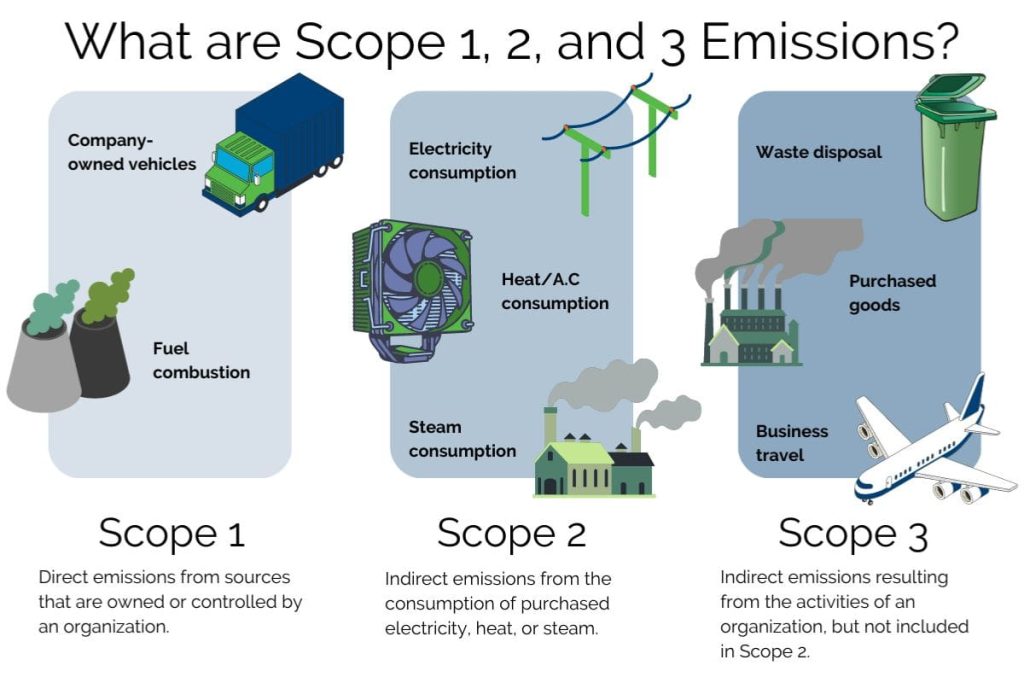
This concept is often confused with being “carbon neutral,” which can sometimes be achieved simply by purchasing carbon offsets without significant internal reductions. A credible net-zero roadmap, however, demands a deep and comprehensive accounting of all emissions, categorized into three distinct “scopes” as defined by the GHG Protocol.
Think of it like personal responsibility. Scope 1 emissions are the direct result of your own actions, like the exhaust from a company-owned vehicle fleet. Scope 2 emissions are indirect, stemming from the electricity you purchase and consume, similar to the carbon footprint of the power plant that charges your phone.
The real challenge, and where true leadership is measured, lies in Scope 3. These are all other indirect emissions that occur in a company’s value chain, both upstream and downstream. This includes everything from the carbon footprint of raw materials purchased from suppliers to the emissions produced when customers use the company’s products. For most corporations, Scope 3 is the elephant in the room, often accounting for over 80% of their total carbon footprint.

The Rising Tide of Climate Action
This surge in corporate pledges is not purely altruistic. It is a pragmatic response to a confluence of pressures. Investors, organized through powerful coalitions like Climate Action 100+, are increasingly using their financial leverage to demand clear decarbonization strategies, viewing climate risk as a significant financial risk.
Simultaneously, consumers are voting with their wallets, showing a growing preference for brands with demonstrable environmental credentials. This market force, coupled with the looming threat of stricter government regulations and carbon pricing, has turned climate action from a public relations exercise into a critical component of corporate survival and long-term value creation.
From Pledge to Progress
However, a pledge is merely a promise. The true test lies in the execution. This article argues that a credible net-zero roadmap is not just an ambitious declaration, but a detailed, science-based, and transparent strategic plan. We will dissect the architecture of a robust roadmap, from emissions accounting to the limited role of offsets.
By analyzing best practices from industry leaders like Microsoft, Unilever, and Holcim, and drawing insights from real-world case studies, we will illuminate the path from ambition to tangible impact. The journey is complex and fraught with challenges, yet it is one the corporate world must undertake to secure not only its own future, but that of the planet.
The Architecture of a Credible Net-Zero Roadmap 🏗️
The Foundation: You Can’t Manage What You Don’t Measure
A credible journey to net-zero begins not with a bold press release, but with meticulous accounting. Before a company can chart a course for the future, it must first understand its present impact. This involves conducting a comprehensive greenhouse gas (GHG) inventory, which acts as the foundational baseline against which all future progress is measured. It’s the corporate equivalent of stepping on a scale before starting a fitness plan.
The primary challenge in this initial step is the infamous Scope 3, which encompasses all indirect emissions across a company’s value chain. For many organizations, particularly those in retail or manufacturing, these emissions can be a staggering multiple of their direct footprint. Research from organizations like the CDP has shown that a company’s supply chain emissions are, on average, over 11 times higher than its operational emissions, making Scope 3 the most critical and complex piece of the puzzle.
Setting the North Star: Science-Based Targets
Once a company has a clear picture of its emissions, the next step is to set a meaningful goal. A vague pledge to “go green” is no longer sufficient. The gold standard today is the adoption of Science-Based Targets (SBTs), which are emissions reduction targets in line with what the latest climate science says is necessary to meet the goals of the Paris Agreement.
The Science Based Targets initiative (SBTi), a collaboration between global environmental non-profits, provides the framework and validation for these goals. Adopting an SBT is the difference between simply promising to drive more carefully and committing to a specific speed limit dictated by safety experts. It aligns corporate ambition with the global 1.5°C trajectory, ensuring that a company’s efforts contribute meaningfully to the collective goal. Best practice also dictates setting ambitious interim targets for 2030 to ensure accountability and drive immediate action.
The Decarbonization Hierarchy: Reduce First, Compensate Last
The strategic heart of any net-zero roadmap is its decarbonization plan, which should follow a clear hierarchy of action. The absolute priority must be direct emissions abatement within a company’s own operations and value chain. Relying on offsets before exhausting all internal reduction options is a widely criticized approach that can lead to accusations of greenwashing.
This “abatement-first” strategy involves a two-pronged attack. First, companies must enhance efficiency in their own operations, for example by upgrading equipment and electrifying industrial processes. This is often followed by a transition to 100% renewable electricity through mechanisms like corporate Power Purchase Agreements (PPAs). Second, they must engage their vast supply chains, collaborating with suppliers to set their own climate targets and redesigning products to embrace circular economy principles.
The Final Piece: The Limited Role of Carbon Offsets
Only after a company has done everything feasible to reduce its own emissions should it turn to carbon offsets. In a credible roadmap, offsets are not a get-out-of-jail-free card. Instead, they serve a specific, limited purpose: to neutralize the small slice of residual emissions that are technologically or financially impossible to eliminate by the net-zero target date, such as certain emissions from cement production or aviation.
Furthermore, not all offsets are created equal. High-quality offsets must be, among other criteria, “additional,” meaning the emissions reduction would not have happened without the investment from the offset credit. They must also be permanent and verified by rigorous, independent standards like the Gold Standard. Using cheap, low-quality credits to claim carbon neutrality undermines the entire effort and erodes stakeholder trust.
Governance and Transparency: The Pillars of Trust
Finally, a world-class roadmap is embedded within the corporate governance structure and is communicated with radical transparency. This means creating clear lines of accountability, often by linking executive compensation to the achievement of climate targets. Board-level oversight is essential to ensure the strategy remains a core business priority.
Equally important is transparent and consistent reporting. By adhering to frameworks like the Task Force on Climate-related Financial Disclosures (TCFD), companies can provide investors, customers, and regulators with the clear, comparable data needed to assess their performance. This transparency is the ultimate mechanism for accountability, building the trust required to navigate the long and challenging road to net-zero.

Best Practices in Action: From Blueprint to Reality 🌍
A theoretical blueprint is one thing, but the true test of a net-zero roadmap is its application in the complex, messy real world. Across diverse industries, from software to cement, pioneering companies are translating ambitious pledges into tangible action. Their strategies, while tailored to their unique challenges, reveal a shared commitment to science, innovation, and transparency.
Tech Sector: Microsoft’s Carbon Moonshot
In the technology sector, where emissions are often hidden deep within global supply chains and massive data centers, Microsoft has set a goal that redefines ambition. The company is not just aiming for net-zero; it has committed to becoming carbon negative by 2030. By 2050, it plans to have removed from the atmosphere all the carbon it has emitted since its founding in 1975.
A cornerstone of its strategy is a powerful internal governance tool: an internal carbon fee. Each division within Microsoft must pay for its carbon emissions, creating a dedicated fund to invest in sustainability improvements. This approach embeds accountability across the entire organization, turning climate performance into a key business metric.
Furthermore, Microsoft is aggressively tackling its vast Scope 3 footprint by investing heavily in novel carbon removal technologies like Direct Air Capture (DAC). This signals a crucial best practice: for emissions that cannot be eliminated, credible roadmaps must invest in high-quality, permanent carbon removal, not just traditional offsets.
Consumer Goods: Unilever’s Lifecycle Approach
For a consumer goods giant like Unilever, the carbon footprint extends from the farms that grow its raw materials to the bathrooms where customers use its products. The company’s strategy, therefore, focuses on the entire product lifecycle. It has set an ambitious goal for a deforestation-free supply chain, a critical step in reducing emissions from land-use change.
Innovation is also key to Unilever’s plan. By reformulating products, such as creating concentrated laundry detergents that require less packaging and lower-temperature washes, the company reduces emissions in both its production and the consumer-use phase. This illustrates a sophisticated understanding of Scope 3, acknowledging that a company’s responsibility doesn’t end when a product leaves the store.
Heavy Industry: Holcim’s Hard-to-Abate Mission
The cement industry is a classic “hard-to-abate” sector, as the chemical process of producing cement is inherently carbon-intensive. This makes the net-zero roadmap from Holcim, a global leader in building materials, particularly significant. Their 2050 targets are among the first in the industry to be validated by the SBTi, lending them immense credibility.

Holcim’s strategy leans heavily on technological innovation and a circular economy model. The company is a major investor in Carbon Capture, Utilization, and Storage (CCUS) to trap emissions at the source. Simultaneously, it is scaling up low-carbon products like its ECOPact concrete, which utilizes recycled construction materials, fundamentally reducing the carbon intensity of its core product.
Lessons in Circularity from the Ground Up
Insights from environmental organizations like Earth5R highlight how specific, ground-level actions contribute to these larger corporate goals. The analysis of Dell’s closed-loop recycling program, for example, is a perfect illustration of circularity as a climate strategy. By recovering and reusing plastics from old electronics, Dell avoids the significant Scope 3 emissions associated with manufacturing virgin materials.
Similarly, Earth5R’s reporting on Starbucks’ C.A.F.E. Practices showcases best-in-class supply chain engagement. By working directly with coffee farmers on sustainable agricultural methods, Starbucks is not just ensuring ethical sourcing but also actively reducing the carbon footprint of its most essential raw material. This deep partnership model is crucial for tackling emissions far upstream.
Finally, the focus on The Coca-Cola Company’s “World Without Waste” initiative demonstrates a holistic approach. By improving water stewardship and increasing the use of recycled PET in its bottles, the company reduces both plastic pollution and the embedded carbon in its packaging. It’s a clear example of how resource management and decarbonization are two sides of the same coin.
Challenges, Criticisms, and the Path Forward 🚧
Overcoming the Hurdles on the Road to Zero
The journey to net-zero is not a smooth highway, but a rugged path filled with significant obstacles. One of the most immediate hurdles is the data gap. For companies to effectively manage their carbon footprint, they need reliable, standardized data, especially for the sprawling complexities of Scope 3. Acquiring this information from thousands of global suppliers is like trying to conduct a global census with no standardized forms, a monumental task that currently hinders precise accounting.
Beyond data, there are stark technological and economic realities. Key technologies needed to decarbonize heavy industry, such as green hydrogen and large-scale Carbon Capture, Utilization, and Storage (CCUS), are still in their infancy. While promising, their high cost and the lack of scaled infrastructure mean they are not yet universally viable solutions, leaving many industries in a difficult position.
This challenge is compounded by policy and regulatory uncertainty. Corporations are being asked to make massive, long-term capital investments in a landscape where government climate policies can shift. Without clear, consistent, and ambitious signals from policymakers, such as a meaningful price on carbon, companies face a higher risk, which can slow down the pace of investment and the overall transition.
Addressing the “Tsunami of Greenwashing”
Alongside the practical challenges, the corporate climate movement faces a crisis of credibility. A growing body of research from institutions like the NewClimate Institute has warned of a “tsunami of greenwashing,” where ambitious pledges often mask inaction or a heavy reliance on low-quality carbon offsets.
This gap between words and deeds is corrosive. When companies claim climate leadership while simultaneously lobbying against climate-friendly policies or using dubious accounting tricks to meet their targets, it erodes public trust. The central criticism is that many roadmaps prioritize offsetting emissions over the much harder work of actually eliminating them. This is the equivalent of trying to solve a leak in your boat by bailing water out, rather than plugging the hole.
To counter this, a move towards radical transparency and stricter accountability is essential. Vague claims are no longer acceptable. Stakeholders are now demanding detailed transition plans that clearly outline short-term actions, capital allocation, and a commitment to direct air capture for any residual emissions, ensuring that a net-zero claim is backed by substance.
The Future Outlook: Collaboration is the New Competition
No single company can solve the climate crisis alone. The path forward requires a fundamental shift from individual corporate roadmaps to systemic, industry-wide transformation. This means embracing pre-competitive collaboration, where rival companies work together to solve shared challenges, such as decarbonizing complex supply chains or co-investing in breakthrough technologies.
Ultimately, the most effective corporate roadmaps will be those that are supported and accelerated by smart public policy. The future of corporate climate action depends on this powerful synergy between private sector innovation and public sector ambition. Only by working together can we bridge the gap between today’s promises and the net-zero economy of tomorrow.

The Verdict on Corporate Climate Action
The evidence is clear. A best-in-class corporate net-zero roadmap is far more than a marketing slogan, it is a detailed blueprint for profound business transformation. The most credible plans are consistently built on a foundation of comprehensive emissions accounting, a deep commitment to science-based targets, and an unwavering focus on direct abatement before considering offsets.
This transition is no longer an elective course in corporate responsibility. It has become a core subject for survival and growth in the 21st-century economy. In an era defined by climate risk, a robust decarbonization strategy is a powerful indicator of operational efficiency, innovation, and long-term resilience. Failing to act is not just an environmental misstep, it is a critical business error that will be judged harshly by investors, consumers, and future generations.
The journey to a global net-zero economy is perhaps the greatest challenge humanity has ever faced. While governments must set the direction, the corporate sector is uniquely positioned to be the engine of this transition. With their immense capacity for innovation, investment, and global reach, corporations hold a pivotal role in scaling the solutions needed to turn the ambitions of the Paris Agreement into our shared reality.
Frequently Asked Questions (FAQs) ❓
What is the real difference between “net-zero” and “carbon neutral”?
“Carbon neutral” often means a company has balanced its emissions by purchasing carbon offsets, sometimes without significant internal reductions. Net-zero, the more ambitious standard, requires a company to reduce its emissions as close to zero as possible across its entire value chain and only use high-quality carbon removal to neutralize any truly unavoidable residual emissions.
What are Scope 1, 2, and 3 emissions?
Think of them in layers. Scope 1 covers direct emissions from sources a company owns or controls, like its factory smokestacks. Scope 2 covers indirect emissions from purchased energy, mainly electricity. Scope 3 is the most comprehensive, covering all other indirect emissions in the value chain, from raw materials to customer use of products.
Why is Scope 3 so difficult for companies to manage?
Scope 3 emissions lie outside a company’s direct control. They are spread across a vast, complex global supply chain with thousands of suppliers and customers. Collecting accurate data from all these partners and influencing their behavior is a massive logistical and collaborative challenge.
What is a Science-Based Target (SBT)?
An SBT is an emissions reduction target that is formally validated by the Science Based Targets initiative (SBTi). It confirms that a company’s plan is aligned with the latest climate science and consistent with the goal of limiting global warming to 1.5°C, making it the gold standard for corporate climate goals.
Why is reducing emissions directly better than just buying offsets?
Relying on offsets without reducing your own emissions is like trying to solve a flood by mopping the floor instead of turning off the tap. Direct abatement permanently removes the source of pollution from a company’s operations and value chain, leading to a real-world decarbonization of the economy.
What is the “decarbonization hierarchy”?
It’s a strategic order of operations for climate action. The first and highest priority is to reduce and eliminate your own emissions (Scopes 1, 2, and 3). Only after all feasible reductions have been made should a company use high-quality carbon removals to neutralize the small amount of remaining, unavoidable emissions.
So when is it okay for a company to use carbon offsets?
In a credible net-zero plan, offsets are a last resort, not a primary strategy. They should only be used to counterbalance the final slice of residual emissions that are technologically or financially impossible to eliminate by the target date, for example, certain chemical process emissions in manufacturing.
What makes a carbon offset “high-quality”?
A high-quality offset must be additional (the climate benefit wouldn’t have happened otherwise), permanent (the carbon is stored away for good), verifiable by a third party, and have safeguards to avoid any social or environmental harm.
What is greenwashing in the context of climate change?
Greenwashing is when a company spends more time and money marketing itself as environmentally friendly than on actually minimizing its environmental impact. It’s the act of making misleading claims about climate action to deceive consumers and investors.
How can I spot a company that might be greenwashing?
Look for vague, unproven claims like “eco-friendly” or “green.” Be wary of companies that heavily publicize a single green initiative while their core business remains highly polluting. A lack of transparent data and reliance on cheap offsets instead of a plan for direct reduction are also major red flags.
What is the TCFD and why does it matter?
The Task Force on Climate-related Financial Disclosures (TCFD) is a framework that guides companies on how to report climate-related risks and opportunities to their investors. It promotes transparency and helps the financial market accurately price climate risk, making it a critical tool for accountability.
Why would a company create an internal carbon fee?
An internal carbon fee, like the one used by Microsoft, treats carbon emissions as a real business cost. It forces different departments to take financial responsibility for their pollution and creates a dedicated pool of money to fund sustainability projects, driving innovation from within.
What is a “hard-to-abate” sector?
These are industries, like cement, steel, and long-haul aviation, where current technology makes it extremely difficult and expensive to eliminate GHG emissions. Their emissions often come from fundamental chemical processes, not just energy use, requiring breakthrough technologies like CCUS or green hydrogen.
How can a cement company like Holcim even plan for net-zero?
It requires a multi-pronged strategy focused on innovation. Holcim’s plan includes investing heavily in Carbon Capture, Utilization, and Storage (CCUS), improving energy efficiency, and scaling up the use of recycled materials in its products to create lower-carbon cement.
What does the circular economy have to do with decarbonization?
A lot. A circular economy aims to eliminate waste by reusing, repairing, and recycling materials. This drastically reduces the need for virgin resource extraction and manufacturing, which are incredibly energy and carbon-intensive processes, thereby lowering a company’s Scope 3 emissions.
Why is a deforestation-free supply chain so important?
Forests are critical carbon sinks. When they are cleared for agriculture (to grow commodities like palm oil or soy), massive amounts of stored carbon are released into the atmosphere. For a company like Unilever, ensuring its supply chain isn’t driving deforestation is one of the most significant ways it can reduce its Scope 3 emissions.
What are the biggest challenges companies face on their net-zero journey?
The main hurdles include the lack of reliable data, especially from suppliers; the high cost and early stage of key decarbonization technologies; and inconsistent climate policies from governments, which can make long-term investment planning difficult.
What role does government policy play in corporate climate action?
Government policy is crucial. Clear, stable, and ambitious policies like carbon pricing, clean energy subsidies, and efficiency standards send a powerful signal to the market. They help de-risk corporate investments in green technology and create a level playing field for all companies to transition.
How does tying executive pay to climate goals help?
It makes climate performance a core business priority. When a CEO’s or an executive team’s bonus is linked to meeting emissions reduction targets, it ensures that sustainability is integrated into strategic decision-making at the highest level of the company, rather than being siloed in a separate department.
Why is collaboration between competing companies necessary?
Many climate challenges, like decarbonizing shipping or developing green steel, are too big and expensive for any single company to solve. By collaborating on research, co-investing in infrastructure, and setting shared standards, industries can accelerate innovation and drive systemic change much faster.
Take Action 🚀
The road to net-zero is being paved today, and every decision matters. Don’t be a passive observer. Use the insights from this article to become a catalyst for change. Scrutinize the climate pledges of the companies you work for, invest in, and buy from. Ask the tough questions: Is their plan backed by science? Are they prioritizing real reductions over cheap offsets?
Share this knowledge with your colleagues, your network, and your community. Advocate for transparency and demand accountability. Whether you are an employee, a consumer, or an investor, you have the power to reward genuine climate leadership and challenge greenwashing. The future of our planet depends on turning corporate promises into immediate, measurable, and meaningful action. Be part of the solution.
~ Authored by Abhijeet Priyadarshi