
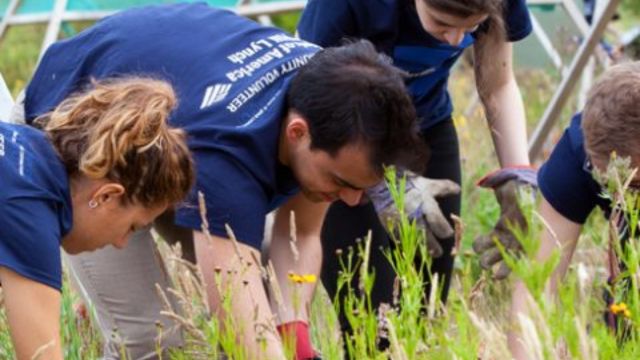
Why Farming Should Be a CSR Priority
In a country where over 43% of the workforce depends on agriculture, yet contributes only around 16% to the GDP, farming remains both India’s backbone and its blind spot. Corporate Social Responsibility (CSR), mandated under the Companies Act, 2013, has emerged as a powerful lever to bridge this development imbalance. But agriculture has not always found priority in CSR portfolios historically focused on education, health, or sanitation.
Recent climate reports underscore how agriculture is not only a climate victim but also a potential climate solution. Practices like regenerative farming, water stewardship, and soil carbon sequestration can significantly reduce emissions while improving farmer income. Recognizing this, a growing number of companies are integrating sustainable agriculture into their CSR strategy.
For example, ITC’s “Mission Sunehra Kal” demonstrates how water management and integrated farming systems can deliver long-term returns, both for the environment and rural economies. Similarly, the Mahindra Group’s CSR wing supports organic farming clusters in Maharashtra, enhancing income by over 20% within two years of project inception.
According to the Earth5R sustainability report, aligning CSR with rural regenerative models not only generates “green jobs” but strengthens village resilience to shocks like inflation and drought. Agriculture-based CSR projects also create scalable value chains. These aren’t just good optics, they’re good economics.
In short, prioritizing farming in CSR isn’t charity. It’s an investment in climate-resilient, self-sustaining communities that anchor India’s development goals. In the words of Earth5R founder Saurabh Gupta, “When a company transforms farming, it transforms the future.”
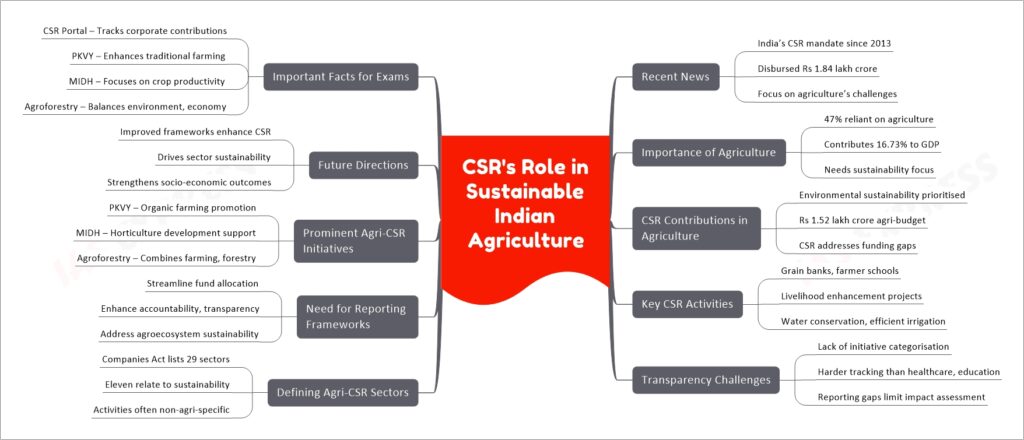
This infographic outlines the vital role of CSR in driving sustainable Indian agriculture, from funding gaps to livelihood and water conservation projects. It highlights how structured CSR initiatives can create a real agricultural impact by enhancing productivity, equity, and environmental sustainability.
From Tokenism to Transformation: What Has Worked
For decades, CSR in agriculture was largely performative, dominated by token initiatives like seed distribution or one-off farmer workshops. However, transformative change demands depth, not display. Fortunately, India now hosts a wave of CSR interventions that are moving beyond optics and delivering measurable impact on ground.
A case in point is Hindustan Unilever’s Project Prabhat, which works across 14 states, supporting farmers with advanced irrigation technologies, market linkages, and training in sustainable practices. The impact? In Maharashtra’s Nashik district, over 5,000 smallholder farmers saw a 40% increase in yield through drip irrigation and mulching practices introduced under the program.
Earth5R’s community-driven green model further showcases how transformation must be embedded in local ecosystems. In its “Building a Green Rural Economy” initiative, Earth5R empowers villages like Vengaivasal in Tamil Nadu with circular tools: turning kitchen waste into organic fertilizer, establishing micro composting units, and linking surplus to peri-urban organic markets.
Academic evidence supports this transformation. A 2022 FAO report found that CSR-funded climate-smart agriculture projects increase productivity by up to 30% while reducing greenhouse gas emissions by 20%. The key lies in shifting from short-term “CSR spend” to long-term socio-ecological investment.
Moreover, the best CSR programs use scientific baselining, real-time monitoring, and inclusive stakeholder design. The Tata Trusts, for instance, deploy satellite-based mapping to track water and crop health in their agri-CSR interventions in Vidarbha. They don’t “give” to farmers, they partner with them to co-create value.
Transformation, then, means moving from isolated acts to integrated systems. And the metric of success isn’t just yield or income, it’s resilience, equity, and sustainability.
Building Soil and Water Resilience at Scale
One of the greatest threats to Indian agriculture is depleted natural capital, eroding soils, saline water, and erratic rainfall patterns. According to the Indian Council of Agricultural Research (ICAR), over 29% of India’s land is degraded, and nearly 50% of farm irrigation relies on unsustainable groundwater extraction. Addressing this crisis requires more than just policy, it needs corporate intervention at scale.
CSR is increasingly filling this gap, especially through landscape-level soil and water conservation programs. The JSW Foundation, for instance, has revitalized over 20,000 hectares of farmland across drought-prone Bellary by implementing contour trenches, percolation tanks, and afforestation. These efforts led to groundwater tables rising by 3–4 meters, ensuring year-round irrigation for farmers.
Earth5R’s rural models offer an innovative spin: using community-led composting and greywater treatment to replenish degraded lands. In Chakan, Maharashtra, their team trained 100 local women to convert biowaste into bio-enriched compost, restoring soil microbiome health without synthetic inputs.
There’s solid science backing this. The National Bureau of Soil Survey found that organically enriched soils can retain 30–40% more water and reduce the need for chemical fertilizers by up to 60%. This not only lowers costs for farmers but also curbs groundwater pollution and enhances long-term fertility.
Successful CSR programs scale this impact by integrating soil-water interventions with agri-extension, ensuring farmers adopt the practices sustainably. Companies like ITC and Syngenta use village resource centers to train farmers on intercropping, mulching, vermicomposting, and rainwater harvesting, often combining these with climate forecasting apps.
Soil and water resilience is no longer a side benefit, it is the foundation for sustainable farming. CSR’s real impact lies in making these invisible resources visible again, in policy, in practice, and in profit.
FPO Capacity Building through CSR Support
Farmer Producer Organizations (FPOs) have emerged as one of India’s most promising rural innovations, offering smallholder farmers the scale and bargaining power they need to survive in an increasingly volatile market. Yet, FPOs often struggle with operational inefficiencies, lack of capital, and weak market linkages. This is where CSR can act as a catalytic enabler.
According to NABARD, less than 25% of registered FPOs in India are financially sustainable. To change that, companies like PepsiCo and Coca-Cola have launched CSR initiatives that help FPOs with branding, packaging, and direct-to-retail market access. PepsiCo’s work with potato-farming FPOs in Punjab, for example, includes training in crop-specific Good Agricultural Practices (GAPs), post-harvest storage, and price forecasting models. This has reduced post-harvest loss by 18%, according to an internal 2023 review.
Earth5R’s approach integrates circular economy entrepreneurship into FPOs. In the village of Vellore, Tamil Nadu, an Earth5R-led FPO model supported local farmers in producing organic herbal teas and compost-based fertilizers, which were then sold through community-owned outlets. These were not mere agricultural units but rural business hubs that empowered marginal farmers to become value creators, not just producers.
The real power of CSR lies in building institutional muscle. When companies provide seed capital for agri-tool banks, fund audit and governance training, or facilitate digital bookkeeping, they transform FPOs from informal collectives to formal enterprises. A study by the World Bank in 2021 noted that FPOs with CSR support grew 3x faster in revenue than unsupported counterparts.
More than just helping farmers sell together, CSR-supported FPOs give them the tools to plan, price, and profit together. And when farmers lead the market, rather than follow it, transformation becomes permanent.
Urban–Rural Partnerships for Sustainable Supply
India’s urban appetite for organic, local, and sustainable food is growing, but rural producers often remain disconnected from these premium markets. Bridging this divide through CSR creates a win-win model where cities get clean food and villages get fair value.
Take BigBasket’s CSR partnership with NGOs in Karnataka, where organic millet growers are linked directly to Bengaluru’s retail shelves. Through training in eco-certification, support in branding, and logistics coordination, small farmers have seen price premiums of 35%. The program also diverts urban organic waste to make compost for these farms, a true urban–rural circular loop.
Earth5R builds on this model by enabling what it calls “Green Corridors”, community systems where waste from cities like Thane is processed in peri-urban compost units, then sent to partner farms in Palghar district. These farms, in turn, supply vegetables and grain to Mumbai eco-stores, completing a closed-loop supply chain that benefits both ends.
The science supports it: a 2023 study in Agricultural Economics found that integrated rural–urban food chains reduce food miles by 22% and increase farmer income by up to 40%, especially when branding and logistics are supported by corporate CSR.
What makes this model powerful is that it doesn’t treat rural India as a recipient, it makes it a partner. When CSR helps build local collection centers, cold storage, and digital payment systems, it lays the foundation for dignified rural entrepreneurship.
CSR-facilitated rural–urban partnerships are not just about food, they’re about fairness. They transform India’s disconnected geographies into a shared ecosystem of producers, consumers, and stewards of sustainability.
Role of Employee Volunteering in Farm Programs
While CSR budgets fund the projects, it’s often employees who fuel the passion behind them. More and more companies are realizing that meaningful, skills-based employee volunteering in agriculture not only benefits farmers, it strengthens internal organizational purpose.
For instance, Mahindra’s “Rise for Good” platform encourages employees to spend weekends conducting financial literacy sessions with rural women farmers. Similarly, Wipro’s employees have offered tech mentoring for agri-startups and supported soil testing campaigns in their local villages. According to Wipro’s impact survey, over 82% of volunteers reported an enhanced connection to the company’s sustainability values.
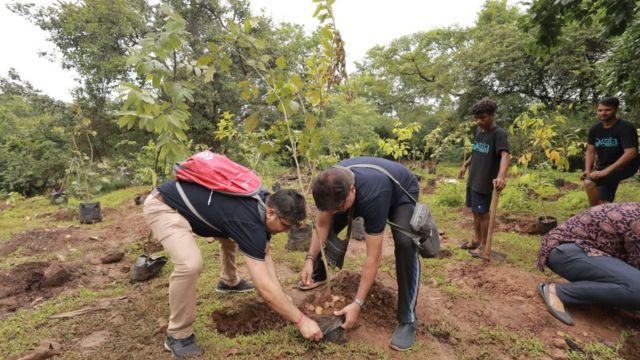
Earth5R’s programs actively leverage employee volunteers from urban offices. In their “Adopt a Village” model, professionals from firms like Capgemini are trained in basic agro-ecology, circular economy, and community engagement, and then deployed for weekend fieldwork. Volunteers have helped design solar dryers, compost systems, and even market prototypes for rural crafts made from agri-waste.
The National CSR Exchange portal now tracks volunteering metrics alongside financial ones. Why? Because volunteers become brand ambassadors of change, often continuing to support their adopted villages beyond the formal project timeline. According to a Harvard Business Review analysis, employee volunteering increases retention by up to 25%, especially among millennials who seek purpose at work.
Moreover, these experiences generate cross-sectoral learning. An urban engineer helping a village develop irrigation canals or a product designer co-creating post-harvest tools offers grassroots innovation through empathy.
When employees stop being just donors and become collaborators in resilience, the impact of CSR multiplies. These aren’t just acts of giving, they are acts of becoming.
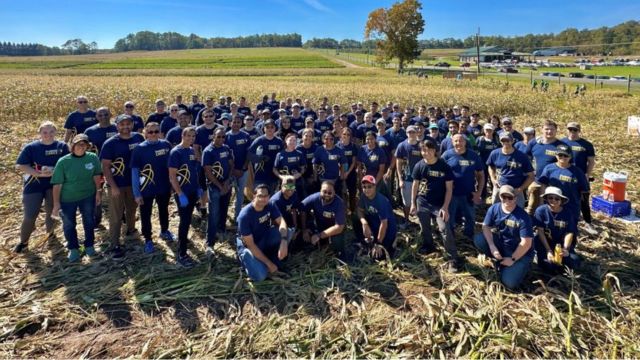
CSR-Driven Agri-Training for Women and Youth
Women contribute to over 70% of India’s agricultural labour, yet they own less than 13% of farmland, and are grossly underrepresented in training and technology access. Meanwhile, rural youth are increasingly disengaging from farming due to low income predictability. CSR can address both issues through targeted agri-training programs that build agency, skills, and enterprise.
The HCL Foundation, through its “Samuday” project in Uttar Pradesh, runs youth-led climate-smart farming hubs, where adolescents receive training in organic cultivation, marketing, and agri-tech tools. In one block alone, over 500 youth were trained, and 40% went on to launch their own agri-enterprises.
Women-focused CSR initiatives are even more transformative. Earth5R’s collaboration with self-help groups in Dindori district helped create a women-run compost cooperative, which now sells 200 kg of bio-fertilizer per week to nearby farms and earns collective profits. The program also teaches mobile app literacy, empowering these women to manage their own digital payments and orders.
Scientific evidence confirms the importance of inclusivity. A 2021 UNDP study shows that when women farmers receive equal access to training and inputs, yields can increase by up to 30%, with ripple effects across child nutrition and family health.
By aligning CSR with gender and youth development, companies don’t just uplift individuals, they reshape intergenerational opportunity structures. And when training becomes empowerment, farming becomes freedom.
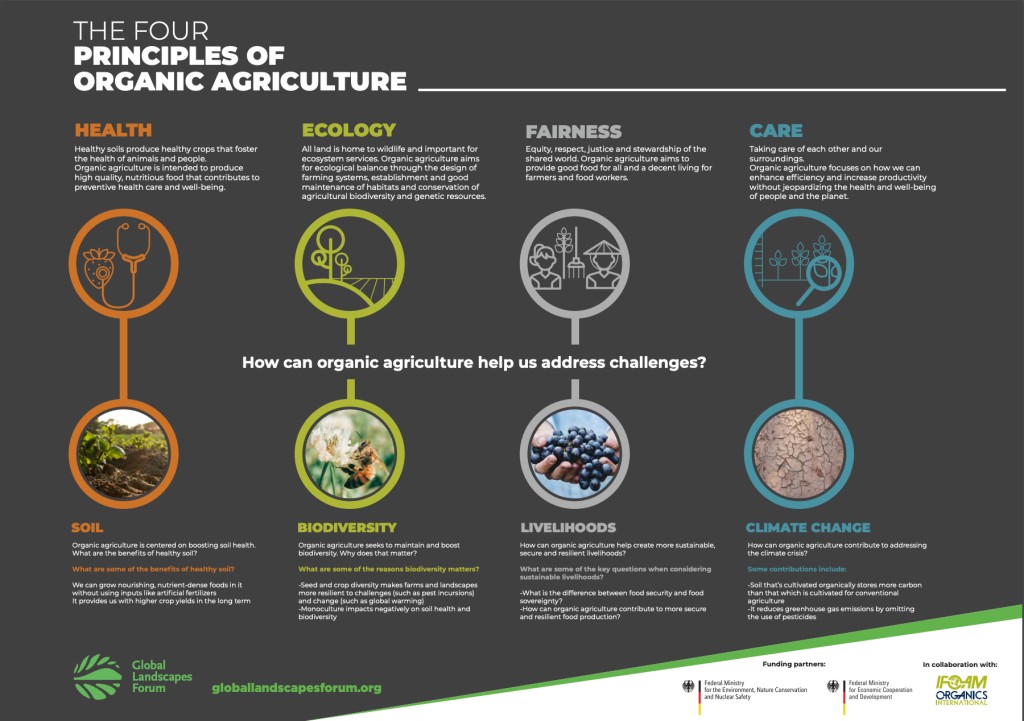
This infographic highlights the four core principles of organic agriculture: health, ecology, fairness, and care. It shows how companies can integrate these principles into their CSR strategies to drive real, sustainable agricultural impact.
Digital Access and Agri-Tech Empowerment
From AI-based crop diagnosis to drone-led soil mapping, the future of agriculture is digital, and CSR can make sure it’s inclusive. While agri-tech is booming in cities, rural India faces a persistent digital divide, with limited access to devices, connectivity, and capacity.
Companies are now stepping in. Cisco’s CSR-funded “Agri Digital Centers” in Andhra Pradesh offer free Wi-Fi zones, crop advisory kiosks, and weather-risk alerts through SMS in regional languages. Over 6,000 farmers have been onboarded in just 18 months, leading to a 22% improvement in pest control efficiency, per their 2023 evaluation.
Earth5R’s tech integration takes a unique turn, combining local knowledge with digital dashboards that track farm waste recycling, rainfall, and yield patterns. In Nashik, Earth5R-trained village youth use tablets to collect real-time compost data, which is then analyzed to fine-tune organic input usage across clusters.
A key enabler is language-friendly UX design. Agri-apps supported by CSR, such as KrishiGuru or Kisan Suvidha, use voice interfaces and visual cues to help even semi-literate farmers navigate digital tools. A study by the Indian School of Business found that such CSR-driven tech adoption increased net farm income by 12–18%.
Digital empowerment, then, is not just about tools, it’s about trust, training, and translation. When CSR enables farmers to decode data into decisions, it helps them shift from being risk-takers to risk managers.
Transparent Impact Measurement in CSR Projects
In the age of ESG and accountability, impact without measurement is impact lost. While traditional CSR relied on anecdotal success stories, today’s credible programs emphasize scientific baselining, third-party audits, and real-time transparency dashboards.
The ITC Group’s CSR work in watershed development uses IoT-based groundwater sensors and satellite data to measure recharge levels, cropping intensity, and water-use efficiency. These metrics are published in annual CSR reports, enabling investors and regulators to assess performance objectively.
Earth5R’s approach includes community-reporting models, where local youth are trained to maintain sustainability logbooks. Their Village Sustainability Scorecard tracks 15 indicators, including soil health, compost quality, and waste-to-resource conversion ratios, ensuring that CSR becomes accountable not just to boards, but to villages themselves.
Impact measurement also enables mid-course correction. Bayer’s CSR collaboration with FPOs in Telangana uses mobile surveys to collect data on pesticide use, helping redesign training modules on the go. The 2022 CSR Box report shows that such adaptive programs are 30% more likely to meet long-term targets.
Ultimately, measurement builds trust and scalability. When a farmer sees their yield charted, or a volunteer sees groundwater levels rise, the impact becomes personal. As Earth5R puts it: “What gets measured, gets multiplied, especially when the community holds the pen.”
Models That Can Be Replicated Nationally
CSR projects often die with their funders. But the truly successful ones are those that embed principles, not just projects, allowing scale without replication fatigue.
The Amul cooperative model, though not CSR-led, offers key lessons. Companies like Nestlé have adapted this into their CSR framework in Gujarat, creating milk producer groups with embedded veterinary, feed, and training services. These have now been replicated across six states with minimal customization.
Earth5R’s circular village model is explicitly designed for replication. With open-source toolkits, training manuals, and digital sustainability dashboards, any village in India can adopt the blueprint. Their pilot in Maharashtra scaled to 15 villages within two years, all led by local youth facilitators, not Earth5R staff.
Government-Corporate convergence further aids replication. The CSR-backed Paramparagat Krishi Vikas Yojana (PKVY) clusters organic farmers and integrates them into state procurement and school meal schemes, ensuring institutional demand sustains the model.
Key to replication is simplicity and modularity. The best CSR models use plug-and-play templates: one for compost, one for agri-training, one for market linkage. This allows even small companies to contribute meaningfully without reinventing the wheel.
As we look to scale sustainability, these models become seeds of national transformation. And the more they grow, the closer we get to an India where farming is not fragile, but future-ready.
CSR: Driving a New Era of Agricultural Transformation
CSR in sustainable farming is no longer a checkbox exercise, it is an engine of systemic transformation. From restoring soil health and empowering women to linking farms with urban markets and digitizing decision-making, companies are reshaping the agricultural economy from the ground up.
What makes this revolution different is its focus on science, scalability, and sustainability. CSR is proving that when businesses engage deeply with rural India, they don’t just grow their brand, they grow food, livelihoods, and climate resilience.
As Earth5R shows, “A village transformed by sustainability doesn’t need charity, it becomes a force for national change.”
Frequently Asked Questions – CSR and Sustainable Farming: 10 Proven Ways Companies Are Creating Real Agricultural Impact
Why should companies invest their CSR funds in agriculture?
Agriculture employs a large portion of India’s workforce but continues to suffer from chronic underinvestment. By directing CSR funds into this sector, companies can boost farm productivity, enhance climate resilience, and contribute to long-term rural prosperity.
What are FPOs and how does CSR support them?
Farmer Producer Organizations (FPOs) help small and marginal farmers aggregate their produce, negotiate better prices, and access larger markets. CSR programs support these groups by funding critical needs such as capacity building, branding, quality certification, and access to digital infrastructure.
How is Earth5R helping rural communities?
Earth5R empowers Indian villages through circular economy practices, by setting up composting units, waste-to-resource systems, and sustainability education programs that enable long-term community-led development.
What is circular economy farming?
Circular economy farming is a system in which agricultural waste is reused productively, as compost, bio-energy, or water filtration material, thereby reducing reliance on synthetic inputs and minimizing environmental degradation.
How can CSR make farming climate-resilient?
CSR-funded programs can make agriculture climate-resilient by supporting techniques such as water harvesting, organic cultivation, mulching, and climate-smart seed varieties. These methods help buffer farmers from unpredictable weather and soil degradation.
Do CSR agri-projects actually increase farmer income?
Yes, data from multiple studies show that CSR-backed agricultural programs often increase farmer incomes by 20 to 40 percent by improving productivity, lowering input costs, and creating better market access.
What is the role of employee volunteering in agriculture?
Corporate volunteers contribute by training farmers, conducting field assessments, designing low-cost innovations, and building digital capacity, turning their professional skills into rural development tools.
Can digital apps really help farmers?
Digital tools provide farmers with real-time weather forecasts, crop diagnostics, price alerts, and market trends, helping them make informed decisions and reducing guesswork in cultivation.
What are Green Corridors?
Green Corridors, a concept by Earth5R, refer to circular supply chains where organic waste from urban centers is converted into compost and sent back to fertilize rural farms, creating a closed and sustainable ecosystem.
How do CSR projects measure impact?
Impact is measured using a mix of tools like scientific baselines, third-party audits, digital dashboards, and community-maintained sustainability scorecards that track metrics such as yield improvement, water recharge, and waste reuse.
How does women’s training in farming help families?
When women receive targeted agricultural training, it leads to increased yields, diversified incomes, and better reinvestment into children’s nutrition, health, and education, driving holistic community development.
What is Earth5R’s Village Sustainability Scorecard?
It’s a locally managed tool that tracks compost use, soil health, water availability, and waste-to-resource metrics, empowering villages to self-monitor their ecological and economic progress.
Can CSR programs be scaled nationally?
Yes, many CSR initiatives are designed with modular toolkits, training templates, and technology integration, making them easy to replicate across districts and states with minimal customization.
What are sustainable supply chains?
These are supply systems that link eco-farms directly to urban markets through fair trade, minimal food miles, waste reduction, and product traceability, ensuring that both producer and consumer benefit.
What crops work best in CSR organic projects?
Millets, pulses, leafy greens, medicinal herbs, and regionally suitable vegetables tend to perform well in CSR-supported organic initiatives due to low input needs and high market demand.
How do CSR and ESG intersect in farming?
CSR programs that invest in soil regeneration, fair pricing, and low-carbon supply chains directly contribute to a company’s Environmental, Social, and Governance (ESG) goals and attract ethical investors.
How long do CSR farm projects usually run?
Sustainable CSR farming projects typically span 3 to 5 years and include an exit strategy that transfers leadership and ownership to the local community, ensuring continuity after funding ends.
Are compost and organic inputs viable alternatives?
Yes. Locally made compost and natural bio-inputs reduce farmers’ dependence on expensive chemical fertilizers, lower their ecological footprint, and build long-term soil fertility.
How can students or professionals get involved?
They can participate through structured CSR internships, rural fellowships, or weekend volunteering programs that apply their academic or corporate skills in the field.
Is sustainable farming the future?
Sustainable farming isn’t just the future, it’s the only way to ensure equitable food systems, climate resilience, and environmental regeneration in India and beyond.
Partnering for Rural and Agricultural Transformation
India’s rural transformation does not depend on miracles but on scalable models, dedicated mentorship, and collective momentum. For corporate leaders, investors, policymakers, and citizens alike, this is an opportunity to support initiatives that build resilience and equity within agricultural communities. By backing proven models such as those developed by Earth5R, volunteering expertise, advocating policies that enable circular practices, and choosing supply chains that empower small farmers, stakeholders can play a crucial role in fostering sustainable development. Ultimately, villages have the potential to become engines of national progress when supported with the right frameworks and collaborations.
– Authored by Sohila Gill