
Introduction: How Drones Are Revolutionizing Modern Agriculture
The agricultural sector has witnessed a technological shift with the adoption of drone technology, allowing farmers to gather real-time insights on their crops. Unlike traditional methods, drones provide precision agriculture solutions that save time and resources. Farmers can now rely on aerial data for crop monitoring, soil health, and irrigation efficiency. This transformation marks a move toward sustainability.
The integration of drones has been accelerated by remote sensing, which allows farmers to detect subtle changes in crops. Advanced tools like multispectral imaging capture plant stress levels unseen to the naked eye. With AI-driven analytics, these images translate into actionable insights. Initiatives such as Earth5R make drone-based data accessible to small farmers, promoting sustainable farming practices.
By leveraging geospatial mapping, drones can track crop growth at different stages. This helps in predicting yield and optimizing fertilizer use. Farmers no longer depend on outdated surveys but instead on real-time field intelligence. Moreover, climate-smart agriculture is now supported with drone-generated data. Crop diseases can be spotted weeks earlier, preventing massive losses.
The affordability of drone services has improved, enabling even smallholders to adopt technology. Governments are funding agricultural innovation to reduce risks and improve food security. Startups are offering subscription models for drone-based monitoring, lowering entry costs. The expansion of rural connectivity further allows seamless integration of data into farm management systems.
Another crucial aspect is sustainability in agriculture, as drones help reduce pesticide overuse by targeting problem areas. They enhance water management through precise irrigation monitoring. Projects like smart farming contribute to reducing carbon footprints. Agricultural drones also support organic farming practices. Farmers benefit from healthier soil and long-term productivity gains.
Finally, drone-based farming is bridging gaps between technology and tradition. Platforms like digital agriculture integrate drone data into holistic systems. Farmers are adapting to data-driven decision-making, supported by IoT-enabled tools. As global food demand rises, drones provide a vital solution. This revolution is shaping resilient, future-ready agriculture.
The Rise of Aerial Imaging in Crop Health Monitoring
The adoption of aerial imaging has changed the way farmers view their fields. Unlike traditional scouting, drones capture high-resolution images that reveal patterns invisible from the ground. Farmers now rely on precision mapping to track plant health and soil variations. Tools like NDVI analysis help identify crop stress early, improving overall yield forecasting.
By combining satellite imagery with drone data, a more detailed agricultural map emerges. This integration allows for multi-layered analysis of soil, irrigation, and crop growth. Farmers can access cloud-based dashboards to interpret imaging results. With the help of AI-powered tools, raw aerial data is converted into insights. Such innovations are shaping the evolution of digital agriculture.
The benefits of imaging extend beyond crop health to pest detection and disease forecasting. For instance, drones can track pest infestations before they spread across entire fields. The ability to monitor soil moisture and nutrient distribution ensures precise fertilizer application. Programs like climate-smart agriculture integrate aerial imaging to mitigate climate risks. This leads to healthier, more resilient crops.
Many startups now offer imaging-as-a-service to farmers who cannot purchase their own drones. Such services include crop scouting and health reporting through mobile apps. Government-backed precision farming schemes are also making imaging tools available at subsidized rates. Farmers in developing nations are benefiting from affordable drone packages. These programs bridge the technology gap across regions.
The integration of imaging also benefits supply chain management by providing transparency from field to market. Retailers can track harvest quality and predict delivery schedules more accurately. Exporters rely on data certification derived from aerial imaging to meet trade standards. By aligning with global food safety, farmers gain access to new markets. Imaging technology, therefore, supports economic growth alongside productivity.
Looking ahead, innovations in hyperspectral imaging promise even deeper crop analysis. This technology can identify nutrient deficiencies at the molecular level. When combined with blockchain traceability, imaging creates a transparent farming system. Partnerships between agritech companies and research institutions will accelerate adoption. Ultimately, aerial imaging will form the backbone of future-ready agriculture.
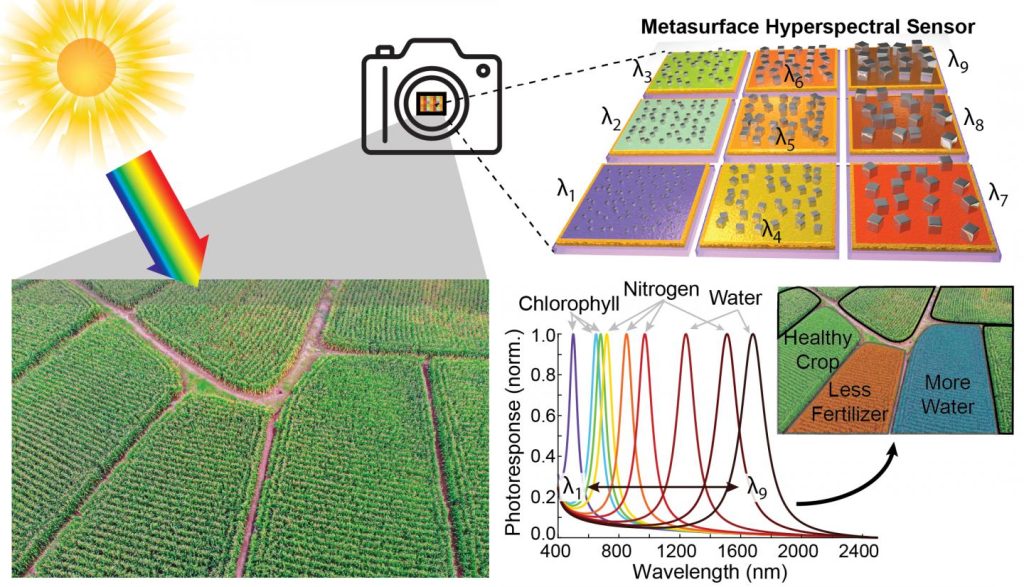
This infographic demonstrates how hyperspectral sensors on drones capture detailed wavelength data to analyze crop health.
By measuring chlorophyll, nitrogen, and water levels, it helps farmers identify areas needing fertilizer, irrigation, or disease control early.
Why Early Disease Detection Matters for Farmers and Food Security
Crop diseases are a leading cause of agricultural losses worldwide, reducing productivity and threatening farmer incomes. Traditional detection often relies on visual inspections, which come too late to prevent spread. With drone-assisted monitoring, farmers can spot infections at early stages. This improves pest management and minimizes chemical overuse. Detecting diseases quickly protects both crops and livelihoods.
The link between early detection and food security is undeniable. Rapid disease spread can affect staple crops like rice and wheat, which billions depend on. Drones using thermal imaging and multispectral analysis can identify subtle changes invisible to farmers. Platforms like Earth5R are bridging the gap by making such technology affordable. This ensures communities have reliable food supplies even under climate stress.
Without early action, diseases like wheat rust or rice blast can devastate harvests. The financial burden forces many farmers into debt cycles and deepens poverty. By implementing precision agriculture, losses are minimized before they spread. Drones provide accurate alerts, guiding timely fungicide applications only where needed. This approach saves money, time, and resources for smallholders.
Early detection also helps in reducing reliance on chemical pesticides. Excess spraying contributes to soil degradation and contaminates water systems. Drone imaging allows targeted interventions that reduce environmental impact. Combined with organic farming practices, this results in healthier ecosystems. It aligns with sustainable development goals, particularly zero hunger and climate action.
For small-scale farmers, disease outbreaks can wipe out an entire year’s income. That’s why support from agriculture cooperatives and government programs is vital in spreading drone adoption. Training modules on digital agriculture ensure farmers understand imaging data. Affordable subscription services provide access without high upfront costs. This democratization of early detection technology is key for long-term resilience.
Ultimately, protecting crops from disease safeguards global food systems. As populations grow, even small losses can escalate into major shortages. By combining AI algorithms with drone imagery, predictions become more accurate. Farmers are empowered to act before disease outbreaks spread. This makes early detection not just a farming tool but a pillar of global food security.
Inside Earth5R’s Tech-Enabled Agriculture Model
Earth5R has built a community-driven model that integrates technology with grassroots farming practices. Their programs focus on empowering farmers through digital tools and capacity building. By using aerial imaging drones, farmers gain insights into crop health and soil quality. Earth5R connects this data with AI analytics, making it actionable. The model emphasizes sustainability and inclusivity in agriculture.
A major strength of Earth5R’s approach is its use of remote sensing and geospatial mapping. Farmers can track field conditions in real time and receive alerts on disease outbreaks. The platform also integrates weather forecasting to help farmers plan better. By linking drones with IoT-enabled devices, Earth5R offers a full-circle solution. This helps bridge the digital divide between urban and rural farming communities.
The model focuses not only on technology but also on farmer education. Training programs guide farmers in interpreting drone-collected data and applying it practically. With support from agriculture cooperatives, knowledge spreads across regions. Earth5R also partners with government schemes to provide subsidies and technical aid. This ensures affordability and encourages adoption.
Another key aspect is Earth5R’s emphasis on sustainable agriculture. By helping farmers reduce pesticide dependency, the model protects soil and water quality. Organic farming practices are promoted through data-backed decisions. Using drones for precision irrigation reduces water wastage. This contributes to climate-smart agriculture, which is vital in the face of climate change.
Earth5R also integrates blockchain technology to track crop production from farm to market. This ensures transparency in supply chains and builds consumer trust. Retailers benefit from quality assurance, and farmers gain premium pricing. Partnerships with agribusinesses enhance reach and impact. This creates a win-win ecosystem where technology supports both producers and consumers.
At its core, Earth5R’s model blends innovation and community to create resilient farming systems. By using data-driven agriculture, farmers gain confidence in decision-making. Collaboration with research institutions ensures continuous improvement. As adoption grows, the model scales to address global food demand. This positions Earth5R as a leader in transforming agriculture for the future.
How Drone Doctors Spot Crop Diseases Before the Human Eye
Drones act as early warning systems by detecting changes in crops invisible to farmers. Equipped with multispectral sensors, they capture variations in plant color and temperature. These subtle shifts indicate stress from disease outbreaks. By combining AI-powered image analysis with drone data, farmers receive accurate alerts. This proactive approach ensures action before visible symptoms appear.
The use of NDVI imaging is a breakthrough in monitoring plant vitality. Healthy crops reflect light differently compared to stressed ones. Drones equipped with infrared cameras can measure these differences precisely. Platforms like Earth5R integrate this data into farmer-friendly dashboards. With real-time monitoring, farmers can act immediately. This minimizes damage and reduces costly interventions.
Drone doctors are particularly useful in spotting fungal infections that spread quickly. For example, powdery mildew can devastate fields if untreated. By using thermal imaging, drones identify unusual heat signatures linked to plant stress. Early treatment prevents widespread damage and boosts yields. Such accuracy was unimaginable with traditional scouting.
Beyond detection, drones provide insights for targeted spraying. Instead of blanket chemical applications, drones guide precision pesticide use. This reduces costs and minimizes environmental pollution. Farmers adopting these methods also align with organic farming standards. Technology ensures healthier crops and safer ecosystems.
The combination of drones and machine learning also improves predictive disease modeling. By analyzing patterns across seasons, drones can forecast outbreaks before they occur. Linking this with climate data creates a comprehensive risk map. Geospatial platforms make this information accessible to farmers at scale. As a result, agricultural resilience is strengthened across communities.
Ultimately, drone doctors give farmers a competitive advantage in food production. By acting faster than human observation, they reduce losses and increase profitability. With support from government programs and private agritech firms, adoption is accelerating. These tools are no longer futuristic concepts but practical solutions for everyday farming. The eye in the sky has become a trusted farming partner.
Data-Driven Farming: Integrating AI, IoT, and Remote Sensing
Modern farming thrives on data-driven decision-making. By combining AI algorithms with drone imaging, farmers can predict crop health and yield more accurately. IoT-enabled sensors track soil moisture, temperature, and nutrient levels in real time. When integrated with remote sensing tools, these insights create a holistic view of farm conditions. Platforms like Earth5R make this technology accessible for sustainable agriculture.
Artificial intelligence translates massive datasets into actionable insights. With predictive analytics, farmers can forecast disease outbreaks or pest attacks. Machine learning improves over time, making recommendations more precise. This reduces reliance on guesswork and enhances precision agriculture. By linking with geospatial mapping, farmers receive location-specific advice. This digital ecosystem ensures efficient resource use.
IoT applications extend beyond monitoring to automated irrigation systems. Sensors can activate watering only when soil moisture falls below a threshold. This prevents water wastage and improves climate-smart farming. Integration with weather forecasting further enhances planning. Farmers gain tools to adapt quickly to climate variability. Drones play a key role in supplying the data needed for these systems.
Remote sensing adds another layer of intelligence by capturing large-scale patterns. Satellite data combined with drones provides unparalleled accuracy. This hybrid approach benefits large-scale farms as well as smallholders. Remote sensing can track soil fertility, crop stress, and even pest migration. Farmers are empowered with insights that were once available only to research institutions.
The value of data-driven farming also lies in supply chain optimization. Retailers and buyers can plan logistics based on accurate yield predictions. Blockchain integration ensures transparent transactions, benefiting both farmers and consumers. By using open-source platforms, data sharing among cooperatives becomes seamless. This strengthens resilience across farming networks.
Ultimately, the integration of AI, IoT, and remote sensing represents the future of agriculture. Farmers can manage risks more effectively while conserving natural resources. With support from global research networks, these technologies will continue evolving. By making decisions backed by evidence rather than intuition, farming becomes more profitable and sustainable. The digital revolution is ensuring agriculture feeds the world efficiently.
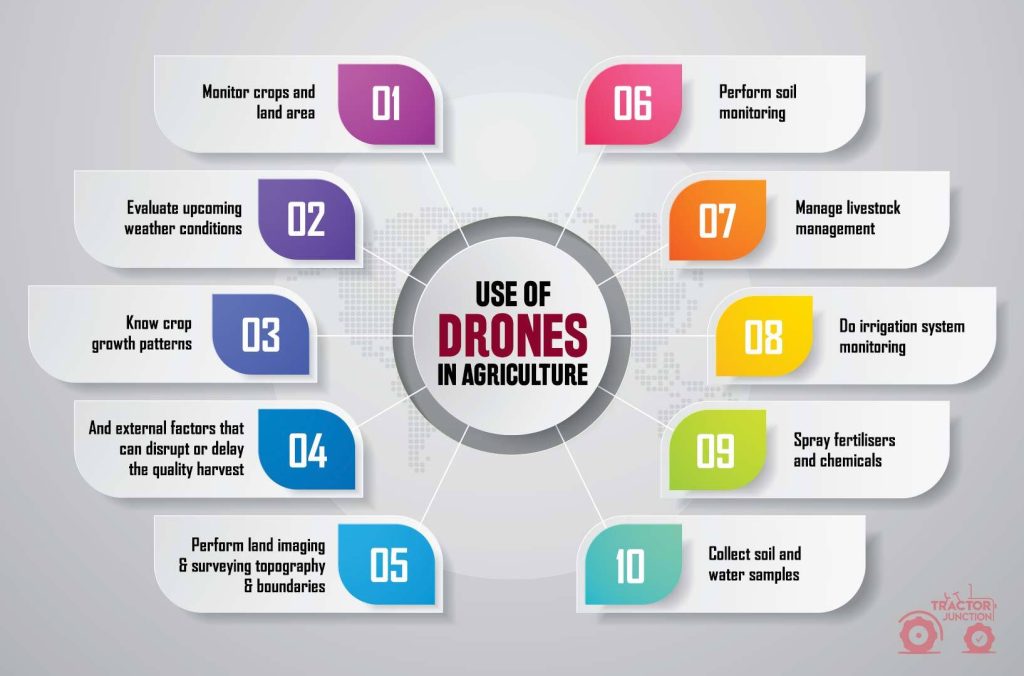
This infographic highlights the multiple uses of drones in agriculture, from crop monitoring and soil analysis to irrigation and livestock management.
It shows how drones improve efficiency, reduce costs, and support smarter, data-driven farming practices.
Benefits for Farmers: Reduced Losses, Higher Yields, and Lower Costs
One of the biggest advantages of drone technology is its ability to reduce crop losses. By spotting diseases early, farmers can act before damage spreads. This minimizes the need for emergency interventions that are often costly and ineffective. Tools like NDVI imaging ensure every part of the field receives attention. With Earth5R’s initiatives, small farmers can access these benefits affordably.
Improved monitoring leads to higher yields. Precision tools guide fertilizer application, ensuring crops receive the right nutrients at the right time. Drones also help optimize irrigation practices, preventing water stress. By combining geospatial mapping with AI, farmers can predict harvest outcomes more accurately. These gains translate into improved food availability and farmer incomes.
Cost savings are another crucial benefit. Targeted spraying reduces chemical use, lowering expenses significantly. Farmers avoid unnecessary treatments, cutting down on pesticide reliance. With real-time monitoring, problems are detected before they escalate. This proactive approach eliminates wasteful spending. The combination of IoT devices and drones makes farming more efficient.
Drone data also improves financial planning for farmers. With accurate predictions, they can secure crop insurance or loans with confidence. Lenders and insurers value verifiable data collected through drone imaging. This reduces risks for both farmers and financial institutions. In turn, farmers gain better access to credit and investment opportunities. Such empowerment drives rural economic growth.
Healthier crops also mean access to premium markets where quality standards are strict. Exporters demand traceability, which drones help provide through accurate documentation. Meeting global food safety standards allows farmers to expand into international trade. This raises incomes while strengthening food supply chains. The technology thus links farm-level improvements to global economic opportunities.
Ultimately, the combination of reduced losses, increased yields, and lower costs creates a cycle of prosperity. With support from sustainable farming programs, these benefits reach even the most marginalized communities. Farmers who adopt drone-based solutions see long-term improvements in productivity. By aligning with climate-smart practices, they also protect natural resources. The result is a win-win for farmers, consumers, and the planet.
Real-World Applications and Success Stories from Earth5R Projects
Earth5R has implemented tech-enabled farming solutions across diverse regions, showcasing measurable impact. In villages adopting precision agriculture, drone imaging reduced crop losses by identifying early disease signs. Farmers reported savings on pesticide use and improved soil health. By linking drone data with AI-driven analytics, Earth5R empowered communities to make informed choices. These success stories highlight the practical benefits of sustainable innovation.
One project in India focused on climate-smart agriculture in drought-prone regions. Drones mapped soil moisture levels, helping farmers optimize irrigation. Local cooperatives adopted IoT-based sensors to track water usage, cutting waste significantly. By combining these tools with remote sensing, farmers achieved higher yields despite scarce resources. This project demonstrated resilience in the face of water scarcity.
In another initiative, Earth5R supported farmers in managing pest infestations. Drones detected hotspots early, allowing for targeted spraying. As a result, farmers reduced crop losses and expenses simultaneously. The project aligned with sustainable farming practices by lowering chemical dependency. Organic farming communities particularly benefited, as drones ensured crops met certification standards. The initiative set a benchmark for eco-friendly innovation.
Beyond crop health, Earth5R’s drone programs improved financial resilience. With reliable yield predictions, farmers accessed crop insurance more easily. Insurers trusted the verifiable data provided by drones, leading to faster claim settlements. Improved credit access allowed farmers to reinvest in better inputs. This success story highlights how technology extends beyond the farm into broader rural development.
Another milestone was achieved in building farmer education programs. Earth5R conducted workshops where farmers learned to interpret drone imagery. Partnerships with local cooperatives ensured widespread knowledge transfer. Governments supported these initiatives by aligning them with agriculture schemes. This community-driven approach ensured that even smallholders benefitted equally. The success demonstrates the scalability of Earth5R’s model.
Ultimately, these projects illustrate the real-world power of integrating drones, AI, and IoT into farming. Farmers gained higher profits, healthier soils, and access to premium markets. Communities improved resilience to climate risks, ensuring food security. By showcasing measurable success, Earth5R proves that sustainable agriculture is achievable. These stories inspire broader adoption of drone-enabled farming worldwide.
Overcoming Challenges: Affordability, Training, and Rural Accessibility
While drones bring immense potential, affordability remains a major hurdle for small-scale farmers. High equipment costs often prevent widespread adoption. To address this, startups offer subscription models that provide drone services without heavy investments. Government subsidies are also helping lower barriers. With Earth5R’s initiatives, shared drone services make technology more accessible across rural regions.
Another obstacle is the need for farmer training. Advanced tools like NDVI imaging and remote sensing require interpretation skills. Without proper knowledge, farmers may struggle to apply data effectively. To bridge this gap, digital literacy programs are being introduced. Agriculture cooperatives play a key role in training farmers at the community level. Education ensures long-term success of drone integration.
Rural connectivity poses another challenge, especially in regions lacking internet infrastructure. Drone data often requires cloud-based platforms for analysis, making connectivity essential. Partnerships with telecom providers are improving access. Offline-friendly solutions and mobile applications are also emerging. This hybrid model ensures farmers in remote areas still benefit from drone technology.
The perception of drones can also be a barrier. Many farmers view them as tools for large corporations rather than smallholders. Through community engagement, organizations like Earth5R are changing this narrative. Demonstrating real-world success stories helps build trust. Farmers see drones not as luxury gadgets but as essential tools. This shift in mindset encourages widespread adoption.
Maintenance and technical support are equally important. Farmers need access to repair services and replacement parts to keep drones functional. Without local support, downtime can affect productivity. Public-private partnerships are filling this gap by establishing service centers in rural areas. Collaborative approaches ensure that drone use is sustainable, not temporary. This creates a lasting impact for farming communities.
Ultimately, overcoming these challenges requires a mix of policy support and grassroots innovation. By making drones affordable, accessible, and easy to use, barriers can be eliminated. With training programs and connectivity improvements, farmers are better equipped for the digital age. The collective efforts of governments, NGOs, and startups ensure drones become a mainstream agricultural tool.
The Future of Agriculture: Scaling Drone Technology for Global Food Systems
As global food demand rises, scaling drone technology becomes essential for sustainable farming. With populations expected to reach nearly 10 billion by 2050, agriculture must embrace innovation. Drone imaging offers scalable solutions for both smallholders and large farms. Supported by AI-driven platforms, farmers worldwide can access predictive insights. Organizations like Earth5R are leading efforts to expand adoption globally.
The future will also depend on integration with smart farming ecosystems. Combining drones with IoT sensors and satellite data creates powerful agricultural networks. This data convergence supports climate-smart agriculture, enabling farmers to adapt to changing weather. With cloud-based platforms, insights can be shared across borders. Scaling these systems will redefine global food production.
International collaboration will play a central role. Partnerships between research institutions, governments, and agribusinesses are already driving innovation. Shared resources reduce costs and accelerate adoption. Blockchain integration further strengthens transparency in supply chains. By connecting local farmers to global markets, drones will support equitable economic growth.
The environmental benefits of scaling drone use are equally significant. Targeted pesticide use reduces pollution, while precision irrigation conserves water. Sustainable agriculture practices are easier to implement when backed by drone data. These advancements contribute directly to achieving UN Sustainable Development Goals. Large-scale adoption can therefore tackle both hunger and climate change.
Challenges remain in terms of affordability and rural accessibility. However, shared service models and training programs are expanding access. Continued investment in digital infrastructure will ensure remote areas are not left behind. With inclusive policies, scaling drone technology becomes realistic for all. The focus will be on creating solutions tailored to diverse farming needs.
Ultimately, the future of agriculture lies in data-driven farming powered by drones and advanced analytics. Farmers will move from reactive practices to proactive, evidence-based strategies. With support from global networks and local cooperatives, adoption will accelerate. Drone technology will not just boost productivity but secure global food systems. The future promises smarter, more resilient, and more sustainable farming worldwide.
Conclusion: Drones Paving the Way for Smarter Agriculture
The rise of drone technology in agriculture marks a turning point for global food systems. By enabling early detection of crop stress and disease, farmers are better prepared to act before losses occur. Organizations like Earth5R are ensuring these tools reach even smallholders. This shift is making farming more proactive, precise, and sustainable.
Beyond boosting productivity, drones support climate-smart agriculture. Precision irrigation and targeted spraying reduce resource waste while protecting the environment. These practices align with the UN Sustainable Development Goals, connecting local farming with global priorities. Such innovations ensure that progress benefits both people and the planet.
At the same time, challenges around affordability and training still remain. Collaborative models such as shared drone services and rural farmer education programs are helping to close these gaps. By addressing accessibility issues, technology becomes inclusive. This ensures farmers of all scales can thrive in the digital age.
Looking ahead, drones will form a critical piece of data-driven farming. Combined with AI, IoT, and satellite insights, they can transform agriculture globally. Farmers will move from reactive responses to predictive strategies, securing food supply chains. With continued innovation, drone-powered agriculture promises resilience, equity, and long-term sustainability.
Frequently Asked Questions: Drone Doctors for Crops: Aerial Imaging that Spots Disease Before Farmers Do with Earth5R’s Tech-Enabled Agriculture Model
What role do drones play in modern agriculture?
Drones provide aerial imaging, crop health monitoring, and early detection of diseases, helping farmers manage fields more efficiently.
How do drones detect crop diseases before farmers notice them?
Drones use advanced sensors like NDVI cameras and thermal imaging to identify stress or infection in plants before visible symptoms appear.
What is Earth5R’s tech-enabled agriculture model?
Earth5R combines drones, AI, IoT, and community-driven training to make precision agriculture accessible and sustainable for farmers.
Are drones affordable for small-scale farmers?
While drones can be costly, shared service models, subsidies, and community cooperatives help small farmers access the technology.
How do drones help in reducing farming costs?
They allow targeted spraying and irrigation, reducing excess use of water, pesticides, and fertilizers, which cuts overall expenses.
Can drones improve crop yields?
Yes, drones enable early intervention, optimize resource use, and improve soil and water management, all of which increase yields.
What kind of data do drones collect in agriculture?
They gather data on crop health, soil moisture, plant density, pest infestations, and field mapping for better farm decisions.
Do drones replace traditional farming methods?
No, drones complement traditional farming by making processes smarter and more efficient rather than replacing them entirely.
How do drones contribute to sustainable farming?
By minimizing chemical use, conserving water, and improving soil health, drones align with eco-friendly agricultural practices.
Can drones work in rural areas with limited internet access?
Yes, some drones can function offline, while hybrid data solutions allow farmers in remote areas to benefit from drone imaging.
How does drone technology support climate-smart agriculture?
Drones monitor water stress, predict crop performance, and guide resource efficiency, making farms more resilient to climate change.
What training is required to use agricultural drones?
Farmers need basic training in drone operation, data interpretation, and digital literacy, often provided through workshops or cooperatives.
Are drone images reliable for crop insurance claims?
Yes, verified drone data provides accurate evidence of crop health, which insurers increasingly accept for faster and fairer settlements.
How do drones integrate with other technologies?
They work alongside IoT devices, AI analytics, and satellite data, forming a complete precision agriculture ecosystem.
What crops benefit most from drone monitoring?
Drones are versatile and can monitor grains, fruits, vegetables, and cash crops, with particular value in large fields.
Do drones help reduce pesticide pollution?
Yes, targeted spraying ensures chemicals are applied only where needed, reducing runoff and environmental contamination.
Can drones help farmers access premium markets?
By ensuring better crop quality and traceability, drones help farmers meet export standards and sell to premium buyers.
How does Earth5R ensure accessibility of drone services?
Earth5R promotes shared models, farmer cooperatives, and localized training so even smallholders benefit from the technology.
What are the biggest challenges in adopting drones for farming?
High initial costs, limited training, poor connectivity, and maintenance are the main barriers to adoption.
What is the future of drones in agriculture?
Drones will scale globally as part of data-driven farming systems, boosting productivity while supporting food security and sustainability.
Call to Action: Embracing the Future of Farming
The future of agriculture depends on how quickly we adopt innovative tools like drones. Farmers, communities, and policymakers must come together to integrate technology into everyday farming. This collective approach ensures that progress is shared across all regions. The time to act is now, before challenges become harder to overcome.
Investing in drone technology means investing in food security. By supporting local farmers with resources and access, we create stronger and more resilient food systems. Communities must rally around sustainable practices that protect the environment. With commitment, agriculture can become both profitable and eco-friendly.
Education and awareness are critical for successful adoption. Training programs should reach every farmer, empowering them with the knowledge to use drones effectively. Knowledge-sharing platforms can spread best practices across borders. When farmers are equipped with skills, the benefits multiply rapidly.
Governments, organizations, and citizens all have a role to play. By encouraging collaboration, we can scale drone-based farming on a global level. Each small action contributes to a larger movement for sustainable food systems. Together, we can create a smarter, healthier, and more resilient future for all.
~Authored By Omshree Konda