
EarthJournal Research Brief · E-Waste Collection Programs & Urban Mining
E-Waste Collection: India’s Bottleneck Isn’t Recycling
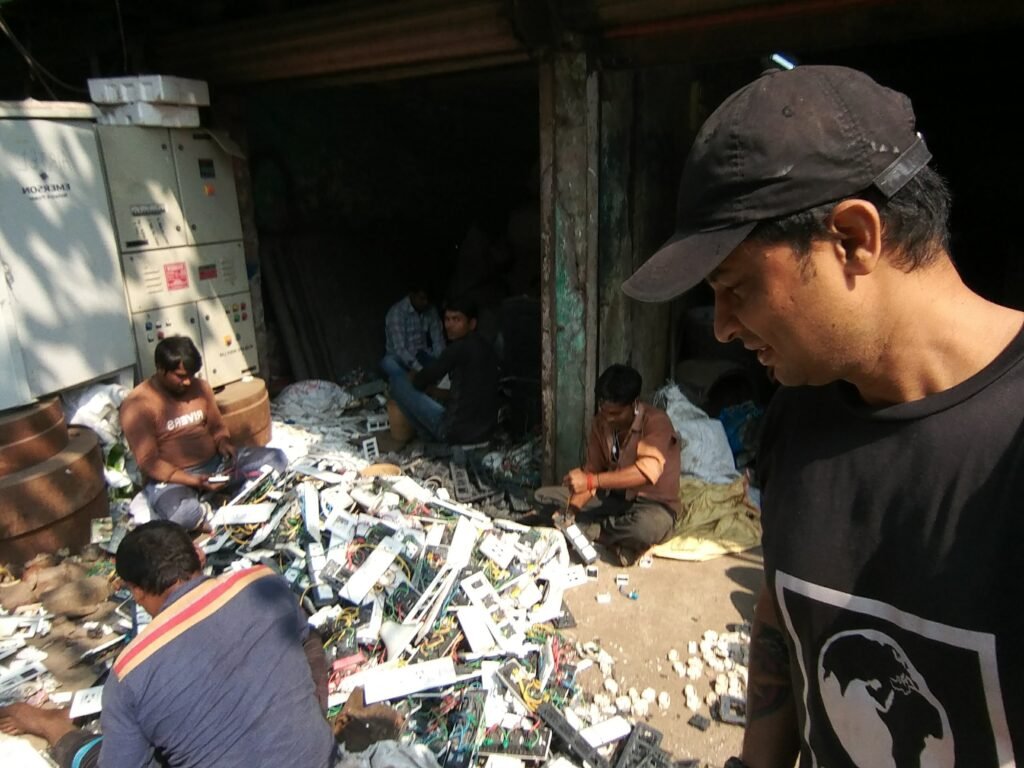
India has built more formal e-waste processing capacity than it generates waste. Those plants still run underfed — because the contest is decided at the doorstep, weeks before any recycler sees the material.
India’s E-Waste Numbers, and What They Hide
India’s official e-waste figures describe a system that is improving quickly on paper. Generation is rising, formal processing is rising faster, and the regulatory architecture has expanded to cover a wide product range. Read alone, the numbers suggest a problem being brought under control. Read against what happens at the point of disposal, they describe something more complicated — a formal system that is growing while the material it needs continues to flow somewhere else.
CPCB data placed India’s e-waste generation at 13.97 lakh tonnes in FY2024–25, up from 12.54 lakh tonnes the previous year, with the figures presented to Parliament covering discarded phones, computers and batteries of every kind. The longer trend is steeper still: generation nearly doubled from 7.08 lakh tonnes in 2017–18, while recorded collection and processing rose from 22,700 tonnes in 2016–17 to 9,88,479 tonnes in 2024–25 — a more than forty-fold increase in eight years.
The framework driving this is the E-Waste (Management) Rules, 2022, effective 1 April 2023, which regulate 106 categories of electrical and electronic equipment and place Extended Producer Responsibility obligations on producers, brand owners and importers. India is now the third-largest e-waste generator globally after China and the United States.
The complication sits underneath the improvement. Government estimates cited in reporting on the current litigation put the informal share of the sector at at least 80%, with roughly 43% of e-waste recycled formally in the reference year. Independent assessments place the informal share higher still. Either way, the gap between what is generated and what reaches an authorised facility remains the defining feature of the system.

The Capacity Paradox: Plants Without Feedstock
Here is the fact that reframes the entire problem. India does not have a shortage of formal recycling capacity. It has a surplus of it, sitting idle, while the material that should feed it moves through channels that leave no record. This inverts the intuitive diagnosis — that the country needs more recyclers — and points the intervention somewhere else entirely.
Sector analysis puts 595 authorised recyclers across 22 states with a combined nameplate capacity of 1.8 million tonnes, against annual generation of a comparable order. Authorised capacity expanded from 1.1 million tonnes in 2021 as capital flowed into new plants. The same analysis identifies the binding constraint plainly: informal operators still outbid formal plants for small-volume lots, which is why large producers are signing exclusive take-back contracts specifically to guarantee feedstock supply to licensed facilities.
Sources: CPCB data presented to Parliament (generation and processing, FY2024–25); sector analysis of authorised recycler capacity. Capacity and generation figures are compiled on different bases and are indicative of relative scale rather than directly comparable line items.
A recycling plant cannot process material it never receives. India’s formal sector is not capacity-constrained — it is feedstock-constrained. Which means the decisive intervention happens at the household and the office, not at the plant gate.
Doorstep Economics: Why E-Waste Collection Programs Lose to the Kabadiwala
To understand why the material goes where it goes, follow the decision made by the person actually holding a dead laptop. That decision is economic, immediate and almost entirely uninfluenced by regulation. Any corporate programme that does not change the conditions of that specific moment will underperform regardless of how much is spent downstream.
- The informal collector comes to the door and pays cash. A kabadiwala offers immediate collection at the household’s convenience with money changing hands on the spot. A formal drop-off point requires the household to transport the item themselves at their own cost in time. Convenience and cash beat compliance messaging every time, and no awareness campaign alone reverses that.
- Informal operators can pay more because they carry fewer costs. Without environmental controls, worker protection, effluent treatment or tax compliance, the cost base is lower, so the price offered at the door can be higher than a formal recycler can match while still meeting its obligations. This is a structural advantage, not a pricing anomaly.
- Most Indian e-waste comes from institutions, not homes. Government bodies and public and private sector companies generate roughly three-quarters of India’s e-waste, with households contributing a much smaller share. That concentration is good news for programme design: institutional disposal is a procurement decision, which can be governed by policy in a way that a household decision cannot.
- The channel leaves no record either way. Whether material moves through a scrap dealer or an unregistered aggregator, the transaction produces no documentation. That absence is what makes the national picture uncertain and what makes an EPR claim resting on it impossible to verify.
- Storage is the default, and it is not a neutral outcome. Households that do not know what to do with a device simply keep it, sometimes for years. Material sitting in cupboards is material not recovered, and it distorts generation estimates by deferring the disposal event.
The Floor Price Fight, and What It Does Not Solve
The most visible policy battle in Indian e-waste right now concerns how much producers must pay recyclers. It is a consequential dispute with real money attached, and it is worth understanding precisely — but it is a dispute about the price of processing, not about whether material arrives to be processed. Reading it as the sector’s central problem mistakes a margin question for a supply question.
Amendments made in March 2024 established floor and ceiling prices for EPR certificates and linked them to environmental compensation, with a minimum payment of ₹22 per kilogram for consumer electronics. Certificates trade on a CPCB platform, are denominated in kilograms and priced by category. From late 2024 onward, major producers including Daikin, Samsung, LG, Havells and Voltas challenged these amendments in the Delhi High Court, arguing the government lacks power under the Environment Protection Act to fix commercial terms between private parties. Carrier’s Indian unit later joined. Producers say the floor raises their costs several-fold; the Environment Ministry has defended it as necessary to prevent a race to the bottom that would leave formal recycling financially unviable. The matter remains before the court.
The most telling line in the litigation came from one of the petitioners rather than the government. LG’s filing argued that if authorities have not managed to regulate the informal sector, that is an enforcement failure — and on the diagnosis, if not the remedy, it is difficult to disagree. Whatever the court decides about ₹22 per kilogram, the price only applies to material that reached a registered recycler in the first place.
- A higher certificate price does not create feedstock. It improves recycler margins on tonnage they already receive, which may support investment over time, but it does not change the household or office decision that determines whether material enters the formal chain at all.
- Compliance cost rises either way for obligated producers. Whether the floor survives or falls, EPR targets remain, generation keeps growing, and the cost of meeting obligations through purchased certificates alone is exposed to a price the producer does not control.
- Owning the collection channel is the hedge. A producer running its own take-back and collection programme converts a variable procurement cost into a managed operation, and generates a documented chain of custody as a by-product. That is why exclusive take-back contracts are spreading.
- Verification risk sits on the producer, not the recycler. If claimed recycling cannot be substantiated, the obligated entity carries the consequence. Certificates purchased without visibility into the underlying physical activity are a governance exposure as well as a cost.
What an E-Waste Collection Program Must Actually Do
If the constraint is at the doorstep, the design brief follows directly. A programme has to change the conditions of the household or office disposal decision, then carry the material through a documented chain to a certified processor. Each of the following addresses a specific reason material currently leaks out of the formal system, and a proposal missing any of them will underdeliver in a predictable way.
- Remove the friction rather than argue with it. Collection points inside the building, scheduled pickup windows and doorstep collection compete on the same dimension the informal channel wins on. A programme that requires a resident to travel is competing on the wrong axis.
- Target institutions first for volume, households for reach. Offices, campuses and government departments dispose in bulk at predictable intervals, so a single policy change moves tonnes. Residential programmes matter for the categories institutions do not generate, and for the behaviour change that sustains the channel.
- Contract certified recyclers before collection starts. Named authorised recyclers with agreed commercial terms, transfer documentation and downstream processing confirmation. Collection without a certified destination reproduces exactly the problem the programme exists to solve.
- Record custody at every handover. Weight, category, location and time captured at collection, then reconciled against recycler intake. This is the evidence an EPR claim rests on, and it is far cheaper to build in than to reconstruct later.
- Handle data security explicitly. Devices carry personal and corporate data, and fear of exposure is a genuine reason people retain hardware rather than release it. Documented data sanitisation removes an obstacle that no amount of environmental messaging addresses.
- Sustain the channel rather than running a campaign. Disposal events are irregular and unpredictable at the individual level. A collection route that exists only during an awareness week captures a fraction of what a permanent channel captures across a year.
Inside a Four-City E-Waste Collection Program
Earth5R designed and executed a collection and awareness programme with an electronics manufacturer across Mumbai, Pune, Delhi and Bangalore, built on precisely that logic. Rather than campaigning for better disposal behaviour in the abstract, it placed a functioning channel inside the buildings where the material sits, and connected that channel to certified processors.
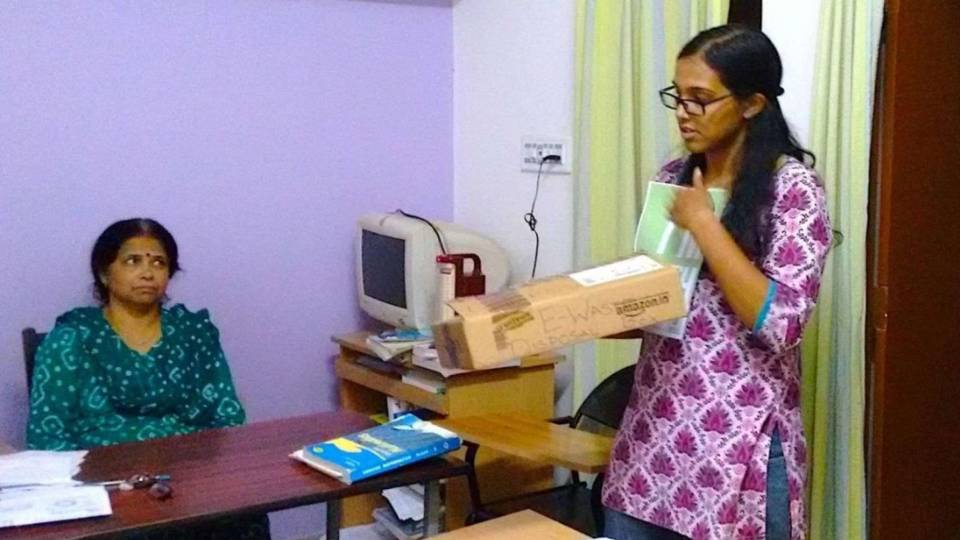
The programme ran awareness and training sessions across 200 residential buildings in the four cities, covering why segregation matters and what improper disposal releases into soil and water. Collection boxes were installed in each building for phones, laptops, batteries and other devices, so that disposal required no travel. Cleanup drives along lakes and riverbanks recovered electronic waste already dumped in the environment. All collected material was routed to certified e-waste vendors who recovered valuable metals and safely handled hazardous components.
| Measure | Four-city building programme | Bangalore public drive |
|---|---|---|
| Geography | Mumbai, Pune, Delhi, Bangalore | Bangalore |
| Duration | 1 year | 2 years |
| Channel | Collection boxes in 200 residential buildings | Twice-monthly drives, colleges and public spaces |
| Volunteers | Corporate and community | 150 college volunteers |
| E-waste recovered | 25 t | 72 t |
| Volunteer hours | — | 28,800 |
| Citizens trained | 200 buildings | 10,000+ |
| CO₂e avoided (project estimate) | 72 t | 103.68 t |
Carbon values are project estimates. The two programmes applied different conversion factors — 2.88 and 1.44 tonnes CO₂e per tonne of e-waste respectively — reflecting different assumptions about material composition and displaced virgin production. Neither is an accredited third-party verified emission reduction, which requires separate certification.
Three features of this design are worth isolating, because they are what distinguish a collection programme from an awareness campaign that happens to gather some material.
- The channel was placed where the material already sits. A box in the lobby of a building the resident already lives in removes the transport barrier entirely, which is the single largest reason household e-waste defaults to the informal collector or to indefinite storage.
- Certified downstream processing was contracted, not assumed. Working with authorised vendors meant recovered metals re-entered the circular economy through a documented route and hazardous components were handled under controlled conditions — the part of the chain where informal processing does the most damage.
- Environmental recovery ran alongside household collection. Drives along lakes and riverbanks addressed electronic waste that had already leaked, which is a different problem from preventing future leakage and requires a different operational approach.
The Bangalore Blueprint: 72 Tonnes Over Two Years
The Bangalore programme took the opposite approach on channel design and is instructive for exactly that reason. Instead of fixed collection points inside buildings, it used a mobile, high-frequency model built on student volunteers — and recovered nearly three times the tonnage of the four-city programme over twice the duration.
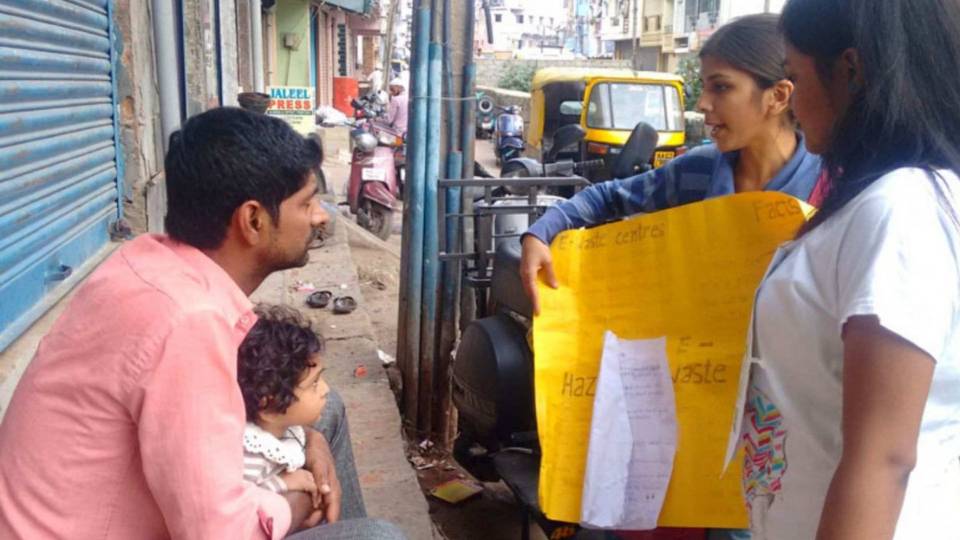
Over 150 volunteers from colleges across the city ran campaigns twice a month for two years in parks, colleges, residential areas and shopping malls, educating citizens on the risks of improper disposal. Collection boxes were placed in colleges, offices and residential complexes. Earth5R partnered with local NGOs and e-waste management companies so that everything collected was processed correctly. Recorded outcomes were 72 tonnes of e-waste recovered, 28,800 volunteer hours contributed, over 10,000 citizens trained, and an estimated ₹14.4 lakh in recovered material value at an assumed ₹20 per kilogram.
- Frequency compounds in a way that campaign intensity does not. Twice-monthly presence over 24 months means 48 collection opportunities. Disposal decisions happen on their own schedule, so the probability that a channel exists when a household is ready to act is what determines capture rate.
- Student volunteers solve the cost problem that limits doorstep models. Door-to-door collection is expensive at commercial labour rates. A structured college volunteer programme supplies the capacity while delivering measurable social value in its own right — 28,800 hours of environmental engagement among young people.
- Public-space collection reaches beyond the residential channel. Parks, malls and campuses capture material from people who would never attend a building-level session, which widens the catchment considerably.
- NGO and recycler partnerships close the loop locally. Rather than building processing capacity, the programme connected an existing certified network to a collection layer that did not previously exist — which is the faster and more capital-efficient route to a working circular economy loop.
Recovery Economics: Urban Mining and Compliance Value
The financial case for a corporate collection programme rests on three streams that are usually assessed separately and therefore each look marginal. Counted together, and set against the cost of compliance by certificate purchase alone, the position changes materially. This is the calculation that determines whether a programme is renewed after its first year.
The first stream is recovered material value. The circular economy value in e-waste is real: it contains copper, gold, silver and aluminium, and Earth5R’s field programmes have recorded realisable value averaging around ₹20 per kilogram across mixed collected streams, with printed circuit boards well above that. The second is compliance value: certificates trade in a range that has recently run from roughly ₹10 to ₹50 per kilogram by category, against a ₹22 floor currently under challenge. The third is avoided environmental compensation for shortfall against EPR targets.
| Value stream | Basis | Reference range | Requirement |
|---|---|---|---|
| Recovered material value | Copper, aluminium, gold, silver content | ~₹20 / kg mixed | Certified recycler with recovery reporting |
| EPR certificate value | CPCB platform, category dependent | ₹10–50 / kg | Registered recycler issuance |
| Avoided certificate purchase | Self-collected tonnage against target | ₹22 / kg floor | Documented chain of custody |
| Avoided environmental compensation | Shortfall against EPR obligation | Linked to certificate price | Reconciled annual return |
| Carbon abatement | Displaced virgin material production | ~1.44–2.88 t CO₂e / t | Accredited third-party verification |
| CSR obligation discharge | Schedule VII environmental sustainability | 2% of net profit | CSR-1 registered implementing agency |
Certificate prices reflect reported market ranges during 2024–25 and are subject to the outcome of the Delhi High Court proceedings. Carbon factors vary with material composition and should be standardised before use in any external claim.
There is a strategic dimension beyond the arithmetic. E-waste is increasingly framed as a domestic source of critical minerals rather than as a disposal problem, with printed circuit boards, hard drives and consumer electronics holding recoverable quantities of copper and rare earth elements. A company that controls a collection channel is positioned in that supply question; one that buys certificates on a portal is not.
The Formalisation Question the Numbers Leave Out
Any honest analysis of Indian e-waste has to address what happens in the informal sector, because that is where most material currently goes and because the people working there are the ones absorbing the consequences. This is not a peripheral ethical footnote to the economics — it is directly relevant to programme design, since a collection model that ignores existing operators tends to fail.
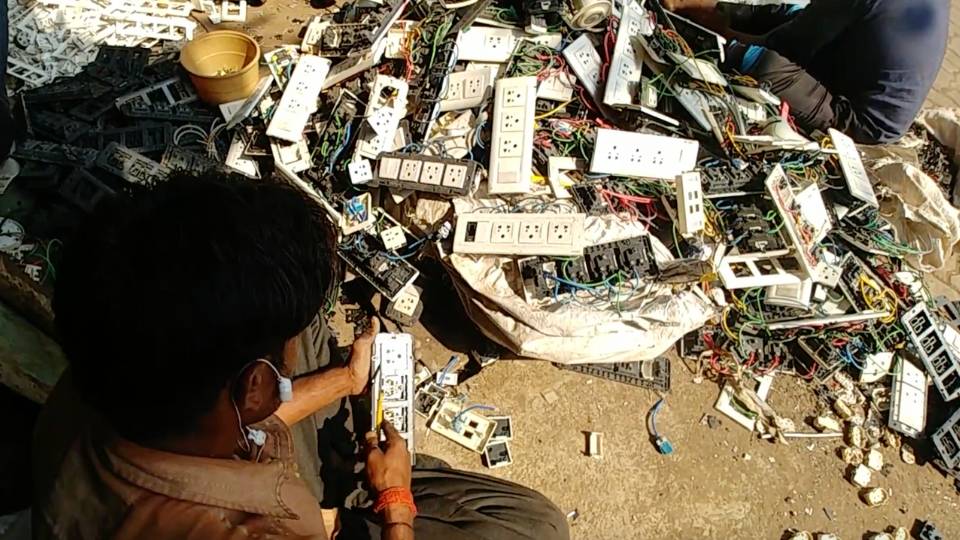
Field research documents the picture clearly. More than 50,000 informal workers in Seelampur in Delhi are involved in collection, dismantling, segregation and metal extraction through acid washing and open burning. A cross-sectional study of 220 workers across three Delhi sites found that 24% knew what e-waste meant and 36% could identify the chemicals released by handling it. Recovery rates from crude methods are low, with assessments placing precious metal recovery well below what controlled processing achieves — so the same material yields less value and more contamination.
The design conclusion is not that informal operators should be displaced. It is that they hold the collection network the formal sector lacks, and that the two are complementary rather than opposed.
- Informal collectors are the most effective aggregation layer in the country. They know the buildings, the offices and the disposal patterns. A programme that routes their collected material to certified processing captures existing reach instead of building it from zero.
- Fair rates plus safe processing beats either alone. Paying competitive collection rates while moving the extraction step into a controlled facility raises worker income, raises recovery yield and removes the acid and burning exposure simultaneously.
- Formalisation without livelihood protection creates resistance. A model that threatens income will be resisted by people who have no alternative. Programmes that offer registration, training and reliable payment convert opponents into channel partners.
- Recovery yield is the commercial argument for the ethical position. Controlled processing extracts materially more value per tonne than crude methods, which means the same collected material funds better conditions. The interests align once the extraction step moves.
Community as E-Waste Collection Infrastructure
Community engagement in this sector is routinely categorised as awareness work — useful for optics, peripheral to tonnage. In e-waste specifically that classification is wrong, because unlike most waste streams, e-waste disposal is a deliberate, infrequent decision that people actively deliberate over. Information genuinely changes the outcome here in a way it does not for a discarded wrapper.

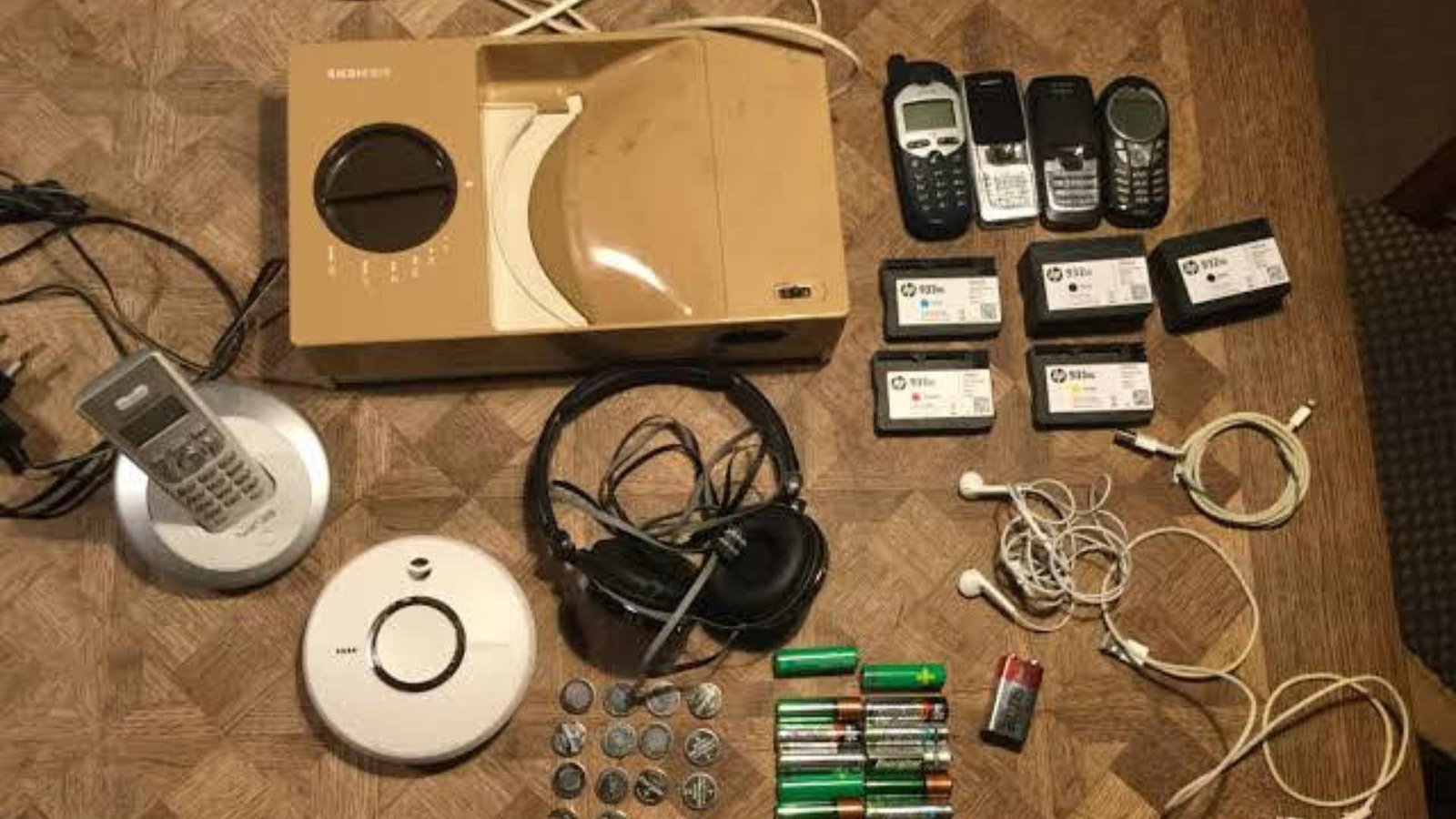
- Most people do not know a legal option exists. The default is a scrap dealer or a cupboard, not because either was chosen over a formal alternative but because no alternative was known. Establishing awareness of a channel is a precondition for the channel working at all.
- Data anxiety is a real and addressable barrier. People retain phones and laptops because they are unsure what happens to what is on them. Explaining sanitisation converts stored devices into collected devices, and it is the single most effective message in residential sessions.
- Trained citizens segregate before handing over. Material arriving already separated by category is cheaper to process and easier to document, which improves both unit economics and the quality of the compliance record.
- Institutional participation follows individual understanding. Employees who learn about e-waste at a residential session carry that into procurement and IT asset disposal decisions at work, which is where the larger volumes are.
How Earth5R Enables Implementation at Scale
Earth5R is a Mumbai-based, UNESCO-recognised global environmental organisation working across more than 65 countries, structured as a CSR and ESG action partner rather than an advisory firm. In e-waste specifically, the relevant capability is the one the sector is short of: a community and institutional collection layer that reaches material before it disappears, connected to certified processing and instrumented well enough to survive an audit.
Collection channel design and field deployment
Earth5R designs and runs the collection layer itself — building and campus assessment, collection point siting, drive scheduling, volunteer mobilisation, doorstep and institutional pickup, and coordination with authorised recyclers for onward processing. The four-city and Bangalore programmes demonstrate both fixed-point and mobile channel models in operation. Sector-specific work is documented in the electronics and technology e-waste solutions portfolio and across CSR and ESG projects.
The technology and data layer
The Earth5R application captures collection activity with geotagging and automated data capture, recording weight, category, location and time at the point of handover rather than reconstructing it later. A management information dashboard provides real-time monitoring, customisable KPI reporting and validation of on-ground activity, accessible to sponsor teams. This is what converts a collection drive into an auditable chain of custody, and it connects to the wider sustainability innovation work on material traceability.
Consulting, assessment and disclosure support
For obligated producers, the deliverable is a defensible compliance position rather than tonnage alone. Earth5R’s ESG practice covers baseline and materiality assessment, proprietary TERRA Score™ scoring and CvR Gap™ analysis, and evidence packs that reconcile collected volumes to EPR obligation categories and BRSR waste disclosures. Adjacent sector work includes plastic waste management ESG solutions and programmes for the information technology sector, where IT asset disposal volumes are concentrated.
Employee engagement, training and partnerships
Collection programmes double as engagement infrastructure. Corporate volunteering, campus volunteer cohorts and certified sustainability training programmes supply field capacity while producing measurable social outcomes in their own right. The BlueCities sustainability network extends the model across urban systems, and the breadth of engagement is visible across the sector programme portfolio and partner network.
The Transition Path Forward
Moving from certificate purchase to an owned, documented collection channel is a sequenced transition, not a single procurement. The order below reflects how the programmes described above were built, and each stage produces an input the next depends on.
- Establish the obligation and evidence baseline. Quantify the EPR target by category, audit how it is currently being met, and identify which claims would survive scrutiny if the underlying activity were examined. This defines the size of the gap before anything is committed.
- Map the highest-yield channels first. Own offices, campuses, dealer and service networks, and employee households typically hold more accessible tonnage than a general public campaign, and they can be governed by internal policy rather than persuasion.
- Contract certified processing before collection begins. Named authorised recyclers, agreed commercial terms, transfer documentation and recovery reporting. Without this, collection creates a storage and liability problem rather than a compliance asset.
- Deploy the data layer with the first collection. Geotagged capture of weight, category and time at handover, reconciled against recycler intake. Retrofitting custody records onto an operating programme is substantially harder than building with them.
- Integrate existing collectors on fair terms. Register, train and pay the informal operators already working in the catchment. This buys reach that would otherwise take years to build and removes the competitive dynamic that starves formal channels.
- Reconcile to EPR, BRSR and CSR reporting. Map collected tonnage to obligation categories, waste disclosures and Schedule VII reporting, and prepare the evidence pack an auditor will request.
- Replicate across geographies on one data standard. Extend city by city using identical instrumentation, so results aggregate credibly at portfolio level rather than as incompatible local claims.
The role of policy, technology, partnerships and field execution
Policy sets the obligation and the price signal: the E-Waste Rules 2022 define targets across 106 categories, and the outcome of the floor price litigation will shape recycler economics for years. Technology supplies the custody record — geotagged capture, dashboards, reconciliation — that makes a collection claim defensible. Partnerships supply what no single actor holds: certified processing capacity, institutional access, community reach and the existing informal collection network. Field execution converts all three into material that actually arrives at a licensed facility, and it is the component most often assumed rather than resourced.
How organisations can engage
Electronics producers, importers and brand owners typically begin with an EPR obligation and evidence-gap assessment, then commission a collection programme sized to their target. IT services firms and large enterprises engage on IT asset disposal, where volumes are concentrated and data security governs the process. Consulting and assurance firms partner on the field and data layer beneath advisory engagements they already hold. Municipal bodies and campuses engage on city-scale collection infrastructure. Earth5R can be reached at community@earth5r.org, with programme documentation across the CSR and ESG projects portfolio.
Frequently Asked Questions on E-Waste Collection Programs
Why does India collect so little e-waste formally when recycling capacity exists?
Because the constraint is upstream of the recycler. Authorised capacity stands at roughly 1.8 million tonnes across 595 registered recyclers, but informal collectors reach households first, pay cash at the door and carry a lower cost base, so material is diverted before any formal facility sees it. The problem is collection, not processing.
What is the EPR floor price, and why is it being challenged?
March 2024 amendments set floor and ceiling prices for EPR certificates linked to environmental compensation, including a minimum of ₹22 per kilogram for consumer electronics. Producers including Samsung, LG, Daikin, Havells, Voltas and Carrier challenged this in the Delhi High Court, arguing the government cannot fix commercial terms between private parties. The Environment Ministry says the floor prevents a race to the bottom. The matter remains before the court.
Does running our own e-waste collection program reduce EPR cost?
It can, in two ways: tonnage collected and routed through a registered recycler reduces the certificates that must be purchased, and it converts a price you do not control into an operation you do. It also produces the chain-of-custody documentation that makes the resulting compliance claim defensible, which purchased certificates alone may not.
How much e-waste can a corporate collection program realistically recover?
It depends on channel design and duration. A one-year programme across 200 residential buildings in four cities recovered 25 tonnes; a two-year twice-monthly public drive model in Bangalore with 150 volunteers recovered 72 tonnes. Institutional and IT asset disposal channels typically yield more per intervention than residential ones, because disposal happens in bulk.
What happens to data on collected devices?
Documented data sanitisation should be specified as part of the collection process before any programme launches, because fear of data exposure is one of the main reasons households and companies retain obsolete hardware rather than releasing it. Addressing it explicitly converts stored devices into collected devices.
Note on sources and claims. Programme figures are drawn from Earth5R records. Carbon values are project estimates calculated from recovered tonnage; the two programmes described applied different conversion factors, and neither figure is an accredited third-party verified emission reduction. Certificate price ranges reflect reported market conditions during 2024–25 and are subject to the pending Delhi High Court proceedings. National capacity and generation figures are compiled on different bases by different bodies and are presented as indicative of relative scale.
Note on ongoing litigation. The Delhi High Court proceedings referenced in this article concern the validity of the 2024 amendments to the E-Waste (Management) Rules, 2022. The matter had not been finally decided at the time of writing, and the positions described are those recorded in filings and public reporting.