
The Growing Crisis of Urban Air Pollution
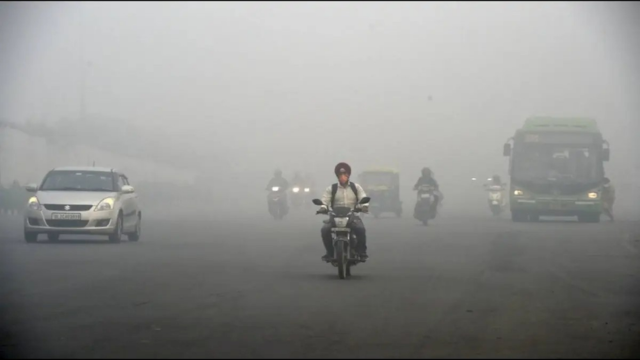
Urban areas worldwide are grappling with a worsening air pollution crisis, driven by rapid industrialization, soaring vehicular emissions, and weak urban planning. According to WHO, 99% of people breathe unsafe air daily. Cities like Delhi and Beijing exemplify this growing health emergency.
One of the most visible effects of urban air pollution is on respiratory health, particularly in children and the elderly. Prolonged exposure to PM2.5 leads to asthma, chronic bronchitis, and even lung cancer. Research from Harvard links polluted air to shorter life expectancy. The World Bank estimates trillions in economic losses yearly, showing how urbanization without safeguards can be deadly.
Traffic congestion remains a leading contributor to deteriorating air quality. Vehicles emit dangerous nitrogen oxides, carbon monoxide, and fine particulates. The International Energy Agency shows cities lacking efficient transit systems face the highest risks. Heavy dependence on fossil fuels worsens urban emissions, while the global shift toward electric mobility is progressing unevenly across regions.
Industries also contribute heavily to worsening urban pollution. Factories near residential neighborhoods emit sulfur dioxide, volatile organic compounds, and heavy metals. A global study highlights industrial emissions as a significant source of toxic exposure. Weak environmental regulations allow polluters to operate unchecked, making stronger policy frameworks essential for future solutions.
The challenge is further magnified by climate change, which alters weather patterns and traps pollutants over cities. Rising heatwaves, temperature inversions, and low wind conditions worsen smog. Findings from NASA confirm how stagnant air worsens ozone pollution. Addressing these complex interactions requires climate-resilient strategies that go beyond local measures.
Globally, the urgency to act is undeniable. The Lancet Commission attributes 6.7 million premature deaths annually to polluted air. Nations like India and China bear some of the heaviest burdens. Initiatives led by Earth5R, Greenpeace, and the UNEP show how collective action can begin reversing toxic skies into healthier futures.
Understanding the Link Between Air Quality and Public Health
Air pollution is not only an environmental concern but also a direct threat to human health. Prolonged exposure to polluted air increases risks of respiratory illnesses, cardiovascular diseases, and even premature mortality. Studies by the World Health Organization confirm that both indoor and outdoor pollutants trigger chronic health conditions. The burden falls disproportionately on urban populations with dense traffic and limited green cover.
One of the most dangerous pollutants is fine particulate matter (PM2.5), which penetrates deep into the lungs and bloodstream. Research from Harvard T.H. Chan School of Public Health links PM2.5 to strokes, heart attacks, and lung cancer. In many cities, these particles exceed the WHO air quality guidelines. Exposure is particularly severe in areas with unchecked vehicular traffic and industrial clusters.
Children are among the most vulnerable groups when it comes to air pollution exposure. Their developing lungs absorb pollutants more quickly, leading to higher cases of asthma and reduced lung function. A report by UNICEF highlights that over 300 million children live in areas with extreme pollution. Poor air quality around schools worsens cognitive development, raising concerns about long-term impacts.
The elderly population is equally at risk, as poor air quality aggravates chronic diseases. Older adults are more likely to experience chronic obstructive pulmonary disease, weakened immune systems, and cardiovascular complications when exposed to pollutants. Findings from the National Institute of Environmental Health Sciences show that air pollution accelerates aging-related decline.
Mental health is another overlooked dimension of the air quality crisis. Studies suggest a strong correlation between polluted air and increased risks of depression, anxiety disorders, and cognitive decline. Research from Lancet Psychiatry highlights that exposure to toxic air may even contribute to dementia in older adults. This broadens the health debate beyond physical diseases to neurological well-being.
The economic and social implications are equally pressing. According to The Lancet Commission, pollution-related health issues cause millions of deaths and cost trillions in healthcare and productivity losses annually. Countries like India and China experience severe productivity setbacks due to poor health outcomes. Reports by the OECD confirm that investment in cleaner air directly improves economic growth and public well-being.
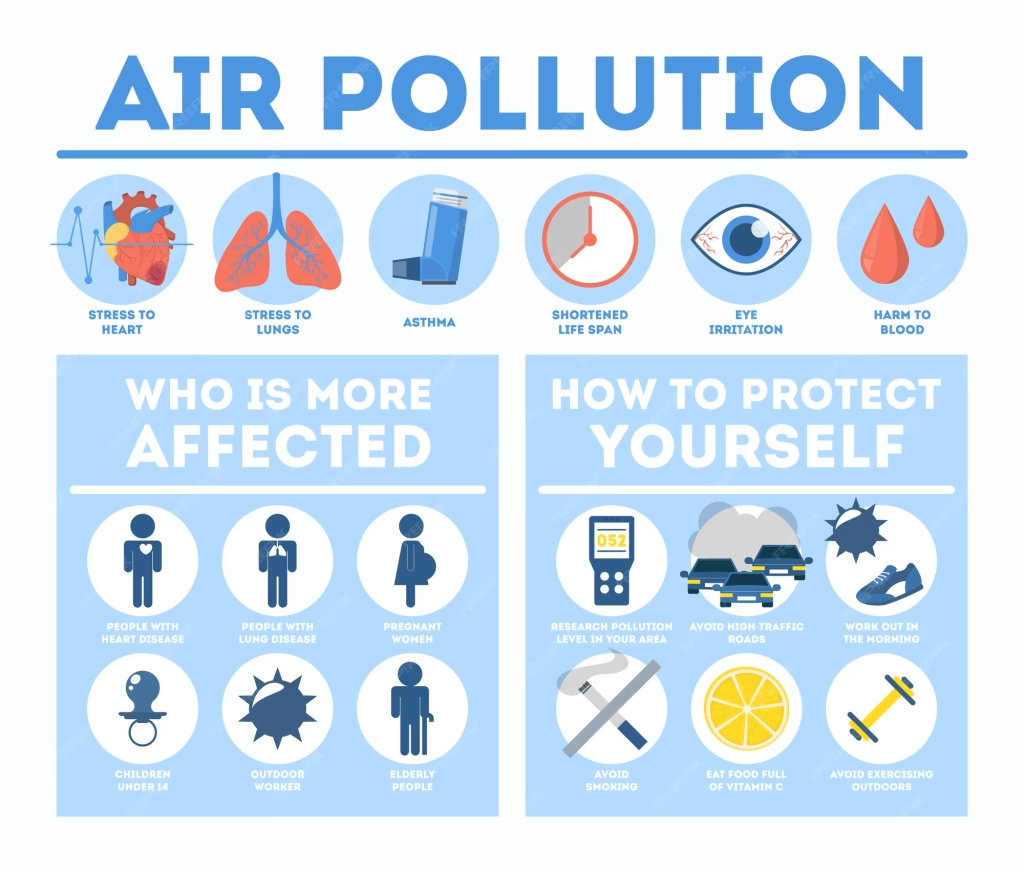
This infographic illustrates the importance of urban air monitoring in addressing rising pollution levels and their direct impact on community health.
It emphasizes the role of sustainable solutions and citizen participation in transforming toxic urban environments into healthier living spaces.
Earth5R’s Vision for Cleaner Skies and Healthier Communities
Earth5R envisions a future where citizens actively participate in tackling air pollution through accessible data and grassroots action. Unlike traditional models that rely solely on government agencies, Earth5R promotes community-led monitoring. This approach democratizes environmental action by giving citizens tools to track local pollution. The goal is not just cleaner air but also stronger public health resilience.
The organization emphasizes the integration of sustainability and technology in addressing air quality challenges. By deploying low-cost sensors, they make real-time monitoring possible in urban neighborhoods often ignored by official systems. IoT technology and open data platforms ensure information reaches both policymakers and communities. This accessibility helps bridge the gaps in conventional air monitoring systems.
Beyond technology, Earth5R fosters community empowerment by training citizens to interpret data and act on findings. Workshops in schools, colleges, and local organizations encourage behavioral changes like reducing vehicle dependence and adopting cleaner household practices. Through environmental education, Earth5R nurtures long-term citizen engagement.
Earth5R’s model also links environmental justice with health equity. By placing sensors in marginalized communities, it highlights pollution hotspots often overlooked by policymakers. A report from UNEP stresses the importance of equitable air quality data. This empowers vulnerable populations with evidence to demand fairer policy interventions. As a result, citizen science becomes a tool for social transformation.
Collaboration forms the backbone of Earth5R’s vision. The organization partners with local governments to ensure data informs decision-making while also working with NGOs and businesses to scale impact. Such multi-stakeholder engagement strengthens advocacy for sustainable urban planning. Through collective action, Earth5R demonstrates that grassroots movements can complement and enhance institutional frameworks.
Ultimately, Earth5R seeks to transform toxic urban skies into healthier environments through innovation, education, and advocacy. By blending citizen science with digital solutions, the organization creates a replicable model for global cities. Initiatives like these align with UN Sustainable Development Goals, particularly those on health and climate action.
Smart, Low-Cost Sensors: Democratizing Air Quality Data
Traditional monitoring systems are often inaccessible to ordinary citizens due to high costs and limited reach. The emergence of low-cost sensors has transformed how air quality data is collected and shared. These compact devices track pollutants like PM2.5, NOx, and ozone in real time. Organizations such as Earth5R use them to empower communities with hyper-local insights.
These sensors work on IoT technology, enabling seamless connectivity and cloud-based data storage. Unlike large government stations, they can be installed on rooftops, schools, and community centers with minimal infrastructure. Platforms like OpenAQ aggregate this data, making it accessible to the public. By bridging information gaps, such innovations reduce dependence on centralized air monitoring systems.
Accessibility is key to their impact. Studies by the Environmental Defense Fund show that affordable sensors increase coverage in underserved communities. Citizens can now access real-time readings through mobile apps or dashboards. This democratization of information builds transparency, allowing communities to hold industries and local authorities accountable.
Accuracy, however, has often been questioned. While low-cost sensors may not match the precision of advanced stations, calibration improvements are closing the gap. Machine learning algorithms are increasingly used to enhance reliability by correcting for temperature and humidity variations. Partnerships between universities and citizen groups further validate data.
The scalability of these sensors is another advantage. A single city can deploy hundreds of devices at a fraction of the cost of conventional networks. Research by the World Economic Forum shows widespread deployment significantly improves pollution mapping. Schools, NGOs, and even households can contribute to the network, creating citizen-driven datasets. This collaborative approach decentralizes air monitoring, expanding both reach and impact.
By making air quality data accessible, low-cost sensors shift the power balance from institutions to people. Communities gain the knowledge needed to demand cleaner urban planning, stricter industrial controls, and sustainable transport policies. For organizations like Earth5R, these devices form the backbone of grassroots campaigns.
Turning Data Into Action: Insights, Dashboards, and Alerts
Collecting air quality data is only the first step; its real value comes from translating numbers into actionable insights. Platforms like AirVisual and OpenAQ provide interactive dashboards that visualize pollution in real time. Earth5R integrates similar tools into its community projects. By simplifying complex datasets, these dashboards allow citizens and policymakers to make informed decisions quickly.
The role of data visualization is crucial in communicating environmental risks. Interactive maps highlight hotspots, while trend graphs show patterns across seasons. MIT research demonstrates that visual platforms increase public engagement. When residents see pollution spikes in their neighborhood, they are more likely to demand policy interventions. This creates a stronger feedback loop between communities and decision-makers.
Alerts are another powerful feature of modern air monitoring. Systems like AirNow issue health advisories when pollution reaches hazardous levels. Mobile apps send real-time notifications, allowing vulnerable populations to take precautions. Research from Environmental Health Perspectives confirms that timely alerts reduce hospital admissions during smog episodes. These warnings transform raw data into life-saving interventions for urban residents.
Dashboards also support policymaking by offering evidence-based insights. For example, the World Resources Institute uses sensor data to advise governments on emission reduction strategies. Local authorities can identify pollution hotspots and enforce targeted regulations, such as traffic restrictions or industrial checks. By aligning with sustainable development goals, such data-driven governance enhances both health and climate resilience.
Another benefit lies in transparency and accountability. When data is publicly accessible, industries and transport systems face greater pressure to comply with emission standards. Civil society groups like Greenpeace often use dashboards to campaign for stricter regulations. Open platforms empower citizens to report discrepancies and demand cleaner practices. This participatory monitoring shifts environmental governance from closed systems to collaborative processes.
Ultimately, dashboards and alerts bridge the gap between science and society. They transform abstract figures into relatable stories about community health. With tools from Earth5R, OpenAQ, and IQAir, ordinary people gain agency in shaping urban futures. By combining real-time data with proactive alerts, these systems ensure that air quality monitoring leads to tangible improvements in daily life.
Citizen Science in Action: Community Engagement and Education
Citizen science is at the core of Earth5R’s mission, enabling ordinary people to become active participants in air monitoring. Projects supported by CitizenScience.org show how communities can generate valuable data while learning about environmental challenges. By engaging residents, schools, and local groups, Earth5R builds grassroots ownership of clean air initiatives. This participation fosters both awareness and long-term commitment.
Education plays a central role in sustaining engagement. Programs like Eco-Schools integrate environmental literacy into classrooms, helping children understand pollution’s impact. Earth5R conducts workshops that teach students how to operate low-cost sensors and interpret results. Studies from UNESCO highlight the importance of experiential learning.
Community engagement also extends to vulnerable populations disproportionately affected by pollution. Research by WHO shows marginalized groups often face higher exposure risks. Earth5R places sensors in such neighborhoods, offering residents access to real-time data. This inclusion ensures that no group is excluded from the clean air movement. Empowered communities can then mobilize for environmental justice.
Workshops and training sessions help citizens interpret complex findings. For instance, National Geographic highlights how hands-on activities strengthen scientific literacy. Earth5R creates easy-to-understand dashboards that translate technical results into practical advice. This guidance includes reducing vehicle emissions or adopting cleaner fuels.
Collaboration with universities and NGOs further enriches engagement efforts. Institutions like Stanford University partner with community groups to validate sensor data and train volunteers. Partnerships with Greenpeace or local governments amplify the reach of citizen initiatives. Such collaborations ensure that community-driven monitoring does not remain isolated but feeds into larger networks of advocacy and policy.
Ultimately, citizen science transforms passive observers into active changemakers. Studies published in Frontiers in Environmental Science confirm that community-led monitoring increases environmental accountability. With initiatives like Earth5R, education and participation go hand in hand. By mobilizing citizens of all ages, these efforts ensure that air quality improvement becomes a collective responsibility rather than a top-down directive.
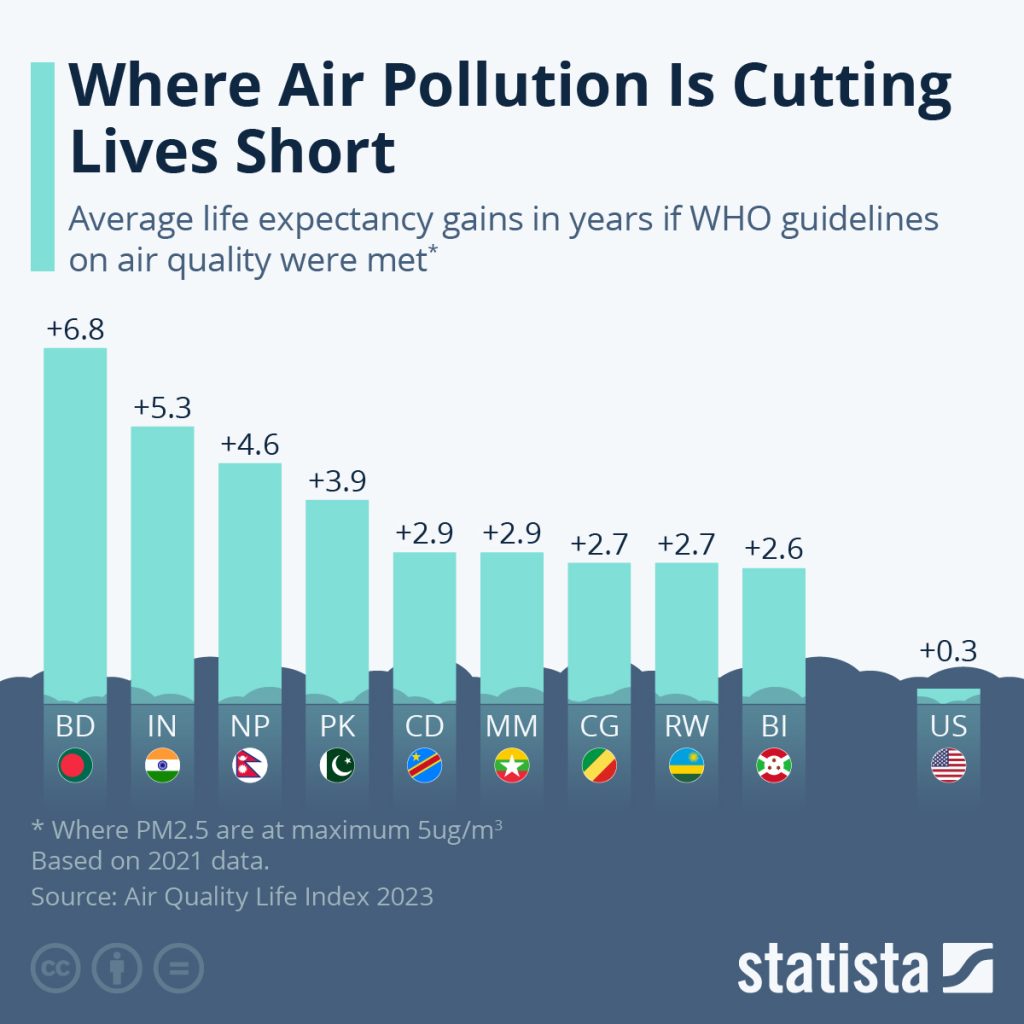
This infographic shows the potential increase in life expectancy if WHO air quality guidelines were achieved, with Bangladesh, India, and Nepal facing the greatest losses due to pollution.
It underlines how meeting clean air standards could significantly improve public health and longevity across the most affected nations.
Policy Advocacy and Real-World Impact
Policy advocacy is a critical dimension of Earth5R’s work, ensuring that citizen-generated data influences decision-making. Reports from the World Health Organization emphasize that evidence-based advocacy drives stronger health protections. By presenting real-time pollution data to local governments, Earth5R helps shape regulations that reflect community needs.
Real-world impact can be seen in how community data informs urban planning. In many cities, identifying pollution hotspots has led to stricter traffic management and emission controls. Studies from the OECD show that localized insights often outperform centralized datasets in guiding interventions. By amplifying citizen voices, Earth5R strengthens accountability in public policy.
Advocacy also addresses environmental justice, ensuring marginalized communities are not overlooked in policymaking. Data from sensors placed in vulnerable areas highlights disproportionate exposure to pollutants. Findings published by UNEP stress the importance of equity-driven policies. Earth5R leverages such evidence to push for targeted support where it is needed most. This creates fairer and more inclusive frameworks.
Partnerships enhance the credibility of advocacy efforts. Collaborations with universities, NGOs like Greenpeace, and civic bodies ensure that citizen data is scientifically validated. When paired with institutional research, grassroots findings become harder to ignore. This fusion of science and community action amplifies the push for sustainable reforms.
In addition to influencing policy, Earth5R’s advocacy inspires behavioral change at the individual level. Campaigns supported by the Environmental Defense Fund demonstrate how awareness shifts habits, such as reduced car use or adoption of clean energy. By linking personal behavior with systemic change, citizen-driven advocacy creates a cycle of responsibility.
Ultimately, the real-world impact of advocacy is measured in improved public health outcomes and stronger environmental protections. With tools like OpenAQ and IQAir, data becomes a foundation for legal reforms, urban redesign, and long-term sustainability. Earth5R demonstrates that citizen science, when combined with effective advocacy, can drive transformative change in urban air management.
Overcoming Challenges: Accuracy, Funding, and Institutional Support
While low-cost sensors have democratized air quality monitoring, concerns about accuracy remain a persistent challenge. Studies from Frontiers in Public Health highlight issues such as calibration errors and environmental interferences. To address this, organizations like Earth5R collaborate with research institutions for validation. This ensures that community-generated data retains credibility in scientific and policy discussions.
Funding is another significant barrier for grassroots projects. Unlike large-scale government networks, citizen-led initiatives often rely on nonprofit grants and donations. Reports by the World Bank emphasize the financial gap in supporting local air quality interventions. Earth5R mitigates this by building partnerships with corporate sustainability programs that align with environmental and social goals. Such collaborations help sustain long-term operations.
Institutional support is crucial for scaling community efforts into systemic change. Research from OECD shows that citizen-driven data is most effective when integrated into official monitoring frameworks. However, bureaucratic resistance often slows adoption. By engaging with local authorities and policy councils, Earth5R ensures grassroots insights feed into broader urban planning and environmental strategies.
Technical literacy presents another hurdle, as communities may struggle to interpret complex datasets. Platforms like OpenAQ and AirVisual simplify access through dashboards and alerts. Earth5R supplements this with hands-on training programs in schools and neighborhoods. By empowering citizens to analyze findings, these initiatives reduce dependency on external experts and build community resilience.
Another challenge lies in public engagement fatigue. Continuous involvement in monitoring projects requires long-term motivation. Studies in Environmental Science & Policy suggest that linking air quality data to tangible health benefits sustains participation. Earth5R addresses this by tying results to local health outcomes, showing residents how cleaner air directly improves well-being. This connection keeps communities invested.
Despite these obstacles, the resilience of grassroots initiatives highlights their transformative potential. With support from UNEP and partnerships with civic bodies, Earth5R continues to refine its approach. By addressing accuracy, funding, and institutional backing, citizen-led monitoring proves scalable and impactful. Overcoming these challenges ensures that community science evolves into a powerful driver of sustainable urban futures.
The Road Ahead: Scaling Solutions for Sustainable Urban Futures
The fight for clean air requires solutions that can be scaled across diverse urban landscapes. Reports from the United Nations stress that sustainable futures depend on inclusive and innovative approaches. Earth5R demonstrates how citizen science can expand beyond single neighborhoods into city-wide frameworks. By combining grassroots participation with technology, scalable systems become both practical and impactful.
Integration with smart city initiatives offers a pathway for growth. Many urban centers are already investing in IoT-enabled infrastructure for energy, mobility, and housing. Embedding air quality sensors within these networks provides continuous monitoring. Cities like London and Delhi show how integrated systems improve public policy. Scaling Earth5R’s model into such frameworks aligns local action with global urban strategies.
Global collaboration is another avenue for expansion. Platforms such as OpenAQ and networks like C40 Cities enable cities to share data and best practices. By participating in these alliances, Earth5R ensures that local findings contribute to international dialogues on pollution. This exchange of knowledge accelerates progress toward climate action while reinforcing community-led solutions.
Sustaining momentum also requires long-term financial planning. Research from the World Economic Forum highlights the importance of blending public funding with private investment. Earth5R’s partnerships with corporate social responsibility programs demonstrate how businesses can play a role in scaling solutions. Diversified funding ensures the continuity of citizen-driven monitoring across regions.
Education and awareness will remain pillars of future scaling. Studies by UNESCO emphasize the role of environmental literacy in building resilient societies. Expanding citizen training programs strengthens scientific capacity across communities. By linking air quality improvements with public health outcomes, Earth5R fosters lasting behavioral change. Education ensures that technological adoption translates into healthier lifestyles.
Looking ahead, the path to sustainable urban futures lies in uniting technology, policy, and people. Earth5R is pioneering a model that is adaptable, inclusive, and globally relevant. By scaling solutions across cities, partnering with international networks, and deepening citizen engagement, cleaner air is within reach. The vision is clear: transforming toxic skies into healthier, livable urban environments for generations to come.
Conclusion: Towards Cleaner Skies and Healthier Futures
Urban air pollution is no longer an invisible problem but a daily health threat for millions. Studies from the World Health Organization reveal its link to respiratory and cardiovascular diseases. Community-driven solutions like Earth5R show that collective action can transform toxic environments.
Technology plays a pivotal role in this transition. With low-cost sensors and IoT-enabled networks, air monitoring is no longer limited to government agencies. Data visualization platforms like OpenAQ turn raw numbers into meaningful insights. These tools bridge the gap between awareness and action, making clean air a shared responsibility.
Yet challenges remain in scaling and sustaining these efforts. Barriers such as funding, accuracy, and policy integration require multi-stakeholder collaboration. Partnerships with local authorities and NGOs like Greenpeace amplify the credibility of citizen science. Addressing these hurdles ensures grassroots initiatives evolve into long-term solutions.
The road ahead lies in combining citizen engagement with institutional support. Aligning efforts with the UN Sustainable Development Goals ensures that cleaner air contributes to broader climate and health priorities. By uniting technology, education, and advocacy, Earth5R envisions a future where cities thrive.
Frequently Asked Questions: From Toxic Skies to Healthy Lives: Earth5R’s Urban Air Monitoring Solutions
What is Earth5R, and what does it do?
Earth5R is a citizen-led environmental organization that focuses on sustainability projects, including urban air quality monitoring and community education.
Why is urban air pollution a major concern today?
Urban air pollution leads to respiratory diseases, heart problems, and premature deaths, affecting millions of people worldwide, especially in developing cities.
How does Earth5R’s air monitoring solution differ from government systems?
Unlike centralized government monitoring stations, Earth5R uses low-cost sensors that provide hyper-local, real-time data accessible to communities.
What pollutants do Earth5R’s sensors measure?
They monitor pollutants such as PM2.5, PM10, nitrogen dioxide (NO₂), ozone, and carbon monoxide, which are harmful to human health.
How do low-cost air quality sensors work?
These sensors use IoT technology to detect pollutants in the air, transmitting data to cloud platforms and dashboards for public use.
Why is citizen science important in air monitoring?
Citizen science empowers people to collect, analyze, and act on air quality data, making communities active participants in solving environmental challenges.
How does poor air quality affect human health?
Exposure to polluted air increases the risk of asthma, lung cancer, cardiovascular disease, and even cognitive decline in children and the elderly.
Can citizens really influence air quality policies?
Yes, when backed by credible data, citizen-led monitoring can push policymakers to enforce stricter regulations and improve urban planning.
How does Earth5R engage schools and youth?
Through workshops, sensor installations, and environmental education programs, Earth5R involves young people in understanding and addressing air pollution.
What role does technology play in Earth5R’s approach?
IoT sensors, dashboards, and mobile apps transform raw data into actionable insights, making air quality information widely accessible.
Are low-cost sensors as reliable as government monitoring stations?
While not as precise initially, advancements in calibration and machine learning have significantly improved their accuracy.
How does air quality data help communities directly?
It alerts residents about dangerous pollution levels, guides healthier choices, and strengthens advocacy for local solutions.
What challenges do citizen-led air monitoring projects face?
Key challenges include sensor accuracy, long-term funding, institutional resistance, and maintaining community engagement.
How does Earth5R ensure marginalized communities are included?
By placing sensors in underserved areas, Earth5R ensures vulnerable populations also have access to air quality data and advocacy tools.
What global partnerships support initiatives like Earth5R’s?
Partnerships with platforms such as OpenAQ, C40 Cities, and research institutions provide credibility and help scale impact.
How does real-time data improve public health outcomes?
Timely alerts and dashboards help people avoid exposure during high pollution events, reducing hospital visits and long-term health risks.
What is the connection between air pollution and climate change?
Air pollutants like black carbon and ozone also contribute to global warming, making clean air a climate as well as a health issue.
How are businesses involved in supporting Earth5R’s work?
Many companies contribute through corporate social responsibility programs, funding sensor deployment and community training.
What is Earth5R’s long-term vision for urban air monitoring?
Its vision is to build citizen-driven, scalable, and sustainable monitoring systems that transform urban air quality and public health.
How can individuals participate in Earth5R’s initiatives?
People can volunteer for workshops, host sensors in their neighborhoods, or support through donations and advocacy efforts.
Call to Action: Building a Movement for Clean Air
The fight for clean air cannot be left to governments or organizations alone—it requires collective responsibility. Every individual, from students to working professionals, has a role to play in shaping healthier urban environments. By making conscious choices in daily life, we can reduce pollution and inspire systemic change.
Communities must come together to support citizen-led air monitoring initiatives. Hosting sensors, attending workshops, or sharing data insights can create stronger networks of accountability. When neighborhoods collaborate, they generate momentum that compels policymakers to act.
Businesses and institutions must also embrace sustainability as a priority. By adopting cleaner technologies, reducing emissions, and funding local projects, organizations can directly influence urban air quality. Corporate responsibility extends beyond profit—it is about safeguarding public health.
Finally, advocacy must continue until clean air becomes a universal right. Raising awareness, demanding stronger policies, and participating in grassroots movements will ensure long-term progress. The journey from toxic skies to healthy lives is not a distant dream but a collective mission.
~Authored By Omshree Konda