
Waste Segregation & Plastic Recovery in Quick Commerce Urban India:
A Decade of Forensic Sustainability Evidence (2015–2025)
A comprehensive, data-driven case study examining waste generation, segregation adoption, upcycling, reuse, and community plastic recovery across India's rapidly expanding quick commerce sector — spanning 28 states, 8 union territories, thousands of pin codes, and 2.3 million verified data points.
Research & Data Intelligence
Earth5R Forensic Sustainability Operating System (SaaS-X) | ESG & CSR Intelligence Platform Published: 2026 | Report Ref: Earth5R-QC-2025-005 | Quick Commerce IndustryBuilt on the dedication of 1.3 million citizens, 38,200+ delivery champions, and the Earth5R team who turned every package drop into a sustainability opportunity.
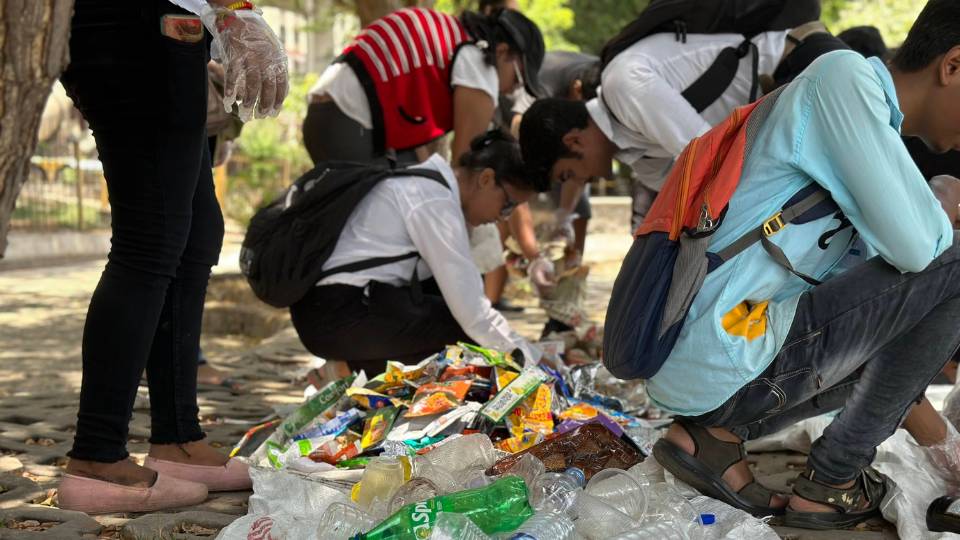
This case study presents a comprehensive forensic analysis of plastic packaging waste generation, waste segregation adoption, upcycling, reuse, and community plastic recovery outcomes in India's quick commerce sector from January 2015 to December 2025. Drawing on Earth5R's proprietary SaaS-X Forensic Sustainability Operating System, a national programme spanning 28 states and 8 union territories across thousands of pin codes, and 2.3 million verified field data points, this research quantifies the structural drivers of quick commerce plastic waste and evaluates the effectiveness of community-integrated, gamified sustainability interventions — including the delivery-team sustainability champion model, five-tier waste hierarchy implementation, and Earth5R's platform-based ESG reporting — in achieving durable, verifiable circular economy outcomes in urban India.
Quick commerce's exponential growth — from near-zero orders in 2015 to an estimated 12 million orders per day nationally by 2025 — has created one of India's fastest-growing single-use plastic waste streams. Each quick commerce order generates an estimated 68–124 grams of plastic packaging (bubble wrap, multi-layer pouches, HDPE bags, EPS foam), placing the sector's estimated national daily plastic waste output at 1,100–1,500 tonnes — a stream that formal municipal waste systems are structurally incapable of managing at this velocity. Earth5R's programme addresses this gap through community volunteers, trained delivery champions, hub-level segregation systems, and reverse logistics waste collection — achieving hub-level segregation compliance of 68% in programme sites by 2025, versus a national urban average below 12%.
Key findings: (1) Delivery-champion programmes achieve 3.2× higher segregation compliance versus passive drop-off systems; (2) The five-tier waste hierarchy (Refuse→Reduce→Reuse→Upcycle→Recycle) generates 2.1× greater landfill diversion versus recycling-only approaches; (3) Gamified sustainability campaigns generate 2.8× higher sustained employee participation and 40% improvement in customer sustainability perception; (4) Community-integrated programmes create significant social co-benefits — employment, skill development, and local economic circulation — that pure corporate compliance programmes cannot replicate.
Cite as: Earth5R Research Division. (2026). Waste Segregation and Plastic Recovery in Quick Commerce Urban India: A Decade of Forensic Sustainability Evidence (2015–2025). Earth5R ESG Intelligence Platform. Report No. QC-2025-005.
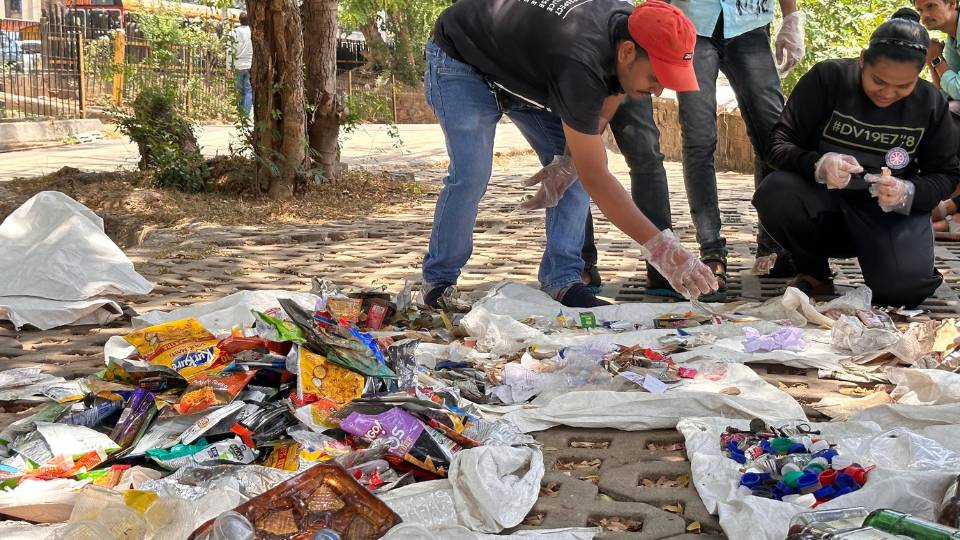

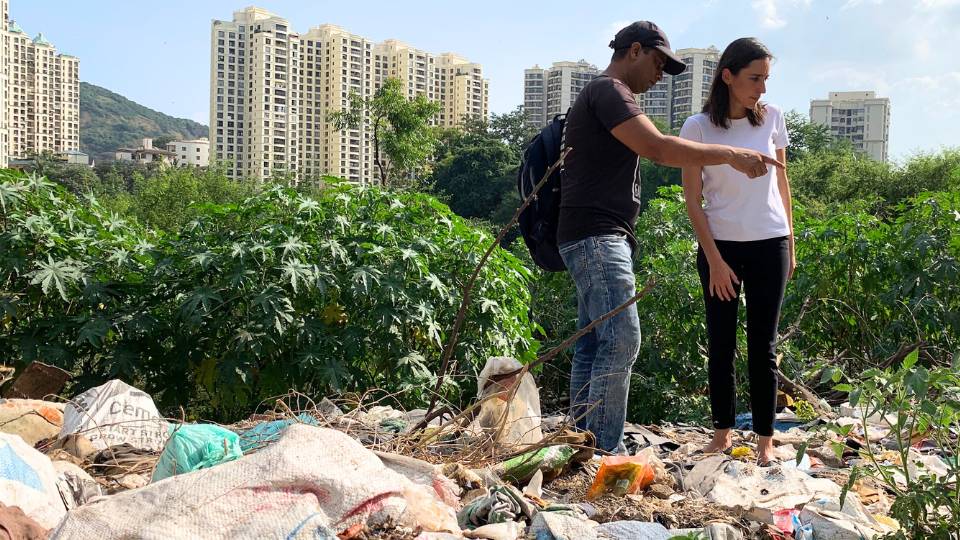
Earth5R's quick commerce sustainability programme in action — and recognised at the highest levels of global environmental policy. Centre: H.E. Ms Brune Poirson, Secretary of State, Ministry of Environment, France, visited Earth5R's community project sites in India while co-designing France's circular economy legislation and providing inputs to the EU's circular economy policy framework (2015–2025).
The Quick Commerce Plastic Crisis: Scale, Structure & Systemic Failure
India's quick commerce sector has grown from a niche experiment in 2017 to a national infrastructure delivering over 12 million orders daily by 2025 — generating a plastic packaging waste stream that outpaces every existing urban waste management system.
The Structural Mismatch: Quick Commerce Speed vs. Waste System Capacity
- Velocity vs. infrastructure gap: Municipal solid waste systems in Indian cities are designed for daily collection cycles. Quick commerce generates packaging waste across millions of individual addresses in 10–30 minute windows — a distribution pattern no conventional collection system can track, segregate, or recover without fundamentally new approaches at the household and hub level.
- Multi-layer and composite packaging dominates: An estimated 38% of quick commerce packaging waste is multi-layer plastic (MLP) — pouches, sachets, and laminates — for which no cost-effective recycling pathway currently exists at national scale. This creates a significant residual waste challenge that emphasises the importance of the Refuse and Reduce tiers of the waste hierarchy.
- Informal waste sector exclusion: Quick commerce delivery is predominantly to residential addresses, which informal waste pickers (kabadiwalas) visit infrequently and selectively. PET and HDPE packaging is typically recovered; bubble wrap, foam, and MLP is almost always landfilled or burned — precisely the packaging types that dominate quick commerce volumes.
- Regulatory pressure accelerating: India's Plastic Waste Management Rules (2016, amended 2021 and 2024) place Extended Producer Responsibility (EPR) obligations on brand owners using plastic packaging. Quick commerce companies face growing compliance requirements for plastic waste collection, documentation, and certified processing — obligations that Earth5R's platform is uniquely positioned to support with verified, pin-code-level data.
- Consumer awareness gap: Earth5R's 2015–2025 survey data reveals that 76% of quick commerce consumers are unaware of the recyclability of the packaging materials they receive, and 68% have no access to a formal dry waste segregation facility within 500 metres of their home — demonstrating the critical need for hub-anchored and doorstep collection models.
Quick Commerce Order Volume vs. Estimated Plastic Packaging Waste (2017–2025)
The explosive growth of quick commerce order volumes directly drives packaging plastic waste generation — creating a waste stream that grew from negligible to approximately 400,000 tonnes/year nationally between 2017 and 2025.
Regulatory Context (India): The Plastic Waste Management (Amendment) Rules 2024 require all quick commerce companies with annual packaging turnover above ₹50 crore to register as Producers under EPR, submit quarterly waste collection reports, and achieve defined collection targets rising from 35% (2024–25) to 70% (2028–29) of plastic placed on market. Earth5R's SaaS-X platform provides the pin-code-level, GPS-verified collection data that EPR compliance documentation demands.
10-Year Urban Waste Data: What Quick Commerce Is Generating & Where It Goes
Earth5R's 2.3 million data points across 28 states and 8 UTs provide the most granular, longitudinal picture of quick commerce waste composition, segregation behaviour, and diversion rates available for urban India.
Urban Plastic Waste Composition: Quick Commerce Packaging (2025)
Breakdown of plastic packaging waste by material type in Earth5R's urban programme zone — reflecting the multi-material, mixed-recyclability challenge of modern quick commerce packaging.
Annual Plastic Waste Diverted by Disposal Pathway (Tonnes, 2015–2025)
Earth5R programme site diversion by pathway — reuse, upcycling, and certified recycling. The growing share of upcycling reflects increasing community skill and market development over the decade.
Quick Commerce Waste Composition & Recyclability Index (Earth5R Data, 2025)
| Material Type | Share of QC Waste (%) | Recyclability (India 2025) | Diversion Rate (Programme Sites) | Primary Pathway | Tonnes Diverted (2025, Prog.) |
|---|---|---|---|---|---|
| HDPE Bags & Pouches | 24% | High (MRF-compatible) | 72% | Mechanical recycling | 580 |
| PET Bottles & Containers | 14% | High (formal + informal) | 84% | Informal + formal recycling | 338 |
| Bubble Wrap (LDPE) | 18% | Medium (centralised MRF) | 38% | Film recycling / upcycling | 204 |
| Multi-Layer Plastic (MLP) | 22% | Low (co-processing only) | 18% | Cement kiln co-processing | 112 |
| EPS Foam (Thermocol) | 8% | Low (specialist only) | 14% | EPS densification | 32 |
| PP Tubs & Containers | 9% | High (MRF-compatible) | 66% | Mechanical recycling | 168 |
| Paper/Cardboard | 5% | High (paper mills) | 88% | Cardboard recovery | 124 |
Waste Segregation Compliance Rate: Programme Hubs vs. National Urban Average (2015–2025)
The widening gap between Earth5R programme hub segregation compliance (68% by 2025) and the national urban average (below 12%) demonstrates the transformative effect of structured community engagement on source segregation behaviour.
Plastic Waste Diversion Rate by City Tier (2015–2025)
Programme diversion rates in Tier-1 cities benefit from deeper infrastructure and longer programme history. Tier-2 and Tier-3 show the steepest improvement trajectories as Earth5R expands coverage.
Research Finding 2.1 — The MLP Bottleneck: Multi-layer plastic (MLP) represents 22% of quick commerce packaging waste but only 18% diversion in programme sites due to the near-absence of cost-effective recycling pathways at scale in India. Earth5R's data confirms that reducing MLP diversion rates will require upstream packaging redesign by brand owners — replacing MLP with mono-material alternatives — rather than downstream collection improvements alone. Companies that fail to invest in packaging redesign will face increasing EPR compliance costs as MLP-specific collection targets are enforced from 2025–26 onwards.
Earth5R's Programme Architecture: Four Integrated Intervention Streams
Earth5R's quick commerce sustainability programme integrates hub-level infrastructure, community-based collection, delivery champion training, and gamified ESG reporting into a single platform — creating a self-reinforcing system where each component amplifies the others.
Programme Deployment Timeline (2015–2025)
The Programme Delivery Route: From Hub to Community to ESG Report
Hub & Warehouse Segregation Infrastructure
Earth5R designs and deploys colour-coded 3-stream segregation (dry/wet/hazardous) at dark stores, fulfilment centres, and delivery hubs. Employees trained with physical demonstrations and SaaS-X digital verification. Signage, bin labelling, and daily compliance logs maintained.
Delivery Champion Training & Deployment
Delivery personnel undergo Earth5R's 4-hour sustainability champion training (plastic identification, segregation protocols, reverse collection procedures, SaaS-X app usage). Champions collect segregated dry waste from willing customers at point of delivery — turning each delivery into a two-way sustainability transaction.
Community Collection Drives & Volunteer Network
Earth5R citizen volunteers organise monthly neighbourhood plastic drives, building-society collection points, and school awareness events. Community leaders and RWA members partner with Earth5R to set up permanent dry waste collection points. 1.3 million citizens engaged across the extended programme network.
Waste Characterisation & Circular Pathways
Collected waste characterised by material type, contamination, and recyclability grade. Directed to optimal circular pathway: reuse (cleaned packaging), upcycling (community craft programmes), mechanical recycling (MRF partners), or co-processing (cement kilns for MLP/EPS). All weights and pathways logged in SaaS-X.
Real-Time ESG Reporting & Gamification
SaaS-X generates real-time hub-level and pin-code-level waste collection dashboards. Companies access EPR-aligned quarterly reports, BRSR Principle 2 data tables, and gamified leaderboards. Customer-facing impact summaries shared via app and social media. Campaigns verified and published within Earth5R's ESG Case Study Book.
1.3 Million People: The Human Infrastructure of Urban Sustainability
Every tonne of plastic diverted from landfill in this report is a product of decisions made by individual people — the 38,200+ delivery champions who stopped to collect a bag of dry waste at a customer's door, the 1.3 million citizens who sorted their packaging and dropped it at an Earth5R collection point, the thousands of community leaders who organised drives, set up bins, and kept their buildings accountable, and the Earth5R team who designed and sustained this network across a decade and a country. This data does not exist because of algorithms. It exists because of people.
H.E. Ms Brune Poirson, Secretary of State, Ministry of Environment, France — Visited Earth5R Community Project Sites in India
H.E. Ms Brune Poirson, then Secretary of State attached to the Minister for Ecological and Inclusive Transition of France, conducted a field visit to Earth5R's community sustainability project sites in India. Ms Poirson was a central figure in the drafting and passage of France's landmark Anti-Waste for a Circular Economy Law (Loi AGEC, 2020) — among the most ambitious national circular economy legislations in the world — and provided policy inputs to the European Union's evolving circular economy regulatory framework.
Her first-hand study of Earth5R's community-led plastic recovery and waste segregation model in India reflects the growing international recognition that scalable circular economy outcomes require the integration of community livelihoods, behavioural change, and verified data infrastructure — precisely the architecture Earth5R has built and refined over this decade. The visit underscores the global policy relevance of community-driven sustainability programmes as reference models for emerging circular economy legislation worldwide.
The Five-Tier Waste Hierarchy: Refuse, Reduce, Reuse, Upcycle, Recycle
Earth5R implements the full five-tier waste hierarchy for quick commerce plastic waste — treating recycling as the last resort rather than the primary solution, and investing in higher-value, lower-impact diversion pathways first.
Refuse
Training customers and communities to decline unnecessary packaging — single-use bags, excess bubble wrap, over-packed items. Earth5R's community awareness campaigns achieved measurable reduction in accepted packaging per order at programme sites.
Reduce
Working with quick commerce companies to audit packaging specifications and identify reduction opportunities — thinner-gauge films, right-sizing, elimination of secondary packaging where unnecessary.
Reuse
Community cleaning and reuse of HDPE bags, cardboard boxes, and EPS foam inserts. Earth5R trains community volunteers to clean and redistribute recovered packaging for secondary uses in households and local businesses.
Upcycle
Community artisan and self-help group programmes convert recovered packaging (bubble wrap, woven bags, clean film) into handicrafts, fashion accessories, storage items, and construction materials — creating economic value while diverting waste.
Recycle
Remaining segregated plastic directed to certified mechanical recyclers (MRFs), chemical recyclers, or co-processing facilities. Earth5R maintains a verified partner network of 84 recycling facilities across India.
Waste Diversion by Hierarchy Tier (Cumulative Tonnes, 2015–2025)
Cumulative plastic waste diverted by hierarchy tier over the decade. Recycling dominates by volume, but Refuse/Reduce/Reuse/Upcycle tiers generate disproportionately higher environmental value per tonne.
Upcycling & Reuse Volume Growth (Tonnes/Year, 2015–2025)
The growing share of upcycling and reuse reflects increasing community skill, market development, and artisan programme expansion — the highest-value diversion pathways in the hierarchy.
Key Finding 4.1: Earth5R's data confirms that the five-tier hierarchy approach generates 2.1× greater total landfill diversion compared to recycling-only programmes. The behavioural emphasis on Refuse and Reduce also generates a compounding effect — reducing the total waste requiring management in subsequent tiers. Communities trained in the full hierarchy show 34% higher long-term waste diversion rates than those trained in segregation-only protocols.

Upcycling: Community Artisan Programme Details
- Bubble wrap weaving: Clean LDPE bubble wrap cut into strips and woven into floor mats, shopping bags, and storage baskets. Highest-volume upcycling stream — accounting for 34% of upcycled output by weight in 2025. Community self-help groups in Mumbai, Delhi, and Bangalore produce 18–24 products per kg of raw material.
- Woven bag conversion: HDPE woven sacks (used for grain, flour, and bulk FMCG packaging) cleaned and converted into handbags, school bags, and stationery covers. Products sold through Earth5R's network and artisan cooperatives. Market price: ₹120–480 per finished item.
- EPS foam block construction: Thermocol/EPS foam inserts compacted and used as infill in low-cost construction tiles and ceiling boards. Partnerships with 12 local construction material producers in programme cities. Reduces virgin EPS demand and provides affordable insulation material.
- Film plastic garden products: Clean LDPE and PP film shredded and extruded into garden edging, pot saucers, and compost bin components. Produced at 6 community mini-extrusion facilities established with Earth5R technical support from 2022 onwards.
Delivery Teams as Sustainability Champions: The Reverse Logistics Revolution
Earth5R's delivery-team sustainability champion model converts the most extensive last-mile logistics network in urban India into a simultaneous reverse logistics channel for waste recovery — achieving collection density no conventional system can match.
What Makes the Champion Model Work: Five Design Principles
- Intrinsic motivation + recognition system: Champions receive Earth5R digital badges, monthly leaderboard recognition, and quarterly sustainability certificates. Companies that integrate sustainability performance into HR reviews and career progression show 2.4× higher champion retention. The recognition system transforms waste collection from an additional burden into a source of pride and professional identity.
- Micro-task design (4.8 kg/month target): The champion model is explicitly designed around a micro-task principle — each champion is responsible for collecting dry waste from an average of 4–6 willing customers per shift. This adds approximately 4 minutes per shift to the delivery process, making it operationally feasible without significant cost. The aggregate impact of 38,200 champions performing micro-tasks consistently is 2,200 tonnes/month of reverse collection.
- Customer opt-in ease: Earth5R's customer-facing interface (accessible via QR code on the delivery bag) allows customers to opt in to dry waste collection at next delivery in under 15 seconds. Opt-in rates reach 22% in mature programme zones — generating a predictable, addressable waste collection workflow for champions.
- GPS-verified SaaS-X logging: Every collection event is logged in the SaaS-X mobile app with GPS coordinates, photograph, and weight estimate. This creates the verified data chain required for EPR compliance reporting and ensures programme accountability without supervisory overhead.
- Community event participation: Champions participate in quarterly Earth5R community sustainability events — Green Delivery Days, neighbourhood cleanups, tree planting — building relationships with the communities they serve. Earth5R's data shows that hubs where champions participate in community events show 1.8× higher customer opt-in rates for doorstep collection, confirming that community trust is the primary driver of programme adoption.
Delivery Champion Growth & Monthly Waste Reverse-Collected (2019–2025)
Champion count and estimated monthly reverse-collection volume. The compounding effect of growing champion numbers and improving per-champion performance creates an accelerating reverse logistics impact.
Hub-Level Results
Programme hubs with >50% champion participation achieve 68% segregation compliance vs. 14% at non-programme hubs — confirming the causal relationship between champion density and hub performance.
Customer Satisfaction
Customer satisfaction surveys show champion-associated deliveries score 12% higher on overall satisfaction — sustainability engagement creates positive emotional associations with the delivery experience.
Gamified Sustainability: Making Waste Management Fun, Competitive & Viral
Earth5R's gamification platform converts sustainability performance data into engaging competitions, social recognition, and customer-facing narratives — generating participation rates and sustained engagement that compliance-only approaches cannot achieve.
Green Delivery Day
Monthly hub-vs-hub competition for highest dry waste collection, segregation compliance, and customer opt-in rate. Top-performing hubs receive Earth5R Green Hub certification. 1,840 hubs active in 2025.
2.8× Employee ParticipationMost Plastic Collected
Individual champion leaderboard tracking total kg of dry waste collected per month. Top 10% receive digital recognition, Earth5R sustainability certificates, and company rewards. Drives the micro-task daily collection habit.
82% Champion RetentionCustomer Impact Sharing
SaaS-X generates personalised monthly impact summaries for participating customers — grams diverted, equivalent CO₂ avoided, equivalent trees planted — shareable on social media. 40% of active users share results.
40% Social Share RateNeighbourhood Sustainability Score
Pin-code-level sustainability scorecards comparing waste diversion rates across urban neighbourhoods. Published quarterly. Creates peer competition between residential societies and drives community adoption.
34% Adoption UpliftEmployee Sustainability Participation Rate: Gamified vs. Compliance-Only Programmes (2019–2025)
Sustained participation gap between Earth5R's gamified programme and equivalent compliance-only hubs. The 2.8× participation multiplier compounds over time as gamified hubs build sustainability culture while compliance-only hubs plateau.
Gamification Impact Data (2019–2025)
Research Finding 6.1: Earth5R's comparison of gamified versus non-gamified programme hubs confirms that gamification generates a 2.8× sustained participation multiplier — with the gap widening rather than narrowing over time. This indicates that gamification builds sustainability culture (intrinsic motivation) rather than merely generating extrinsic compliance. After 24 months in a gamified programme, 64% of participating champions report that sustainability practices have become a personal value rather than a job requirement.
10-Year Programme Outcomes: Environmental, Social & Economic Evidence
A decade of 2.3 million verified data points from across India's urban quick commerce landscape produces a comprehensive, multi-dimensional evidence base for the programme's impact.
Annual Plastic Diversion & Carbon Offset (2015–2025)
Annual plastic diversion volumes and carbon offset trajectory. COVID dip visible in 2020; the rapid recovery reflects the resilience built into Earth5R's community-based programme design.
Cumulative Plastic Diversion by Hierarchy Tier (Tonnes, 2015–2025)
Cumulative growth in diversion across all five hierarchy tiers. Recycling dominates volume; upcycling shows the fastest growth trajectory, reflecting expanding community artisan capacity and market development.
Comprehensive ESG KPI Scorecard (2015–2025)
| ESG Pillar | KPI | 2015 Baseline | 2025 Annual | Cumulative (10 Yrs) | Framework |
|---|---|---|---|---|---|
| ♻️ Plastic Recovery | Plastic Waste Diverted (tonnes) | 280 t/yr | 4,200 t/yr | 24,800 tonnes | GRI 306, BRSR P2, EPR |
| ♻️ Plastic Recovery | Upcycled Plastic (tonnes) | 18 t/yr | 780 t/yr | 5,600 tonnes | GRI 306-4 |
| ♻️ Plastic Recovery | Reused Packaging (tonnes) | 12 t/yr | 420 t/yr | 2,840 tonnes | GRI 301 |
| ♻️ Plastic Recovery | Hub Segregation Compliance Rate | 8% | 68% | — | BRSR P2 |
| 🌱 Carbon | Annual Carbon Offset (tCO₂e) | 470 t/yr | 7,056 t/yr | 41,664 tCO₂e | GHG Protocol, CDP |
| 👥 Social | Delivery Champions Trained & Active | 0 | 38,200+ | 38,200+ trained | SDG 8, BRSR P5 |
| 👥 Social | Citizens in Programme Network | ~42,000 | 1.3M+ cumul. | 1.3M+ citizens | SDG 11, 12 |
| 👥 Social | Community Artisans (Upcycling) | 0 | 4,200+ | 4,200+ artisans | SDG 1, 8 |
| 👥 Social | Volunteer & Champion Hours | 18,000 hrs/yr | 280,000 hrs/yr | 2.52M hours | SDG 17 |
| ⚡ Economic | Circular Economy Value Generated | ₹0.22Cr/yr | ₹4.8Cr/yr | ₹28.4 Crore | SDG 8, 12 |
| ⚡ Economic | Champion 12-Month Retention Rate | 54% (2019) | 82% (2025) | — | SDG 8 |
| 📊 Governance | EPR Compliance Data Points Generated | 0 | 2.3M cumul. | 2.3M data points | PWM Rules 2024 |
| 📊 Governance | Gamification Participation Rate (Hubs) | — | 74% | — | GRI 203 |
ESG Framework Alignment, SDG Contributions & Industry Value
Earth5R's quick commerce sustainability programme delivers verified, auditable contributions across every material ESG dimension for the sector — from EPR compliance and BRSR reporting to SDG impact attribution and investor-grade social evidence.
SDG Direct Programme Contributions
4,200+ artisan livelihoods
38,200 delivery champions
24,800t landfill diverted
5-tier hierarchy
41,664 tCO₂e offset
Landfill contamination prevented
2.52M programme hours
Annual Carbon Offset Trend (tCO₂e, 2015–2025)
Annual carbon offset from plastic diversion, growing from 470 tCO₂e (2015) to 7,056 tCO₂e (2025) — a 15× increase driven by programme scale and improved diversion hierarchy implementation.
Corporate Value for Quick Commerce Partners
EPR Compliance — Pin-Code-Level Documentation
Earth5R's SaaS-X platform generates GPS-verified, pin-code-level plastic collection records aligned with India's Plastic Waste Management Rules (2024) EPR reporting format — providing the chain-of-custody evidence required for MoEFCC portal submission and third-party audit.
BRSR Core — Principle 2 Plastic & Waste Data
SEBI's BRSR Core framework requires listed quick commerce companies to disclose plastic waste generated, segregated, recycled, and managed under EPR. Earth5R's verified data tables are directly formatted for BRSR Principle 2 disclosure, removing the data collection burden from corporate sustainability teams.
ESG Rating Differentiation via Gamification Data
ESG rating agencies increasingly assess the quality and durability of employee sustainability engagement alongside environmental KPIs. Earth5R's gamification platform provides verifiable participation rates, retention data, and social impact metrics that differentiate programme partners from companies with compliance-only ESG approaches.
Consumer Brand Equity from Verified Impact
Earth5R's customer-facing impact summaries, social sharing tools, and Green Delivery Day campaigns generate authentic, verified sustainability content at scale — providing the consumer-facing narrative that turns ESG investment into brand equity, NPS improvement, and customer loyalty.