
Introduction: The Need for Circularity in Rural India
India’s rural economy, long anchored in agriculture, is facing deep stress due to declining soil fertility, water scarcity, and rising input costs. Traditional linear models of farming—where resources are extracted, used, and discarded—are no longer viable.
Reports from the Ministry of Agriculture show stagnating yields and increasing farmer distress. To address these challenges, the circular economy model is emerging as a holistic solution. Organizations like NITI Aayog are now advocating circularity as a cornerstone of rural revitalization.
The average Indian village generates significant agricultural waste, including crop stubble, animal manure, and food residues, most of which go unmanaged. This not only contributes to rural pollution but also represents a massive loss of bioresources. According to the FAO, over 30% of harvested produce is wasted post-harvest.
By rethinking waste as a resource, villages can reduce environmental harm and boost economic value. This is the essence of zero-waste farming, which aims to eliminate waste across the agricultural cycle.
India’s national missions like the Swachh Bharat Abhiyan and Jal Shakti Abhiyan stress the importance of waste management and water conservation. However, without integrating these into farming practices, the impact remains limited.
Programs like PM-KUSUM, which promote renewable energy in agriculture, also reflect circular economy principles. Earth5R is pioneering these integrations at the village level. Their work bridges policy with grassroots action, making circular farming practical.
Circularity is not a new idea—it’s rooted in India’s agrarian traditions, such as natural farming, vermicomposting, and rainwater harvesting. But these systems were fragmented and informal. The modern challenge is to formalize, scale, and digitize these practices using tools like GIS mapping, IoT sensors and decentralized composting units. This modernization can help rural India leapfrog into a future that’s both resilient and regenerative.
Adopting a circular model can restore depleted soils through organic inputs, reduce water usage via greywater recycling, and generate clean energy from biomass and cow dung. These practices also cut dependency on synthetic chemicals and fossil fuels.
Studies from the Centre for Science and Environment (CSE) show how integrating waste-to-resource loops improves both farm incomes and ecological balance. This is especially crucial for climate-resilient agriculture in rain-fed regions.
More than just an environmental fix, circular farming unlocks new livelihoods, reduces rural-urban migration, and empowers women and youth as stewards of sustainability. Platforms like the National Rural Livelihood Mission (NRLM) and Startup India are increasingly supporting eco-enterprises in agriculture.
With global attention on India’s role in the climate transition, rural circularity offers a pathway to low-carbon, high-impact development. The future of sustainable farming in India starts with reinventing the village economy.
What is Zero-Waste Farming? Rethinking Inputs, Outputs, and Cycles
Zero-waste farming is a regenerative agricultural model where all outputs are recycled back into the system as inputs. Inspired by circular economy principles, it eliminates pollution by designing out waste entirely. This model builds on practices like permaculture, agroecology, and natural farming, aiming for long-term ecological balance. The goal is to mimic natural ecosystems where nothing is wasted and everything has value.
In contrast to industrial agriculture, zero-waste farming rejects the use of chemical fertilizers, pesticides, and excessive water. Instead, it promotes organic amendments, mulching, green manuring, and crop rotation. These methods enhance soil structure, retain moisture, and boost nutrient cycling. Farms become self-sufficient systems with minimal external input and zero harmful output.
The philosophy of zero-waste extends beyond crops to animal husbandry and daily rural life. Practices like integrated farming, cow dung composting, biogas generation, and poultry-livestock integration are key. Waste from one operation becomes a resource for another, forming a loop. This interdependence increases productivity, reduces cost, and creates a resilient farming ecosystem.
The core innovation lies in closing the nutrient loop, which means recycling nutrients from food and organic waste back to the soil. Farmers use vermicompost, jeevamrut, and panchagavya to rejuvenate soil health without external inputs. This reduces reliance on fossil-fuel-derived agrochemicals and lowers the carbon footprint. Even post-harvest waste like crop stubble can be composted or converted into biomass energy.
Tools like compost bins, anaerobic digesters, and biochar kilns help manage waste at both household and community levels. Many villages are adopting community composting units, which also create jobs and reduce landfill dependence. By integrating waste processing into the farming routine, zero-waste villages keep resource cycles hyper-local. This reduces emissions from transport and fosters local resilience.
Zero-waste farming is also deeply cultural. India’s ancient Vedic farming systems emphasized harmony with nature, a concept now echoed in modern sustainability science. Reviving these practices with the support of technology, policy, and community participation can enable rural economies to become regenerative powerhouses. The shift to zero-waste is not just technical—it’s also ethical and ecological. It reflects a fundamental change in how rural India views farming, waste, and wealth.
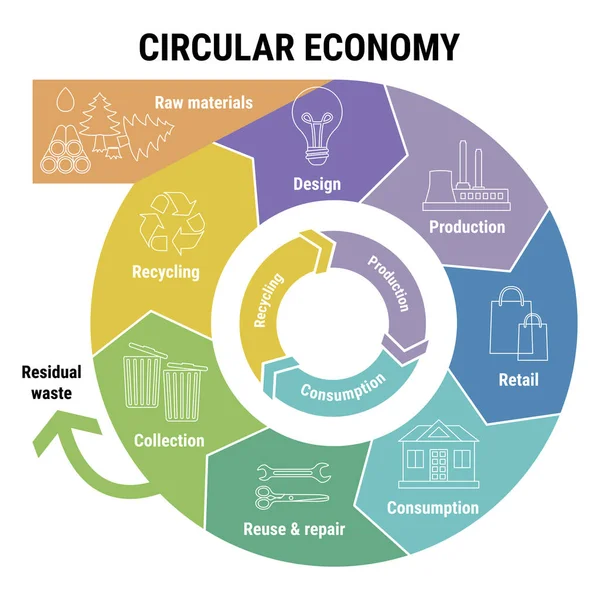
This infographic illustrates the core loop of the circular economy, showing how materials flow from raw resources to design, production, retail, and ultimately back through reuse, repair, collection, and recycling.
The Rural Waste Crisis: From Farm Residue to Environmental Hazard
India’s agricultural sector generates nearly 500 million tonnes of crop residue annually, a large portion of which is burned in the open. This results in severe air pollution, especially in northern states like Punjab and Haryana. The infamous Delhi smog is often attributed to stubble burning. Beyond air quality, residue burning leads to the loss of essential soil nutrients and microbial biodiversity.
Apart from stubble, Indian farms are also plagued by plastic pollution in the form of mulch films, fertilizer bags, and pesticide containers. These materials are rarely recycled and are either burned or dumped in fields. Over time, they release microplastics into the soil, affecting food safety and crop health. Reports by the ICAR suggest growing concerns over non-biodegradable waste in intensive farming zones.
Chemical-intensive agriculture has also contributed to invisible but devastating waste—nitrate leaching, pesticide runoff, and heavy metal accumulation. These pollutants contaminate groundwater, harming human and animal health. Villages reliant on borewells are exposed to unsafe drinking water. According to the Central Ground Water Board, many rural aquifers now exceed safe contaminant limits..
Household organic waste in villages—kitchen scraps, animal dung, and food leftovers—often rots in open pits or is dumped in nearby water bodies. This leads to pathogen proliferation, mosquito breeding, and groundwater contamination. Without decentralized composting systems, this waste remains untapped. Studies from TERI show how rural organic waste can be converted into compost or biogas if collected and processed correctly.
Livestock-generated waste is another overlooked stream. India has over 536 million livestock, producing enormous quantities of dung and urine daily. Without structured waste management, this becomes a vector for methane emissions, disease, and contamination.. Programs like GOBAR-DHAN aim to fix this but need greater community engagement.
The cumulative effect of unmanaged rural waste is a vicious cycle: polluted air, toxic water, degraded land, and deteriorating health. It worsens poverty and deepens vulnerability to climate shocks. Without intervention, the waste crisis will continue to undermine agricultural sustainability.
It’s no longer just an environmental issue—it’s a rural survival issue. Transitioning to zero-waste ecosystems is not just desirable—it’s imperative for rural India’s future.
Circular Solutions: Closing Loops in Agricultural Villages
Rural India is adopting circular models like vermicomposting, community biogas plants, and organic composting to transform waste into resources. These systems process kitchen waste, farm residue, and animal dung into soil enhancers or clean energy. With support from Krishi Vigyan Kendras and Earth5R, villagers are building localized waste loops that improve yield and cut costs.
Crop residues once burned are now reused via mulching techniques, biochar production, and green manure creation. NGOs like CSE are training farmers to compost paddy husks, wheat stubble, and sugarcane trash. Some villages sell enriched compost to nearby farms, creating revenue from former waste. These techniques reduce air pollution while restoring soil health.
Plastic waste in agriculture—from mulch films to pesticide containers—is a growing threat. Solutions like eco-bricking, plastic waste collection points, and agri-recycling cooperatives are emerging. Some regions have introduced biodegradable plastic alternatives and campaigns for plastic-free farming, enabling farmers to reduce long-term soil contamination.
Greywater from homes is being reused through constructed wetlands, stone filtration units, and soak pits. In Gujarat and Telangana, treated greywater irrigates kitchen gardens, reducing borewell dependence. Programs under the MGNREGS are building village-level wastewater recycling systems. This improves hygiene and enables circular water loops in agriculture.
Circular energy systems are emerging via biomass fuel, solar pumps, and gobar gas plants. Sugarcane bagasse and groundnut shells are converted into rural electricity and cooking fuel. These reduce diesel use and create carbon credit income. Earth5R models show how clean energy loops can lower emissions and create jobs in villages.
Government schemes like NITI Aayog’s CE roadmap, PM-KUSUM, and Swachh Bharat Mission support local circular systems. Earth5R’s zero-waste village projects integrate sustainability education, community participation, and livelihood creation. Their scalable model aligns waste management with regenerative agriculture, offering a replicable solution for India’s villages.
Earth5R Case Studies: Rural Transformation Through Zero-Waste Models
Earth5R has implemented zero-waste farming in villages by integrating community-based composting, sustainable agriculture, and circular livelihoods. In Maharashtra’s Raigad district, residents converted farm waste into organic fertilizers, cutting input costs by 40%. Women-led self-help groups were trained in vermiculture techniques, creating jobs and reducing dependence on chemical inputs. The initiative also improved soil health indicators.
In Tamil Nadu, Earth5R collaborated with farmers to replace burning practices with bio-composting units, using stubble to enrich soil rather than pollute the air. Through climate education programs, villagers learned to create eco-bricks from plastic waste, addressing agri-plastic pollution. The integrated system combined water conservation and energy reuse for irrigation. This model helped the village become nearly self-reliant in inputs within one harvest cycle.
In Uttarakhand, Earth5R introduced greywater filtration and home-scale compost bins to improve rural sanitation and soil productivity. Households filtered kitchen water for backyard gardens and used food waste for compost generation. With support from MGNREGS, villagers built soak pits and trenches to manage waste water. These solutions elevated hygiene standards while strengthening climate resilience.
In Karnataka, Earth5R collaborated with youth to build solar dryers for drying produce, reducing post-harvest waste by up to 60%. Using upcycled materials, young entrepreneurs designed dryers for small landholders. These devices preserved food longer and enabled sales in organic marketplaces, boosting income. The initiative bridged clean energy access with circular farming, proving that innovation can emerge from within communities.
Earth5R’s projects have also focused on women empowerment in farming through zero-waste initiatives. In Madhya Pradesh, SHGs received training in agro-waste recycling and compost marketing. Women-led bio-compost businesses increased household incomes while restoring the local ecology. Partnerships with CSR programs provided seed funding and infrastructure for scale.
Each Earth5R village transformation aligns with the UN Sustainable Development Goals, especially those targeting climate action, responsible consumption, and decent work. The model combines citizen science with hands-on training to make sustainability tangible. These case studies demonstrate that with the right tools, education, and partnerships, rural India can transition from linear farming to thriving zero-waste ecosystems.
Farm to Fork to Fertilizer: Integrating Food, Waste, and Soil
The farm-to-fork model traditionally ends at consumption, but circular agriculture extends it to include waste recovery and soil regeneration. In zero-waste villages, food scraps from households are turned into organic compost, closing the loop. Community kitchens and homes use compost bins to divert food waste from dumping sites. This reduces methane emissions from rot and restores nutrient cycles.
Food that reaches local markets often involves losses at post-harvest and retail stages. To address this, Earth5R has introduced solar food dryers and value-added processing for surplus vegetables and grains. Farmers preserve excess produce to reduce spoilage and extend shelf life. This not only cuts food waste but also adds economic value to every harvest. Circular farming thereby integrates preservation into the food supply chain.
Once food is consumed, its remnants—vegetable peels, leftovers, and crop residue—are treated as soil resources. These are processed into vermicompost, biofertilizers, or natural manures like jeevamrut. This replenishes soil with microbial life and micronutrients lost in intensive farming. Zero-waste systems make every morsel part of a nutrient recovery cycle, helping farmers reduce chemical dependency.
At the village level, this cycle is often facilitated through community compost hubs or integrated farming systems. Residents bring waste to collection points, where it’s weighed, sorted, and processed. This data-driven tracking allows for better nutrient budgeting. Local SHGs often manage these units, creating green jobs while making compost affordable and accessible to all farmers.
Even livestock and poultry waste are reintegrated into the food system through biogas digesters, slurry reuse, and manure drying systems. This circular model replaces chemical energy and fuel inputs with renewable alternatives. In addition, these byproducts enrich fodder fields and kitchen gardens, completing the biological loop. Earth5R’s training in livestock waste circularity shows that every form of waste has regenerative potential.
The full-circle approach improves soil health, food security, and climate resilience. Instead of ending at consumption, food systems return their nutrients to the land, revitalizing the next harvest. Earth5R’s model proves that a closed food loop is practical, profitable, and sustainable. It’s not just about reducing waste—it’s about feeding the soil that feeds us.
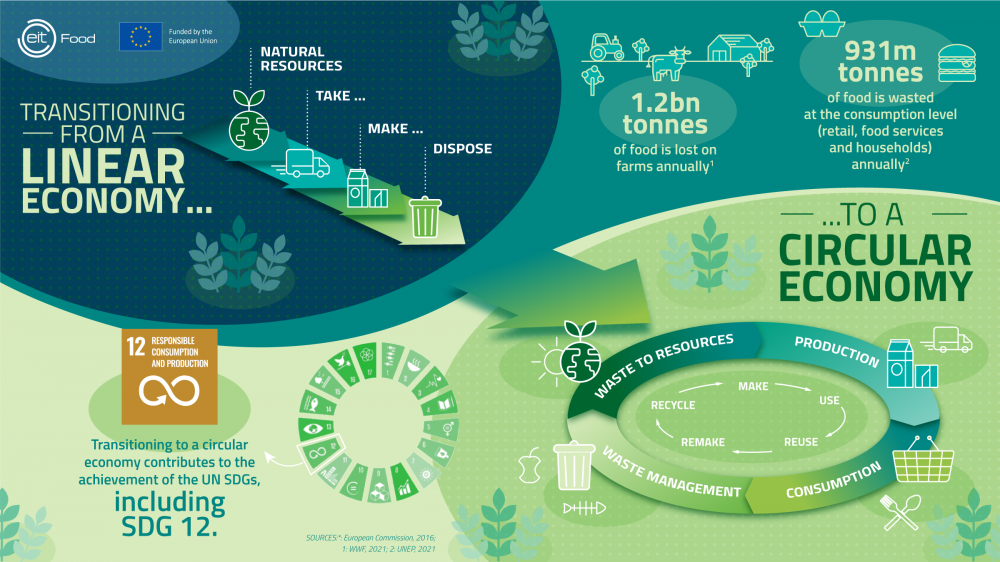
This infographic contrasts the wasteful linear economy—based on taking, making, and disposing—with a regenerative circular economy that reuses, remakes, and recycles resources.
Livelihood Opportunities in Circular Agriculture
Circular agriculture generates new income streams from what was once waste. Farmers trained in composting, vermiculture, and biofertilizer production can sell organic inputs locally. Programs like Startup India and Agri-Clinics and Agri-Business Centres support rural entrepreneurs entering green business. Earth5R’s training modules help villagers turn biowaste into micro-enterprises, creating circular income cycles.
Women’s self-help groups are emerging as key drivers of this shift. In Earth5R’s Maharashtra projects, women manage community compost hubs, make eco-products from agri-waste, and handle local waste audits for farms. With support from NRLM, women-run green businesses now supply compost, upcycled packaging, and natural fertilizers. These ventures offer financial independence while improving ecological outcomes.
Youth in villages are using technology to scale circular systems. From building solar dryers to launching mobile waste collection apps, young innovators are reimagining farming as a clean-tech opportunity. Government schemes like Atal Innovation Mission and Digital India are fueling this ecosystem. Earth5R’s digital literacy programs empower rural youth to monitor waste cycles, carbon savings, and compost distribution.
There’s also growth in services like sustainable supply chain logistics, waste-to-energy consulting, and green certification audits. Farmers now offer consulting on organic transitions and zero-waste methods, adding intellectual capital to the local economy. Circular farming supports not just produce sales but knowledge-based services, shifting farmers from laborers to agripreneurs.
Biogas plants, when community-owned, become shared income assets. The GOBAR-DHAN scheme encourages collective slurry marketing and renewable energy cooperatives. Farmers and SHGs managing digesters can earn by selling biogas to households and bio-slurry as fertilizer. This turns waste into wealth and brings energy security to remote communities.
Circular livelihoods also create resilience during crises. During COVID-19, Earth5R’s village compost units remained operational, helping residents grow food and earn via local bartering systems. This decentralization reduces economic shocks from supply chain failures. As climate change and global disruptions intensify, circular work models make rural communities less dependent, more regenerative, and economically vibrant.
Women and Youth: The New Champions of Zero-Waste Farming
Women are increasingly becoming the stewards of sustainable agriculture, especially in zero-waste rural systems. Through Earth5R’s soil revival projects, women have been trained in organic input preparation, composting methods, and community waste management. With support from Self-Help Groups (SHGs), they manage compost units and organic marketplaces. This enables both environmental and financial empowerment.
Women-led initiatives are also addressing plastic pollution and greywater reuse. In Earth5R’s projects, rural women have turned agro-waste into eco-friendly products, including seedling trays, packaging, and bags. Some SHGs now run eco-brick workshops and train other communities in zero-waste living. These practices enhance circular economies while reducing environmental degradation caused by linear consumption.
Youth are embracing zero-waste farming as a future-ready career path. In Karnataka, Earth5R’s solar dryer initiative was led by student innovators using upcycled materials to reduce food spoilage. Others are developing digital monitoring tools to track compost production and waste cycles. Youth clubs supported by Atal Innovation Mission and Skill India are bringing tech-driven circularity into rural ecosystems.
In some villages, young people are launching agri-based startups that offer services like biofertilizer delivery, waste pickup, and compost marketing. With guidance from Earth5R and access to government seed funds, these youth-led enterprises are becoming profitable while solving local waste challenges. Their innovations are not only boosting income but also shifting public attitudes about agriculture.
Programs focused on climate education, green entrepreneurship, and citizen training are preparing the next generation of eco-leaders. Young farmers now see value in regenerative systems that combine profit with environmental care. Earth5R’s hands-on sustainability modules in schools and colleges have inspired many to stay in their villages and build local impact rather than migrate to cities.
The dual leadership of women and youth is transforming zero-waste farming into a social movement. Their combined efforts are reviving community ownership, restoring ecological balance, and building intergenerational sustainability. Earth5R’s rural models prove that when women and youth are empowered with knowledge and tools, they become the strongest agents of change in India’s circular transition.
Barriers to Adoption and How to Overcome Them
One of the biggest barriers to zero-waste farming is the lack of awareness about circular models. Most rural communities remain unfamiliar with the economic value of waste and the climate impact of unsustainable agriculture. Earth5R addresses this through citizen science education and village-level training in local languages. When people understand that waste equals opportunity, adoption improves organically.
The lack of infrastructure is another major obstacle. Many villages lack composting pits, biogas plants, or even waste segregation bins. Earth5R collaborates with CSR programs, gram panchayats, and government schemes to co-develop low-cost waste infrastructure. This localized approach ensures long-term sustainability.
Behavioral resistance is common, especially regarding chemical fertilizer overuse and stubble burning. Farmers often fear lower yields or higher labor. Earth5R counters this through demonstration farms and community engagement programs that showcase results. Success stories from neighboring villages often become powerful motivators for behavioral change.
Policy fragmentation limits implementation of circular systems. Although initiatives like GOBAR-DHAN, PM-KUSUM, and Soil Health Cards exist, they operate in silos. There’s a need for integrated models combining waste reuse, energy recovery, and regenerative agriculture. Earth5R advocates for multi-sector collaboration to bridge this gap.
Market limitations discourage farmers from selling bio-compost, eco-products, or biogas slurry. Many struggle to access mandis or digital markets. Earth5R enables SHGs to build local value chains and reach buyers directly. Building demand is as vital as creating supply in circular systems.
A major challenge is the skill gap in managing circular systems. Many farmers lack knowledge in waste recovery science, business planning, or green technology. Earth5R provides hands-on rural mentorship and toolkits to build capacity. With the right skills and support, circular farming shifts from a challenge to a local innovation opportunity.
Conclusion: From Waste to Wealth – Scaling Sustainable Rural Futures
Zero-waste farming is no longer a theory—it’s a growing movement across India’s villages that transforms waste into a valuable resource. Models that close the loop between production, consumption, and regeneration are proving both sustainable and profitable. Earth5R’s community-driven approach is evidence that with education, support, and local ownership, even low-resource villages can thrive in a circular economy.
The success of Earth5R’s interventions shows that circularity thrives when tied to livelihood creation, gender equity, and youth engagement. From composting to biogas, upcycling to solar drying, every waste stream offers an economic opportunity. When communities are equipped with the right tools and training, circular systems become self-sustaining and replicable.
To scale these solutions, integrated policy support is crucial. Programs like PM-KUSUM, GOBAR-DHAN, and Digital India offer fragmented yet powerful incentives. What’s needed is a cohesive, village-level framework that links agricultural waste management, clean energy, and soil regeneration under one umbrella. Earth5R’s holistic models can guide this integration.
Technology must also play a larger role in enabling smart, circular farming. From IoT-based compost monitoring to blockchain traceability, tools already exist to track waste conversion, improve transparency, and open up green markets. Youth-led innovation hubs, supported by missions like Atal Innovation Mission, can bridge the digital divide in rural areas.
Earth5R’s scalable success shows that bottom-up change, when aligned with global goals like climate action and sustainable consumption, can build resilient food systems. When farmers become climate stewards, and waste becomes wealth, villages evolve into self-sustaining ecosystems. The circular model ensures that growth is not extractive—but regenerative and inclusive.
India’s rural future can be both green and abundant. By turning agricultural villages into circular innovation hubs, we ensure not only food security, but also climate resilience, economic dignity, and community empowerment. With collaborative effort, rural India can lead the world in zero-waste innovation, proving that the path from waste to wealth is already being walked.
Frequently Asked Questions: How Circular Economy Principles Are Reinventing Rural Agriculture
What is zero-waste farming?
Zero-waste farming is an agricultural system where all organic waste—crop residue, food scraps, livestock manure—is reused to regenerate soil, produce energy, and create income-generating byproducts like compost and biogas.
How does circular agriculture benefit rural farmers?
It reduces dependence on chemical fertilizers, cuts input costs, and creates new income streams through compost sales, biogas, and eco-product manufacturing.
What types of waste are reused in zero-waste villages?
Farm waste, food scraps, livestock dung, greywater, agro-plastics, and biomass are all reused in composting, biogas, and upcycling units.
Is zero-waste farming economically viable?
Yes, by converting waste into valuable products and reducing external input costs, farmers can significantly improve their profit margins.
How does Earth5R support rural circular economy projects?
Earth5R trains communities in composting, bio-fertilizer production, upcycling, and climate education while connecting them to markets and infrastructure partners.
Can women and youth participate in zero-waste initiatives?
Absolutely. Women run SHGs for composting and eco-brick production, while youth innovate with solar dryers and digital waste-tracking tools.
What role does composting play in this model?
Composting transforms organic waste into nutrient-rich fertilizer, reviving degraded soils and replacing harmful chemical inputs.
How is biogas used in zero-waste villages?
Biogas plants convert livestock dung into clean cooking gas and slurry fertilizer, reducing reliance on LPG and firewood.
What government schemes support circular agriculture?
PM-KUSUM, GOBAR-DHAN, Soil Health Cards, and NRLM are among several schemes that provide subsidies and training for circular systems.
How do farmers sell compost or upcycled products?
Through SHGs, local markets, e-commerce platforms, and partnerships with NGOs and corporate CSR programs.
Is training required for zero-waste farming?
Yes, farmers need skills in composting, organic input preparation, waste management, and basic business planning, often provided by organizations like Earth5R.
How are villages handling plastic and non-organic waste?
Non-biodegradable waste is converted into eco-bricks or upcycled into products like bags, packaging, and seedling trays.
What impact does zero-waste farming have on the environment?
It reduces methane emissions, prevents open burning, restores soil health, and mitigates groundwater pollution.
Are there successful case studies in India?
Yes, villages in Maharashtra, Tamil Nadu, Uttarakhand, and Karnataka have adopted Earth5R’s zero-waste model with measurable social and ecological impact.
What is a farm-to-fork-to-fertilizer model?
It’s a closed-loop system where food is grown, consumed, and its waste is returned to the soil as compost or biofertilizer, completing the cycle.
How do circular models promote livelihood generation?
They create green jobs in composting, waste management, bio-energy, and eco-product manufacturing, especially for women and youth.
Can zero-waste systems be replicated across all rural areas?
Yes, with proper training, infrastructure, and policy alignment, the model can scale to diverse agro-climatic regions.
What are the main challenges to adoption?
Lack of awareness, infrastructure gaps, behavioral resistance, fragmented policies, and limited market access are key barriers.
How are these challenges being overcome?
Through community-led demonstrations, partnerships with CSR programs, integration with government schemes, and hands-on training.
Why is circular agriculture important for India’s future?
It offers a sustainable path to food security, economic resilience, environmental restoration, and climate adaptation for rural communities.
Call to Action: How Circular Economy Principles Are Reinventing Rural Agriculture
India’s villages are sitting on a goldmine of untapped potential—agricultural waste that can power livelihoods, restore soil, and generate clean energy. Zero-waste farming isn’t a luxury; it’s a necessity for climate resilience and rural prosperity. Every compost pit, solar dryer, and biogas plant brings us closer to a self-sustaining ecosystem where waste becomes wealth.
Now is the time to invest in the people who feed the nation. By supporting circular farming models, we not only uplift farmers but also reduce environmental degradation and strengthen the local economy. Whether you’re a policymaker, business leader, student, or citizen, your role in this transition is critical. Scalable change begins with collective participation.
Communities must be empowered with training, infrastructure, and market access to make zero-waste systems the norm, not the exception. With the right support, rural India can lead the world in sustainable innovation. The transformation is already underway—it just needs your hands to build it faster and stronger.
Join the movement. Advocate for circular farming, support local initiatives, and help spread awareness. When rural communities rise through sustainability, the entire nation thrives. Let’s turn India’s farming villages into beacons of climate leadership, one zero-waste model at a time.
–Authored by Barsha Sharma