
Organic India Rising: Farmers Redefining Sustainability : An Earth5R Insight
A special report on the farmer-led circular economy movement that is transforming India’s agricultural landscape, one village at a time.
India’s agricultural journey is a story of profound paradox. The Green Revolution, a 20th-century triumph, secured the nation’s food supply and pulled millions back from the brink of famine. But this success, built on a foundation of chemical fertilizers and high-yield seeds, came at a steep ecological price.
Decades of this intensive model have left deep scars on the land. We see critically depleted groundwater tables, soils stripped of organic life, and alarming pesticide residues tainting our food and water. The very system that fed us is now testing our long-term resilience.
Yet, from this challenged soil, a powerful counter-narrative is sprouting. A quiet, determined, and farmer-led revolution is underway. This is “Organic India Rising,” a grassroots movement that is gaining unstoppable momentum, moving from the niche to the mainstream.
This is not just anecdotal. The data confirms a seismic shift. India currently has the highest number of organic producers in the world, with millions of farmers embracing the change. The domestic market for organic products is expanding at a remarkable rate, reflecting a new wave of consumer consciousness.
But to view this shift as merely a market-driven trend is to miss the real story. The rise of organic farming in India is far more than a simple switch from synthetic to natural inputs.
It represents a fundamental redefinition of “sustainability” itself. Farmers are moving beyond the passive slogan and architecting an active, holistic, and community-centric model that is both ancient in its wisdom and modern in its application.
This is the core insight from the extensive on-the-ground work of Earth5R, an organization at the forefront of this transformation. Their work with rural communities reveals a critical truth: True sustainability is achieved not just by changing inputs, but by creating closed-loop circular economy systems that empower farmers economically and restore ecosystems simultaneously.
This special report delves into this new sustainable paradigm. We will first explore the hard science and statistical bedrock that farmers are building upon, from soil carbon to human health.
We will then move to the front lines, presenting exclusive insights and case studies from Earth5R’s projects. You will see how farmers are turning systemic “waste” into agricultural “wealth” and leveraging technology to build climate resilience.
This is the story of a revolution, not just of what India grows, but of how it grows. It’s a farmer-led model for a future that is not just organic, but also circular, profitable, and truly sustainable.
Beyond the Hype: The Science and Statistics Fueling India’s Organic Wave
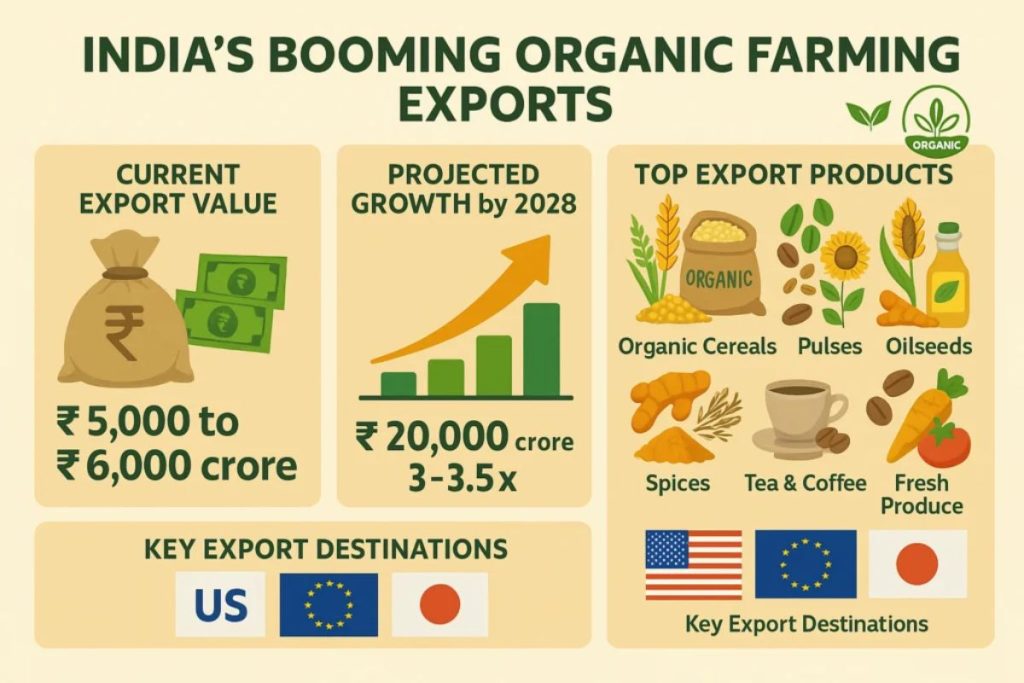
This farmer-led shift is not a fringe movement; it’s a verifiable economic and ecological trend, and the numbers are compelling. India now leads the world with the largest number of organic producers, a testament to a massive grassroots adoption involving millions of farming families.
This isn’t just for global markets. According to data from the Agricultural and Processed Food Products Export Development Authority (APEDA), while export-oriented organic cultivation continues to grow, it is the booming domestic market that signals a foundational change in what Indian consumers demand.
This groundswell has been actively nurtured by forward-thinking government policy. The Paramparagat Krishi Vikas Yojana (PKVY), in particular, has been a critical catalyst. It promotes a cluster-based approach, helping smallholders, who form the backbone of Indian agriculture, to band together to share resources and knowledge, easing the often-difficult transition.
Crucially, the scheme champions the Participatory Guarantee System (PGS). This innovative “for the farmers, by the farmers” model is a decentralized certification system built on community trust. It empowers farmer groups to verify and vouch for each other’s organic practices, slashing the high costs and red tape of third-party certification that often exclude small farmers.
But policy and market demand are only part of the story. The real, lasting conversion is happening at a microbial level, in the soil itself. Farmers are embracing this change because they are witnessing the scientific revival of their own land.
The most critical factor, and the one most damaged by the chemical-intensive era, is soil health. Conventional farming often treats soil like inert dirt, a mere medium to hold a plant upright while dousing it with a cocktail of NPK (Nitrogen, Phosphorus, Potassium) salts.
Organic farming, in contrast, treats soil as a living, breathing ecosystem. By reintroducing organic matter like compost, green manure, and cover crops, farmers are rebuilding Soil Organic Carbon (SOC). Think of SOC as the soil’s “battery” and “sponge.”
Research from institutions like the Indian Council of Agricultural Research (ICAR) consistently shows that for every 1% increase in SOC, soil can hold significantly more water. This single, research-backed fact is revolutionary for a nation’s farmers, making their land dramatically more resilient to India’s increasingly erratic monsoons and severe droughts.
This living soil then fosters a cascade of benefits. When synthetic pesticides are eliminated, the farm’s micro-ecosystem rebounds. Farmers universally report the return of earthworms, spiders, and ladybugs. These creatures aren’t just welcome guests; they are a free, 24/7 labor force.
Scientific studies on agroecology confirm that these natural predators effectively manage pests, and the resurgence of native bees and butterflies boosts pollination. This restoration of biodiversity creates a more stable, self-regulating, and resilient farm system.
Of course, the benefits extend directly to our dinner plates. The most obvious is the drastically reduced load of harmful pesticide residues on and in our food, a pressing public health concern for families across the nation.
But the science goes deeper. A growing body of research, including a landmark meta-analysis from the British Journal of Nutrition, suggests that organic crops are not just cleaner.
These studies found that organic produce often contains significantly higher concentrations of antioxidants, specifically polyphenols. The working theory is that these plants, unstressed by artificial chemicals and forced to build their own natural defenses against pests and disease, produce more of these complex compounds, which are precisely what our bodies value for long-term health.
Despite this compelling scientific and economic case, the transition to organic is not a simple path. Farmers face very real and often daunting challenges.
These hurdles include the high initial cost of organic inputs, a potential “yield lag” in the first few years as the soil biology recovers, and a critical knowledge gap for managing pests and diseases naturally.
Perhaps the biggest barrier is the disconnect from reliable markets that will pay a fair premium for their intensive efforts. Certification alone is not a magic wand, and this is where traditional organic models often fall short.
It’s a systemic gap that demands a systemic solution. This is precisely where innovative, community-based circular economy models, like those championed by Earth5R, are beginning to write the next chapter.
Redefining Sustainability: The Earth5R Insight in Action
The primary roadblock for organic farming in India isn’t philosophy, it’s economics. Farmers ask the hard, practical questions: How do I survive the three-year transition? How do I fight pests without chemicals? And who will guarantee me a better price for my efforts?
This is where the traditional “organic” model often fails, and where the Earth5R insight begins. Their on-the-ground action, through initiatives like the Rural Sustainability Program and the CircularFarms Network, is built on a simple but profound truth: environmental sustainability must be profitable, scalable, and owned by the community.
This philosophy is best understood not through reports, but through action. Earth5R’s model is a live ecosystem, a series of interconnected case studies that demonstrate how to solve systemic problems by creating value from what was previously considered “waste.”
Case Study 1: The Circular Economy – From Waste to Wealth
For decades, the agricultural “waste” of one season has been the public health crisis of the next. The annual stubble burning in North India is a tragic example, a desperate act by farmers that chokes cities in smoke and, ironically, destroys the rich organic carbon in their own fields.
Earth5R’s intervention re-engineers this problem into a solution. Instead of just “awareness campaigns,” they implement waste-to-wealth models that train farmers and, crucially, local women’s self-help groups (SHGs), to see this residue as a resource.
The first pathway is composting and biochar creation. Farmers are trained to convert this agri-residue into a carbon-rich soil amendment. In a project spanning several villages, this Earth5R model prevented the burning of 10,000 tons of crop residue. The scientific impact, as cited in their project data, was a direct mitigation of approximately 18,000 tons of CO2 emissions.
The second pathway is even more direct. Other forms of waste, from agri-residue to collected urban refuse, are processed into bio-fuel pellets. This creates a clean, local energy source and, critically, a new business. Earth5R’s data indicates this model has generated ₹12 million annually for local entrepreneurs.
This is the Earth5R Insight in action: Sustainability is redefined as a revenue-positive circular economy. The farmer is no longer just a food producer, but a resource manager, capturing carbon and energy, and earning from both.
Case Study 2: Tech-Enabled Transition – The App and Carbon Farming
The second major barrier for farmers is trust. How do they prove to a distant buyer that their produce is genuinely organic? And how can they be compensated for practices, like planting cover crops, that don’t have an immediate, visible profit?
The answer is technology. The Earth5R App is a powerful tool for transparency and empowerment. It functions as a digital field-diary, enabling farmers and field agents to log and validate every sustainable action, from applying compost to installing drip irrigation.
This creates an unforgeable record known in the climate-tech world as MRV (Monitoring, Reporting, and Verification). This verified data acts as a digital passport, proving the crop’s organic integrity and connecting farmers directly to premium markets, solving the market-linkage problem.
But the app’s most revolutionary function is unlocking a brand-new income stream: carbon farming.
By scientifically validating practices that sequester carbon in the soil (like non-tillage and composting), the app generates data that is eligible for the global carbon credit market. For the first time, farmers are not just paid for their produce (what they grow), but for their process (how they grow it).
Earth5R estimates this can unlock an additional ₹800 to ₹1,200 per year for a small farmer. This redefines sustainability as a data-driven, verifiable, and financially rewarded process, turning climate action into a reliable paycheck.
Case Study 3: The Urban-Rural-Corporate “Green Corridor”
The final case study solves a great paradox of modern India: our cities, like Mumbai or Thane, are drowning in organic waste, spending crores to dump it in methane-spewing landfills. Simultaneously, our rural farms, just a few kilometers away in districts like Palghar, are starved of the very organic matter that this “waste” contains.
Earth5R’s solution is to build a symbiotic loop, a “Green Corridor” that connects these two problems.
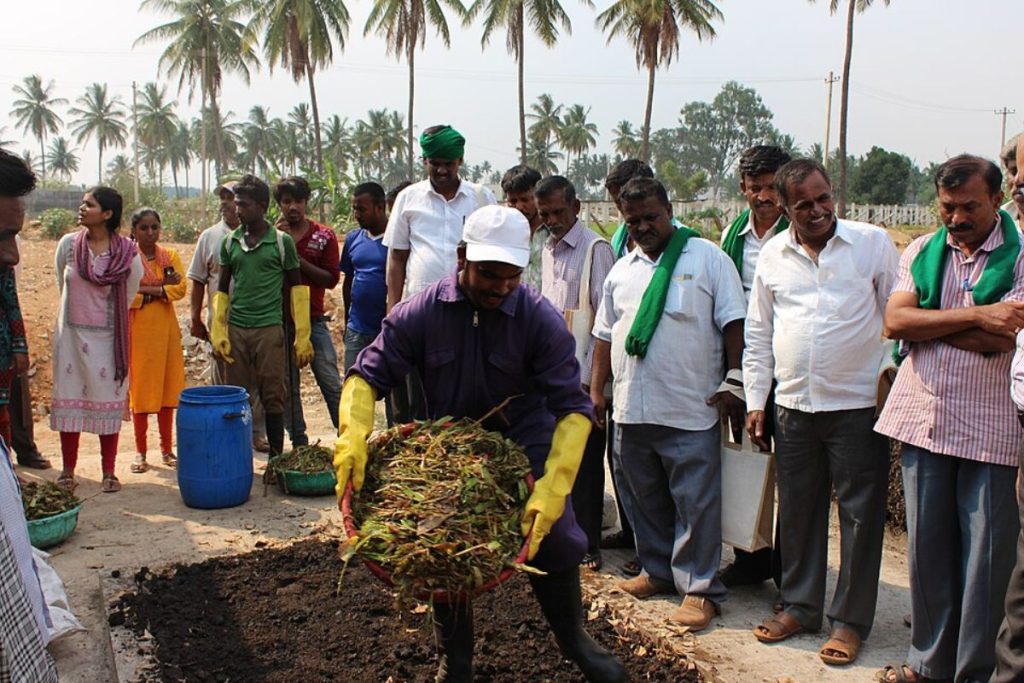
The model works through three-way partnerships. First, Earth5R partners with corporations to fund the initiative as a part of their Corporate Social Responsibility (CSR). Second, they work with municipalities to collect and divert tons of segregated urban organic waste (from vegetable markets, housing societies) from landfills.
Third, this waste is processed at decentralized hubs into high-grade, nutrient-rich compost. This “black gold” is then transported to partner farmer groups in the rural belt, providing them with a low-cost, high-quality organic fertilizer.
The loop is closed when these farms, with their soil now enriched, supply their certified organic produce back to urban consumers, often the same corporations and communities that provided the waste.
This is the most holistic redefinition of sustainability: a system-level, cross-sectoral partnership that breaks down the false wall between urban and rural, turning a city’s liability into a farmer’s greatest asset.
The Harvesters: How This Revolution is Empowering Communities
The technology and the circular economy models are, at their core, just tools. The true engine of this sustainable revolution is the community itself. This is not a top-down corporate mandate, but a human-centric model built on trust, shared knowledge, and grassroots mobilization.
This approach is a living embodiment of the Earth5R philosophy: sustainable change is most effective and lasting when it is driven by the very community that owns, and benefits from, that change.
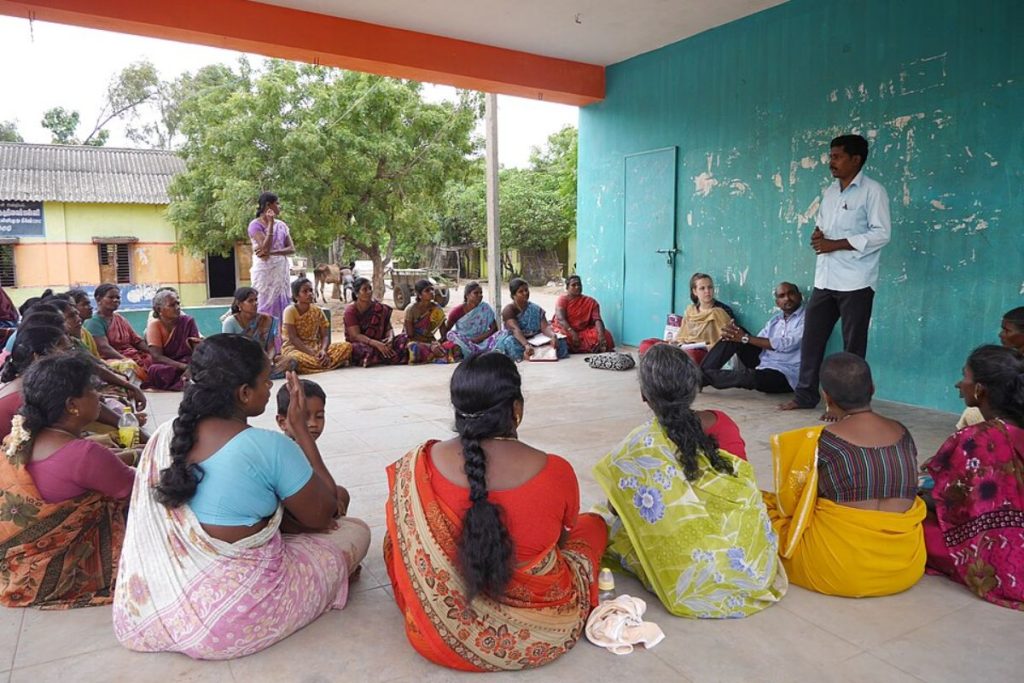
They achieve this by identifying and training local “Green Champions.” These are trusted, enterprising farmers who become advocates and mentors. They demonstrate the new techniques on their own land, creating a powerful, localized proof-of-concept.
This “farmer-to-farmer” knowledge sharing is infinitely more potent than any expert’s lecture, as it relies on the most persuasive form of evidence, which is a neighbor’s tangible success.
This revolution is also profoundly inclusive. It actively redraws the economic map of the village by empowering those who have traditionally been on the margins, especially women.
A cornerstone of the Earth5R model is the deep integration of Women’s Self-Help Groups (SHGs). These organized, highly effective, and entrepreneurial community groups are trained to become the primary operators of the new circular economy.
In village after village, it is these women who manage the community composting units, run the waste-to-wealth enterprises, and manufacture the bio-fuel pellets. This isn’t just a token role, it’s entrepreneurship. It provides women with a new, independent stream of income and elevates their status as key economic decision-makers in the community.
Furthermore, this model is a powerful engine for creating “green jobs,” a concept that international bodies like The World Bank identify as critical for a just and sustainable transition.
Instead of displacing labor, this sustainable model creates entirely new, skilled roles: solar pump technicians, compost quality managers, biodiversity auditors, and digital-savvy ‘Green Champions’ who manage the app-based data collection.
The impact of this shift is best captured not in statistics, but in the words of the farmers themselves. The transformation is, in essence, one of identity.
We spoke to a farmer in the Palghar district who recently completed his transition. His perspective encapsulates the entire movement.
“Before, I was only a buyer,” he explained. “I bought expensive chemical fertilizers, I bought toxic pesticides, and I bought seeds from the same company every year. My profits were decided by them.”
“Now, I am a producer in every sense. I produce my own compost, my own pest control. With the Earth5R model, I am even learning to sell carbon credits. I am no longer just a farmer waiting for rain; I am an entrepreneur managing a sustainable business.”
Conclusion: The Future is Organic, Circular, and Farmer-Led
The story of “Organic India Rising” is, in the end, far more than a simple agricultural trend. It is a story of a quiet, powerful, and necessary revolution. The initial success, seen in the millions of farmers and hectares now certified, was just the opening chapter.
The true potential, now being unlocked by innovators like Earth5R and the farming communities they partner with, is proving to be a systemic re-architecture of our entire relationship with the land and the economy.
The central insight is now clear and undeniable: for sustainability to be sustainable, it must be profitable, and for it to be scalable, it must be community-owned.
This new model redefines sustainability itself. It is no longer a passive act of just “avoiding” chemicals. It is an active, intelligent, and data-driven process that:
- Finds value in what was once “waste”
- Builds wealth from the soil up
- Uses technology to connect farmers to new forms of income like carbon credits
- And places women at the center of this new green economy
The farmers of India are not just feeding the nation. They are providing a real-time, working-on-the-ground blueprint for a climate-resilient future.
They are demonstrating that it is possible to de-link economic growth from ecological degradation. This farmer-led model, rooted in the principles of the circular economy, is perhaps India’s most powerful, scalable, and hopeful solution to the climate crisis.
The revolution is not just in what they grow, it is in how they grow and the resilient, profitable, and regenerative systems they are building for all of us.
Frequently Asked Questions: Understanding India’s Organic Revolution
What is “Organic India Rising” really about?
It refers to the significant, data-backed movement of Indian farmers shifting away from chemical-intensive agriculture toward organic and sustainable practices. This is driven not just by market demand, but by a need to restore soil health and build economic resilience, with India now having the most organic producers in the world.
Isn’t organic farming just farming without pesticides?
That is a common misconception. While it avoids synthetic pesticides and fertilizers, true organic farming is a holistic system. It focuses on proactively building healthy, living soil using compost and crop rotation, which in turn creates resilient plants that can naturally resist pests, reducing the need for pesticides in the first place.
What is the “circular economy” in agriculture?
A circular economy moves away from the linear “take-make-dispose” model. In farming, this means treating “waste” as a valuable resource. For example, instead of burning crop stubble, it is converted into nutrient-rich compost or biochar to feed the soil, or processed into bio-fuel pellets for energy, creating a closed, profitable, and self-sustaining loop.
How does Earth5R’s model differ from standard organic farming?
Earth5R’s insight is that environmental sustainability must also be economically profitable for the farmer. Their model integrates organic farming with a community-owned circular economy. They train farmers to turn all forms of waste, from agri-residue to urban garbage, into valuable products like compost and fuel, creating new revenue streams that fund and accelerate the transition.
What is Soil Organic Carbon (SOC) and why is it so important?
Think of Soil Organic Carbon as the “lifeblood” of the soil. It’s the “C” in CO2, pulled from the air by plants and stored in the soil as decomposed matter. Scientific research confirms that higher SOC levels create a sponge-like soil structure that holds more water, making farms far more resilient to drought. It also binds nutrients and feeds the soil microbes that are essential for plant health.
What is a “waste-to-wealth” model?
It is the practical application of a circular economy. A powerful example is Earth5R’s program to combat stubble burning. By training farmer groups to convert 10,000 tons of crop residue into compost and fuel, they prevented 18,000 tons of CO2 emissions while creating new income for the community. The “waste” literally became “wealth.”
What is the Participatory Guarantee System (PGS)?
The PGS is a farmer-centric certification model. Instead of an expensive, top-down third-party inspection, it empowers local farmer groups to verify and vouch for each other’s organic practices. It’s a system built on community trust and shared knowledge, which drastically lowers costs and makes organic certification accessible for small farmers.
How does the Earth5R App help farmers?
The app is a critical tool for transparency and empowerment. It allows farmers to log and digitally verify their sustainable practices, like applying compost or reducing water use. This data creates a trusted digital record that helps them access premium markets and proves their eligibility for new income sources, like carbon credits.
How can a farmer earn money from carbon credits?
When a farmer uses practices like composting or no-till farming, they are actively pulling carbon from the atmosphere and storing it in their soil. The Earth5R app helps Monitor, Report, and Verify this carbon sequestration. This verified data can then be sold as carbon credits to companies wanting to offset their emissions, providing a new, direct paycheck to the farmer for their climate-positive actions.
What is the “Green Corridor” mentioned in the article?
The “Green Corridor” is an innovative, system-level solution by Earth5R. It solves two problems at once by connecting urban waste with rural needs. Massive amounts of organic waste from cities like Thane are collected, processed into high-grade compost, and then transported to partner farms in rural areas like Palghar, restoring their soil. The farms, in turn, sell their organic produce back to the cities.
Do organic farms produce lower yields?
This is a major myth. While some farms may see a temporary “yield lag” during the first one or two years of transition as the soil biology recovers, long-term studies show that established organic farms are often as productive, and sometimes more productive, than chemical farms. More importantly, they are far more resilient to drought and climate shocks because their healthy soil holds more water.
What is the benefit of organic food besides being “pesticide-free”?
The absence of pesticide residues is a major health benefit. However, research also suggests a potential “bonus.” A large-scale meta-analysis in the British Journal of Nutrition found that organic crops tend to have higher concentrations of antioxidants like polyphenols, which are beneficial compounds linked to long-term health.
How does this movement empower women?
This is a key part of the social impact. Earth5R’s model actively trains and partners with Women’s Self-Help Groups (SHGs) to run the new circular economy enterprises. These women’s groups manage the community composting units and waste-to-wealth businesses, providing them with independent income streams and elevating their role as economic leaders in the community.
What are “Green Champions” and the “farmer-to-farmer” model?
A “Green Champion” is a local farmer trained by Earth5R who acts as a community leader and mentor. The “farmer-to-farmer” model relies on these champions to teach their neighbors. This peer-to-peer learning is highly effective, as it’s based on a trusted community member demonstrating real-world success on their own land, which is more persuasive than any outside expert.
Why is biodiversity (like bees and earthworms) important for a farm?
Biodiversity is the farm’s free, natural labor force. Earthworms are “soil engineers” that create channels for air and water, while their castings are rich fertilizer. Bees and butterflies are essential for pollinating crops, ensuring a good harvest. Research on agroecology shows that a farm rich in biodiversity is more stable, resilient, and self-regulating.
What is the Indian government’s role in this?
The government has been a key catalyst through supportive policies. The Paramparagat Krishi Vikas Yojana (PKVY), for instance, provides financial and technical support to farmers who form clusters to adopt organic practices. Its promotion of the community-based Participatory Guarantee System (PGS) has been vital for small farmers.
How does this organic movement fight climate change?
It fights climate change on two fronts. First, conventional chemical fertilizer production is incredibly energy-intensive, so avoiding it reduces emissions. Second, and more importantly, organic practices that build Soil Organic Carbon (SOC) are a form of carbon sequestration. The soil literally pulls CO2 out of the atmosphere and stores it safely underground, turning farms into climate solutions.
Why did Indian farmers start using so many chemicals in the first place?
This was the legacy of the Green Revolution in the 1960s. At a time of severe food shortages, the model of high-yield seed varieties, chemical fertilizers, and pesticides was introduced. This model succeeded in achieving national food security and preventing famine, but the long-term, unintended consequences have been soil degradation and water pollution, which farmers are now working to reverse.
What is the biggest challenge for a farmer wanting to switch to organic?
The biggest hurdles are economic and knowledge-based. The three-year “transition period” to get certified can be difficult, as the soil is still healing and yields might temporarily dip. During this time, farmers also need new knowledge on how to manage pests and fertility naturally. This is why the Earth5R model, which provides new income streams (like from waste) during the transition, is so critical.
What is the final, most important “insight” from this article?
The most important insight is that sustainability must be profitable. The “Organic India Rising” movement is succeeding because models like Earth5R’s are proving that farmers can make more money, not less, by being sustainable. By turning waste into wealth and getting paid for climate action, farmers are becoming entrepreneurs who are both healing the planet and strengthening their own communities.
Join the New Harvest: Your Role in the Circular Revolution
The farmer-led revolution to redefine sustainability is not a distant trend; it is happening now, in the soil beneath our feet and in communities across India.
As this report shows, the shift to a circular, profitable, and farmer-owned model is already building a more resilient, wealthy, and healthy nation.
The great insight from Earth5R’s work is that everyone has a role to play in this new, closed-loop system. The question is no longer if this change is possible, but how you will be a part of it.
This isn’t just about charity; it’s about smart, sustainable investment in our shared future. The harvest is here. It is time to join.
~ Authored by Abhijeet Priyadarshi