
How to Design a CSR Policy: A Practical Guide for Boards and CSR Committees in India
What Section 135 and the CSR Rules require, updated for the 2025 and 2026 amendments. How a UN-backed river project was structured. What eight companies in the Above Average band of TERRA, Earth5R’s ESG intelligence platform, do differently. Plus a model CSR policy and a planning workbook you can download and adapt.
What the guide covers
- Why the CSR policy matters
- CSR in India by numbers
- The law in one page
- Rules that shape your policy
- What changed in 2025 and 2026
- Case study: the Mithi River
- Best cases from TERRA
- Twelve clauses worth copying
- Anatomy of a strong CSR policy
- A model CSR policy you can adapt
- Choosing focus areas
- Choosing and vetting partners
- From policy to annual action plan
- The CSR committee’s year
- Monitoring, impact and an indicator bank
- Ten common mistakes
- Policy review checklist
- Glossary of CSR terms
Free templates
Model CSR Policy (Word)
A fifteen-section policy with fill-in brackets, covering focus areas, geography, delivery model, due diligence, project standards, governance, fund management, impact assessment, exclusions and disclosure. Updated for the 2026 Rules.
CSR Planning Workbook (Excel)
A 2% obligation calculator with the 5% overhead check, an Annual Action Plan sheet under Rule 5(2), a weighted partner scoring grid, a due diligence checklist and the compliance calendar.
CSR in India by numbers
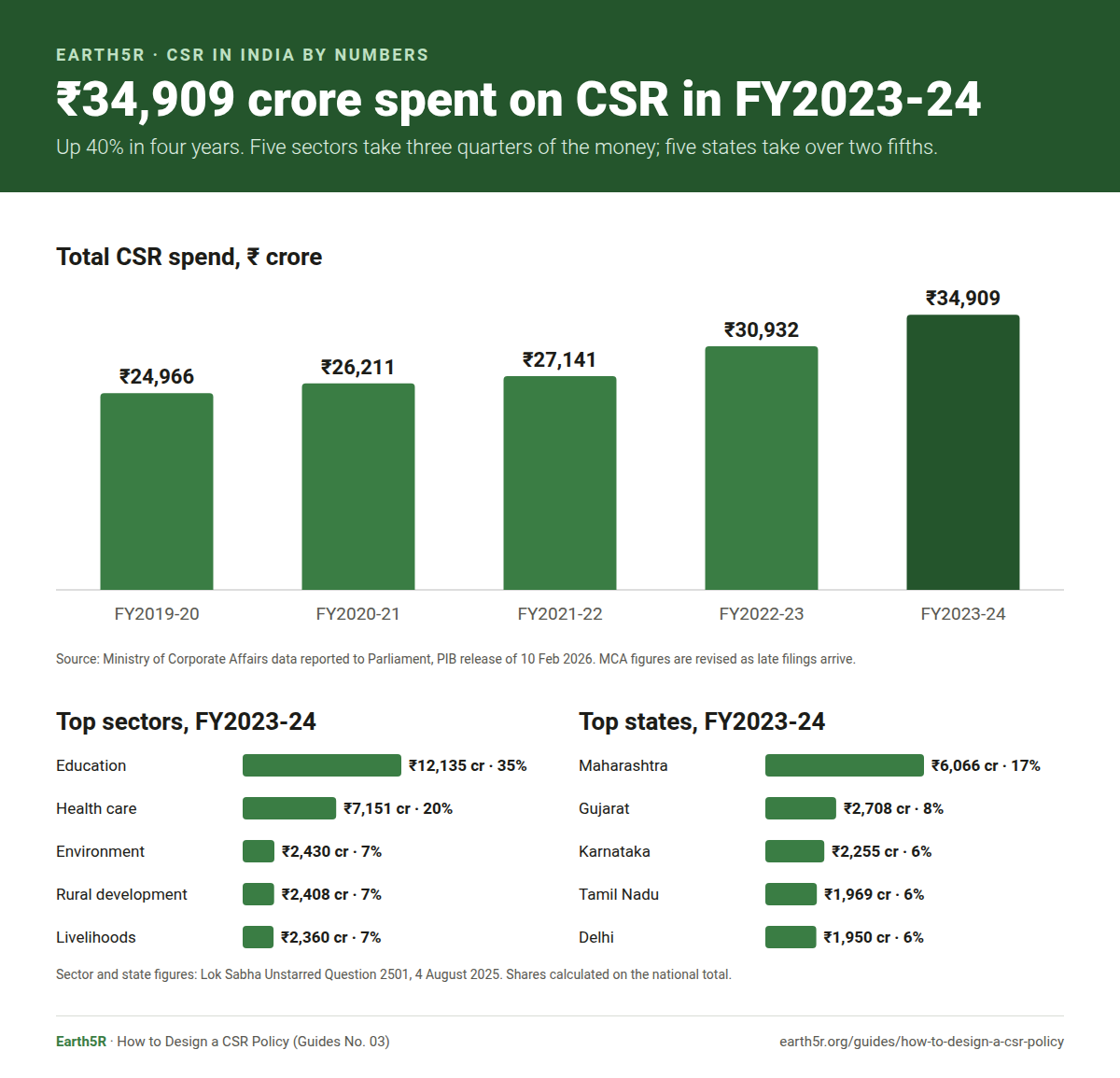
Companies spent ₹34,908.75 crore on CSR in FY2023-24, up from ₹24,965.82 crore in FY2019-20. Education (35%) and health care (20%) took over half; environmental sustainability about 7%. Five states, led by Maharashtra, received about 43% of the total. Aspirational districts received ₹1,402.89 crore in FY2022-23.
Case study: how a UN-backed river project was structured
On the Mithi River in Mumbai, Huhtamäki, the global packaging company, funded a €0.6 million project delivered by Earth5R with United Nations Technology Innovation Labs, RiverRecycle and the Municipal Corporation of Greater Mumbai. Between October 2020 and November 2024 it removed 11,100 tonnes of waste, 4,440 tonnes of it plastic, and trained 10,000 families and 500 businesses in the catchment. Earth5R then handed operations to the delivery partners.
| Design choice | What it teaches a CSR policy |
|---|---|
| A packaging company funded river plastic recovery | Choose focus areas linked to your own footprint |
| Four partners with distinct roles: funder, UN validator, technology, city | Name roles in the delivery model, not just grant recipients |
| Half the work was in the catchment | Fund the source of the problem, not only the symptom |
| Every plastic fraction had a destination | Require an output and asset plan for every project |
| Avoided emissions reported as estimates, no credits claimed | Set rules on what the company may claim |
| Designed for handover from day one | Make an exit plan a condition of approval |
Best cases from TERRA
All eight companies below sit in the Above Average band of TERRA, Earth5R’s ESG intelligence platform, which scores listed Indian companies on disclosed and ground-verified data. We read their statutory CSR reports, BRSR and impact assessments to find what others can copy.
| Company | Lesson | What their reports show |
|---|---|---|
| Tata Steel | Go deep where you operate | 57,70,219 people reached in FY2024-25, 94% from vulnerable and marginalised groups; ₹295.63 crore spent in aspirational districts. |
| HCLTech | Assess everything independently | Completed projects evaluated for inclusiveness, relevance, effectiveness, convergence and sustainability, with a social return on investment, annexed to the Directors’ Report. |
| Infosys | Use the rules to plan | Spent ₹526.26 crore in FY2024-25 and moved ₹16.15 crore to its Unspent CSR Account for ongoing projects within the 30-day window. |
| Hindustan Unilever | Build one community programme | Prabhat reached 12,21,629 beneficiaries in FY2024-25, 95% from vulnerable and marginalised groups. |
| Persistent Systems | Publish cost per beneficiary | Spent its full 2% (INR 237.71 million) in FY2025-26; health spending of INR 13,077 per beneficiary; independent assessments by Chhaaya Strategic Advisors. |
| ABB India | Budget for evidence | Spent ₹36.34 crore against ₹34.75 crore in 2025, including ₹14.40 lakh on impact assessment using OECD-DAC criteria. |
| Ashok Leyland | Let government help you target | Road to School blocks chosen with state education departments identifying educationally backward blocks; ₹18.26 crore of prior excess spend set off under Rule 7(3). |
| Dalmia Bharat | Measure social return | KPMG found 84.11% of surveyed DIKSHa skilling beneficiaries placed and a social return of ₹7.76 per rupee (2024). |
CSR policy checklist: 15 tests
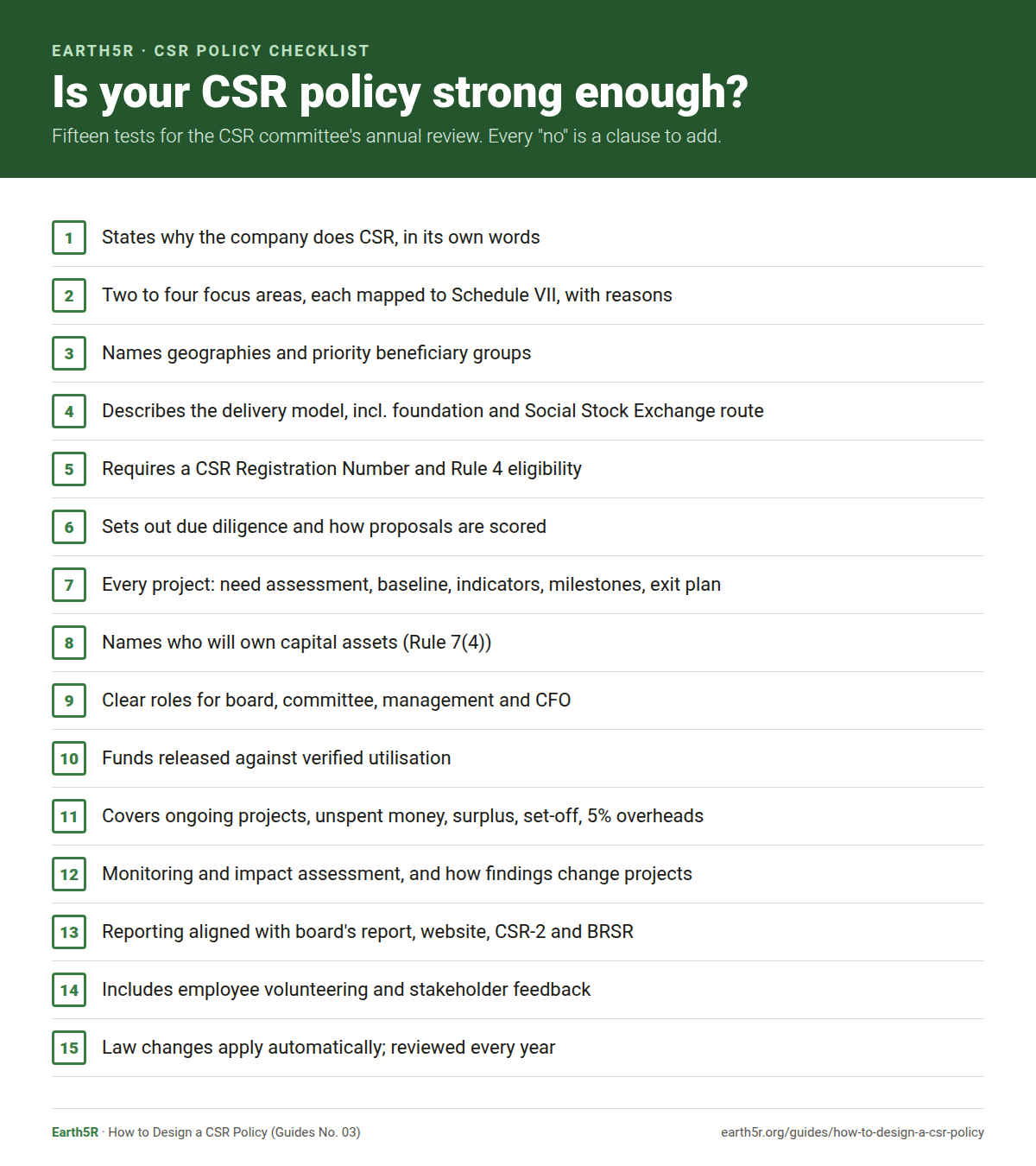
Use this in the CSR Committee’s annual policy review. Every “no” is a clause to add.
- States why the company does CSR, in its own words
- Two to four focus areas, each mapped to a Schedule VII item, with reasons
- Names the geographies and priority beneficiary groups
- Describes the delivery model, including any foundation and the Social Stock Exchange route
- Requires implementing agencies to hold a CSR Registration Number and meet Rule 4 eligibility
- Sets out due diligence and how proposals are scored
- Requires every project to have a need assessment, baseline, indicators, milestones and exit plan
- Names who will own capital assets, in line with Rule 7(4)
- Makes the roles of board, committee, management and CFO clear, including the annual action plan process
- Releases funds only against verified utilisation
- Covers ongoing projects, unspent amounts, surplus, set-off and the 5% overhead cap
- Describes monitoring, impact assessment and how findings change projects
- Aligns reporting with the board’s report, website, Form CSR-2 and BRSR
- Includes employee volunteering and stakeholder feedback
- Says changes in law apply automatically, and sets an annual review
The CSR committee’s year
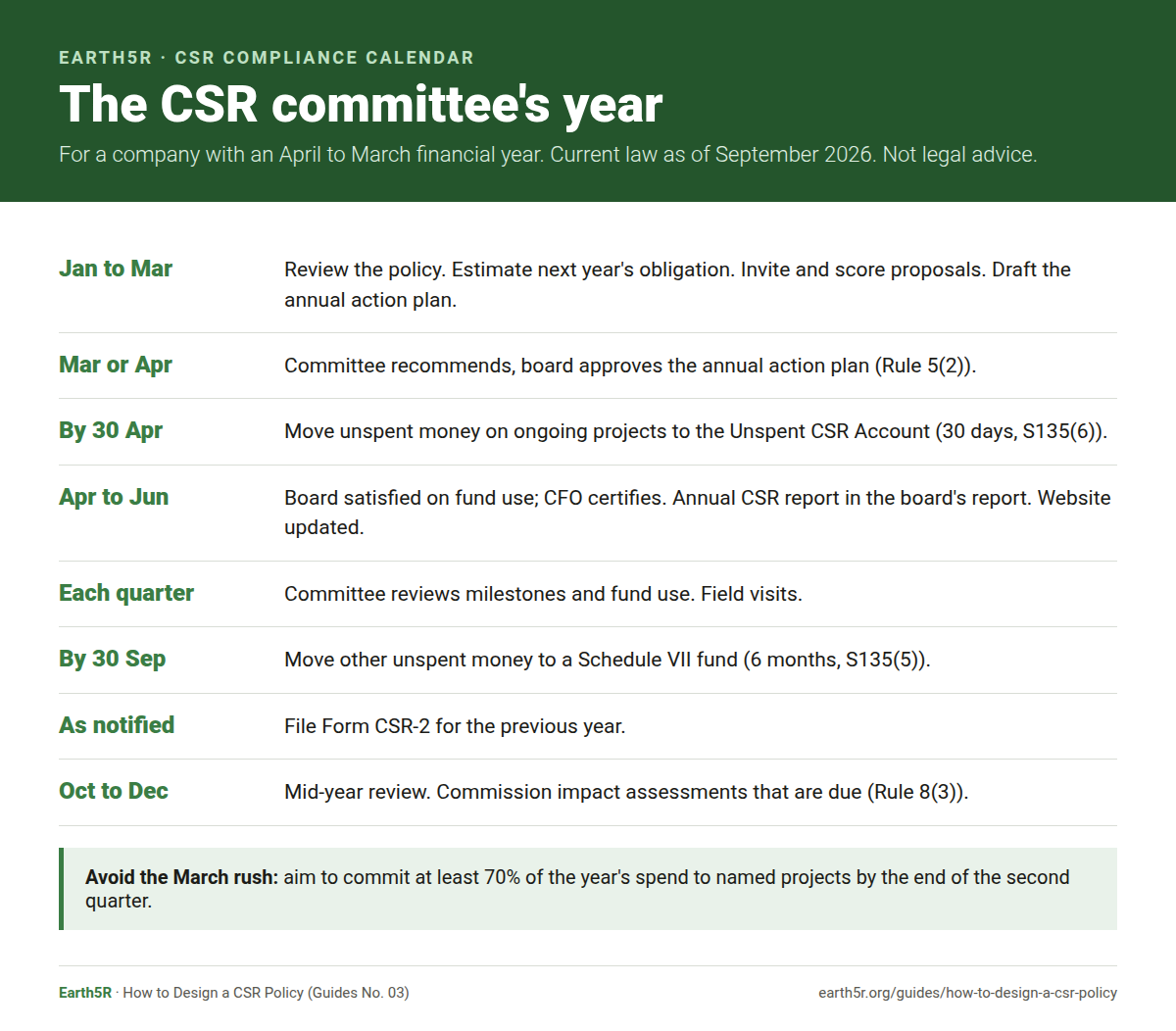
| When (April to March year) | What |
|---|---|
| January to March | Review the policy. Estimate next year’s obligation. Invite and score proposals. Draft the annual action plan. |
| March or April | CSR Committee recommends, and Board approves, the annual action plan (Rule 5(2)). |
| By 30 April | Transfer unspent money on ongoing projects to the Unspent CSR Account, within 30 days of year end (Section 135(6)). |
| April to June | Board satisfies itself on fund use; CFO certifies. Annual CSR report in the board’s report. Website updated. |
| Every quarter | Committee reviews milestones and fund use. Field visits. |
| By 30 September | Transfer other unspent money to a Schedule VII fund, within six months of year end (Section 135(5)). |
| As notified by MCA | File Form CSR-2 for the previous year. |
| October to December | Mid-year review. Commission impact assessments that are due (Rule 8(3)). |
Cite or share this guide
CSR teams, company secretaries, NGOs, universities and industry bodies are welcome to link to this page, add it to reading lists or training material, and embed the infographics. Please link to this page rather than the PDF, so readers always get the latest edition.
Questions
Is the CSR policy guide free?
Yes. The guide, the model CSR policy (Word) and the CSR planning workbook (Excel) are free to download without a sign-up, and free to share or adapt with credit to Earth5R.
Which companies must have a CSR policy in India?
Under Section 135 of the Companies Act, 2013, a company must comply if in the immediately preceding financial year it had a net worth of ₹500 crore or more, turnover of ₹1,000 crore or more, or net profit of ₹5 crore or more. Its board must approve a CSR policy and disclose it on the website.
What should a CSR policy contain?
Under Rule 2(1)(f), a CSR policy states the board’s approach and direction, including guiding principles for selecting, implementing and monitoring CSR activities and for the annual action plan. Earth5R’s model policy covers fifteen sections, from focus areas and geography to partner due diligence, capital asset ownership, fund management and review.
How much do Indian companies spend on CSR?
Companies spent ₹34,908.75 crore on CSR in FY2023-24, according to Ministry of Corporate Affairs data reported to Parliament (PIB, 10 February 2026), up from ₹24,965.82 crore in FY2019-20. Education and health care took over half.
What is an annual action plan under the CSR Rules?
Rule 5(2) requires the CSR Committee to recommend an annual action plan listing approved projects, the manner of execution, fund use and implementation schedules, the monitoring and reporting mechanism, and need and impact assessment details where applicable. The board approves it.
What changed in CSR rules in 2025 and 2026?
A revised Form CSR-1 for registering implementing agencies came into force in July 2025. The May 2026 amendment (G.S.R. 415(E)) added Rule 4A, allowing up to 10% of CSR spend through zero coupon zero principal instruments on the Social Stock Exchange. The Corporate Laws (Amendment) Bill, 2026 proposes further changes but is not yet law.
Can I use the infographics on my website?
Yes. Each infographic on this page has embed code. Please keep the credit link to this page.
Can Earth5R review our CSR policy?
Yes. Earth5R reviews CSR policies and annual action plans, designs measurable projects and delivers them with partner NGOs across 144 Indian cities. Talk to us through the contact page.
Download How to Design a CSR PolicyGet your CSR policy reviewed