
CSR Impact Assessment Handbook: How to Know, and Show, What Your CSR Changed
Rule 8(3) of the CSR Rules in plain language, updated to May 2026, and a practical method for impact studies that are worth reading: evaluation questions, sample sizes, OECD-DAC criteria, social return on investment done honestly, commissioning an independent agency, and reporting to the Board. With what eight companies in the Above Average band of TERRA, Earth5R’s ESG intelligence platform, publish, and four free templates.
What the handbook covers
- Why impact assessment matters
- Impact assessment by numbers
- The rule in one page
- Is it mandatory for you?
- Monitoring, audit or impact assessment?
- Choosing a framework
- Designing the study
- Commissioning an independent agency
- Fieldwork and ethics
- Social return on investment, done honestly
- Case study: measuring from day one on the Mithi River
- Best cases from TERRA
- Six common weaknesses
- Reporting and disclosure
- From findings to decisions
- Checklist for CSR committees
- Glossary of impact assessment terms
Free templates
Impact Assessment Workbook (Excel)
Nine sheets: is assessment mandatory for each project, how much you can book as CSR, a sample size calculator, an OECD-DAC evaluation matrix, a score out of 100, an SROI calculator with a sensitivity test, an agency scorecard, an action tracker and a 12-month calendar.
Terms of Reference (Word)
A 15-section model for commissioning an independent assessment: background, evaluation questions, method, ethics, independence, deliverables, agency profile, selection criteria and budget.
Report and Executive Summary (Word)
A full report outline, a two-page executive summary to annex to the annual report on CSR, and a ready note placing the reports before the Board.
Field Tools (Word)
A consent script, a beneficiary survey with before-and-now questions, a focus group guide, a key informant interview guide and a field quality checklist.
CSR impact assessment by numbers
In KPMG’s review of Nifty 250 companies, 114 (46%) were eligible for mandatory impact assessment and 91 (80%) of them disclosed impact assessment information. Only 51 (45%) gave access to the detailed studies. Just 7.8% of companies used a baseline and 2.0% a control group, and only 14.6% reported on people the programme did not reach.
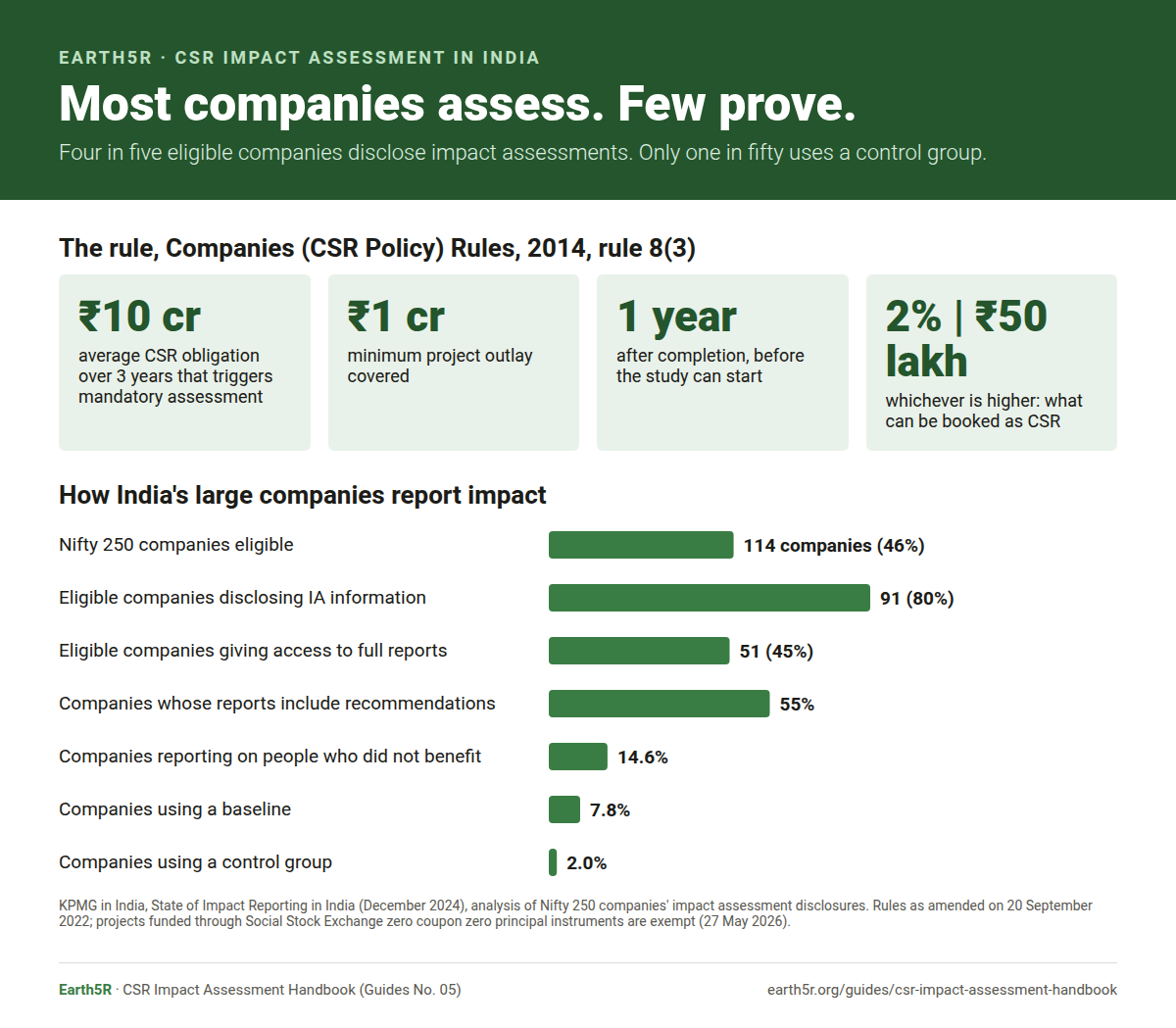
The rule in one page: Rule 8(3), Companies (CSR Policy) Rules, 2014
| Question | What the rules and MCA FAQs say |
|---|---|
| Which companies? | Average CSR obligation of ₹10 crore or more in the three immediately preceding financial years |
| Which projects? | Outlay of ₹1 crore or more, completed not less than one year before the study |
| From when? | Projects completed on or after 22 January 2021 |
| Who does it? | An independent agency; the Board sets the eligibility criteria |
| Where does it go? | Before the Board, and annexed to the annual report on CSR (a web link plus an executive summary is sufficient) |
| What can it cost? | Up to 2% of total CSR expenditure for the year or ₹50 lakh, whichever is higher, bookable as CSR (since 20 September 2022) |
| Exemption | Projects funded through zero coupon zero principal instruments on a Social Stock Exchange (since 27 May 2026) |
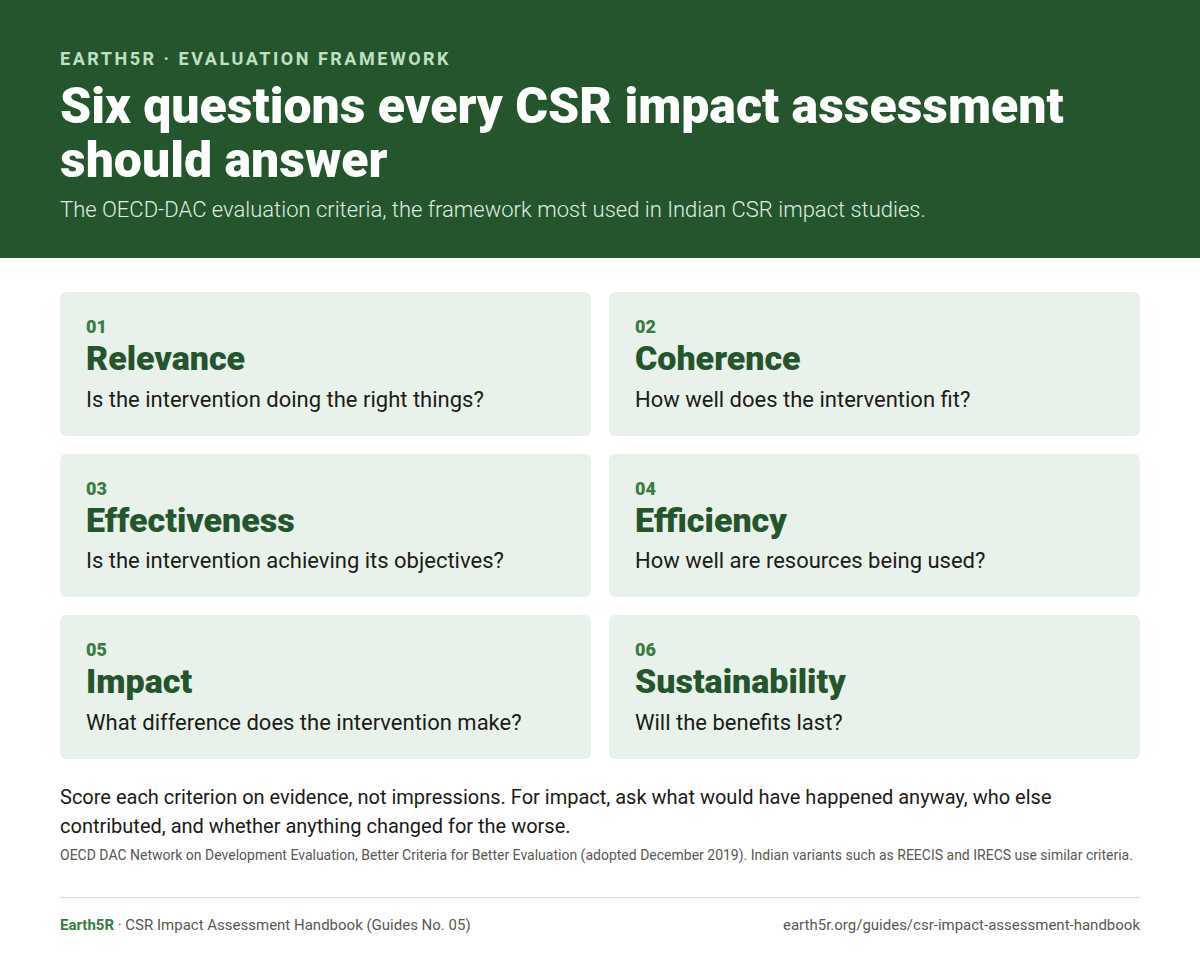
Six questions every CSR impact assessment should answer
The OECD-DAC evaluation criteria are the most used framework in Indian CSR impact studies: relevance, coherence, effectiveness, efficiency, impact and sustainability. Indian variants such as REECIS and IRECS add convergence with government schemes and inclusion.
How big should the survey sample be?
| Completed interviews (p = 0.5) | 100 | 300 | 1,000 | 3,000 | 10,000 |
|---|---|---|---|---|---|
| 95% confidence, ±5% | 80 | 169 | 278 | 341 | 370 |
| 95% confidence, ±7% | 67 | 119 | 165 | 185 | 193 |
| 95% confidence, ±10% | 50 | 73 | 88 | 94 | 96 |
Social return on investment, done honestly
An SROI ratio is only as good as its assumptions. KPMG’s 2024 study of Dalmia Bharat Foundation’s DIKSHa skilling programme surveyed 627 trainees and reported an SROI of 7.76:1, falling to 4.26:1 when attribution was increased by 50%. Publishing that test makes the base case more credible. SROI ratios use different proxies and assumptions, so never compare them across companies.
Best cases from TERRA
Each company below sits in the Above Average band of TERRA. We read their annual reports on CSR and published impact assessments for practices others can copy.
| Company | What their impact reports show | Worth copying |
|---|---|---|
| HCLTech | 117 projects independently assessed in FY2025-26 using OECD-DAC REECIS, IRECS and KAB, with SROI for most; findings given with sample sizes; ₹1.82 crore spent on assessment | Assess the whole portfolio, not only mandatory projects |
| Infosys | PwC assessed 26 projects in one report (April 2025) using the IRECS framework; 575 beneficiaries surveyed for Springboard alone | One consolidated, public report |
| ABB India | Seven projects on OECD-DAC criteria, three also on SROI (4.70, 13 and 18.41); risks such as scholarship dropouts flagged; ₹14.40 lakh on assessment in 2025 | State the assessment cost |
| Dalmia Bharat | KPMG evaluative SROI of DIKSHa skilling: 7.76:1, falling to 4.26:1 when attribution rises by 50%; post-placement drop-off reported | Publish the sensitivity test |
| Persistent Systems | Cleft and cochlear surgery projects scored on 30 aspects (26 and 23.5 out of 30); monsoon and language limitations stated | A transparent scoring rubric |
| Hindustan Unilever | Assessments by PwC and EY with executive summaries annexed; ₹2.49 crore on assessment in FY2024-25 including voluntary studies | Voluntary studies alongside mandatory ones |
| Tata Steel | Voluntarily assesses key CSR projects; studies on OECD-DAC criteria published online | Assess by choice, not only by rule |
| Ashok Leyland | Qualitative study of the Hinduja Foundation type 1 diabetes programme reporting gaps in counselling and follow-up | Report what did not work |
Six common weaknesses, and the fix
| Weakness | Fix |
|---|---|
| Recall bias | Collect a baseline at the start and track a few outcomes during the project |
| No counterfactual (only 2.0% used a control group) | Use a comparison group, waitlist or neighbouring area |
| Outputs called impact | Report the share of people whose lives changed, and by how much |
| Only the successes (14.6% reported on people not impacted) | Random samples from full lists, including dropouts |
| SROI without stress tests | Publish proxies, deadweight, attribution and a sensitivity test |
| Reports that go nowhere (45% had no recommendations) | Require a management response with owners and dates |
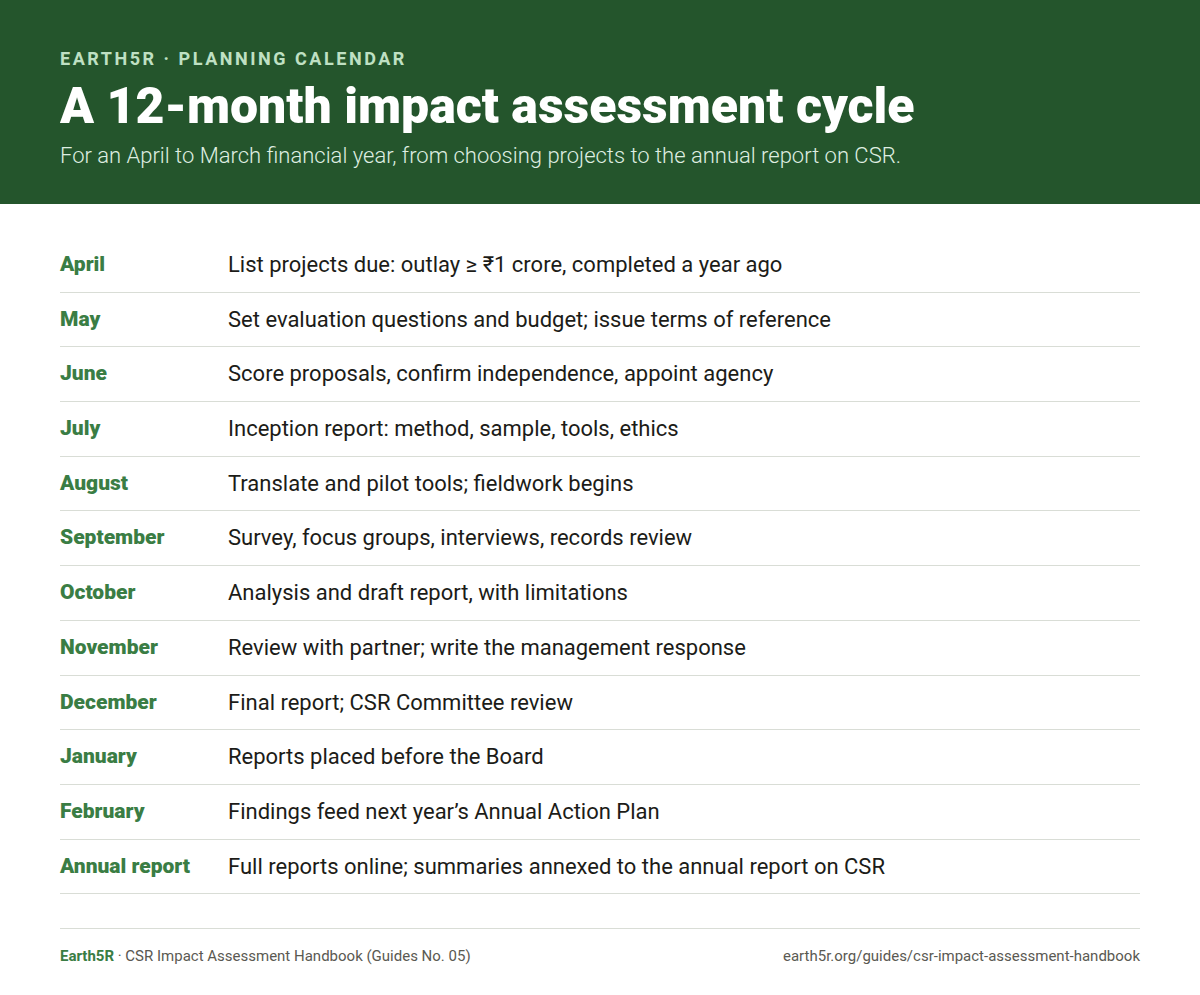
A 12-month impact assessment cycle
From listing the projects that fall due in April to publishing reports alongside the annual report on CSR, with findings feeding next year’s Annual Action Plan.
Case study: measuring from day one
The Mithi River project, funded by Huhtamäki and delivered by Earth5R with United Nations Technology Innovation Labs, RiverRecycle and the Municipal Corporation of Greater Mumbai, recorded recovery volumes throughout and mapped waste hotspots by drone before and during the work. Its results, 11,100 tonnes of waste removed and 4,440 tonnes of plastic recovered, did not depend on anyone’s memory years later. Read the Mithi case study.
Cite or share this handbook
CSR teams, company secretaries, evaluators, NGOs, industry bodies and universities are welcome to link to this page, add it to reading lists or training material, and embed the infographics. Please link to this page rather than the PDF, so readers always get the latest edition.
Questions
Is the CSR Impact Assessment Handbook free?
Yes. The handbook, the Impact Assessment Workbook (Excel) and the three Word templates are free to download without a sign-up, and free to share or adapt with credit to Earth5R.
Which companies must do a CSR impact assessment in India?
Under Rule 8(3)(a) of the Companies (CSR Policy) Rules, 2014, companies with an average CSR obligation of ₹10 crore or more in the three immediately preceding financial years must get an independent impact assessment of CSR projects with outlays of ₹1 crore or more that were completed at least one year before the study.
How much can a company spend on CSR impact assessment?
Since the amendment of 20 September 2022, impact assessment spend can be booked as CSR up to 2% of total CSR expenditure for the financial year or ₹50 lakh, whichever is higher. This is over and above the 5% cap on CSR administrative overheads.
Who can conduct a CSR impact assessment?
An independent agency. MCA’s FAQ says the Board decides the eligibility criteria for selecting it. The agency should have no role in designing or delivering the project.
Does the full impact assessment report have to be attached to the annual report?
MCA’s FAQ 9.6 says a web link to the complete reports together with an executive summary in the annual report on CSR is sufficient compliance. The reports must also be placed before the Board.
Which projects are exempt from impact assessment?
Projects below the thresholds can be assessed voluntarily. Since 27 May 2026, CSR spent through zero coupon zero principal instruments on a Social Stock Exchange is exempt from impact assessment.
What framework should a CSR impact assessment use?
Most Indian studies use the OECD-DAC criteria (relevance, coherence, effectiveness, efficiency, impact, sustainability) or Indian variants such as REECIS and IRECS, often with SROI for livelihood and health projects. Choose the one that fits the project and state why.
Can I use the infographics on my website?
Yes. Each infographic on this page has embed code. Please keep the credit link to this page.
Download the CSR Impact Assessment HandbookDesign measurable CSR with Earth5R