
A notebook from a river survey is full of small facts. The time a sample was taken. The colour of the water near an outfall. What a resident remembered. Students who do real climate and sustainability field work collect pages like this every week, and then one day they face a different page: the statement of purpose. This guide is about turning those field notes into an SOP that admissions readers trust. If you have typed how to write SOP into a search bar and found a hundred templates that all sound the same, this is a different starting point. We began with the people who read these documents for a living and with the students who struggle to write them.
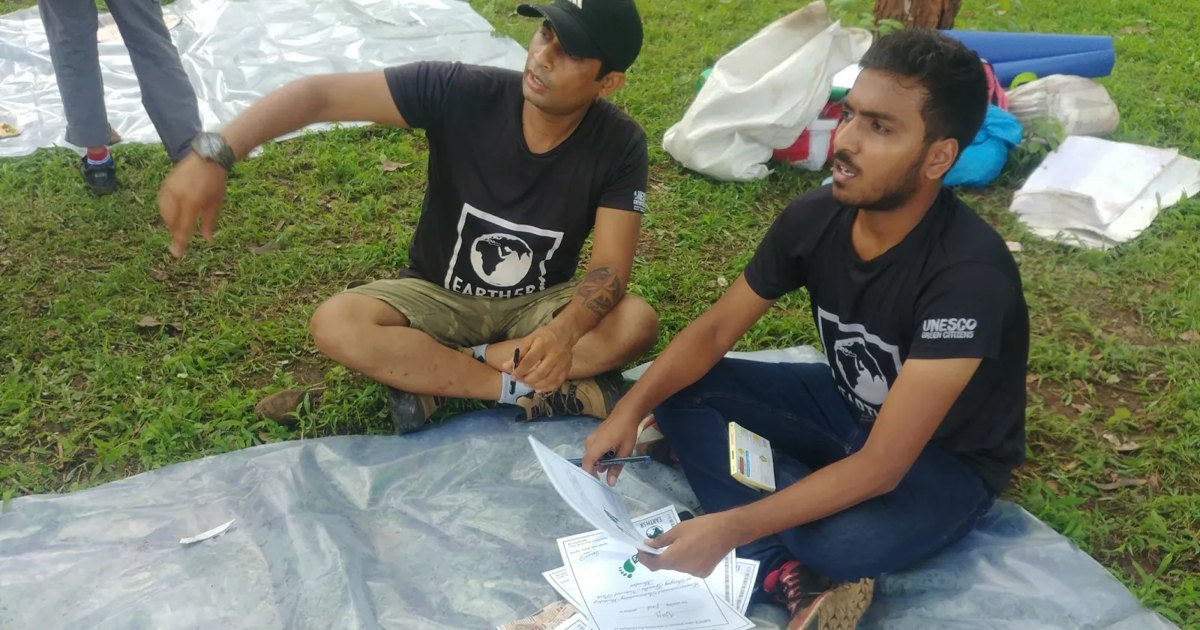
Earth5R is a Mumbai based environmental organisation recognised by the United Nations and UNESCO, running climate and sustainability programmes across India since 2014. Through FIELDWORK by Earth5R, school and college students study rivers, lakes, waste and water near their homes, always with a parent or guardian present. Many of them later apply abroad. The work comes first here, and a good SOP simply reports it honestly.
For this article we watched talks on YouTube by admissions officers, university tutors, professors and counsellors, read their transcripts, and checked their claims against official university pages. We also pulled the public comments under 33 of those videos, 919 comments in all, to see what students and parents actually struggle with. We read and categorised them to show which problems are most common, and quote them word for word below, without names or handles, linked to each video.
In this guide
- What 919 comments tell us about the SOP struggle
- What admissions people say they want
- How an SOP is actually read
- How field work, research and activities make an SOP stronger
- How to write SOP drafts from field notes, step by step
- Mistakes the speakers keep naming
- US essay, UK three questions, Canada and Europe
- What viewers say in the comments
- What students say on Reddit
- Videos worth watching
- Where FIELDWORK fits
- FAQ
What 919 comments tell us about the SOP struggle
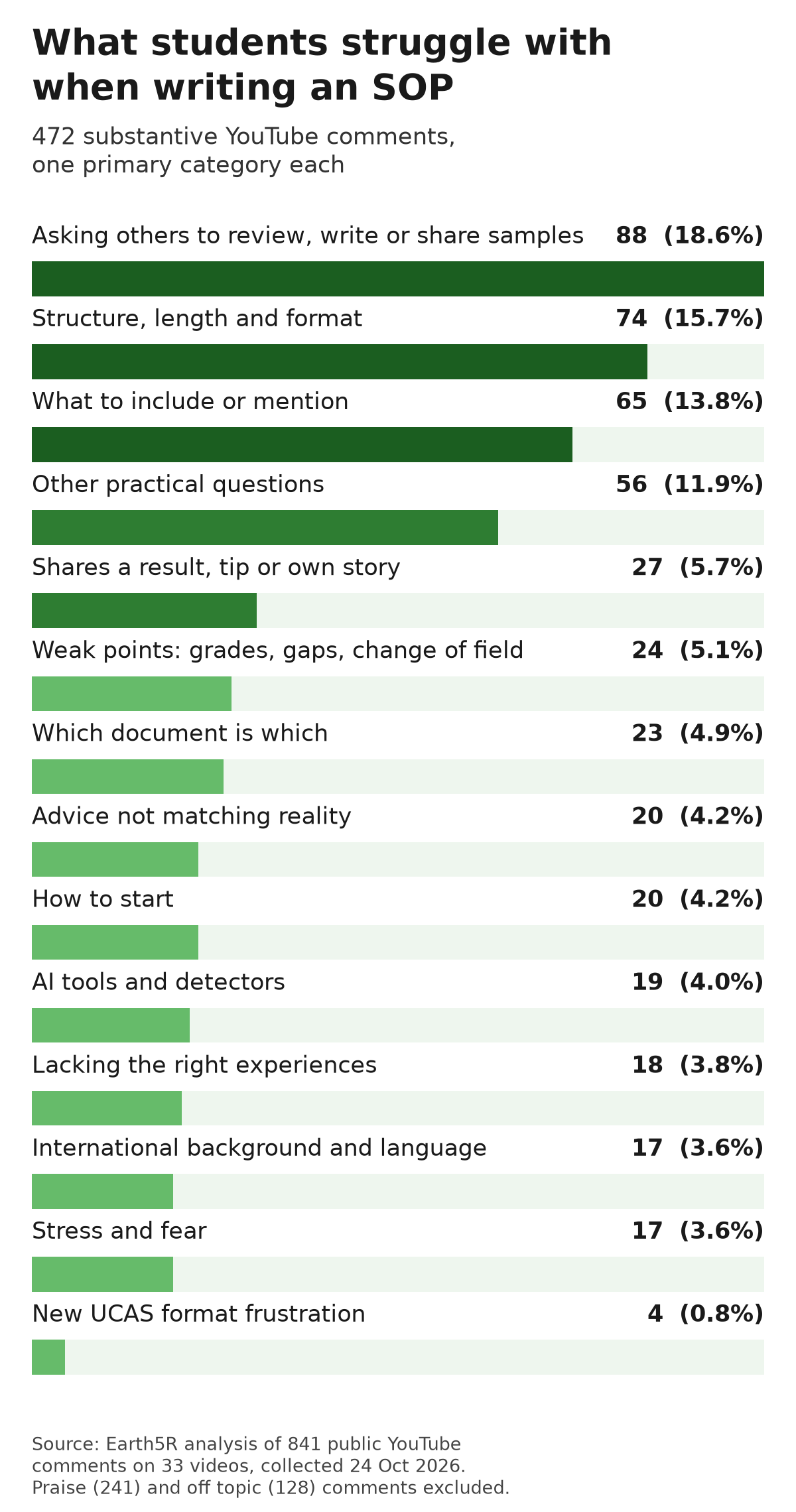
Before the advice, here is the size of the problem. On 24 October 2026 we collected the top level public comments under 35 YouTube videos used for this guide. 33 of them had comments. After removing replies by the channels themselves we had 919 comments. We then removed 75 exact repeats posted under the same video, mostly the “one cook” chant that one UK channel asks viewers to type, and 3 empty comments, which left 841 comments to analyse. We read each comment and gave it one primary category, so every comment is counted once and the shares add up to 100, give or take rounding. Short thank you notes were first sorted by a simple rule and then checked by reading them, and 241 of the 841 were pure thanks or praise. Another 128 were jokes, chants, wish me luck posts or off topic. That leaves 472 substantive comments, and the chart and table below are based on those. This is a snapshot of public comments read by one reviewer, not a scientific survey, and the people who comment are not a random sample of applicants.
| Category | Comments | Share |
|---|---|---|
| Asking others to review, write or share samples | 88 | 18.6% |
| Structure, length and format | 74 | 15.7% |
| What to include or mention | 65 | 13.8% |
| Other practical questions (deadlines, eligibility, contacting faculty, choosing a programme) | 56 | 11.9% |
| Shares a result, tip or own story | 27 | 5.7% |
| Weak points such as grades, gaps or a change of field | 24 | 5.1% |
| Which document is which (SOP, personal statement, motivation letter) | 23 | 4.9% |
| Advice not matching reality | 20 | 4.2% |
| How to start or what to write about | 20 | 4.2% |
| AI tools and AI detectors | 19 | 4.0% |
| Lacking the right experiences or extracurriculars | 18 | 3.8% |
| International background and language | 17 | 3.6% |
| Stress and fear | 17 | 3.6% |
| Frustration with the new UCAS three question format | 4 | 0.8% |
| All substantive comments | 472 | 100% |
The single biggest group is not a writing question at all. 88 comments, or 18.6% of the substantive ones, ask someone to read, fix, write or share an SOP, often a stranger in the comments or the channel owner. Many of these come from students who have nobody else to ask, and some are wary of the paid route. As a viewer on Perfect SOP, Tips, Tricks, Format, Do’s and Don’ts, Statement of Purpose Mastery put it, “Thing is I can’t put blank trust on paid services.” A trusted teacher, a school counsellor or a mentor who saw your work first hand is usually a better reader than a stranger online.
The next two groups together make up 29.4% of the substantive comments, and they are about what goes where and what goes in. 74 comments (15.7%) ask about structure, length, word limits and format, such as a viewer on How to Write a Statement of Purpose for Grad School Applications asking “For schools with page/words limit, what sections of the statement of purpose would you advise to remove?” Another 65 (13.8%) ask whether a specific thing belongs in the statement at all. A viewer on SOP mistakes that lead to straight REJECTION || MS and PhD applicants MUST know these wrote that they “forgot to mention that i want to come back to india in the long term. will this put me at a disadvantage?” The step by step section below answers most of these by starting from one real moment in your notes.
A middle band of worries each accounts for roughly 4% to 5% of substantive comments. Weak points such as grades, gaps or a change of field make up 5.1%, confusion between document types 4.9%, advice that does not match reality 4.2%, how to start 4.2%, AI tools and detectors 4.0%, lacking the right experiences 3.8% and an international background 3.6%. One viewer on How to Write a Statement of Purpose for Grad School Applications asked “What if i want to apply for a masters program that is totally different from my background education?” Students worried about weak points or thin experience are exactly the ones who gain most from documented climate and sustainability field work, because it gives them evidence they can describe in their own words.
Some problems look small by count but large by reaction. Only 17 comments are mainly about stress and only 4 are mainly about the new UCAS format, 4.4% of substantive comments between them. Yet they gathered 801 of the 2,363 likes on substantive comments, or 33.9%, because the most liked substantive comment in the whole set, with 366 likes, is about the new UCAS format, and one stress comment alone has 100 likes. Both are quoted in the comments section below. Questions are everywhere too. 318 of the 841 comments, or 37.8%, ask something, and among substantive comments the share rises to 62.5%. Only 16 comments, or 1.9%, mention India or use Hindi words by our keyword check, so this is mostly a global picture, which the sections below then apply to students doing field work in India.
What admissions people say they want
Across very different systems, the people who read applications keep returning to the same few ideas. The first is that the document should sound like one specific person thinking. Dr Matt Williams, a politics tutor and Access Fellow at Jesus College Oxford, put it simply in his talk on the new UCAS format: “the best personal statements are actually personal”. He also gave a question every applicant should keep in front of them while writing.
“the magic forward question for a top university like Oxford is “What do you think?””
Dr Matt Williams, Jesus College Oxford (watch the video)
The second idea is evidence over adjectives. In a Trinity Hall Cambridge video on the three questions, the speaker warns against simply announcing passion: “try to demonstrate your interest and understanding of the subject rather than just asserting that you’re passionate about it”. UBC says the same thing on its personal profile page: “Instead of simply listing your accomplishments and experiences, tell us what you’ve learned from them. Be specific.”
The third idea is context. In an interview on the kellyoncampus channel, MIT Dean of Admissions Stu Schmill said “we always evaluate students in the context from where they’re coming from”. He also said “really you don’t need to stand out you just need to be yourself”, and that applicants should “describe to us what you do and why you do it”.
For graduate programmes the emphasis shifts toward research and fit. Prof. Casey Fiesler, who works on PhD admissions in her information science department, says in her SOP video that a statement should be “kind of specific but not too specific”, and she is blunt about copy and paste applications: “Do not send the exact same statement of purpose to every program. It’s very easy to tell”.
How an SOP is actually read
Students often imagine a reader who lingers over every sentence. The speakers describe something faster and more practical. Dr Williams answers the common question of whether statements are read at all: “we take them very seriously we do read them quite quickly though”. Dr Philippe Barr, a former professor who now advises graduate applicants, describes committees that are “pretty much skimming through it quite quickly” in his video on how committees read.
“Your statement of purpose is not a narrative. It’s an evaluation document.”
Dr Philippe Barr (watch the video)
Barr says the reader is asking one question, “Does this applicant make sense in this specific case?”, and is scanning for “Where you come from, where you’re going, and why this program makes sense.” That is why he calls repeating your CV “a total waste of time”. For undergraduate applications, the reading is often comparative. UBC Admissions explains in How UBC evaluates your application that its process is “competitive and comparative”, and in its personal profile video that answers “will be read and reread by trained ubc staff”.
The UK has a specific rule worth knowing. UCAS says that even with three separate questions, “Admissions staff will still review your personal statement as a whole” (UCAS). Cambridge adds that “We do not expect your statement to be aimed at Cambridge alone.” (University of Cambridge). A fast reader wants clear signals early and specific evidence.
Dr Philippe Barr explains how admissions committees read a statement of purpose (open on YouTube)
How field work, research and activities make an SOP stronger
This is where students who have done real work have an advantage, and where many waste it. Activities help an SOP only when they become evidence of thinking. Dr Williams reads out a weak template that many students will recognise, “as part of an A-level geography field trip I saw blah and I was particularly interested in”, and then pushes for more. About a volunteering example he asks: “what did you learn there what did you take away”. The activity is only the doorway. The reflection is the content.
He also gives a climate example of what not to do. Reading out an opening line about earth sciences and a planet that “hangs on a precipice”, he counts “four metaphors in one sentence”. Big climate language feels important to write, but it tells the reader nothing about you. Compare it with the opener Prof. Lace Padilla uses as a model in her grad school SOP video:
“With climate change on the rise, uncertainty communication is becoming increasingly important, particularly for extreme weather events.”
Prof. Lace Padilla, example opening sentence (watch the video)
That sentence names a real problem in plain words, then narrows quickly. Padilla follows it with a “however” statement that names a gap, and she advises students to “describe what you did and what you learned”.
Depth beats a long list
Every SOP speaker we watched made some version of the same point. Uday of Edflight Education says “writing 10 lines about two relevant projects is way better than writing two lines each about five different projects” (Edflight). Barr says “preparedness is not a question of volume. It’s definitely a question of relevance.” A King’s College London postgraduate guide recommends “quality over quantity” and a simple CAR structure, which stands for context, action and result (King’s College London).
What this looks like with field notes
Here is an illustration we wrote for this guide. It is not a real applicant’s text. Suppose a student spent several weekends on a lake survey with a community group. A list version says the student surveyed a lake, collected samples, spoke to residents and made a report. A CAR version picks one moment:
- Context: the residents near one inlet said the smell got worse after rain, but the survey sheets had no column for rainfall.
- Action: the student added a rainfall note to each sheet and compared readings before and after two storms.
- Result: the pattern was not clear, which raised a better question about how runoff reaches the lake, and that question is what the student now wants to study.
The second version shows a method, an honest uncertain result and a link to the course. It does not claim the student saved the lake. An honest small finding reads as more mature than a big claim.
Dr Matt Williams of Jesus College Oxford reviews real personal statement examples in the new UCAS format (open on YouTube)
How to write SOP drafts from field notes, step by step
This sequence pulls together the advice from the talks and the official pages above. It works for an undergraduate personal statement and for a master’s or PhD statement of purpose, with the differences noted in the next section.
- Read the instructions first. Yash Mittra of YMGrad starts here. Note the limit and every question asked.
- Collect raw material before you write. Go through your field notebook, data sheets and photos. Note five moments where you noticed something or got a surprising result.
- Pick two or three moments, not ten. Choose the ones closest to the course.
- For each moment, answer four questions. What was the situation? What did you do? What happened? What do you think now? The last one is the “What do you think?” question that Dr Williams calls the key for top universities.
- Connect each moment to the course. King’s College London suggests around 75% of a personal statement should be directly relevant to your academic pursuits. If a paragraph cannot be linked to the subject, cut it or shorten it.
- Write a plain opening. Start with the problem or question that pulls you toward the subject. Mittra warns against the “child prodigy” opening.
- Explain weak points briefly and calmly. Edflight advises addressing a low GPA or backlogs honestly rather than hiding them. Schmill reminds students that “A B is not a bad grade”.
- Write the bad draft. A Harvard student in Harvard Admissions’ essay tips video says “you have to write the bad drafts first before you can get to anything good”. DAAD advises: “Never try to write it down in one evening” (DAAD).
- Test it on a non expert. Dr Williams offers a rule of thumb: “if a friend or family member couldn’t understand what you’re trying to say then it’s too complicated”. Ask a teacher or counsellor to read it too. King’s says your statement “should be written by you alone, but do get someone you trust to check it for you”.
- Tailor the final version. For graduate programmes, name what draws you to that specific programme. For UCAS, write one statement that works for every choice.
Mistakes the speakers keep naming
- Turning the SOP into a CV. Uday of Edflight says “your sop is not an other version of your resume”. DAAD says “Do not start your letter of motivation by repeating your CV.”
- Copying a template or a sample. Edflight warns “universities check plagiarism nowadays”. Barr warns that “the goal of your statement of purpose is not to sound like somebody who got in.”
- Letting AI write it. Dr Williams: “if you just straight up get AI to do it all for you then yeah that’s not going to help you at all”.
- Flowery or metaphor heavy language. DAAD says “Avoid all kind of platitudes, flowery phrases and flattery.” The earth sciences example with four metaphors is the climate version of this mistake.
- Treating a graduate SOP like a school essay. College Essay Guy says graduate statements “are academic pieces of writing”, and lists not researching programmes and not understanding “the depth and the quality of research needed” among common errors (College Essay Guy).
- Oversharing. Padilla says the statement “is not a place to ‘trauma dump'”. A King’s College London speaker adds “avoid writing as if it’s a personal story remember it’s a professional academic statement” for postgraduate study.
US essay, UK three questions, Canada and Europe
The phrase SOP gets used for very different documents. Writing the wrong one is a confusion that keeps coming up in the comments, so here is how the main systems differ.
United States: the college essay and the graduate SOP
For undergraduate entry, most US colleges use the Common App personal essay. The Harvard student in Harvard Admissions’ video describes the “650 word limit that the college application imposes”, and Common App confirmed that the 2026 to 2027 prompts remain the same as the year before (Common App). It is broader and more personal than a UK statement. For graduate school, the statement of purpose is a professional document about research interests and fit. Berkeley notes “Faculty are the people who read these statements” and advises “don’t spend a great deal of time on autobiography” (Berkeley Graduate Division).
United Kingdom: UCAS three questions
From 2026 entry, UCAS replaced the single essay with three questions (UCAS):
- “Why do you want to study this course or subject?”
- “How have your qualifications and studies helped you to prepare for this course or subject?”
- “What else have you done to prepare outside of education, and why are these experiences useful?”
UCAS says “Each answer will have a minimum character count of 350 characters” and “The 4,000 overall character limit (including spaces) remains the same”. It also says “There’s no ‘wrong’ place to include information in your answers”. Field work usually fits the third question, unless it was part of your coursework, in which case it may fit the second. Cambridge applicants may also complete an additional statement through My Cambridge Application (Cambridge).
UCAS explains the three question personal statement (open on YouTube)
Canada: profiles and short answers
Many Canadian universities ask for short answers rather than one long essay. UBC calls it a personal profile, sets a character range for each answer, and asks for two references. It warns that “We may contact the references included to verify your activities and achievements.” (UBC). In its video, UBC even names sustainability among the things applicants might write about.
Germany and much of Europe: the motivation letter
In Germany and much of Europe, programmes often ask for a motivation letter. DAAD’s guidance asks applicants to “Deal with your topics in a reflective and factual way.” The Germany Dreams channel puts the contrast this way in its SOP versus motivation letter video: “SOP is about your story. Motivational letter is about your decision.” It adds “A good motivation letter does not need fancy words. It needs clear thinking.”
What viewers say in the comments
The talks tell you what readers want. The comment sections tell you where students actually get stuck. The data section near the top counts how often each problem comes up. Here is what those questions and frustrations sound like, in viewers’ own words.
Stress, rarely the main point but widely shared
“Writing SOP is the most stressful thing of applying for higher studies.”
A viewer on 5 Things to Do in a Statement of Purpose for PhD/Grad School | PhD SOP + an example (mine!) (watch the video)
“this personal statement stuff is the most stressful and traumatic experience i have ever had”
A viewer on How to Write an UNBELIEVABLY Good UCAS Personal Statement (New 2026) (watch the video)
Too much advice can add to the fear. The calmest talks drew some of the most grateful replies.
Confusion about the format
The new UCAS format drew the strongest reaction. The most liked comment under the Jesus College video, with 366 likes when we collected it, reads:
“I feel like an essay is so much easier than juggling three questions!!”
A viewer on Perfecting Your UCAS Personal Statement (*New* 2025 Format) | Real Examples + Oxford Tutor Insights (watch the video)
“i have been struggling on the difference between question 2 and 3.”
A viewer on How to Write an UNBELIEVABLY Good UCAS Personal Statement (New 2026) (watch the video)
“ive just written a huge personal statement only to find out i have to scrap it all because its apparently 3 questions now.”
A viewer on How to write your personal statement (watch the video)
What helps here is the official line. UCAS says there is no wrong place to include information and that the statement is reviewed as a whole. That should end most of the question 2 or question 3 worry.
Not knowing how to start
“Everyone keeps giving tips on what to write but I genuinely don’t know how to start writing”
A viewer on How to Write an UNBELIEVABLY Good UCAS Personal Statement (New 2026) (watch the video)
“how the beginning should be if no childhood experience or philosophical sentence?”
A viewer on SOP mistakes that lead to straight REJECTION || MS and PhD applicants MUST know these (watch the video)
This is exactly where field notes help. You do not need a childhood story or a philosophical opening. You need one real observation and the question it raised. That is the opening Padilla models with her climate sentence.
Feeling you lack the “right” experiences
“This is only focusing on lucky people who got experience”
A viewer on Writing Amazing Personal Statements | CareersLab (watch the video)
“What if I don’t live in the Uk, what alternatives to attending masterclasses are there that i can write in my personal statement”
A viewer on How to Write an UNBELIEVABLY Good UCAS Personal Statement (New 2026) (watch the video)
“in our school we don’t have such thing as extracurricular”
A viewer on College Essay Tips + Writing your Best College Essay | Real Advice from Harvard Admissions (watch the video)
This is a real gap between advice and reality, and it deserves an honest answer. Some advice does assume access to internships and lab placements. But the official speakers push the other way. Schmill says students are evaluated in the context of where they come from. Dr Williams says “work experiences are not expected or required for medical applications because we know not everyone has access to those sorts of experiences”, and that for Oxford and Cambridge “we don’t put any weight on extracurricular activities” as such. Local, unpaid, unglamorous work counts if you can show what you learned from it.
International students and language
“i was really lost because in my country we dont really write essays”
A viewer on College Essay Tips + Writing your Best College Essay | Real Advice from Harvard Admissions (watch the video)
“Do the proffessors reading SOP mind grammatical mistakes?”
A viewer on Perfecting Your UCAS Personal Statement (*New* 2025 Format) | Real Examples + Oxford Tutor Insights (watch the video)
Students from school systems without essay writing often meet this format late. Plain, correct English is enough.
Weak points and what to hide
“my senior told me to not to show your weak points whats your opinion on that”
A viewer on SOP mistakes that lead to straight REJECTION || MS and PhD applicants MUST know these (watch the video)
“So don’t worry too much about one bad grade, but do explain it if possible.”
A viewer on Exclusive Interview with MIT Dean of Admissions Stu Schmill (watch the video)
The speakers mostly agree with the second viewer. Explain a weak point briefly, then move on.
AI tools and detectors
“it says that some parts of my essay where writen by an AI, but they were not.”
A viewer on SOP mistakes that lead to straight REJECTION || MS and PhD applicants MUST know these (watch the video)
“when I ran it through multiple AI detectors, the results were inconsistent”
A viewer on How to write the PERFECT SOP 2026! Content, Strategies, AI Tools, Statement of Purpose (watch the video)
Students are now anxious about being accused of using AI even when they did not. The best protection is specific detail only you could know, such as the date of a survey, the reading that surprised you, or what a resident told you. Field notes give you that detail for free.
Contradictions between talks
“I thought Oxford doesn’t consider extracurriculars at all, no?”
A viewer on Five top tips for writing your personal statement when applying to Oxford University (watch the video)
This viewer noticed a real tension. In one Oxford video, Dr Williams suggests about 80% academic content and 20% extracurricular. In the Jesus College talk, he says Oxford and Cambridge put no weight on extracurricular activities as such. Read together, the message is consistent: the bulk of the statement should be about the subject, and activities earn space when they show subject thinking.
When the advice does not match the outcome
“My child did all of this and beyond, and still got rejected.”
A viewer on How to Write an UNBELIEVABLY Good UCAS Personal Statement (New 2026) (watch the video)
“Admission committee will never tell you the reason for rejection.”
A viewer on 5 HUGE Mistakes To Avoid In SOP | Common SOP Mistakes For Studying Abroad | MS in USA | Yocket (watch the video)
The first of these is from a parent, and it is worth taking seriously. A strong statement improves an application. It does not guarantee an offer, and nobody honest can promise that it will. UBC describes its own process as competitive and comparative. Parents and students both deserve to hear that before the results arrive.
What helped
“Thank you for mentioning that I might not have discovered a gap. I was racking my brain over that.”
A viewer on How to Write a Statement of Purpose for Grad School Applications (watch the video)
“Writing is not a talent but a trainable skill.”
A viewer on 5 Things to Do in a Statement of Purpose for PhD/Grad School | PhD SOP + an example (mine!) (watch the video)
Many comments also show students looking for someone to trust. Some ask strangers in the comments to review or write their statement, and one YMGrad viewer wrote “Thing is I can’t put blank trust on paid services.” Your teachers and school counsellors already know your work and are usually the best first readers.
What students say on Reddit
Reddit threads show the same struggles at greater length. These quotes are copied word for word from public threads, without usernames.
“I have also read a bunch of sample SOPs online and now I am even more confused because they all sound so polished and perfect.”
A master’s applicant on r/gradadmissions (read the thread on Reddit)
“how do you pitch a solid, credible research direction to a potential PI without manufacturing fake passion or pretending to have had a life-altering revelation?”
A PhD applicant on r/gradadmissions (read the thread on Reddit)
“Open with your research problem, motivate the research problem, and mention the relevant preparation you have for tackling it.”
A commenter who says they are faculty, r/gradadmissions (read the thread on Reddit)
“Instead of framing this opportunity as an escape, convince them that it’s a deliberate choice you’re making and that place you’re applying to is THE DESTINATION.”
A reply on r/Indians_StudyAbroad (read the thread on Reddit)
“I’d rather learn how to write it properly than just copy some template from Google.”
A student on r/Indians_StudyAbroad (read the thread on Reddit)
Videos worth watching
Each of these was checked against its transcript before we quoted it.
Prof. Casey Fiesler on five things to do in a PhD or grad school statement of purpose (open on YouTube)
Prof. Lace Padilla on structure, gaps and her climate example opener (open on YouTube)
Harvard Admissions with student advice on the college essay (open on YouTube)
Where FIELDWORK fits
FIELDWORK by Earth5R
Earth5R is a Mumbai based environmental organisation recognised by the United Nations and UNESCO, running climate and sustainability programmes across India since 2014. FIELDWORK gives school and college students real climate and sustainability work on rivers, lakes, waste and water, always with a parent or guardian present. Students keep field notes, collect data and talk to the communities affected.
FIELDWORK is a two way ecosystem. Professors join conversations with students. They are not hired, and some projects are built in partnership with universities. Teachers and counsellors remain the students’ main guides. We do not write statements for students, and nobody can promise admission. What field work can give you is real material, and the habit of noticing, measuring and reflecting that every speaker above asks for.
FAQ
What is the difference between an SOP and a personal statement?
The terms overlap. A graduate statement of purpose focuses on research interests, preparation and programme fit. A UK personal statement answers the three UCAS questions about the subject. A US college essay is broader and more personal. Always follow the exact prompt you are given.
How long should an SOP be?
Follow the programme’s own limit. UCAS uses 4,000 characters including spaces across three answers, with at least 350 characters each. The Common App essay has a 650 word limit. Graduate programmes and European universities set their own lengths.
Can I write about climate or sustainability field work if I am applying for engineering or economics?
Yes, if you connect it to the subject. A water survey can lead to questions about sensors, data, cost or policy. Show the question the work raised and how the course helps you answer it.
Turn real field work into real evidence
If you want climate and sustainability work worth writing about, start with the work itself. Learn how FIELDWORK by Earth5R runs projects with students and families at earth5r.org/fieldwork.