
The Sustainable Futures Podcast
Deep conversations with eminent scientists, economists and policy researchers on climate and sustainability. We share them with fellow researchers, companies, governments, students and communities who can build on their work.
Co-hosted by Saurabh Gupta, founder of Earth5R, and Marine Ragnet of New York University.

A New Time
AI now holds much of what experts have learned and produced over generations, and AGI is close. Knowledge that once took a lifetime to build is now available to anyone with a phone.
Much of what we read and watch online is now machine-generated and recycled. In this new time, real conversations between people who study the world and people who live its challenges matter more than ever.
Researchers bring methods and evidence. Communities bring lived experience and ground truth. When they meet, new questions open up and new ideas take shape.
The Sustainable Futures Podcast is a space for these conversations. It is a place to learn from each other, build bridges and look at new horizons together.































Scientists work in labs. Communities work on the streets. This podcast brings them together.
Before Earth5R, Saurabh spent two years cycling through Asia, Africa and Europe. He saw something that rarely made the news. In much of the Global South, people conserve because they have no choice. In richer places, sustainability is often just a word, and the waste goes somewhere else. He came to see this as climate injustice.
After more than ten years of field work, Earth5R has a lot of data from the ground. The podcast shares it with the people who study these problems.
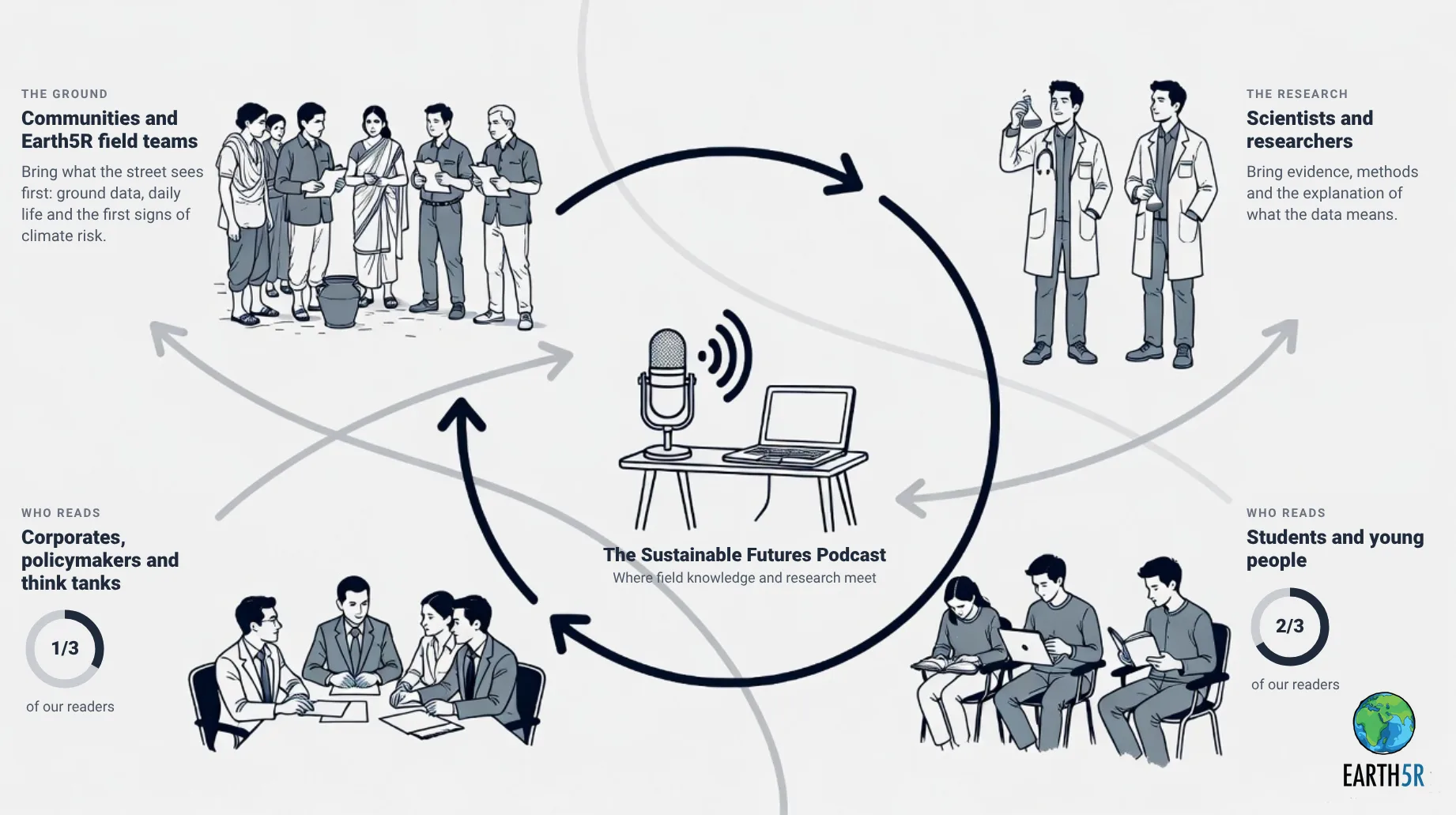
A two-way conversation
We learn from your research, and we share what our teams see on the ground.
Science people can use
Scientific work is often not understood outside its field. We explain it in plain words, so a student can follow it and a policymaker can use it.
Your story, not just your findings
We ask what you found and how you got there. Many of our listeners want to build careers like yours.
An entry point
Partnerships often start with an episode. This can mean field research with our volunteers, or introductions to organisations that want to work with you.
A worldwide audience of 6.9 million readers
Every episode is published in EarthJournal, Earth5R's publication, and reaches two groups of readers.
Students and young people
Many are Gen Z. They worry about climate change and want action. They need reliable science because there is a lot of misinformation. Many want a career in sustainability. Many young listeners see our speakers as role models.
Corporates, policymakers and think tanks
They include policymakers, people from UN bodies, the OECD and government ministries, and researchers from many fields. They also include CEOs and other senior leaders who want to understand climate risk for their companies. After an episode, some listeners write to us asking to connect with the speaker.
Meet the hosts

Saurabh Gupta
Founder & CEO, Earth5R · Young Leader India–France, awarded by President Emmanuel Macron · Project Leader, Paris Peace Forum · TEDx speaker
Saurabh worked in HR and environment, health and safety at Café Coffee Day. He then left corporate life and spent two years cycling 50,000 kilometres through Asia, Africa and Europe. On the road he saw a gap. The Global South lives sustainability. The Global North mostly talks about it. That gap led him to start Earth5R in 2014. Today Earth5R runs field programmes on rivers, waste, water and livelihoods across India and builds TERRA, its climate readiness platform. He is a circular economy advisor to the Confederation of Indian Industry and a member of the OECD Roundtable on Cities and Regions for the SDGs.

Marine Ragnet
AI and Peacebuilding, New York University · Fellow, Portulans Institute · Strategic Advisor, Earth5R
Marine began her career as a French diplomat in Mumbai, working on India-France relations. She then moved to New York for her master's and worked with the US government and the OECD. At New York University she founded the Peace AI initiative on community-centred AI governance in the Global South, and her field work takes her to communities in Africa and India. With Earth5R she is researching how data centres affect water and women in India.
Featured conversations
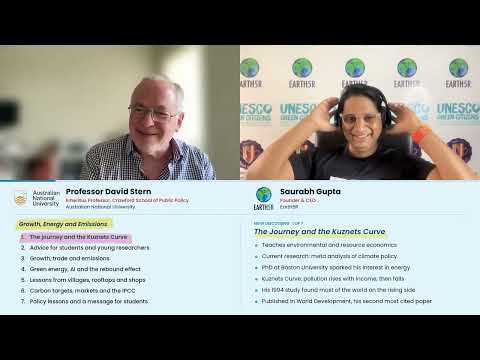
Prof. David Stern
Emeritus Professor, Crawford School of Public Policy, The Australian National University
Why solar, AI and electric cars won't save us on their own, how the rebound effect works, and what India can learn about growth and emissions.
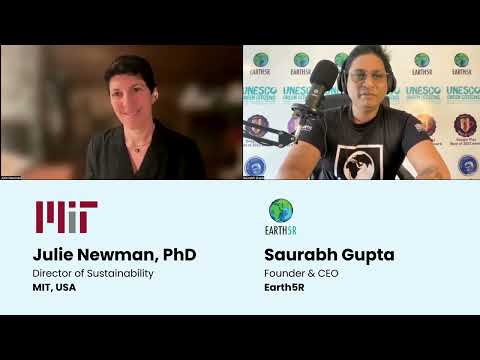
Dr Julie Newman
Director of Sustainability, Massachusetts Institute of Technology
How a university decarbonises itself, and why institutions have to change before they ask individuals to.
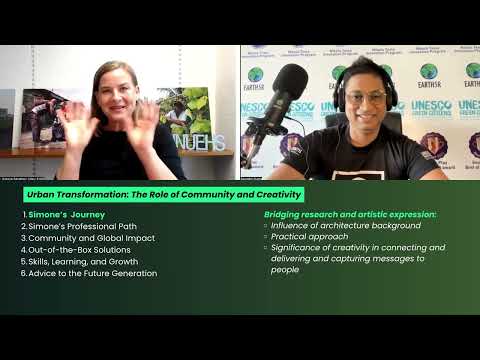
Dr Simone Sandholz
Urban Futures and Sustainability Transformation Programme, UNU Institute for Environment and Human Security
Cities of the future, informal settlements, and new ideas for climate action.
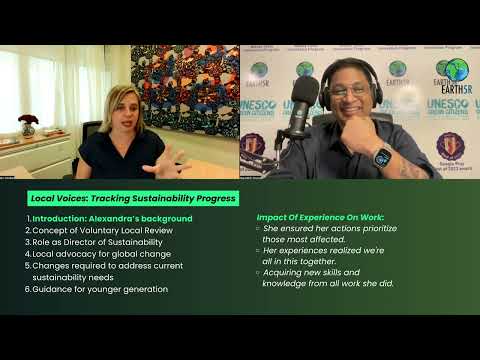
Alexandra Hiniker
Director, Sustainability Initiative, Carnegie Mellon University
She created the first Voluntary Local Review of the UN goals at the New York City Mayor's Office. What cities and universities can learn from it.
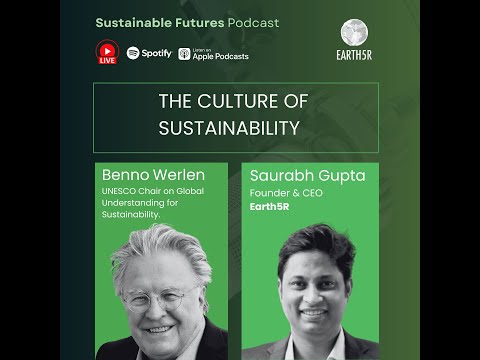
Prof. Benno Werlen
UNESCO Chair on Global Understanding for Sustainability, Friedrich Schiller University Jena. Founder of the International Year of Global Understanding.
How arts, humanities and culture shape sustainability, and why change has to start with citizens.
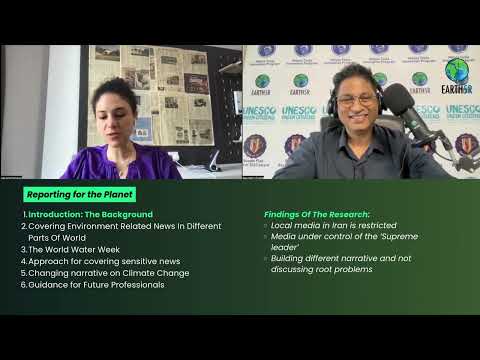
Sanam Mahoozi
Journalist writing for The New York Times on climate change, water and the environment, with a focus on Iran and the Middle East.
Climate stories that get little coverage, and advice for young climate journalists.
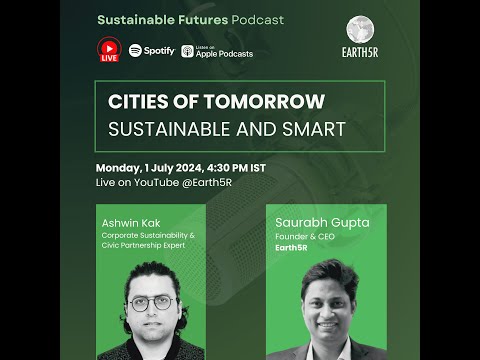
Ashwin Kak
Partner, Circular Economy, Intellecap
On cradle to cradle design, Bangalore's lakes, zero slums and why corporates cannot hide behind weak city governance.
Our upcoming conversations
IPCC authors and national academy members from 18 universities, including Columbia, LSE, ETH Zurich, Cornell and IIT Bombay. Each will talk about their research and how they came to it.
Prof. Ulrike Lohmann
How aerosols and clouds interact, one of the hardest parts of climate science.
Professor of Atmospheric Physics at ETH Zurich. Lead Author, IPCC Fourth and Fifth Assessment Reports, and a member of the core writing team for the Fourth Assessment Synthesis Report. This work was part of the IPCC's 2007 Nobel Peace Prize. Member of the Leopoldina and 2025 recipient of the EGU Vilhelm Bjerknes Medal.
Prof. David N. Bresch
Putting numbers on what weather and climate do to society, with the open-source CLIMADA model.
Professor for Weather and Climate Risks at ETH Zurich and MeteoSwiss. Spent sixteen years at Swiss Re, including as Global Head of Sustainability, served on the Swiss delegation to the UNFCCC, and advises the Rockefeller Foundation.
Prof. Subimal Ghosh
The Indian monsoon, its extremes, and what a changing climate means for India's water.
Institute Chair Professor of Civil Engineering at IIT Bombay and head of its Centre for Climate Studies. Lead Author, IPCC Sixth Assessment Report, on weather and climate extremes. Winner of the Shanti Swarup Bhatnagar Prize and the European Geosciences Union's 2024 Alexander von Humboldt Medal.
Prof. Kim Cobb
What past climate tells us about future extremes and coastal flooding.
Director of the Institute at Brown for Environment and Society. Lead Author, IPCC Sixth Assessment Report, and recipient of the European Geosciences Union Hans Oeschger Medal and the US Presidential Early Career Award.
Prof. Suzana J. Camargo
Tropical cyclones and other weather extremes in a warming climate.
Professor of Climate at the Columbia Climate School and Lamont-Doherty Earth Observatory. Lead Author, IPCC Seventh Assessment Report, Working Group I, and Fellow of the American Meteorological Society and the American Geophysical Union.
Prof. Scott Barrett
Why countries find it hard to act together on climate, and how treaties can help.
Lenfest-Earth Institute Professor of Natural Resource Economics at Columbia. Member of the US National Academy of Sciences. Lead Author, IPCC Second Assessment Report. This work was part of the IPCC's 2007 Nobel Peace Prize. He is currently on sabbatical at the University of Oxford.
Prof. Elizabeth Robinson
Climate, food security and health, and the policies that cut emissions fairly.
Director of the Grantham Research Institute on Climate Change and the Environment at LSE. Lead Author, IPCC Seventh Assessment Report, Working Group III, and former chair of the economics advisory group for the UK Climate Change Committee.
Prof. Brian Murray
What makes carbon pricing work, and what makes it fail.
Director of the Nicholas Institute for Energy, Environment and Sustainability at Duke. Convening Lead Author, IPCC Special Report on Land Use, Land-Use Change and Forestry. This work was part of the IPCC's 2007 Nobel Peace Prize.
Prof. Catherine Kling
Putting a value on nature and clean water, and how that changes policy.
Tisch University Professor and faculty director of the Atkinson Center for a Sustainable Future at Cornell. Member of the US National Academy of Sciences, and ten years on the US EPA Science Advisory Board.
Prof. Lucas Bretschger
The economics of sustainable growth, and whether climate policy has to cost growth.
Professor Emeritus of Resource Economics at ETH Zurich and former director of its Center of Economic Research. Former President of the European Association of Environmental and Resource Economists.
Prof. Daanish Mustafa
Water, hazards and fairness in South Asia, and the questions we should be asking.
Professor in Critical Geography at King's College London. Co-authored Pakistan's first climate change response strategies and a five-year flood response strategy for UNDP Pakistan.
Prof. Naho Mirumachi
Rivers that cross borders, and how countries end up in conflict or cooperation over shared water.
Professor in Environmental Politics at King's College London and co-director of the King's Water Centre. Author of Transboundary Water Politics in the Developing World, lead author on freshwater policy for UN Environment's GEO-6 report, and a contributor to the IPCC Sixth Assessment Report. Has trained more than 200 policymakers and professionals on water security and cooperation.
Prof. Sheila Olmstead
How economics can guide water pricing and water quality policy as climate change puts pressure on supplies.
Professor at the Cornell Jeb E. Brooks School of Public Policy and a Cornell Atkinson Scholar. Served as senior economist for energy and the environment at the US President's Council of Economic Advisers in 2016 and 2017. President-elect of the Association of Environmental and Resource Economists, editor of its journal, and a university fellow at Resources for the Future.
Prof. Carol Adams
Why sustainability reporting began, and what it should do for companies today.
Emeritus Professor at Durham University Business School. Former Chair of the GRI Global Sustainability Standards Board, founding editor of the Sustainability Accounting, Management and Policy Journal, and newly elected Fellow of the Academy of Social Sciences.
Dr Matthew Shaw
How newspapers recorded the world, and how a society can keep a reliable memory now that most news is digital.
Librarian at The Queen's College, Oxford, responsible for the College's library collections and services. He was previously lead curator of the Americas Collections at the British Library and has a background in eighteenth-century history. He is the author of An Inky Business, a book about newspapers, and Time and the French Revolution: The Republican Calendar, 1789-Year XIV.
Radhica Kanniganti
How large Indian companies manage ESG, and what good sustainability disclosure looks like in practice.
Head of ESG at Wipro Limited. She leads business sustainability and ESG disclosures for the company, and speaks widely on corporate ESG leadership in India.
Prof. Bhavik Bakshi
How industry can reach net zero, and designing technology together with the ecosystems that support it.
Julie Ann Wrigley Professor at Arizona State University, in engineering and the School of Sustainability. Author of Sustainable Engineering (Cambridge) and editor of Engineering and Ecosystems: Seeking Synergies Toward a Nature-Positive World. AIChE Fellow.
Prof. Vivian Loftness
Building energy performance, and how our homes and workplaces shape our footprint.
University Professor and former head of the School of Architecture at Carnegie Mellon. Fellow of the American Institute of Architects, co-director of the Center for Building Performance and Diagnostics, and member of 14 US National Academy of Sciences panels on sustainable buildings.
Prof. Paulina Jaramillo
Energy access, and how the transition can serve people who still lack power.
Professor of Engineering and Public Policy at Carnegie Mellon. Coordinating Lead Author, IPCC Sixth Assessment Report, Working Group III, co-founder of the Open Energy Outlook, and an Andrew Carnegie Fellow.
Prof. Thomas B. Johansson
Energy systems for sustainable development, and which policies have held up over time.
Professor Emeritus at Lund University's International Institute for Industrial Environmental Economics. Convening Lead Author, IPCC Second Assessment Report. This work was part of the IPCC's 2007 Nobel Peace Prize. Former Director of UNDP's Energy and Atmosphere Programme and co-recipient of the Volvo Environment Prize.
Prof. Anand B. Rao
Mitigation technology and the rural energy transition in India.
Professor at IIT Bombay's Centre for Technology Alternatives for Rural Areas (CTARA). Lead Author, IPCC Sixth Assessment Report, Working Group III. Works on carbon capture and storage, renewable energy, energy efficiency and rural electrification.
Prof. Tony Roskilly
Hydrogen networks and the decarbonisation of industry and shipping.
Chair of Energy Systems at Durham University and director at the Durham Energy Institute. Associate Director of the National Centre for Energy Systems Integration, and adviser to the UK Government's Hydrogen Advisory Council.
Prof. Christian Breyer
What a fully renewable energy system looks like, and what solar power can do for countries like India.
Professor for Solar Economy at LUT University in Finland. Lead Author, IPCC Seventh Assessment Report, Working Group III. Models 100% renewable energy systems for countries and for the world, with more than 400 scientific papers, and a Clarivate Highly Cited Researcher.
Prof. Ramteen Sioshansi
Energy storage and electricity markets, and how power grids can run on more solar and wind.
Professor in the Department of Engineering and Public Policy at Carnegie Mellon and Director of the Carnegie Mellon Electricity Industry Center. IEEE Fellow for his work on energy storage in power systems.
Prof. Xiliang Zhang
Carbon markets and the low-carbon energy transition in the world's largest emitter.
Director of the Institute of Energy, Environment and Economy at Tsinghua. Lead Author, IPCC Fourth and Fifth Assessment Reports. This work was part of the IPCC's 2007 Nobel Peace Prize. Leads the expert group on the design of China's national carbon market.
Prof. Kaveri K. Iychettira
Managing uncertainty in India's energy transition.
Associate Professor at the School of Public Policy, IIT Delhi. Contributed to drafting India's Long-Term Low Emissions Development Strategy submitted to the UNFCCC, and Associate Editor of The Energy Journal.
Lucy Yu
How flexible energy demand can accelerate electrification and make fossil fuels redundant.
CEO of Centre for Net Zero, the open energy research institute established by the Octopus Energy Group. She has nearly 20 years of experience building tech ventures and developing tech policy for governments. Named a Financial Times Top 100 Most Influential BAME Leader in tech and one of Diversity UK's Top 5 Leaders in GreenTech. Associate Fellow of Technology and Public Policy at the Tony Blair Institute for Global Change.
Prof. Johannes Lehmann
Biochar and soil: how much carbon better soil management can really store.
Liberty Hyde Bailey Professor at Cornell. Member of the US National Academy of Sciences and the Leopoldina, and Lead Author of the IPCC methodology report on carbon dioxide removal.
Prof. Elena Bennett
Landscapes and ecosystem services, and what change for nature looks like in practice.
Professor at McGill and Canada Research Chair in Sustainability Science. Member of the US National Academy of Sciences, co-founder of the Seeds of a Good Anthropocene project, and Coordinating Lead Author for IPBES.
Prof. Ruth DeFries
How the demand for food and resources changes land and forests across the tropics.
Denning Family University Professor of Sustainable Development and co-founding dean of the Columbia Climate School. Member of the US National Academy of Sciences and the National Academy of Engineering, and a MacArthur Fellow.
Aneire Khan
Climate and health evidence from Bangladesh, from the team of Prof. Paolo Vineis.
Epidemiologist at Imperial College London's School of Public Health. Her PhD and field studies with 1,400 women in coastal Bangladesh linked salty drinking water to high blood pressure and pre-eclampsia, a climate and health risk rarely discussed.
Prof. Sagnik Dey
Air quality, climate and health in India, and the evidence behind clean air policy.
Head of the Centre for Atmospheric Sciences at IIT Delhi. Fellow of the American Geophysical Union and recipient of its Devendra Lal Memorial Medal. Expert member of the WHO programme on air quality and health.
Prof. Marianne Engelman-Lado
Why climate harms fall unevenly, and what the law can do about it.
Director of the Environmental and Climate Justice Initiative at NYU School of Law. Former Deputy General Counsel for Environmental Initiatives at the US Environmental Protection Agency.
Andreas Schleicher
How education and skills systems can prepare young people for a low-carbon economy.
Director for Education and Skills at the OECD and special adviser on education policy to the OECD Secretary-General. His directorate runs PISA, the international assessment of what 15-year-old students know and can do. Author of World Class: How to Build a 21st-Century School System (OECD, 2018), honorary professor at Heidelberg University and recipient of the Theodor Heuss Prize.
Prof. Ajay Kumar Sood
How India builds its strength in science and clean technology, and how research informs national policy.
Principal Scientific Adviser to the Government of India since April 2022 and chair of the Prime Minister's Science, Technology and Innovation Advisory Council. A physicist and National Science Chair Professor at the Indian Institute of Science, Bengaluru, he works on quantum materials and soft and active matter. Fellow of the Royal Society, former President of the Indian National Science Academy and recipient of the Padma Shri and the Shanti Swarup Bhatnagar Prize.
Dr Francesca Froy
How cities rebuild complexity, and what urban policy can learn from systems thinking.
Departmental Lecturer in Sustainable Urban Development at the University of Oxford and a Fellow of Kellogg College. She directs the programme's professional and open access courses. Former senior policy analyst at the OECD, and author of Rebuilding Urban Complexity.
Stefano Marta
How cities and regions can use the Sustainable Development Goals to shape local policy and investment.
Head of the Smart and Sustainable Cities Unit at the OECD Centre for Entrepreneurship, SMEs, Regions and Cities. He oversees OECD work on a territorial approach to the Sustainable Development Goals, decentralised development co-operation, city-to-city partnerships and smart cities for inclusive growth. He previously worked at FAO and led a joint FAO, OECD and UNCDF initiative on a territorial approach to food security and nutrition policy.
Prof. Obijiofor Aginam
Education for sustainable development, and how schools and youth programmes can build peace and climate literacy.
Director of UNESCO's Mahatma Gandhi Institute of Education for Peace and Sustainable Development (MGIEP) in New Delhi since July 2024. Former Deputy Director and Head of Governance for Global Health at the United Nations University International Institute for Global Health. He holds a Ph.D. in international law and global health governance from the University of British Columbia.
Prof. Brian Schmidt
How scientific evidence informs public decisions, and the role universities play in society.
Distinguished Professor at the Research School of Astronomy and Astrophysics, ANU, and Vice-Chancellor and President of the university from 2016 to 2023. He shared the 2011 Nobel Prize in Physics for the High-Z Supernova Search team's 1998 evidence that the expansion of the universe is accelerating. Fellow of the Royal Society, the Australian Academy of Science and the US National Academy of Sciences.
Prof. Thomas Bernauer
Why some climate and environmental policies win public support, and what that means for policies that work.
Professor of Political Science at ETH Zurich, where he studies environmental politics and how citizens, consumers and governments respond to environmental policy. He was a lead author in IPCC Working Group II for the Sixth Assessment Report and founding director of ETH Zurich's Institute of Science, Technology and Policy. He received the American Political Science Association's Elinor Ostrom career achievement award.
The Street Knows First
Stories from the Ground on the Climate Risks Leaders Miss
Saurabh is writing a book on a simple observation from more than a decade in the field: the real impact of climate change is felt first on the streets. Only later does it reach the boardrooms, then the scientific community, and policymakers are often the last to know.
The strongest conversations from the podcast will become part of the book, and speakers whose work fits its story may be invited for an interview.
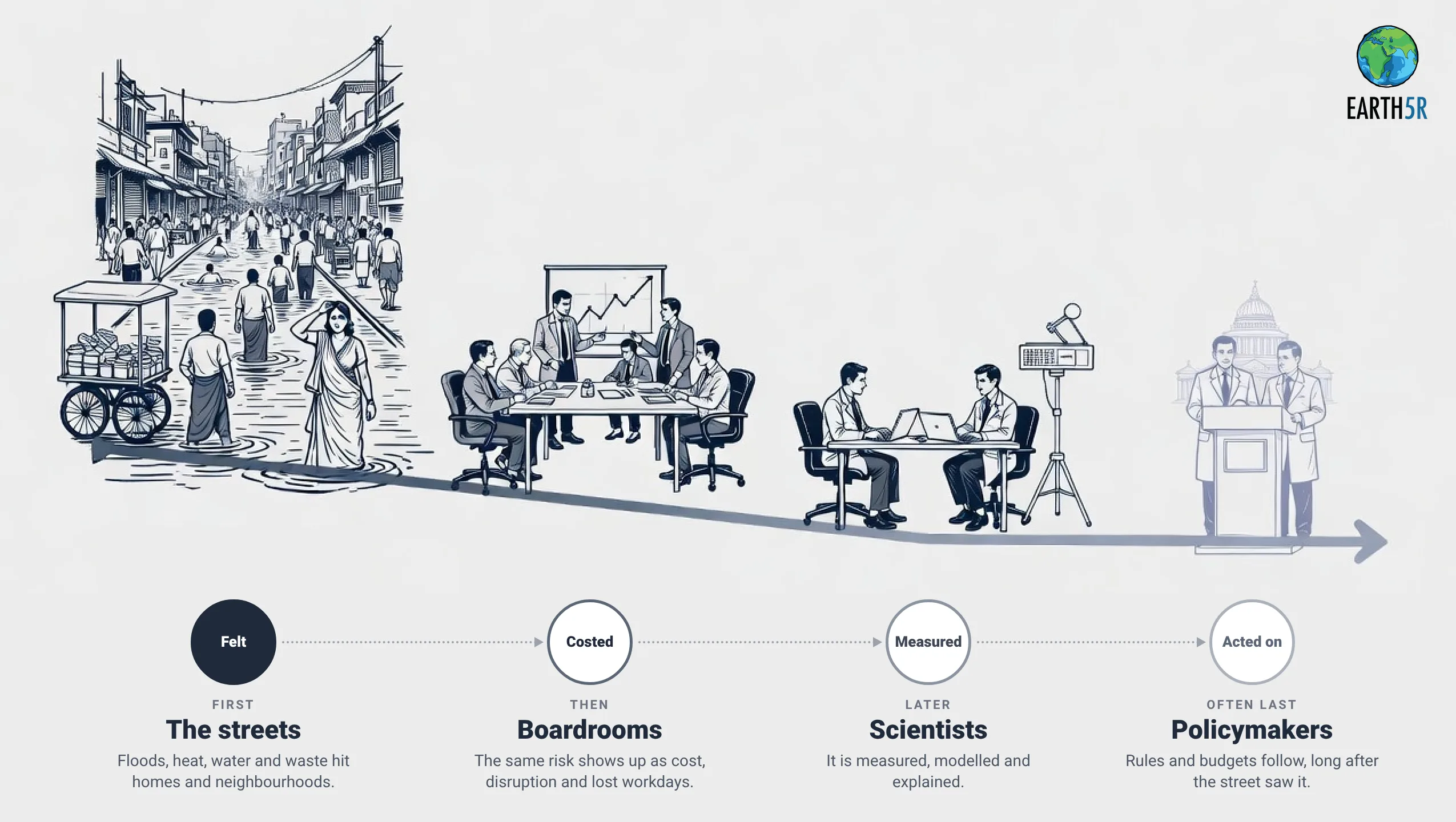
Built on community work in cities across India
Earth5R is an environmental organisation working on the ground in India since 2014, on rivers, waste, water, farming and livelihoods, with TERRA, a platform that checks what companies report against what is happening on the ground.
Bring your research to the people it can help
If your research can help companies, cities or communities, we would like to hear from you.
Book a 20-minute call All episodes on YouTube