
Water Stewardship Guide: Managing Water Risk at Your Sites and in the Catchments You Share
A practical guide for Indian sustainability, EHS and CSR heads: groundwater and basin risk, the site water balance in BRSR format, CGWA rules, zero liquid discharge, rainwater and reuse, community water projects under CSR, and how to make “water positive” claims that hold up, with the AWS Standard V3.0 and VWBA 2.0. With best cases from TERRA and three free templates.
What the guide covers
- Water is a local risk
- India’s water by numbers
- The rules and standards
- Measure: the site water balance
- Find the sites that matter
- Cut, reuse and recycle
- Beyond the fence: the catchment
- Water claims that hold up
- CSR and community water projects
- Best cases from TERRA
- Case: Earth5R’s water work
- Eight common weaknesses
- A 12-step plan
- Checklist for site heads and boards
- Glossary
Free templates
Water Stewardship Workbook (Excel)
A site water balance in BRSR format, a site risk screen using CGWB categories and basin stress, a replenishment tracker that shows your ratio to consumption, a rainwater potential calculator and a targets sheet.
Site Water Stewardship Plan (Word)
A site plan in the five steps of the AWS Standard: gather and understand, commit and plan, implement, evaluate, communicate and disclose.
Water Replenishment Project Charter (Word)
For pond, lake, watershed and recharge projects you will count toward targets: problem, baseline, volumetric benefit, method, monitoring, ownership and reporting.
India’s water by numbers
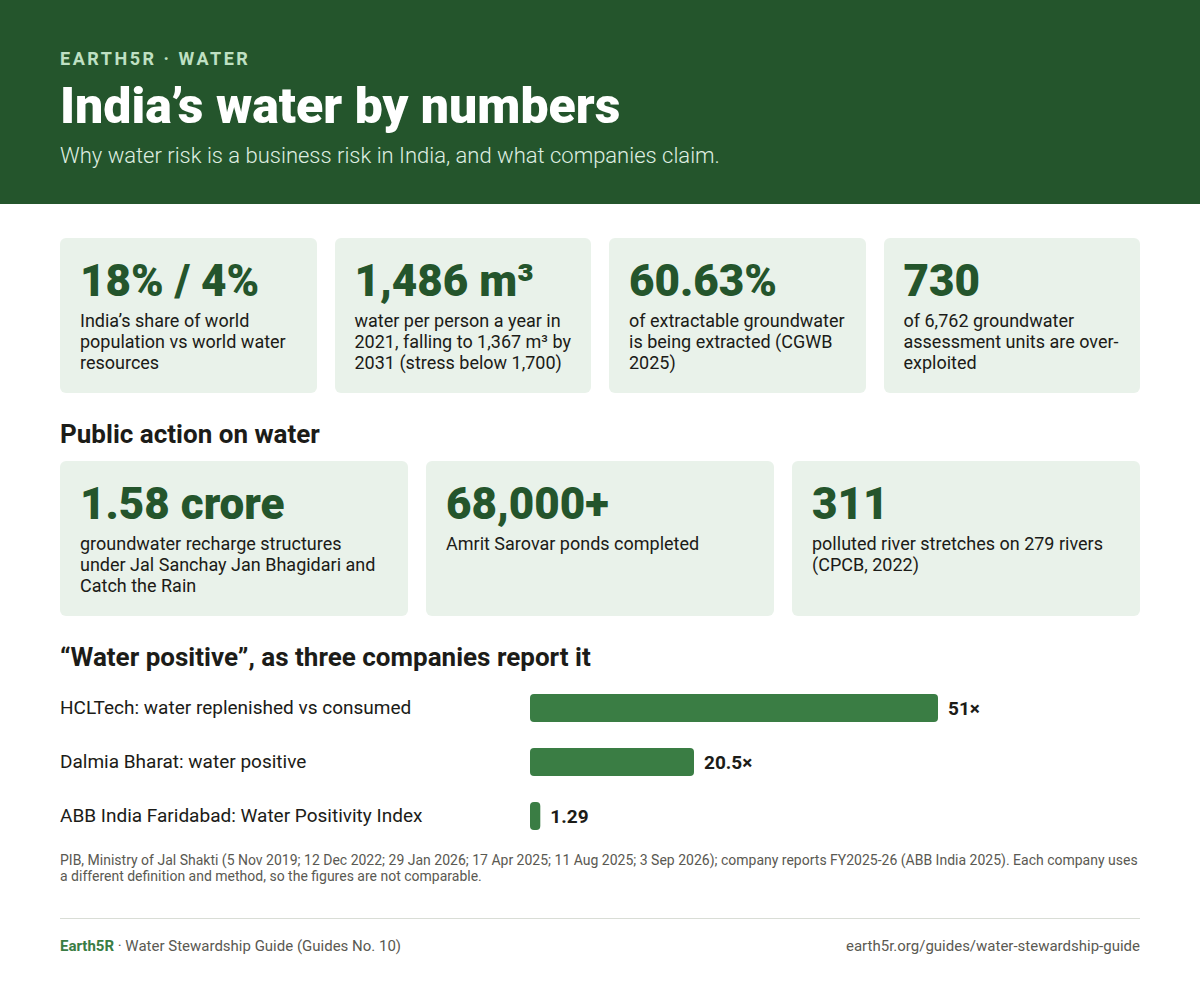
India has 18% of the world’s population and 4% of its water resources. Water per person was 1,486 m³ in 2021, below the 1,700 m³ stress line. The 2025 groundwater assessment found 60.63% of extractable groundwater being extracted and 730 of 6,762 assessment units over-exploited.
The rules and standards
| Rule or standard | What it covers |
|---|---|
| SEBI BRSR, Principle 6 | Withdrawal by source, consumption, intensity, discharge by destination and treatment, ZLD; leadership indicator on water-stressed areas |
| SEBI BRSR Core | Water footprint: consumption, intensity, and discharge by destination and treatment, with assessment or assurance |
| CGWA guidelines (24 Sept 2020) | No groundwater NOC for new industry in over-exploited areas; abstraction charges; flow meters with telemetry; piezometers |
| AWS Standard V3.0 (18 March 2026) | Site certification in five steps; one-year transition from V2.0 |
| VWBA 2.0 (WRI and partners, 2025) | Six-step method to measure and claim volumetric water benefits |
| SBTN freshwater targets | Basin-specific targets on withdrawals and nutrient pollution |
Water claims, decoded
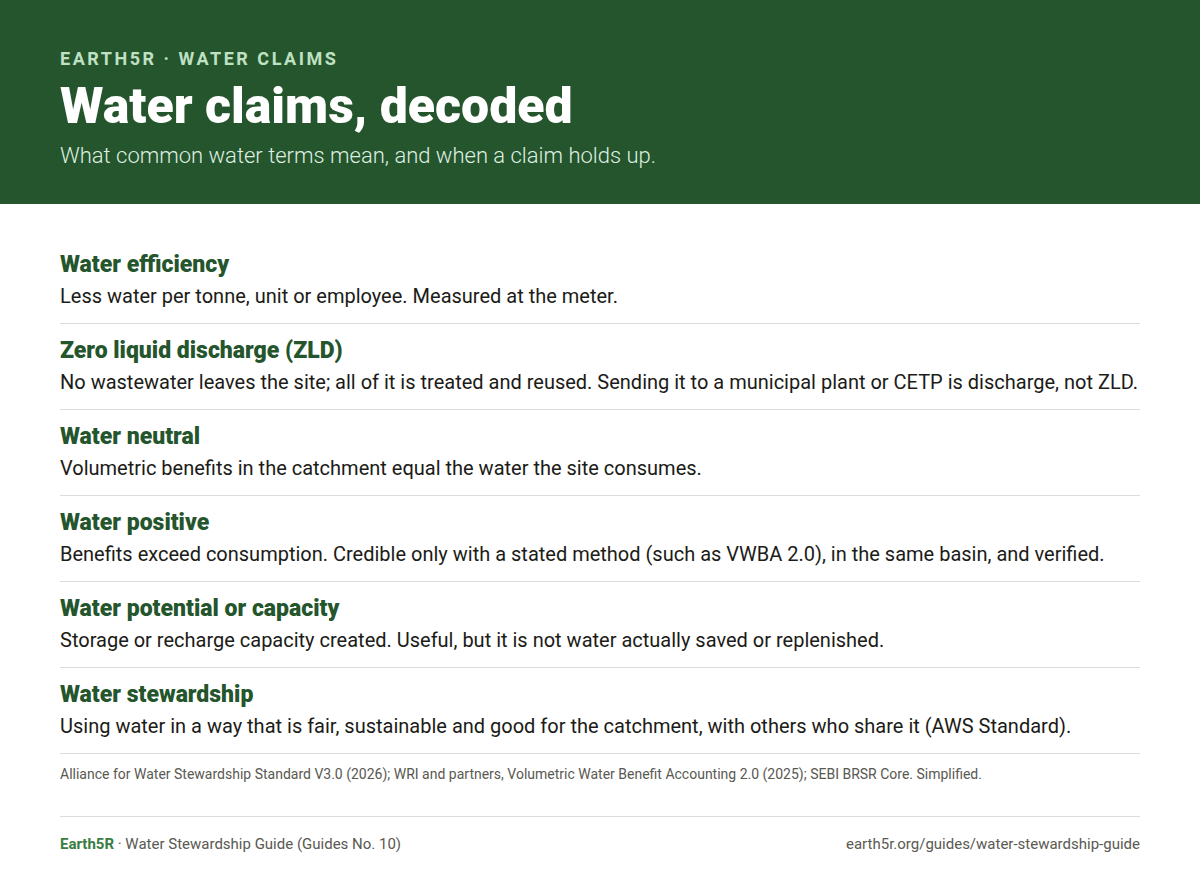
“Water positive” means 51× at one company, 20.5× at another and an index of 1.29 at a third. A claim holds up only when it states its method, sits in the same basin as the company’s stressed sites, excludes design capacity and is verified.
Best cases from TERRA
| Company | What their reports show |
|---|---|
| HCLTech | Replenishes 51× what it consumes; 47.57 billion litres in FY2025-26 |
| Hindustan Unilever | 4.5 trillion litres of water potential; 23 of 25 factories ZLD; Platinum AWS certification at two sites |
| Dalmia Bharat | 20.5× water positive; ZLD at 100% of cement units |
| Tata Steel | 4.41 kL per tonne; sites categorised with WRI Aqueduct |
| ABB India | Faridabad certified water positive by GRIHA (index 1.29) |
| Infosys | 100% of campus wastewater recycled; 4.3 billion litres of capacity from lakes |
| Ashok Leyland | 68% recycling; groundwater dependency below 50%; 80% self-reliance goal by 2030 |
| Persistent Systems | Watershed work across 495 acres; wastewater to on-site and municipal treatment |
A 12-step water stewardship plan
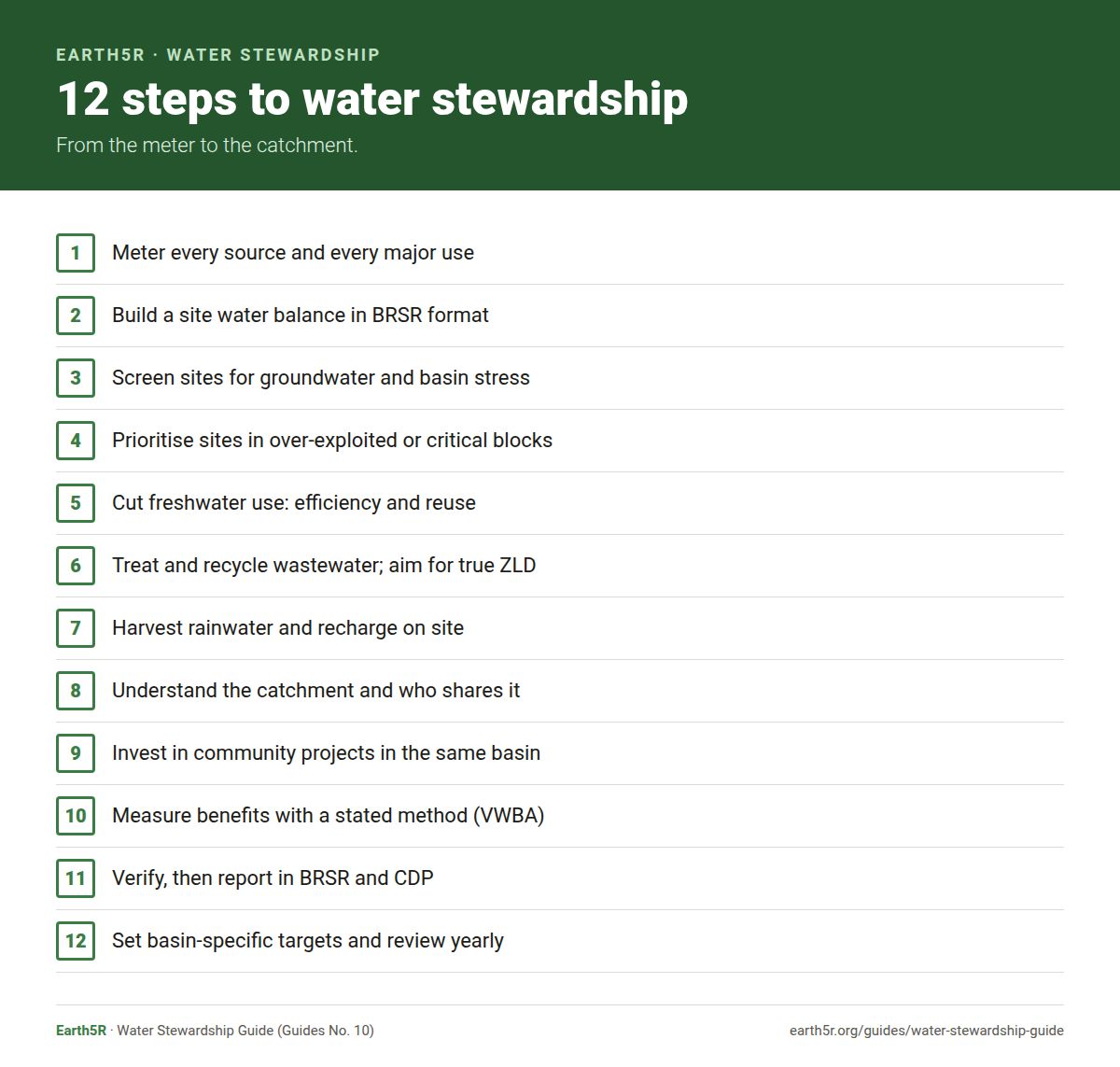
- Meter every source and every major use
- Build a site water balance in BRSR format
- Screen sites for groundwater and basin stress
- Prioritise sites in over-exploited or critical blocks
- Cut freshwater use: efficiency and reuse
- Treat and recycle wastewater; aim for true ZLD
- Harvest rainwater and recharge on site
- Understand the catchment and who shares it
- Invest in community projects in the same basin
- Measure benefits with a stated method
- Verify, then report in BRSR and CDP
- Set basin-specific targets and review yearly
Cite or share this guide
Companies, industry associations, NGOs, water user groups and universities are welcome to link to this page, add it to training material, and embed the infographics. Please link to this page rather than the PDF, so readers always get the latest edition.
Questions
Is the Water Stewardship Guide free?
Yes. The guide, the Water Stewardship Workbook (Excel) and the two Word templates are free to download without a sign-up, and free to share or adapt with credit to Earth5R.
What is water stewardship?
Using water in a way that is socially fair, environmentally sustainable and economically beneficial, through action at the site and with others in the catchment. The Alliance for Water Stewardship Standard, now in Version 3.0, sets out five steps and five outcomes for sites.
What water data does BRSR ask for?
BRSR Principle 6 asks for water withdrawal by source, consumption, intensity, discharge by destination and level of treatment, and whether the entity has zero liquid discharge. BRSR Core includes a water footprint attribute with consumption, intensity and discharge.
What does “water positive” mean?
There is no single legal definition. Companies usually mean that the volumetric water benefits of their projects exceed their water consumption. A credible claim states its method (such as VWBA 2.0), is in the same basin as the company’s water-stressed sites, excludes design capacity and is verified.
Is sending wastewater to a municipal plant zero liquid discharge?
No. Zero liquid discharge means no wastewater leaves the site. Sending it to a municipal sewage plant or a common effluent treatment plant is treated discharge and should be reported as such.
Can CSR funds be used for water projects?
Yes. Schedule VII of the Companies Act includes environmental sustainability, conservation of natural resources and maintaining the quality of water, and the government’s Jal Sanchay Jan Bhagidari campaign names CSR as one of its three principles.
Can I use the infographics on my website?
Yes. Each infographic on this page has embed code. Please keep the credit link to this page.
Download the Water Stewardship GuidePlan a water programme with Earth5R