
CBAM Guide for Indian Exporters: What the EU Carbon Border Charge Costs and How to Get Ready
The EU Carbon Border Adjustment Mechanism in plain language, updated for the October 2025 simplification and the January 2026 EU-India trade deal: which goods are covered, how the bill is worked out, why default values are expensive, verification, India’s carbon market and green steel label, contracts with EU buyers, and a 12-step readiness plan. With four free templates.
What the guide covers
- A price problem, not paperwork
- CBAM by numbers
- CBAM in one page
- How the bill is worked out
- Default values or actual data?
- What changed in 2025 and 2026
- Who does what
- Measuring embedded emissions
- Verification
- India’s side: CCTS, green steel, the FTA
- Contracts and pricing
- Best cases from TERRA
- Small exporters and MSMEs
- Cutting the carbon, cutting the bill
- Case: data that can be checked
- A 12-step readiness plan
- Checklist for CFOs and export heads
- Glossary of CBAM terms
Free templates
CBAM Cost and Data Workbook (Excel)
Your EU exposure by product and CN code, a simplified embedded emissions calculator, cost per tonne on actual versus default values for any year, the CBAM factor schedule, a data pack checklist, a precursor tracker and a timeline.
CBAM Emissions Data Pack (Word)
What to send each EU importer for each installation and year: processes, embedded emissions by CN code, electricity, precursors, methodology, carbon price paid and verification.
CBAM Monitoring Plan (Word)
Installation boundary, source streams, calculation methods, electricity, data flow, quality control and records, ready for a verifier.
Contract Clauses and Buyer Letter (Word)
A letter to open the CBAM conversation with EU buyers and model clauses on data, verification, default values, cost sharing and confidentiality.
CBAM by numbers
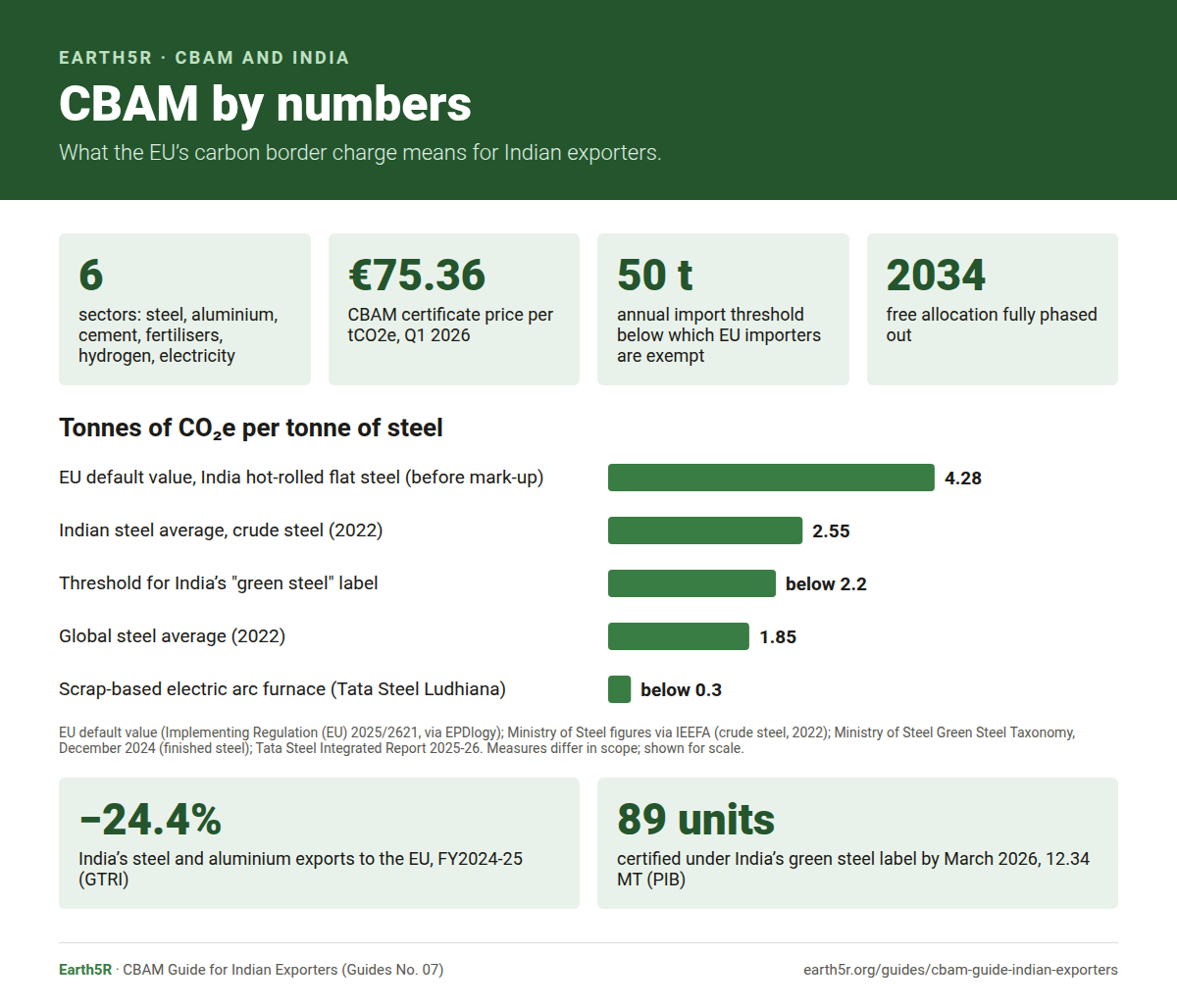
CBAM certificates for 2026 imports are priced at the quarterly average of EU carbon auctions: €75.36 per tonne of CO₂e in Q1 and €75.28 in Q2 2026. The EU default value for Indian hot-rolled flat steel is 4.28 tCO₂e per tonne before mark-up, against an Indian crude steel average of 2.55 (2022). India’s steel and aluminium exports to the EU fell 24.4% in FY2024-25.
CBAM in one page
| Question | Rule as of September 2026 |
|---|---|
| Law | Regulation (EU) 2023/956, amended by Regulation (EU) 2025/2083 of 8 October 2025 |
| Goods | Cement, iron and steel, aluminium, fertilisers, hydrogen, electricity |
| Who pays | The EU importer, as an authorised CBAM declarant |
| Small importers | Exempt below 50 tonnes a year of CBAM steel, aluminium, fertilisers and cement combined |
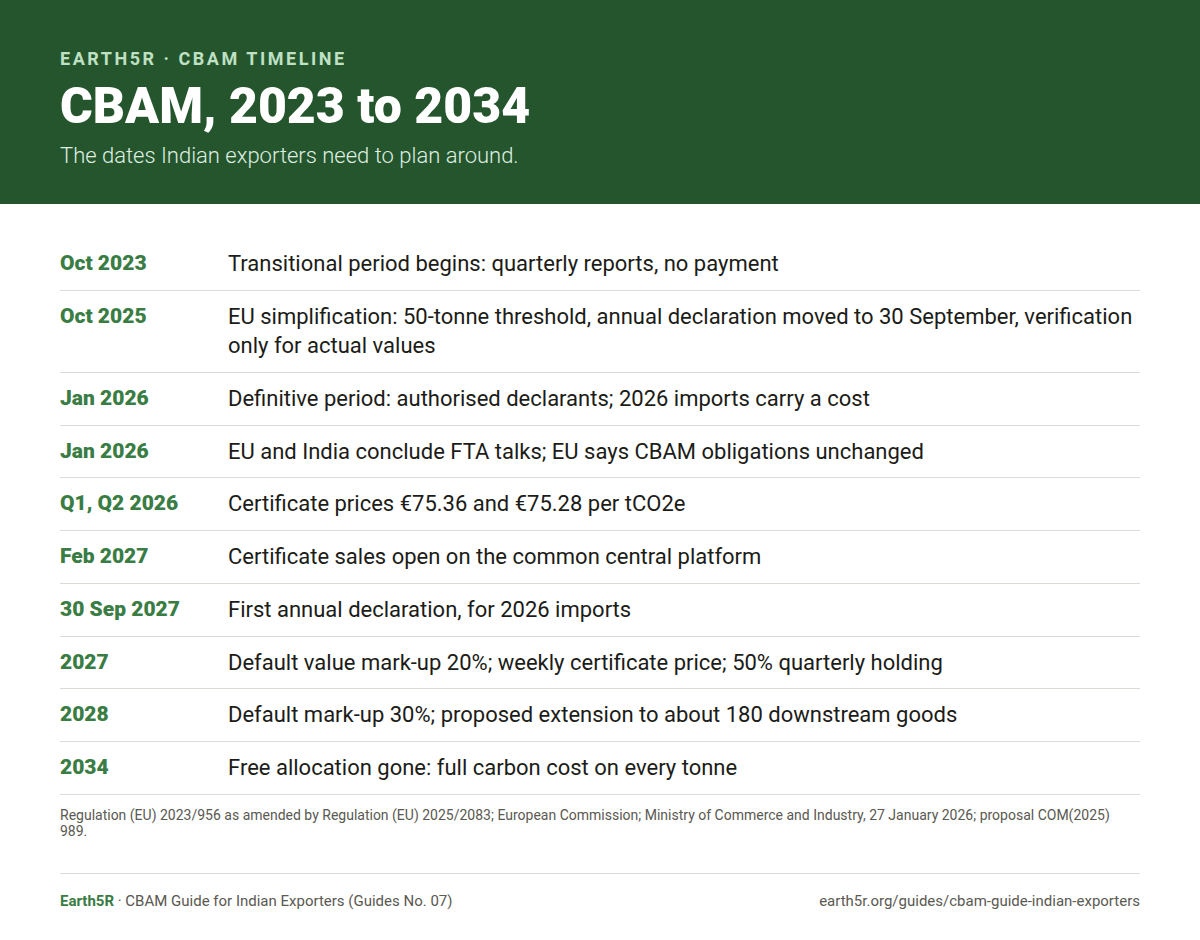
| Certificates | Sold from 1 February 2027; 2026 price is the quarterly average (€75.36 in Q1, €75.28 in Q2 2026) |
| Declaration | Annually by 30 September, first in 2027 for 2026 imports |
| Data | Actual values verified by an accredited verifier, or EU default values with a 10% (2026), 20% (2027) or 30% (2028 on) mark-up |
How the bill is worked out
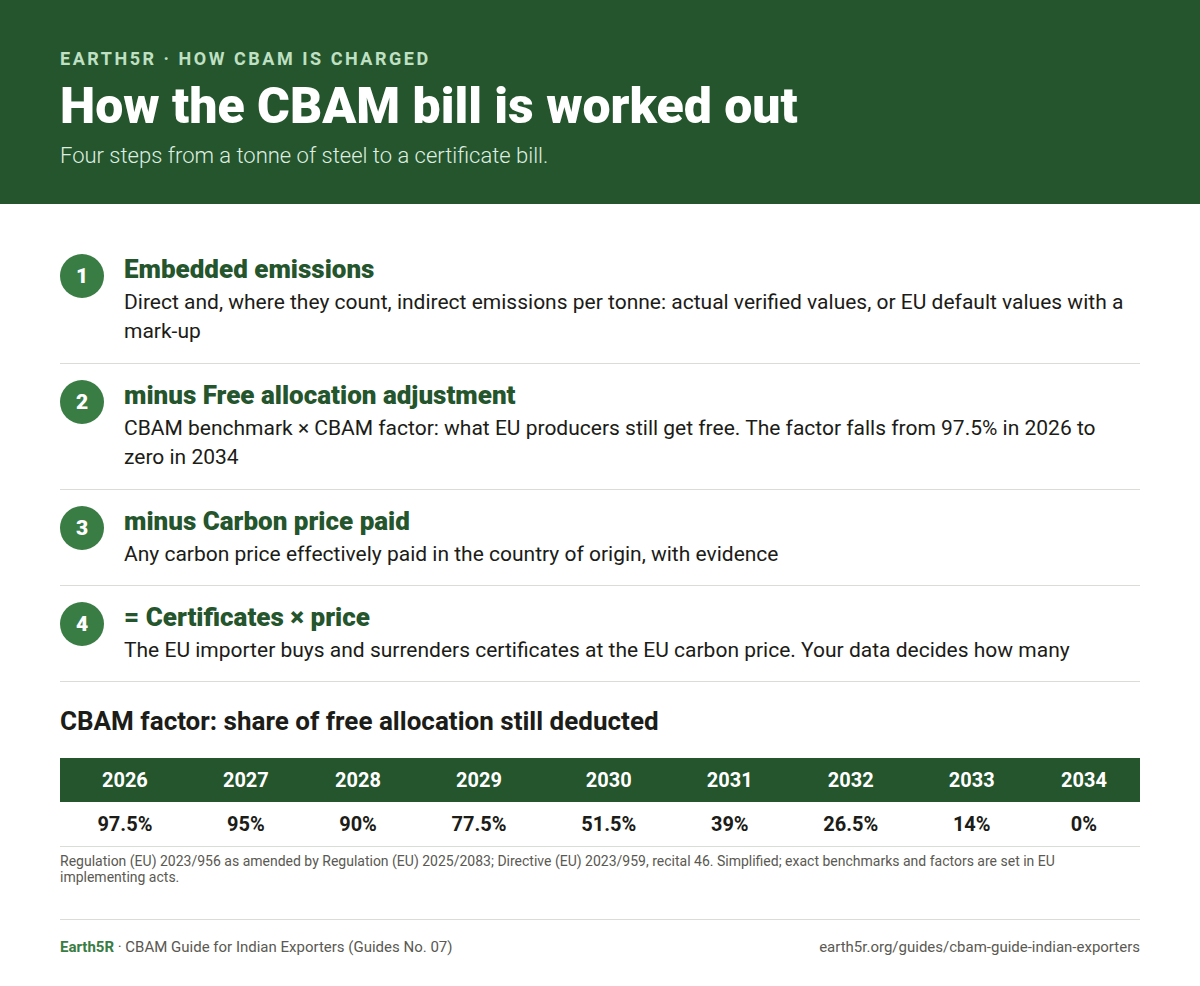
Certificates = embedded emissions − free allocation adjustment (CBAM benchmark × CBAM factor) − carbon price already paid. Emissions above what EU producers still get free are charged in full, even in 2026.
| Year | 2026 | 2027 | 2028 | 2029 | 2030 | 2031 | 2032 | 2033 | 2034 |
|---|---|---|---|---|---|---|---|---|---|
| CBAM factor | 97.5% | 95% | 90% | 77.5% | 51.5% | 39% | 26.5% | 14% | 0% |
India default values (before mark-up)
| CN code | Product | tCO2e per tonne |
|---|---|---|
| 7207 | Semi-finished steel | 4.27 |
| 7208 | Hot-rolled flat steel | 4.28 |
| 7214 | Bars and rods | 4.27 |
| 7601 | Unwrought aluminium | 1.87 |
| 2523 29 00 | Grey Portland cement | 1.48 |
India’s side
India’s Carbon Credit Trading Scheme has notified emission-intensity targets for 490 entities in aluminium, cement, chlor-alkali, pulp and paper, refineries, petrochemicals, textiles and secondary aluminium, with a draft for iron and steel in June 2026. The Green Steel Taxonomy labels steel below 2.2 tCO₂e per tonne, and 89 units were certified by March 2026. The EU-India FTA, concluded on 27 January 2026, includes cooperation on carbon prices and verifiers, but the EU says CBAM obligations are unchanged. Whether CCTS will count as a deductible carbon price is not established.
Best cases from TERRA
| Company | What their reports show | Worth copying |
|---|---|---|
| Tata Steel | Building an “installation-level data pack, verification pathways, and commercial pass-through clauses” for EU shipments; site-level intensity (India 2.45 tCO2/tcs FY2025-26); 81% of India products with EPDs | A three-part readiness plan |
| Dalmia Bharat | 466 kg CO2 per tonne of cementitious material; 12 plants in India’s carbon market cycle | Benchmarking against a public pathway |
| ABB India | Plans to identify EU export-ready product lines after the EU-India FTA | Linking trade access to product readiness |
A 12-step CBAM readiness plan
- Map EU exposure by product, CN code, tonnes and buyer
- Talk to top buyers about data format, deadlines and verifiers
- Name one owner for CBAM
- Write a monitoring plan
- Collect a full year of data
- Request precursor data from suppliers
- Calculate embedded emissions per tonne and CN code
- Compare with default values and estimate the saving
- Verify with an accredited verifier
- Send data packs to buyers
- Agree contract terms
- Plan decarbonisation before 2034
Cite or share this guide
Exporters, industry associations, export promotion councils, trade bodies, consultants and universities are welcome to link to this page, add it to reading lists or training material, and embed the infographics. Please link to this page rather than the PDF, so readers always get the latest edition.
Questions
Is the CBAM Guide for Indian Exporters free?
Yes. The guide, the CBAM Cost and Data Workbook (Excel) and the three Word templates are free to download without a sign-up, and free to share or adapt with credit to Earth5R.
Which Indian exports are covered by CBAM?
Cement, iron and steel, aluminium, fertilisers, hydrogen and electricity, as listed by CN code in Annex I of Regulation (EU) 2023/956, including some downstream steel articles. The EU has proposed adding about 180 downstream goods from 2028.
Who pays CBAM, the Indian exporter or the EU importer?
The EU importer, as an authorised CBAM declarant, buys and surrenders CBAM certificates. But the exporter’s emissions data decides how many certificates are needed, so the cost shows up in the price the buyer is willing to pay.
When do CBAM payments start?
CBAM’s definitive period began on 1 January 2026, so 2026 imports carry a cost. Certificates go on sale from 1 February 2027, and the first annual declaration, for 2026 imports, is due by 30 September 2027.
What are CBAM default values and why do they matter?
Default values are emissions per tonne published by the European Commission by country and product. They are conservative and carry a mark-up of 10% in 2026, 20% in 2027 and 30% from 2028. Exporters with verified actual data usually give their buyers a much lower CBAM cost.
Does the EU-India FTA exempt Indian exports from CBAM?
No. India reports cooperation on recognition of carbon prices and verifiers and a most-favoured-nation assurance on flexibilities, but the EU has said there is no commitment to change CBAM obligations for India.
Can I use the infographics on my website?
Yes. Each infographic on this page has embed code. Please keep the credit link to this page.