
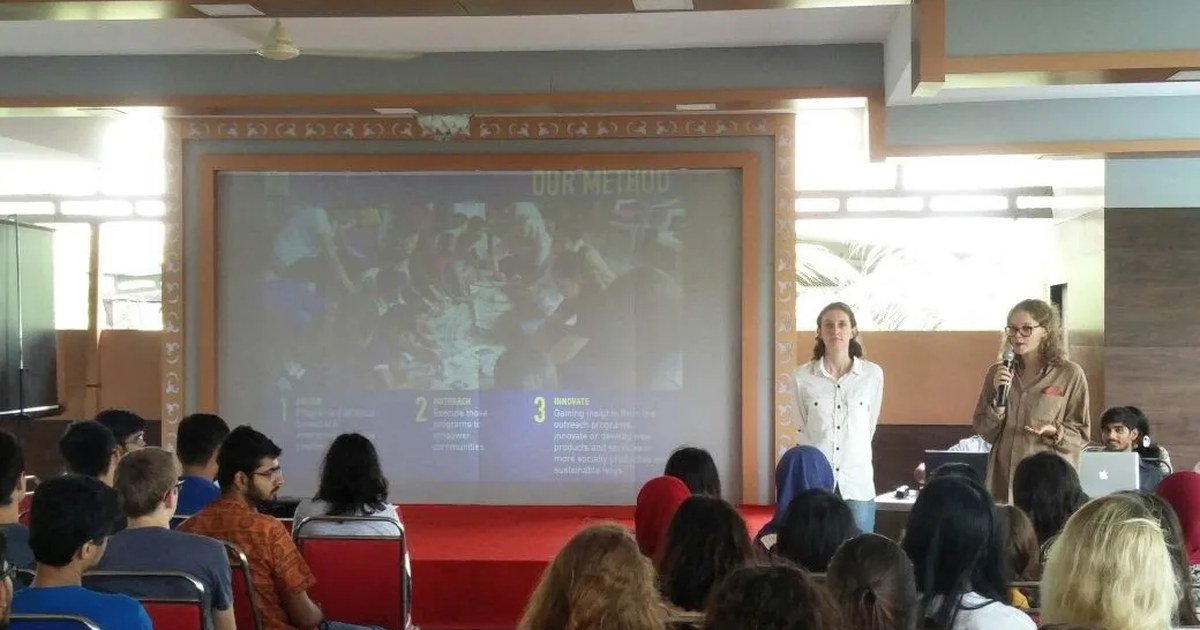
Earth5R is a Mumbai based environmental organisation. Since 2014, we have worked with communities across India on rivers, waste, water and climate. Through FIELDWORK by Earth5R, school students join this sustainability work and carry out real environmental research near their homes, studying a local river, lake, waste problem or water source and documenting what they find.
That work matters first for the place being studied. It also says something true about the student who did it. Many of these young researchers study in CBSE, ICSE or state board schools that have rarely, if ever, sent a student straight to a university abroad. If that sounds like your school, this article is for you and your parents. It explains how universities abroad read your board and your school, and how real climate field work can help you stand out.
A Class 11 CBSE student on Reddit described the situation many families recognise. Their school, they wrote,
“does not really send that many students internationally directly”
A Class 11 CBSE student on Reddit (Reddit)
That student was not worried about their marks. They were worried about everything around the marks. Will a university abroad understand my board? What if my school does not offer AP courses? Who writes the documents a counsellor normally writes?
These are fair questions, and they have practical answers. Indian schools and teachers do a great deal with very large classes and demanding board exams. The international application system simply asks for some extra pieces that many schools are not used to preparing. Once you know what those pieces are, the path becomes much clearer.
Here is honest guidance for CBSE students applying abroad, and for ICSE and state board students too.
Do universities abroad accept CBSE, ICSE and state board students?
Yes. Leading universities read Indian school qualifications every year. MIT Admissions tells applicants from other curricula not to worry, because
“our admissions officers are well-trained in evaluating curricula from the 190+ countries outside of the United States.”
From MIT Admissions (MIT Admissions)
The University of Toronto lists the CBSE certificate, the CISCE certificate and “Year 12 State Board Exams with excellent results” among its general admission requirements for Indian applicants. (University of Toronto, Faculty of Arts and Science) UCL in London publishes entry equivalents for CBSE and CISCE, and for a named list of state boards. (UCL)
So acceptance of your board is rarely the real problem. The real questions are what each country looks at, and whether your application helps the reader understand your school.
What does each country look at?
Every university sets its own rules, and they change from year to year. Always check the official admissions page for your course and your board. In broad terms, though, the main destinations look for quite different things.
United States
Most selective US universities read the whole application. That includes your school record, essays, activities and recommendation letters, read in the context of your school. Penn Admissions explains it clearly:
“We understand that schools and communities have different resources and offerings, so we evaluate each student individually based on what is offered to them.”
From Penn Admissions (Penn Admissions)
This is good news for students from schools with few options. It also means your application has to show what your school offered, and what you did with it.
United Kingdom
In the UK you apply for one subject, so universities focus closely on your marks and preparation in the subjects linked to that course. Check the requirements for each course, not only for the university. UCL, for example, notes that “specific entry requirements for some programmes may differ and may also be higher.” (UCL)
Canada
Canadian universities usually focus on your grades, especially in the prerequisite subjects for your programme. Small subject choices made in Class 11 can matter here. The University of Toronto states that “Class XII Applied Mathematics (new and old syllabus) will not meet the Calculus requirement.” It also says that early admission may be based on “excellent 10th board examination results, final 11th school grades and predicted grade 12 Board results from their school.” (University of Toronto, Faculty of Arts and Science) So Class 11 marks can count, even when they feel like a practice year.
Germany
Germany is the country where the board makes the biggest difference. DAAD India, the German Academic Exchange Service, explains:
“After a class 12 certificate from any of these boards, one cannot get a direct admission to a German university (the exception being a valid IIT-JEE Advanced result).”
From DAAD India (DAAD India)
Many students with an Indian Class 12 certificate first complete a foundation course called the Studienkolleg and pass an assessment exam, or complete a year of a related bachelor’s degree in India. DAAD also notes that an IB diploma is generally recognised as a school leaving certificate in Germany. If Germany is a serious goal, look into this before you choose your board for Class 11.
Does the board I choose in Class 11 matter for studying abroad?
Students often hear that one board or one subject is the shortcut. An IGCSE student choosing between the IB Diploma and A levels wrote that
“it’s important to me that the board can provide an easy pathway out of India where I live.”
An IGCSE student on Reddit (Reddit)
A CBSE student in Class 10, choosing an additional subject, said
“a lot of people have told me to take cs as it would be easier for me to go abroad.”
A Class 10 CBSE student on Reddit (Reddit)
The honest answer is that no board or subject is an easy pathway on its own. For most destinations other than Germany, CBSE, ICSE and IB students all have a fair route in. What matters more is:
- The subjects your course needs. For many science, engineering and economics courses that means mathematics at the right level, as the Toronto example shows.
- How well you do in them. Choose subjects you can enjoy and keep up with for two years, alongside board exams.
- What you do beyond the syllabus. A subject you genuinely care about gives you more to read, explore and write about later.
- The countries on your list. If Germany is on it, the board itself becomes part of the decision.
Your school teachers know you and your subjects well. Talk your choices through with them before you decide. They can tell you which combinations your school can actually timetable.
My school doesn’t offer AP or honours courses. Will that hurt me?
This worry comes up constantly. A CBSE student applying to US universities wrote:
“My school is a CBSE affiliated school (Indian), where no Honors or AP courses are given.”
A CBSE student on Reddit (Reddit)
Universities know that most schools outside the US do not offer AP courses. An MIT Admissions blogger answered this exact question:
“Admissions evaluates an applicant within his or her context. If your school doesn’t, for example, offer AP classes, you will not be penalized for not taking AP classes.”
From the MIT Admissions blog (MIT Admissions blog)
The same answer adds that “the committee looks for evidence that the applicant tried hard to take classes that were challenging.” In practice, that means:
- Take the most demanding options your school offers in the subjects closest to your course.
- Go deeper on your own, with structured online courses, self study or real research. MIT lists several options for students without access to advanced classes. (MIT Admissions)
- Use the space applications give you to explain your context. MIT says it provides space in its application “to explain those reasons or anything else we should know about your educational context or obstacles.” (MIT Admissions)
My school has no school profile. What should we do?
A school profile is a short document, usually one or two pages, that tells universities about your school. Many Indian schools have never needed one. The same Class 11 student asked whether to tell their school to mention
“the fact that they don’t offer IB Honors/AP exams or courses, they deflate grades in 9th and 11th?”
A Class 11 CBSE student on Reddit (Reddit)
That is exactly the kind of information a profile is for. Penn Admissions says a good profile “helps us make sense of an applicant’s transcript, and to understand a student within the context of their school community.” (Penn Admissions)
What a simple school profile can include
- The school’s name, address, board and affiliation, and contact details for the principal and the teacher acting as counsellor.
- The size of the school and of the Class 12 batch.
- The streams and subjects offered, and what is not offered, such as AP or IB courses.
- How marks are given, including how internal and board marks work, and whether some years are marked strictly.
- Clubs, activities and opportunities available to students.
- Where recent students have gone after school, if the school keeps this record.
- For a fuller checklist, College Board publishes guidance on creating a school profile. (College Board)
A student can offer to help collect information, but the profile belongs to the school. Every detail must be accurate, and the principal or coordinator should check and approve it. Ask early and kindly. For a busy coordinator, a clear request with a sample outline makes the job much easier.
What if my school has no experience with international applications?
A student applying for scholarships abroad put it simply:
“My school has no experience with international applications.”
A student on Reddit (Reddit)
This is a gap in the system, not a failing of the school. Indian schools are built around board exams, and they do that work well. Teachers and principals are usually willing to help once they understand what is needed. A few things make it easier for everyone:
- Make one simple sheet listing each university, its deadline and exactly which documents it asks the school for.
- Share the official instructions with your teachers, rather than your own summary of them.
- Ask the school to use one contact person and one email address for all universities, so that nothing gets lost.
- Give recommenders real material about your work. Our article on recommendation letters that grow from real work explains how.
How can a student from such a school show what they can do?
Context explains what your school could not offer. Evidence shows what you did anyway. Universities and professors look for students who can research, innovate and lead, in the same way that students look for good universities. The strongest applications from small or traditional schools often show one thing done deeply, rather than many things done briefly.
- Pick one real question linked to the subject you want to study. Where does the waste from your colony actually go? How clean is the lake near your school?
- Work on it for months, not days. Collect data, write up what you found and share it with the people affected.
- Keep a dated record of your work, your mistakes and how you fixed them.
- Let adults see the work. A teacher or mentor who watched it happen can describe it in a letter.
Our guide to building a real profile beyond marks explains how to start a small field study near home. You may also find it useful to read what admissions officers actually look for.
No project, programme or board can guarantee admission. Real work done well simply gives a reader something true and specific to understand about you.
For parents. You can help most by starting early, checking official university pages together and supporting your child’s conversations with teachers. Any field work near home should always happen with a parent or guardian present. Let the requests to the school, and the work itself, stay your child’s own. A careful study of a local lake, drain or waste problem gives your child something real to show, because their profile then rests on environmental work they actually did in their own community.
Where FIELDWORK by Earth5R fits
Everything in this article can be done without joining any programme. Some students, though, want structure and experienced people around them while they work on a real environmental problem in their own community.
Earth5R is a Mumbai based environmental organisation, recognised by the United Nations and UNESCO, running climate and sustainability programmes across India since 2014.
FIELDWORK by Earth5R is a two way ecosystem that Earth5R manages. Students look for good universities, and universities and professors look for students who can research, innovate and lead. FIELDWORK brings the two together around real environmental work. Students:
- study, take part in and do research on real Earth5R environmental projects
- carry out field research near home, always with a parent or guardian present
- join conversations with professors, where they can ask questions and get clarity about subjects, research and university life
- work on some projects that are built in partnership with universities
- plan their work around school and board exams
This kind of documented environmental work can help a student from any board show a university what they did with the opportunities they had, and what they learned about a real sustainability problem near home. School teachers remain at the centre of a student’s application, and FIELDWORK gives them more real work to see and talk about.
You can read more at earth5r.org/fieldwork.
Frequently asked questions
Do foreign universities accept CBSE?
Yes. UCL and the University of Toronto name CBSE in their published requirements for Indian applicants, and MIT says its admissions officers are trained to evaluate curricula from around the world. Requirements differ by course, so check the official page for each one. Germany is the main exception, where DAAD India explains that a Class 12 certificate alone does not usually give direct admission. (DAAD India)
Is IB better than CBSE for studying abroad?
Not automatically. Universities in the US, UK and Canada accept both. IB can make a direct difference for Germany. For most students, the subjects you take, how well you do and what you explore beyond the syllabus matter more than the board name.
Can ICSE and ISC students apply abroad?
Yes. UCL and the University of Toronto, for example, list the CISCE certificate alongside CBSE for Indian applicants.
Can state board students study abroad?
Yes, though you should check carefully. The University of Toronto considers “Year 12 State Board Exams with excellent results”, and UCL lists the state boards it accepts by name. (UCL)
Do Class 11 marks matter when applying abroad?
They can. Many universities ask for your school record, and the University of Toronto mentions final Class 11 grades for early admission. If your school marks Class 11 strictly, a school profile can explain that.
Coming from a school that has never sent anyone abroad is not a weakness you need to hide. It is context, and universities are used to reading it. Help them read it well, choose your subjects with care, and spend your time on work that is real. If that work also cleans a lake, reduces waste or helps a community understand its water, so much the better.
Let real work show what you can do
FIELDWORK by Earth5R helps school students from every board research real environmental problems near home, and join conversations with professors who help them find clarity.