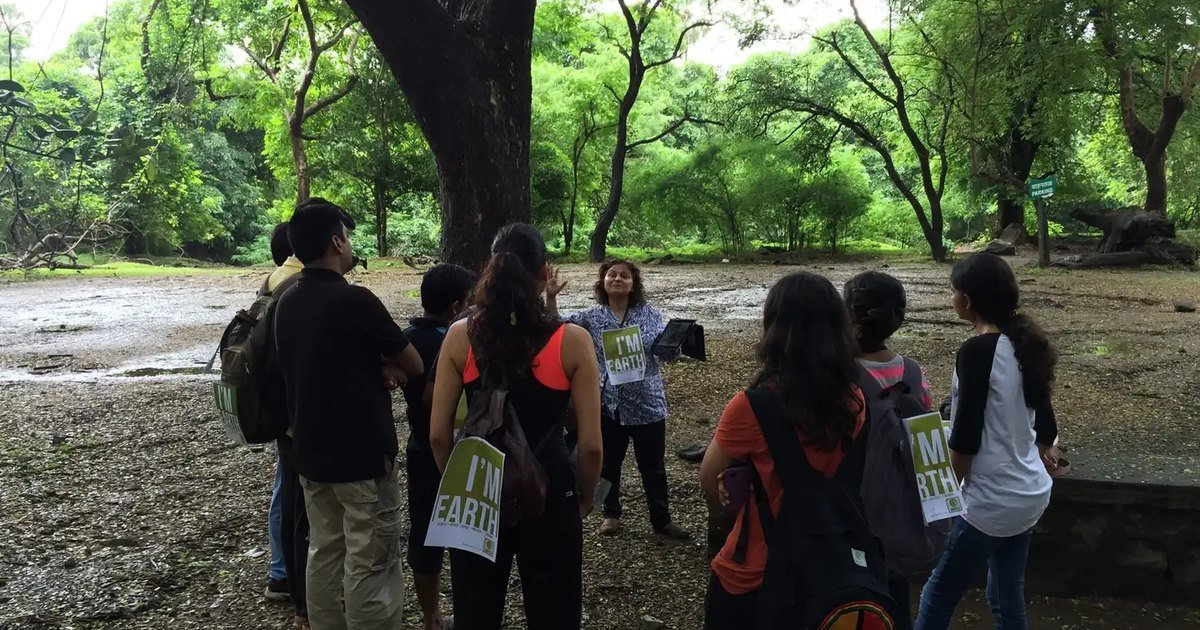
A Class 9 student can walk to the end of her lane with a notebook, a parent beside her, and count how many bags of mixed waste leave her building on a Monday morning. That is climate field work. It is small, it is local, and it is real. Done once, it is an afternoon. Done every month for four years, with better questions each time, it becomes the kind of record that admissions readers in the United States, the United Kingdom and Canada say they actually value. This guide is for Class 9 and Class 10 students who feel they have nothing on their profile yet, and for the parents who want to help. If you have been searching for 9th grade extracurricular activities, the honest answer is that the best one may be a sustainability project on your own street.
Earth5R is a Mumbai based environmental organisation recognised by the United Nations and UNESCO, running climate and sustainability programmes across India since 2014. Through FIELDWORK by Earth5R, school students study waste, water, air and biodiversity near their homes, always with a parent or guardian present. Many of them later apply to universities abroad. In this guide the work comes first and applications come second, because that is also the order that admissions offices describe.
Everything below is checked. Advice from universities is quoted from their own pages, linked so you can read it yourself. Student voices are quoted word for word from public Reddit posts, without usernames. Where we could not verify something, we say so.
In this guide
- The “nothing on my profile” panic in Class 9 and 10
- What admissions offices say about commitment over time
- How Class 9 and 10 count in the US, UK and Canada
- Small climate field projects near home
- How to document field work so it counts later
- A year by year roadmap from Class 9 to Class 12
- Mistakes to avoid
- How parents can help without taking over
- Where FIELDWORK fits
- FAQ
The “nothing on my profile” panic in Class 9 and 10
Every week, Indian school students post the same fear online. They have just learned how admissions abroad work, they look at their own lives, and they see a blank page. Here is how some of them put it in the last week of October 2026.
“I’m in 9th grade and want to go to top 50 unis but I haven’t started anything no extracurricular no internship no awards”
A Class 9 student in India on r/ApplyingToCollege (read the post on Reddit)
“I found out about international college admission process like a couple of months ago and now I am genuinely panicking about it”
A Class 10 student on r/Indians_StudyAbroad (read the post on Reddit)
The fear gets sharper the later it arrives. A Class 12 science student with strong test scores wrote this in r/IntltoUSA.
“i have nothing for my profile(i know im too late, sorry…)”
A Class 12 student in India on r/IntltoUSA (read the post on Reddit)
One reply to that student was blunt, and it explains why starting early matters more than starting big.
“Cramming in ECs in six months will not even scratch the surface. Your competitors will have started during their early years of high school.”
A reply on r/IntltoUSA (read the post on Reddit)
There is good news hidden in that reply. If you are in Class 9 or Class 10, you are in those early years right now. You do not need to win anything this year. You need to start one real thing and keep going.
A snapshot from one Reddit scan
Between 22 and 26 October 2026 we read about 790 posts across Reddit communities where Indian students ask about studying abroad. 27 of them came from Indian school students, from Class 9 to Class 12 or just finished Class 12, or from their families, asking about undergraduate study abroad. Counting each post once under its main theme, 6 were mainly about weak, late or “chance me” profiles. That was down from 11 in our previous scan, but the worry had moved younger, with Class 9 and Class 10 students asking where to start. Please read this as a snapshot of one small scan, not a survey. The busiest communities were only partly covered, so the real numbers are certainly different.
The same gap shows up elsewhere. When we classified 472 substantive YouTube comments under 33 videos about personal statements and SOPs for our SOP guide, 18 of them (3.8%) were about lacking the right experiences or extracurriculars. One viewer under a video featuring Harvard admissions advice wrote “in our school we don’t have such thing as extracurricular” (watch the video). If that is you, keep reading. Universities have thought about exactly this situation.
What admissions offices say about commitment over time
Many students imagine that admissions officers want a long list of clubs, medals and certificates. The official guidance says something different. Here is what the universities and application systems themselves say, in their own words.
Common App: fewer activities, told well
The Common App is used by hundreds of US colleges. Its own guide, Approaching the Activities section, says “You can add up to ten activities to your application, but that doesn’t mean that you need to enter ten.” It adds “Focus on what activities can best tell that story and not on the number you’re reporting.” For each activity you report hours per week and weeks per year, and the description field allows only 150 characters. That is a short space. A sustained project with a clear result fits it far better than a list of one day events.
Harvard: quality, depth and the grades you took part
Harvard’s application tips are direct: “We are much more interested in the quality of students’ activities than their quantity so do not feel you need to fill in the entire grid!” On the grade levels you list for each activity, Harvard writes “The grades during which you have participated are important because they help us to understand the depth of your involvement in that activity and your changing interests over time.” It also says “Not all extracurricular activities must be a four-year commitment for our applicants.”
That last line matters for anxious Class 10 students. You do not have to have started in Class 9 for something to count. But it also shows why an early start helps. When an activity runs from grade 9 or 10 to grade 12, the reader can see it grow. Harvard also writes, for students whose schools offer little, “You should not feel that your chances for admission to college are hindered by the lack of extracurricular opportunities.”
MIT: a few things you care about
MIT asks for “up to four activities that are the most important to you” on its activities page, and advises students to “choose your activities because they delight, intrigue, and challenge you” rather than because they look impressive. Its What we look for page says “We don’t expect applicants to do a million things.” and asks students to choose quality over quantity. MIT also explains its motto, Mind and Hand, this way: “you shouldn’t just enjoy thinking about problems, you should be excited about doing something to help solve them.”
For students outside the United States, MIT’s extracurriculars FAQ adds an important line: “Remember that your application is reviewed in context, and that we look to see what you did with the options available to you no matter where you live or attend school.” A waste audit in your own housing society is exactly the kind of thing that answers that question.
Cambridge and the UK: super-curricular, not extra-curricular
UK universities read activities differently, and Cambridge is very clear about it. On its Improve your application page it lists super-curricular activities, ways of exploring your subject beyond the classroom, including to “volunteer, or get some work experience that’s relevant to your course” and to “take part in academic competitions or projects”. It also says “your experience of them and your reflections are more important than the number of different activities you’ve pursued”.
The same page warns that general extra-curricular activities, such as sports or music unrelated to your course, “won’t be taken into consideration by Cambridge during the application process.” So for a UK application, a water quality project helps most if you plan to study geography, environmental science, chemistry, engineering or something close, and if you can explain what it taught you about that subject.
Christ’s College Cambridge says this on its resources page: “Supercurriculars are not about who has certain connections or who can pay for certain experiences!” It suggests that “Around one or two hours per week of exploration throughout Year 12” should be sufficient. Year 12 in the UK is roughly Class 11 in India. One or two hours a week, kept up steadily, is a realistic pace for a student who starts in Class 9 or 10.
UCAS: three questions and room to reflect
From the 2026 entry cycle, the UCAS personal statement is answered as three questions, with a total limit of 4,000 characters and at least 350 characters per answer, as explained on the UCAS page on the new personal statement. UCAS describes the first question as a place to highlight “super-curricular activities as evidence of curiosity and interest in the subject outside of the classroom”. On work experience and volunteering it says “the key thing here is for you to reflect on your experiences”. Reflection is the common thread. You can only reflect on something you have done for long enough to learn from it.
Toronto and Canada: marks first
The University of Toronto shows a third pattern. Its required documents page says “Most programs only require your academic results for admission.” It adds that “some programs ask for a supplemental application to get a fuller picture of your interests and experiences.” For India, its country requirements list the CBSE All India Senior School Certificate or the CISCE Indian School Certificate, and note that CBSE students applying to programmes that need calculus must present Class XII Standard Mathematics. Field work will not replace marks for most Toronto programmes. It can still matter for programmes with a supplemental application, and it often feeds scholarship and essay writing elsewhere.
One commenter on the Class 10 thread above summed up the difference between systems in plain words. It is an opinion, not an official rule, but it matches what the official pages suggest.
“Europe mostly doesn’t care about extracurriculars and for the most part is cheaper than the US.”
A reply on r/Indians_StudyAbroad (read the post on Reddit)
Read together, the official sources point the same way. Do fewer things. Do them for longer. Choose work connected to what you might study. Be able to say what you learned. None of that requires money or connections, and all of it rewards an early start.
How Class 9 and 10 count in the US, UK and Canada
United States
US applications look at the whole of high school, usually grades 9 to 12. On the Common App you mark which grades you took part in each activity, so an activity from Class 9 shows up as a line that starts in grade 9. Harvard says this helps it see depth and changing interests over time. Your school report and counsellor letter usually cover your record across these years as well, so marks in Class 9 and 10 are not invisible.
Each university has its own rules for grades. As one example, the University of California calculates its GPA for students in American schools from courses taken between the summer after 9th grade and the summer after 11th grade. Check what each university says about Indian marksheets, because rules for international students can differ.
United Kingdom
UK applications are subject focused. Activities count when they connect to your course, and they appear mainly in the personal statement. Class 10 results matter too. Cambridge says on its transcript page that it will ask for a high school transcript if, for example, “you studied outside the UK and took non-UK qualifications at age 15 or 16”, which describes Class 10 boards. Churchill College Cambridge adds on its FAQ that it will look at results like these “as an indicator of your previous academic performance and take them into account when assessing your application.” So your Class 10 board marks travel with you to Cambridge, and field work you start in Class 9 can become super-curricular material by Class 11.
In Canada, as the Toronto pages show, many programmes decide mainly on marks. The common lesson is simple. Class 9 and 10 marks count, and so does what you start doing in those years. For more on how board students are read abroad, see our guide for CBSE, ICSE and state board students applying abroad.
Small climate field projects near home
A good first project for a 14 year old is small enough to finish, close enough to repeat, and real enough that the results surprise you. Every project below should be done with a parent or guardian present, in public or shared spaces where you have permission, and never in unsafe places such as fast water, busy roads, landfills or industrial sites. For a longer list, see climate projects students can run.
1. A household or building waste audit
Weigh or count what your home throws away for one week, sorted into wet, dry and other. Repeat it every month. Then ask your housing society if you can audit one common bin, with an adult, using gloves. Questions grow naturally. Which day produces most waste? How much is food? Does segregation hold up after collection? Within a year you have a dataset, a few changes you tried, and evidence of what worked.
2. Water use and water quality
Start with a water diary. Record how much water your family uses, when supply comes, and how much is stored or wasted. Later, with a parent present and simple test kits bought from a reputable supplier, record basic readings at a tap, a tank or a public lake edge you can reach safely from the bank. Note the date, time and weather every time. Never enter the water.
3. Air quality near school and home
Write down the official air quality index for your nearest monitoring station every day at the same time, and compare it with what you see: traffic, burning, construction dust. If your school has a low cost sensor, compare readings, and learn why cheap sensors and official monitors can disagree. This is a strong start for students interested in engineering, data or public health.
4. Biodiversity counts
Pick one park, garden or tree lined road and count birds, butterflies or trees on the same route each month. Public citizen science apps such as eBird and iNaturalist let you record observations, but follow their rules for young users and let a parent manage the account. A tree census of your colony, with species, girth and health, is a project that can run for all four years.
5. A small community survey
Ask neighbours, shopkeepers or vendors a short set of questions about something that affects them, such as flooding, heat, waste collection or water supply. Ask permission, explain why, keep answers anonymous, and have a parent with you. Surveys teach you that people know things data cannot show, and that is often what you will write about later.
Pick one project to start, not all five. The aim in Class 9 is to build the habit of noticing and recording. The idea fits MIT’s description of Mind and Hand above: thinking about a problem, and then doing something to help solve it.
How to document field work so it counts later
Applications are written in Class 11 and 12, but the evidence is created in Class 9 and 10. If you do not record it, you will forget it. Keep these from day one.
- A dated field notebook. Date, time, place, weather, what you measured, what surprised you. Paper is fine.
- A simple spreadsheet. One row per visit. This is what lets you show change over months and years.
- Photos with captions. Photograph the place and the method, not people’s faces without permission.
- A monthly reflection. Three lines: what I did, what I learned, what I will change. These become essay and personal statement material.
- An hours log. Common App asks for hours per week and weeks per year. Write them down as you go.
- A one page summary each year. The question, the method, the result, and what happened next. Show it to a teacher and ask for honest feedback.
When it is time to write, these records make your writing specific and believable. Our guides on college essay examples from climate and community work and how to write SOP drafts from field notes show how to turn notebooks like these into applications.
A year by year roadmap from Class 9 to Class 12
This roadmap assumes that your marks come first, because in every system they do. Field work should fit around board preparation, not compete with it. A steady one to two hours a week, in line with the Christ’s College suggestion, is enough for most of the year, with more time during holidays.
Class 9: start and explore
- Choose one project near home and run it monthly, with a parent or guardian present.
- Start the notebook, spreadsheet and hours log described above.
- Read widely about your topic. Note which school subjects it connects to.
- Talk to your class teacher or science teacher about what you are doing. Teachers are often the first to notice real interest.
- For CBSE, ICSE and state board students, Class 9 is the lighter year before boards. Use school holidays for the bigger field days.
Class 10: keep going lightly, protect your boards
Class 10 boards matter abroad, as the Cambridge and Toronto pages show. From 2026, CBSE runs two board examinations in Class X. Its notification says the main exam “will begin from Mid-February”, a second exam is held in May, and all passed and eligible students may improve their performance in up to three subjects among Science, Mathematics, Social Science and languages. ICSE and state boards have their own calendars, so check yours.
- Cut field work to a short monthly visit from about November to the end of your exams. Keep the record going, even if only one line.
- Use the summer after Class 10 to expand the project: a second site, a new question, a short report.
- Think carefully about Class 11 subjects. If you might study economics, engineering or science abroad, keep mathematics. Speak to your school counsellor before you decide.
That subject advice is not theoretical. A student on r/ApplyingToCollege wrote this about a choice made at the end of Class 10.
“I dropped math in my 11th and 12th grade which at the time I did not know the effect it would have”
A Class 11 student in India on r/ApplyingToCollege (read the post on Reddit)
Class 11: go deeper and connect it to a subject
- Ask a sharper question. Not “is there waste” but “does segregation survive collection in my ward”.
- Connect the project to the subject you want to study. This is what makes it super-curricular for the UK.
- For IB Diploma students, field work can feed CAS. The IB says CAS service is an unpaid and voluntary exchange with a learning benefit for the student, and every DP student completes a CAS project.
- Begin a short written report each term, and share results with the people affected, such as your housing society.
Class 12: reflect and write
- Keep the project running at a lower intensity while you prepare for boards and entrance tests.
- Use your records to write the Common App activity line, UCAS answers or essays.
- Ask the teacher who has seen your work over the years for a recommendation. A long view is what makes such letters strong.
If you are reading this in Class 10 or even Class 11, do not panic. Harvard says not every activity has to last four years. Start now and follow the same steps at a faster pace. Our guide Beyond Marks has more on building a real profile from wherever you are.
Mistakes to avoid
Collecting certificates
Many Class 9 students sign up for every online quiz, webinar and olympiad that promises a certificate. A folder of participation certificates rarely tells a reader anything about you. The Common App asks you to focus on the activities that tell your story, not the number you report. One activity carried over four years usually says more than twenty certificates from twenty different weekends.
Paid “international internships” for school students
Families are often offered expensive programmes for school students that promise international exposure, an impressive title or a famous name. Be careful. Christ’s College Cambridge says plainly that supercurriculars are not about who can pay for certain experiences. MIT says it looks at what you did with the options available to you. A paid title is not the same as real work, and the reader often cannot tell what you actually did. Free, local, sustained work that you can describe in detail is more convincing.
Buying a publication
Some services charge families to place a school student’s paper in an online journal. In a 2023 investigation, ProPublica reported that “College admissions staff, besieged by applicants proffering links to their studies, verify that a paper was published but are often at a loss to evaluate its quality.” The same report described services that portrayed affiliated publications as independent journals. If a publication is paid for and you cannot explain the work in your own words, it can hurt more than help. A clear report on your own field data, shared with your community, is honest and easy to discuss in an interview.
Starting too many things at once
Five projects started in Class 9 and dropped by Class 10 look like five false starts. One project kept going, with a second added only when the first is steady, looks like commitment.
Letting field work hurt your marks
Every official page above treats academic results as essential. If your marks fall because of an activity, cut the activity back. You can always expand it again in a holiday.
How parents can help without taking over
Parents are part of field work in a very practical way. For students of this age, every field visit should happen with a parent or guardian present. But being present is different from doing the work. Admissions readers can usually tell when a parent wrote the report or chose the question.
Not every student has that support. One student wrote this on r/CBSE.
“My parents aren’t very supportive, and I have no one to guide me through this.”
A student on r/CBSE (read the post on Reddit)
If that is you, a teacher, an older cousin or a school counsellor can play the same role. If you are a parent reading this, here is how to help well.
- Come along, and stay safe. Choose safe sites together, carry water, and step in when a place or person is not safe.
- Let your child choose the question. Ask “what do you want to find out” rather than suggesting the answer.
- Ask, do not edit. Ask what they noticed this month. Do not rewrite their notes or reports.
- Protect exam time. Help plan lighter field months around tests and boards.
- Be careful with money. Be cautious of programmes that charge for titles, certificates or publications. The official guidance above does not ask for them.
- Respect teachers and counsellors. They know your child’s school record and can write the letters that matter. Keep them informed of the project.
- Be honest about outcomes. Field work makes an application stronger and more truthful. No project, programme or person can promise admission.
Where FIELDWORK fits
FIELDWORK by Earth5R
Earth5R is a Mumbai based environmental organisation recognised by the United Nations and UNESCO, running climate and sustainability programmes across India since 2014. FIELDWORK gives school students real climate and sustainability work on waste, water, air and biodiversity near their homes, always with a parent or guardian present.
FIELDWORK is designed as a four year programme from Class 9 to Class 12. Students return each year and take on more scope and responsibility, so the work builds into a multi year record instead of a single event. It is a two way ecosystem. Professors join conversations with students. They are not hired, and some projects are built in partnership with universities. Teachers and counsellors remain students’ main guides, and nobody can promise admission. What the work gives you is real material and the habit of noticing, measuring and reflecting that admissions offices describe.
FAQ
What are good 9th grade extracurricular activities for students who want to study abroad?
Choose one or two activities you can keep up for several years, ideally connected to a subject you enjoy. A climate or community field project near home, done with a parent or guardian present, is a strong choice because it is free, repeatable and produces real evidence. Official guidance from Harvard, MIT and the Common App all favour quality and depth over the number of activities.
Is Class 10 too late to start?
No. Harvard says not every activity needs to be a four year commitment. Starting in Class 10 still gives you two to three years of growth before you apply. Start one project now and keep a careful record.
Do UK universities care about activities in Class 9?
UK universities focus on your subject. Cambridge says general extra-curricular activities are not considered, while super-curricular activities linked to your course are. Field work started in Class 9 can become super-curricular if you connect it to your subject by Class 11. Your Class 10 board results also matter.
Do I need an internship or a published paper?
No. None of the official pages quoted here ask school students for internships or publications. Be careful with paid programmes and paid journals. Real work you can explain in detail counts for more.
How much time should field work take?
Christ’s College Cambridge suggests one or two hours a week of exploration through Year 12 can be enough. Most Class 9 and 10 students can manage a monthly field visit plus a short weekly write up, with more during holidays and less before exams.
Can I do field work alone?
At this age, field work should always happen with a parent or guardian present, in safe and permitted places.
Sources
- Common App, Approaching the Activities section (PDF)
- Harvard College, Application tips
- MIT Admissions, Activities
- MIT Admissions, What we look for
- MIT Admissions, How does MIT consider extracurriculars?
- University of Cambridge, Improve your application
- University of Cambridge, Providing a transcript
- Churchill College Cambridge, Undergraduate FAQs
- Christ’s College Cambridge, Resources
- UCAS, The new personal statement for 2026
- University of California, GPA requirement
- University of Toronto, India requirements
- University of Toronto, Required documents
- CBSE, Two Board Examinations in Class X from 2026 (PDF)
- International Baccalaureate, Creativity, activity, service
- ProPublica, The Newest Way to Buy an Advantage in College Admissions (2023)
Start your first field project this month
You do not need a full profile in Class 9. You need one real question, a notebook, and a parent or guardian beside you. Learn how FIELDWORK by Earth5R supports students from Class 9 to Class 12 at earth5r.org/fieldwork.