
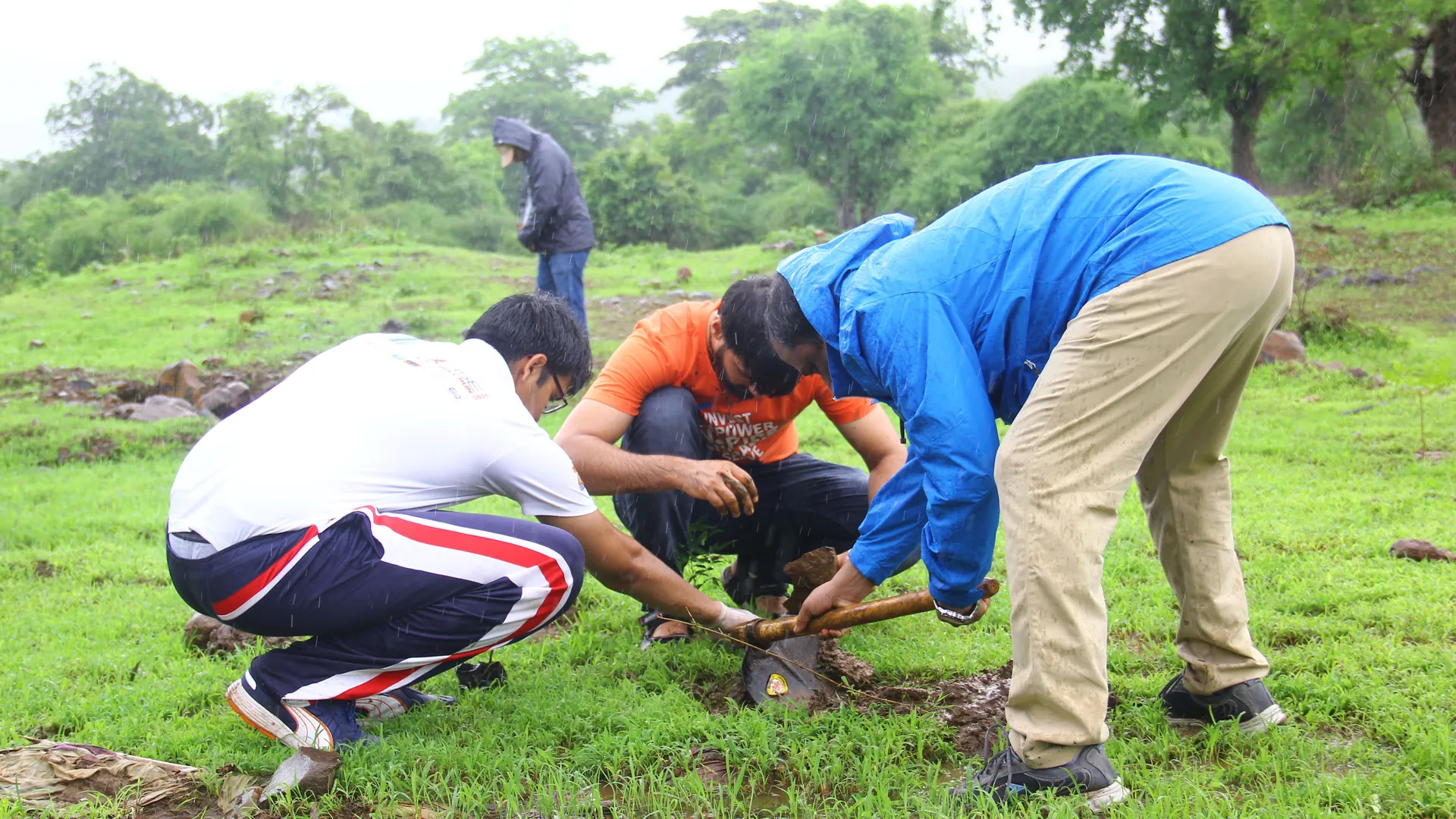
India has planted more than 310 crore saplings under Ek Ped Maa Ke Naam since June 2024, one of the largest tree planting drives in the world, and its forest and tree cover has grown to 25.17% of the country. This research brief looks at the next step those two numbers point to: helping every sapling grow into a tree. It brings together the forest survey, parliamentary answers, satellite data and national programmes, adds what a decade of Earth5R plantation drives taught on the ground, and ends with how companies, communities and citizens can help saplings survive.
Tree plantation in India: the evidence at a glance
- 310 crore saplings, one of the world’s largest drives
- Forest and tree cover has grown to 25.17%
- Trees outside forests led the gain
- Why protecting old forest matters
- National programmes for forests and mangroves
- Survival, the shared next step
- What helps a sapling become a tree
- CSR funding and the green credit rule
- What Earth5R’s plantation drives taught
- Case study: ACT Powai saplings from compost
- Case study: compost and a river catchment
- The five R’s, applied to trees
- What a CSR plantation should measure
- Questions
This is the fifth EarthJournal research piece this month on India’s environment in numbers. Read it with our data on groundwater depletion in India and food waste in India, because a sapling’s survival depends on both: water in the dry months, and the compost that feeds it.
01
India has planted more than 310 crore saplings since June 2024, one of the largest tree planting drives in the world
Ek Ped Maa Ke Naam, “a tree in my mother’s name”, was launched on World Environment Day, 5 June 2024, to make tree plantation in India a people’s movement. Plantation and maintenance are carried out mainly by state governments, and plantings are uploaded to the Meri LiFE portal.[6] By 24 December 2025 the campaign had reached 262.4 crore saplings.[7] By August 2026 the environment ministry told the Lok Sabha that “over 310 crore saplings have been planted across the country”.[1]
Where the 2026-27 saplings were planted
Saplings planted under Ek Ped Maa Ke Naam in 2026-27, as on 5 August 2026, crore
Source: Ministry of Environment, Forest and Climate Change, Lok Sabha Unstarred Question 3511, Annexure-A, 10 August 2026.[6] “All other” is the national total of 38,64,54,584 minus the seven states shown.
Uttar Pradesh led the season. Of 38,64,54,584 saplings logged in 2026-27 up to 5 August, Uttar Pradesh accounted for 24,83,86,023, close to two in every three. Rajasthan logged 3,27,75,868, Madhya Pradesh 2,87,75,647 and Gujarat 2,76,93,947.[6]
Plantation sites under the campaign are geotagged, and state forest departments assess survival “in accordance with the extant norms and procedures”.[6] That gives every partner in the campaign, from schools and resident groups to companies, a clear next step: look after what is planted.
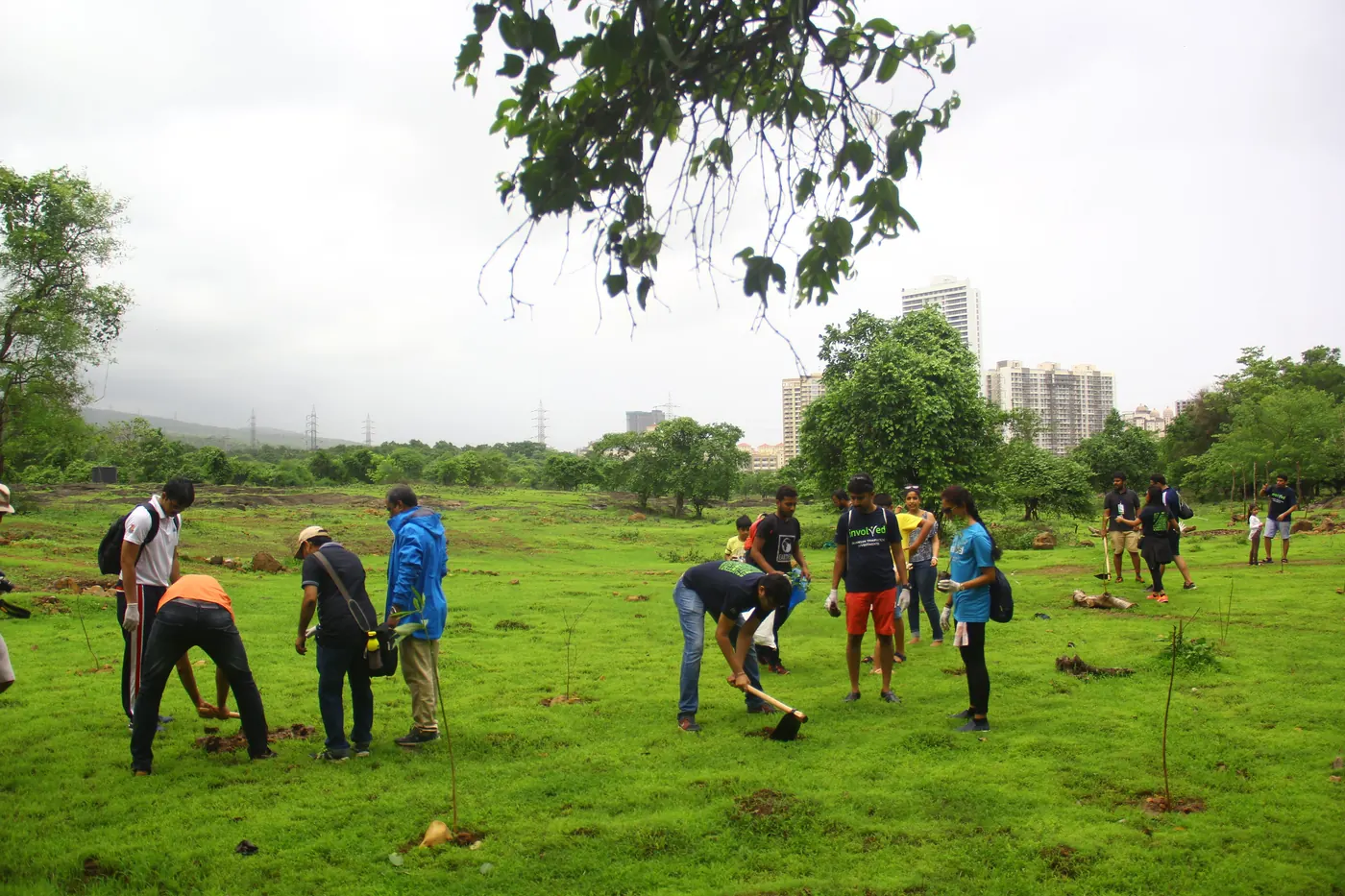
Mass participation has made planting a national habit. The next step, for every partner in the campaign, is helping each sapling grow into a tree, and counting the trees that do.
02
Forest and tree cover has grown to 25.17% of India, on the way to the one-third goal set in 1988
The India State of Forest Report 2023, released by the Forest Survey of India in December 2024, puts forest and tree cover at 8,27,357 km², or 25.17% of the country. Forest cover is 7,15,343 km² (21.76%) and tree cover, meaning patches of trees outside forest smaller than one hectare, is 1,12,014 km² (3.41%). Compared with 2021, the total rose by 1,445 km²: 156 km² of forest cover and 1,289 km² of tree cover.[2][8]
The National Forest Policy of 1988 set the goal of one-third of the land under forest or tree cover, and two-thirds in the hills.[9] Nineteen states and union territories are above 33%. Madhya Pradesh has the largest forest and tree cover at 85,724 km², followed by Arunachal Pradesh at 67,083 km² and Maharashtra at 65,383 km². The biggest gains were in Chhattisgarh (684 km²), Uttar Pradesh (559 km²), Odisha (559 km²) and Rajasthan (394 km²).[2]
The FAO ranks India ninth in the world for forest area and third for annual net forest gain.[7] India’s forest and tree carbon sink reached 30.43 billion tonnes of CO₂ equivalent, 2.29 billion tonnes more than in 2005, against the 2030 target of 2.5 to 3.0 billion tonnes.[2] In March 2026 the Cabinet raised the ambition for the next decade: a sink of 3.5 to 4.0 billion tonnes through forest and tree cover by 2035, from the 2005 baseline.[5]
The trend is up, and India’s climate targets build on it. A sink counted in billions of tonnes rests on trees that live for decades, which is why caring for today’s saplings matters so much.
03
Trees outside forests led the gain, with 1,289 km² of new tree cover on farms, in towns and along roads
Most of the growth came from trees outside forests. An analysis of the report by The Indian Express found that 149.13 km² of the 156 km² of new forest cover lay outside recorded forest areas, and 7.28 km² inside them. Within recorded forests, very dense forest grew by 2,431.50 km², while moderately dense forest shrank by 1,234.95 km² and open forest by 1,189.27 km².[3]
Where India’s green cover changed, 2021 to 2023
Change in area, km². Bars show size of change, labels show direction. Laterite bars are losses.
Source: Forest Survey of India, ISFR 2023, as analysed by The Indian Express, 21 December 2024, and Press Information Bureau.[3][2] Inside recorded forest areas the three density classes net to +7.28 km².
Definitions matter here. In ISFR, “forest cover” is any land over one hectare with tree canopy of 10% or more, whatever the ownership or species, so it includes orchards, bamboo and palm.[3] The survey classes canopy of 70% and above as very dense, 40% to 70% as moderately dense and 10% to 40% as open forest.[4] A mango orchard and an old sal forest can both count.
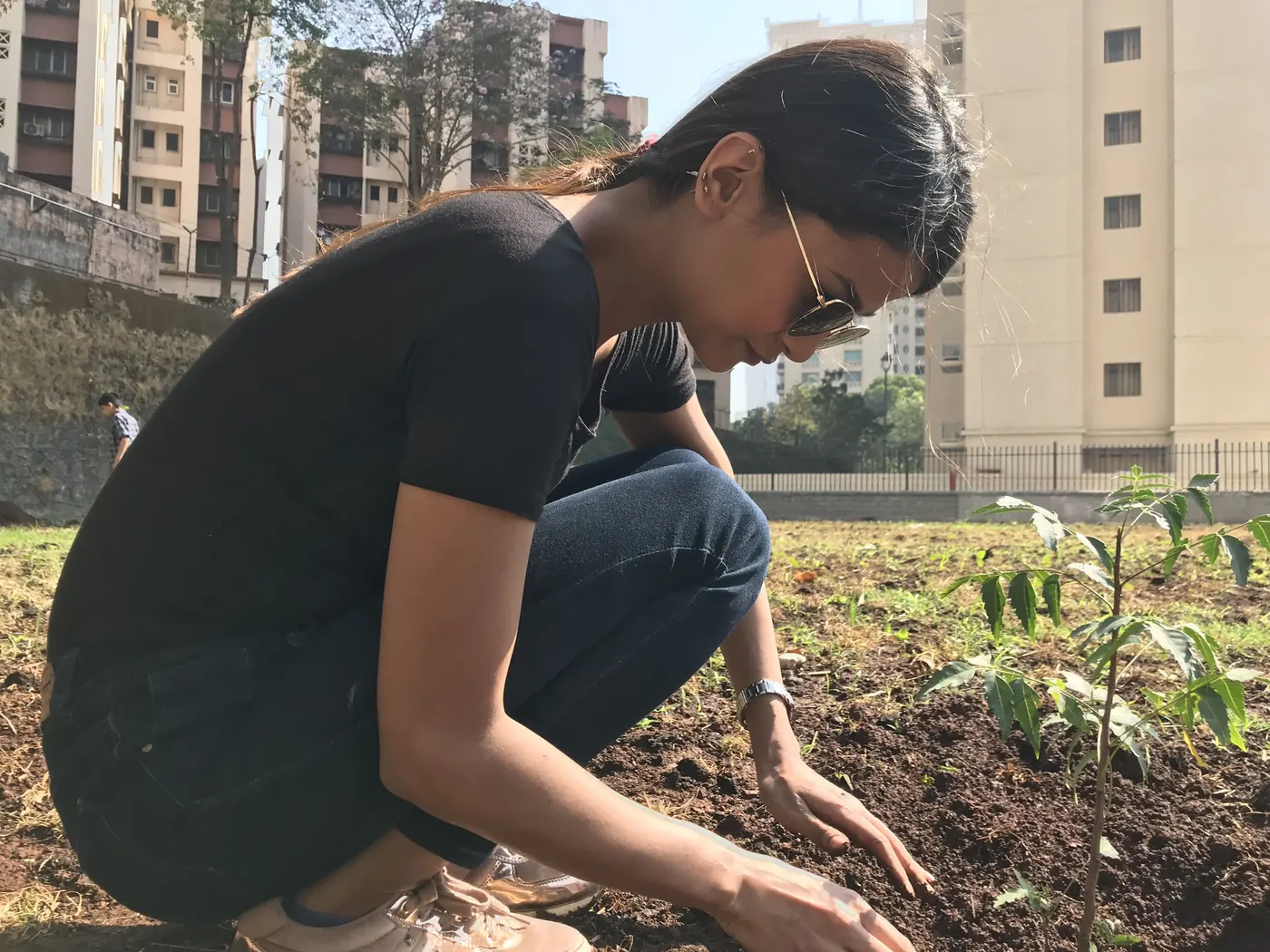
Trees on farms, in cities and along roads are real gains for heat, water and livelihoods. Protecting natural forest alongside them, which holds more carbon, species and water, makes those gains go further.
04
Satellite data shows why protecting old forest matters as much as planting new trees
Satellite datasets use different definitions from the Forest Survey of India, so the two cannot be compared directly. They are useful for a different purpose: showing where standing natural forest needs protection. Global Forest Watch, now Global Nature Watch, estimates that India had 44 million hectares of natural forest in 2020, about 15% of its land. In 2025 it lost 140 thousand hectares of natural forest, equivalent to 63 million tonnes of CO₂ emissions.[11]
Humid primary forest lost in India, by year
Hectares, Global Forest Watch data as reported in May 2025
Source: Global Forest Watch data reported by The New Indian Express, 23 May 2025.[12] Primary forest here means mature humid tropical forest, a subset of all tree cover.
For humid primary forest, mature tropical forest that has not been cleared in recent history, Global Forest Watch recorded a loss of 18,200 hectares in 2024, against 17,700 hectares in 2023 and 14,500 hectares in 2019. From 2001 to 2024, India lost 2.31 million hectares of tree cover, 7.1% of its tree cover in 2000, equal to 1.29 gigatonnes of CO₂e. Assam alone lost 3,40,000 hectares, and shifting cultivation was the largest driver nationally at 1.39 million hectares.[12]
A sapling planted this year takes decades to do what a mature tree does for carbon, water and wildlife. Protecting standing forest and planting new trees work best together.
05
National programmes are restoring forests, mangroves and city green across India
Ek Ped Maa Ke Naam sits alongside a wider set of public programmes for forests and trees. The National CAMPA Authority approved annual plans of operations worth ₹8,561.34 crore for 32 states and union territories in 2025-26. The Nagar Van Yojana for urban forests has sanctioned 620 projects with a total outlay of ₹654 crore, 75 of them in 2025. Under MISHTI, 22,560 hectares of degraded mangroves have been restored, 4,536 hectares of it in 2025.[7]
The environment ministry also reports that 1,78,261.52 hectares of compensatory afforestation were carried out in the last five years.[4] Together with the people’s campaign, these programmes give India one of the broadest tree and forest efforts of any country.
Public programmes have built the scale and the framework. Companies, resident groups and organisations like Earth5R can add what works best at the local level: care, follow-up and community ownership of each site.
06
Sapling survival is the shared next step, and it is decided in years one to five
Planting takes a day. Growing a tree takes years. Alongside the state forest departments, saplings are now planted in crores by schools, companies, resident groups and families, and each of these planters can help the campaign most by looking after what they plant.
The work that decides survival is patient and practical. A sapling needs water through its first dry season, protection from grazing animals, weeding, and a replacement if it dies. It also needs the right start: a species that suits the soil and climate, a site where trees are wanted, and someone nearby who cares whether it lives.
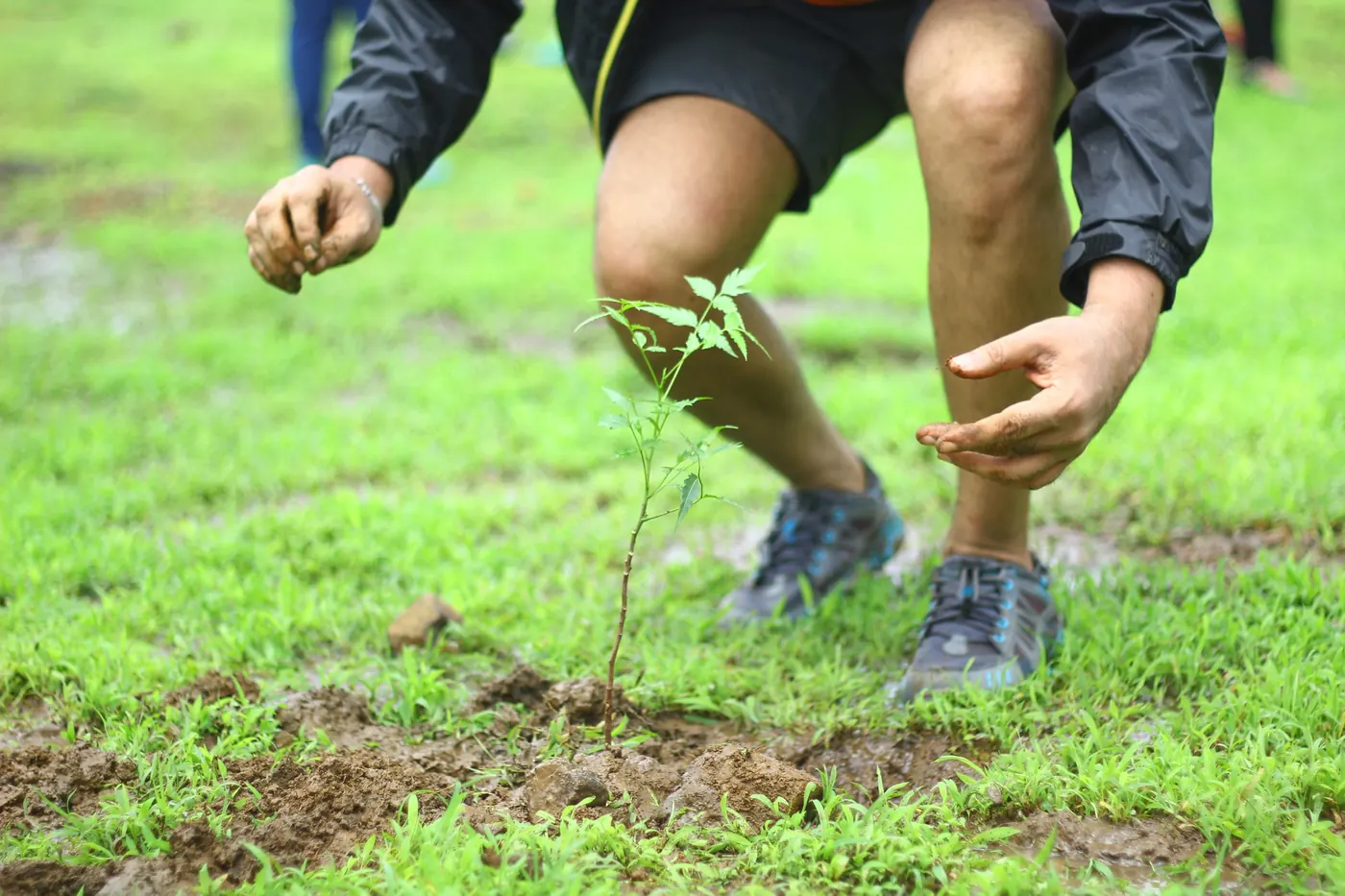
Earth5R’s plantation design for rural Maharashtra sets a target of at least 85% survival over two years, with village monitoring groups to track it. It is a design, not yet an outcome, but it shows how a survival goal can be written into a project from the first day.[13]
When every planter counts survivors at one, three and five years, India’s planting numbers become a measure of growing forest. That is work companies, communities and organisations can share with the forest departments.
07
What helps a sapling become a tree: native species, local nurseries and a carer for every site
Experience from plantation drives points to the same few habits. Native and locally valued species, chosen with the people who live nearby, suit local soil and rainfall and are more likely to be looked after. Saplings bought from local nurseries are raised in local conditions and give a local gardener a reason to care. A forest patch on land that can hold it does more than scattered saplings along a roadside.
The most important habit is naming a carer. A planting that says who will water, protect and count each sapling has a better chance of being counted again next year. Earth5R’s own drives, described below, were built around these habits.[16][17][19]
A sapling becomes a tree when someone is there to water it through the first dry season.
Species, site, nursery and carer are choices made before planting day. Getting them right costs little and decides most of what follows. The green credit rule rewards exactly this, with credits only for trees that grow into canopy.[15]
08
CSR can grow its share of tree funding, and the green credit rule sets a clear five-year standard
Companies have room to do more. Out of ₹34,908.75 crore of CSR spending in 2023-24, environmental sustainability received ₹2,429.97 crore, conservation of natural resources ₹423.47 crore and agro forestry ₹74.47 crore.[14] Agro forestry, the sector closest to trees on farms, received about 0.2% of the total, which leaves a large opportunity for companies that want to back trees on farms and in communities.
Where Indian CSR money went in 2023-24
CSR expenditure by selected development sector, ₹ crore, FY 2023-24
Source: Ministry of Corporate Affairs data in a Rajya Sabha answer, Press Information Bureau, 25 March 2026, data up to 31 March 2025.[14] Tree plantation spending can sit in several of these sectors.
The green credit rule rewards trees that grow into canopy
The most important change for anyone funding trees came on 29 August 2025, when the environment ministry notified a forward-looking method for green credits from tree plantation. Credits are issued only after at least five years of restoration on degraded forest land, and only once the land reaches a canopy density of 40%. One credit is awarded per surviving tree older than five years. The credits cannot be traded, and can be used once, to meet compensatory afforestation, CSR or other legal obligations, and to report under the leadership indicators of BRSR. It replaced the earlier norm of 1,100 trees a hectare.[15]
The green credit rule gives companies a clear standard to align with. A plantation that shows survival and canopy after five years can earn a credit and a stronger place in a BRSR report. Budgets that run five years, not one monsoon, are the way to get there.
What Earth5R’s plantation drives taught on the ground: local nurseries, reused bottles and someone to water
Earth5R is a Mumbai-based environmental organisation, recognised under UNESCO Green Citizens, that has run climate and sustainability programmes across India since 2014. Its plantation drives were small, but they recorded the details that decide survival: where saplings come from, who waters them, and whether the site is meant to become a forest.
Chandivali, Powai: a birthday, 50 trees and a watering plan
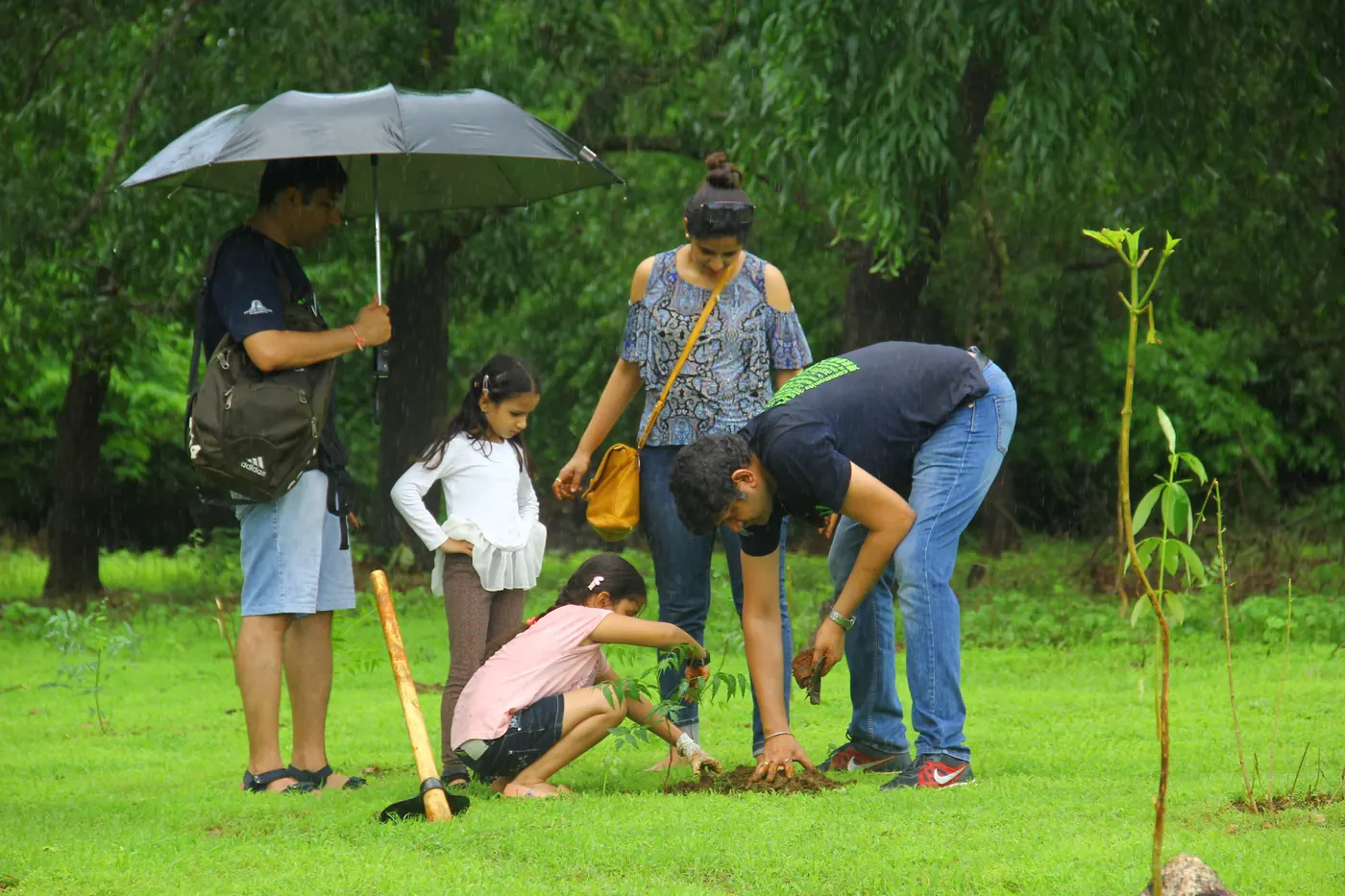
Earth5R volunteer Shashi Yadav decided to celebrate a birthday by planting 50 trees, and the ACT Powai team organised a drive at Chandivali in Powai. Every plant was bought from a local nursery to support a local gardener’s business. Children from a nearby slum came to help and learn, and women from a slum community nearby took on the watering for the months until the monsoon arrived. Shashi Prabha, Sushma Yadav, Akanksha Tehlani, Ishit Patel, Ketul Patel, Saurabh Gupta, Alan and Sharad Vegda helped with the plantation.[16]
Bhawale village, Thane: a forest patch, not scattered saplings
On 19 July 2015, Earth5R’s Mumbai team, Aniket Patil, Sagar Kulkarni, Nikita Shrawgi, Manish Jha, Kaksha Mahudkar and Darshana Kubal, planted in the forest area of Bhawale village in Thane, on barren land leased by the Hariyali Foundation. The team chose to develop a recognised forest area “rather than having a scattered plantation”. Plastic bottles were reused for watering, and trenches were dug to increase groundwater percolation. The team also learned to grow saplings in old milk and plastic bags.[17]
Shalimar Bagh, Delhi: containers turned into nurseries
On 16 January 2016, Sanchi Singh of Earth5R led a programme at the community centre in Shalimar Bagh, Delhi, where residents reused plastic containers and bottles to grow saplings, after a demonstration of how to plant a seedling in a pot and care for it.[18]
Saurabh Gupta later turned lessons like these into a step-by-step method for organising community tree planting campaigns, from choosing a site to keeping volunteers involved after planting day.[19]
Three habits run through these drives: source saplings locally, give each site a carer for the dry months, and plant a forest patch rather than scattered saplings. Any planting programme, large or small, can build them in.
Case study: ACT Powai designed a sapling supply that starts with compost and pays women to grow trees
Earth5R’s ACT Powai tree plantation model began with a gap the drives had exposed: there were too few nurseries, and nobody local earned from the trees. The project page notes that Powai had lost 30% of its green cover in ten years.[20]
The model links waste, livelihoods and trees. Most of the waste in Powai’s low-income communities is organic, and it can be composted. With compost, households can grow saplings on their roofs, shading and cooling their homes, and Earth5R buys the saplings back once they are big enough to plant around Powai. The idea was inspired by Wangari Maathai’s Green Belt Movement in Kenya, which organised women to plant trees.[20]
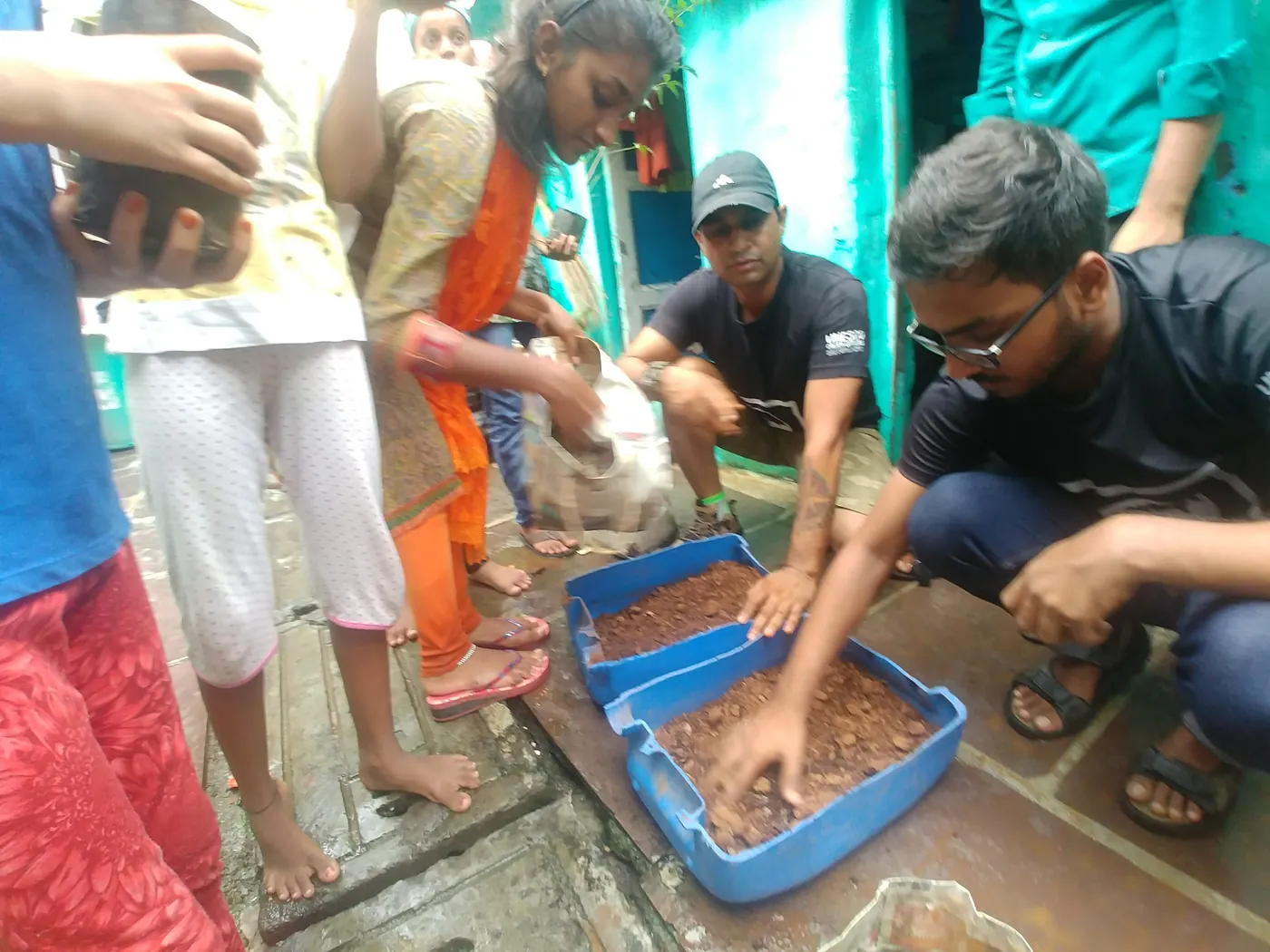
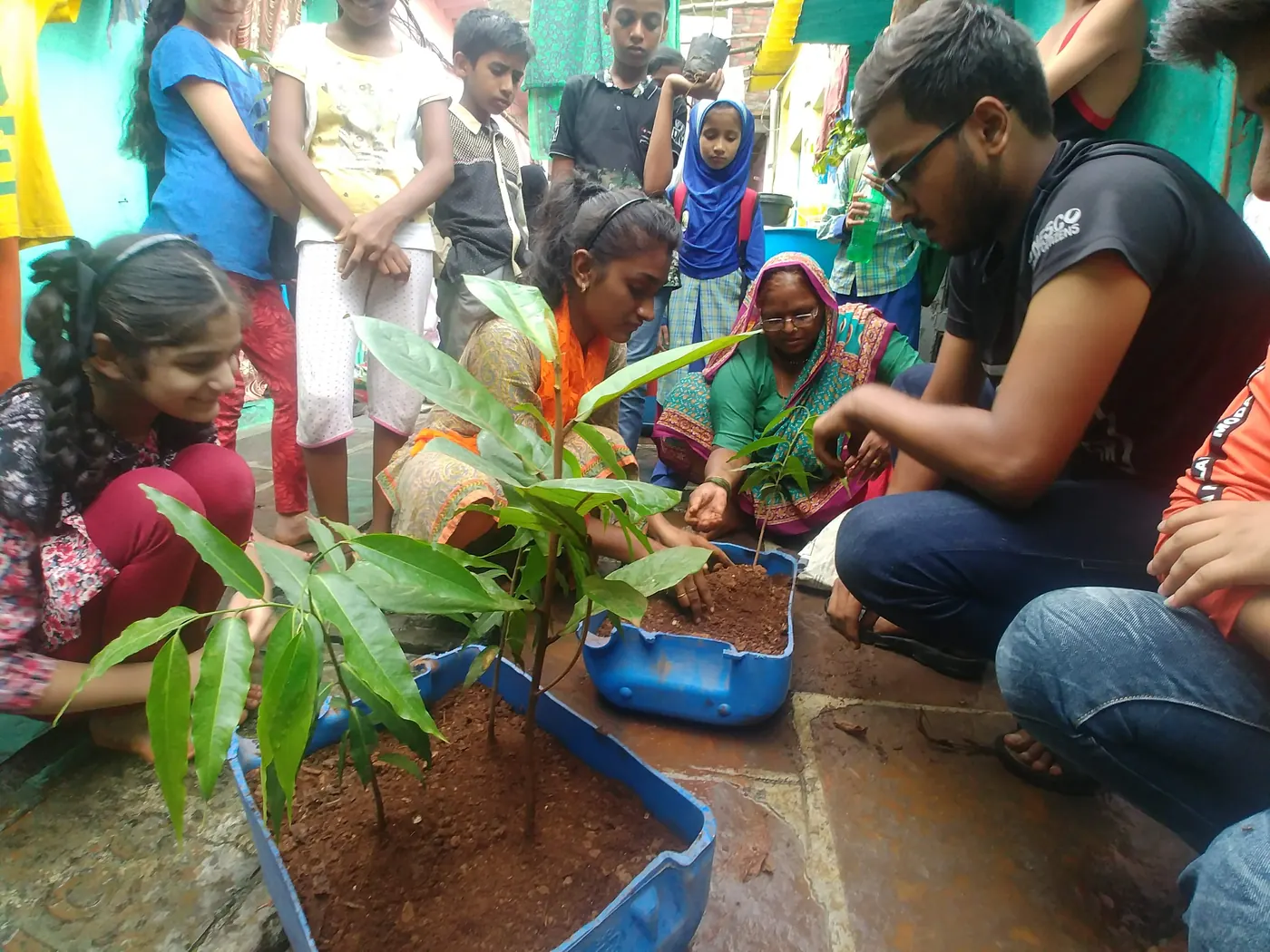
The team tested the idea on 27 June with women in a local community. Earth5R supplied compost from residential buildings nearby, with the plan that households would later compost their own waste. Saurabh Gupta explained to the women that once the trees were big enough, Earth5R would buy them and plant them around Powai. The stated goal was to plant 3,600 trees in Powai in three months while creating a second income for families.[20]
About these figures. The 3,600 trees is a goal set out on the project page, not a reported result, and the 30% loss of green cover is the page’s own statement. Earth5R figures in this article are programme-reported or planned. They have not been independently verified for this article and should not be compared directly with the official or satellite data above.[20]
A sapling grown by a family who will be paid for it is watched through the dry months, and compost from the same street replaces bagged soil. For any city CSR plantation the template is simple: buy saplings from the people who will look after them.
Case study: the Mithi programme shows compost and catchment care working at the scale of 10,000 families
Earth5R’s Mithi River programme, which ran from October 2020 to November 2024, worked on the 17.8 km river that runs from the Vihar and Powai lakes through the middle of Mumbai to Mahim Creek.[21]
Alongside a solar-powered recovery unit in the water, the programme trained 10,000 families and 500 businesses in the catchment in waste segregation and circular economy practice, including composting organic waste to grow herbs and medicinal plants at home. It engaged 15,000 volunteers and reports removing 11,100 tonnes of waste, 4,440 tonnes of it plastic, between October 2020 and November 2024.[21]
The way the programme reports its carbon is a lesson for tree projects. It estimates about 6,660 tonnes of CO₂e avoided, and says plainly that this is an estimate against a stated factor, that no carbon credits were issued or retired, and that no party has claimed it against a corporate target.[21] Tree plantation claims in CSR reports would be stronger with the same discipline: say what was measured, what was estimated, and what was not claimed.
About these figures. The Mithi totals are programme-reported by Earth5R on its case study page. They describe one programme over four years and are not national estimates.[21]
Earth5R’s five R’s, applied to tree plantation in India
Earth5R’s name comes from a sequence it has taught since 2014: Respect, Reduce, Reuse, Recycle, Restore. “The order matters,” Saurabh Gupta writes. “Respect comes first, respect for nature, for communities and for the limits of growth.”[22] For trees, the order maps closely onto the evidence above.
| The R | What it means for trees and forests | Where it shows up on the ground |
|---|---|---|
| Respect | Protect what is standing first: natural forest and the people who use it. Plant species local people value and will look after.[11] | Earth5R bought saplings from a local nursery at Chandivali and planted with the slum communities next to the site[16] |
| Reduce | Reduce losses before adding trees: fewer forest fires, with hotspots down to 2,03,544 in 2023-24, and fewer sapling deaths through care in the dry months.[10] | At Bhawale, the team planted a forest patch on barren land instead of scattering saplings, so fewer saplings did more work[17] |
| Reuse | Reuse what is at hand to grow and water saplings, and reuse degraded land rather than clearing new ground. | Plastic bottles reused for watering at Bhawale, and containers turned into planters in Shalimar Bagh, Delhi[17][18] |
| Recycle | Close the loop on nutrients: compost organic waste into the soil that saplings need, instead of buying bagged soil. | Compost from residential buildings for the ACT Powai rooftop saplings, and home composting by families in the Mithi catchment[20][21] |
| Restore | Measure what grows: native species, survival at one, three and five years, and canopy. The green credit rule now asks for 40% canopy after five years.[15] | Earth5R’s Maharashtra plantation design sets a target of at least 85% survival over two years, with village monitoring groups. It is a design, not yet an outcome[13] |
The order is the point. A programme that starts at Recycle has skipped the three most important steps.[22]
A CSR tree plantation in India should be judged on trees alive in year five, not saplings planted in year one
Tree plantation is one of the most popular environmental CSR activities in India. The green credit rule now gives companies a clear standard for what a strong programme looks like.[15]
| Question | Counting saplings | Growing trees |
|---|---|---|
| Headline number | Saplings planted on the day | Trees alive at one, three and five years, from the same geotagged sites[6] |
| Species | Whatever the nursery has, often fast-growing exotics | Native and locally valued species, chosen with the community[17] |
| Site | Any free land, often roadsides | Degraded land that can hold a forest patch, checked for soil and water[17] |
| Budget | Planting day | Five years of watering, protection and replacement[15] |
| Who benefits | Volunteers for a morning | Local nurseries, carers and families paid to grow and tend[20][16] |
Five things to ask for in a tree plantation proposal
- A survival plan: counts at one, three and five years, with geotags and photographs from the same points, and a survival target written in from the first day.[13]
- A species list: native species named, with the share of each, and a reason for any exotic.
- A canopy goal: the canopy density expected after five years, using the 40% green credit threshold as a guide.[15]
- A people plan: who supplies, waters and protects the saplings, and how they are paid.[20]
- An honest claim: what is measured, what is estimated and what is not claimed, in the CSR and BRSR report.[21]
Earth5R designs CSR and ESG projects with field data that fits impact assessment and BRSR reporting. Its Employee Volunteering Guide covers how to turn a planting day into volunteering that lasts, and its Corporate Sustainability Training helps teams read the data behind claims like these. Students who want to learn this work on the ground, in communities and with real data, can join the FIELDWORK fellowship.
Plan a plantation that survivesRead the impact assessment guide
Frequently asked questions about tree plantation in India
- How many trees have been planted in India under Ek Ped Maa Ke Naam?
- The environment ministry told the Lok Sabha in August 2026 that over 310 crore saplings had been planted under the campaign since it began on 5 June 2024. In 2026-27, 38.65 crore had been logged by 5 August 2026, about 64% of them in Uttar Pradesh.[1][6]
- How can companies and communities help saplings survive in India?
- Plantation sites are geotagged and state forest departments assess survival under established norms. Companies, communities and organisations like Earth5R can help by planting native species, buying saplings from local nurseries, naming who will water and protect each site, and counting survival at one, three and five years.[6][15]
- Is India’s forest cover increasing?
- Yes. Forest and tree cover rose by 1,445 km² between 2021 and 2023 to 25.17% of the country, according to ISFR 2023. Most of the gain came from tree cover outside forests, on farms, in towns and along roads, and the FAO ranks India third in the world for annual net forest gain.[2][3][7]
- How do green credits for tree plantation work in India?
- Under the method notified on 29 August 2025, credits are issued only after at least five years of restoration on degraded forest land and once canopy density reaches 40%, at one credit per surviving tree older than five years. They are not tradable and can be used once for compensatory afforestation, CSR or other obligations.[15]
- Can a company fund tree plantation under CSR in India?
- Yes. Environmental sustainability, conservation of natural resources and agro forestry are all CSR sectors, and together they received about ₹2,928 crore in 2023-24, which leaves plenty of room to grow. A strong programme budgets for five years and reports survival and canopy, in line with the green credit rule.[14][15]
- What has Earth5R done on tree plantation?
- Earth5R has run community plantation drives in Powai, Mumbai, at Bhawale village in Thane with the Hariyali Foundation, and in Shalimar Bagh, Delhi. Its ACT Powai model uses compost from organic waste to grow saplings with women in low-income communities, which Earth5R buys back to plant.[16][17][18][20]
Related reading on Earth5R
References
- Ministry of Environment, Forest and Climate Change (2026). Lok Sabha Unstarred Question No. 3627, answered 10 August 2026: Mission LiFE, Ek Ped Maa Ke Naam and the Green Credit Programme. sansad.in
- Ministry of Environment, Forest and Climate Change (2024). India State of Forest Report 2023 released. Press Information Bureau, 21 December 2024. pib.gov.in
- Ghanekar, N. (2024). India’s forest and tree cover up, but dense forests shrink and natural forests decline. The Indian Express, 21 December 2024. indianexpress.com
- Ministry of Environment, Forest and Climate Change (2026). Lok Sabha Unstarred Question No. 1264, answered 27 July 2026: diversion of forest land and compensatory afforestation, with Annexures I and II. sansad.in
- Prime Minister’s Office (2026). Cabinet approves India’s Nationally Determined Contribution (2031-2035) to be communicated to the UNFCCC. 25 March 2026. pmindia.gov.in
- Ministry of Environment, Forest and Climate Change (2026). Lok Sabha Unstarred Question No. 3511, answered 10 August 2026: Ek Ped Maa Ke Naam campaign, with Annexure-A, state-wise saplings planted in 2026-27 as on 05.08.2026. sansad.in
- Ministry of Environment, Forest and Climate Change (2025). Year-end Review 2025. Press Information Bureau, 31 December 2025. pib.gov.in
- Forest Survey of India (2024). India State of Forest Report 2023, Volume I. Ministry of Environment, Forest and Climate Change, Dehradun. fsi.nic.in
- Ministry of Environment, Forest and Climate Change (2025). Parliament Question: Steps to bring more area under green cover. Press Information Bureau, 6 February 2025. pib.gov.in
- Ministry of Environment, Forest and Climate Change (2024). Growth in forest cover: ISFR 2023 highlights. Press Information Bureau. pib.gov.in
- Global Nature Watch, formerly Global Forest Watch (2026). India country dashboard: natural forest extent and tree cover loss. World Resources Institute. Accessed 26 October 2026. globalforestwatch.org
- Express News Service (2025). India lost 18,200 hectares of primary forest in 2024: Global Forest Watch. The New Indian Express, 23 May 2025. newindianexpress.com
- Earth5R. Plantation Project in Rural Maharashtra: project design. earth5r.org
- Ministry of Tribal Affairs (2026). Welfare schemes under CSR for tribals, Rajya Sabha answer with Annexure: development sector-wise CSR expenditure FY 2021-22 to FY 2023-24, data up to 31.03.2025. Press Information Bureau, 25 March 2026. pib.gov.in
- Express News Service (2025). Centre tweaks norms on tree plantation-based green credits, ties it to tree canopy, their survival. The Indian Express, 31 August 2025. indianexpress.com
- Earth5R. Tree Plantation in Powai by Environmental Organisation Earth5R. EarthJournal. earth5r.org
- Earth5R. Reusing Plastic Bottles for Plantation and a New Water Conservation: Hariyali and Earth5R, 19 July 2015. EarthJournal. earth5r.org
- Singh, S. (reporter). Plastic Recycling for Plantation at Delhi, 16 January 2016. Edited by P. Lodha and S. Ramanjaneyulu. EarthJournal, Earth5R. earth5r.org
- Gupta, S. How to Organize Successful Community Tree Planting Campaigns. EarthJournal, Earth5R. earth5r.org
- Earth5R. Sustainable Tree Plantation Under ACT Powai. EarthJournal. earth5r.org
- Gupta, S. Mithi River Cleaning and Plastic Waste Management Case Study, October 2020 to November 2024. Earth5R. Programme-reported. earth5r.org
- Gupta, S. (2026). AI and Sustainability: Planetary Limits. EarthJournal, Earth5R. Section on the Earth5R method, Respect, Reduce, Reuse, Recycle, Restore. earth5r.org
How to cite this article
Earth5R (2026). Tree Plantation in India: 310 Crore Saplings, Forest Cover Growth and How to Help Trees Survive. EarthJournal, Earth5R, 26 October 2026. https://earth5r.org/tree-plantation-india/
Figures are taken from the sources cited and were current on 26 October 2026. Forest Survey of India figures are from ISFR 2023, the latest edition cited by the ministry. Satellite datasets use different definitions from ISFR and are not directly comparable with it. Indian figures use lakh and crore. Earth5R figures are programme-reported or planned.