
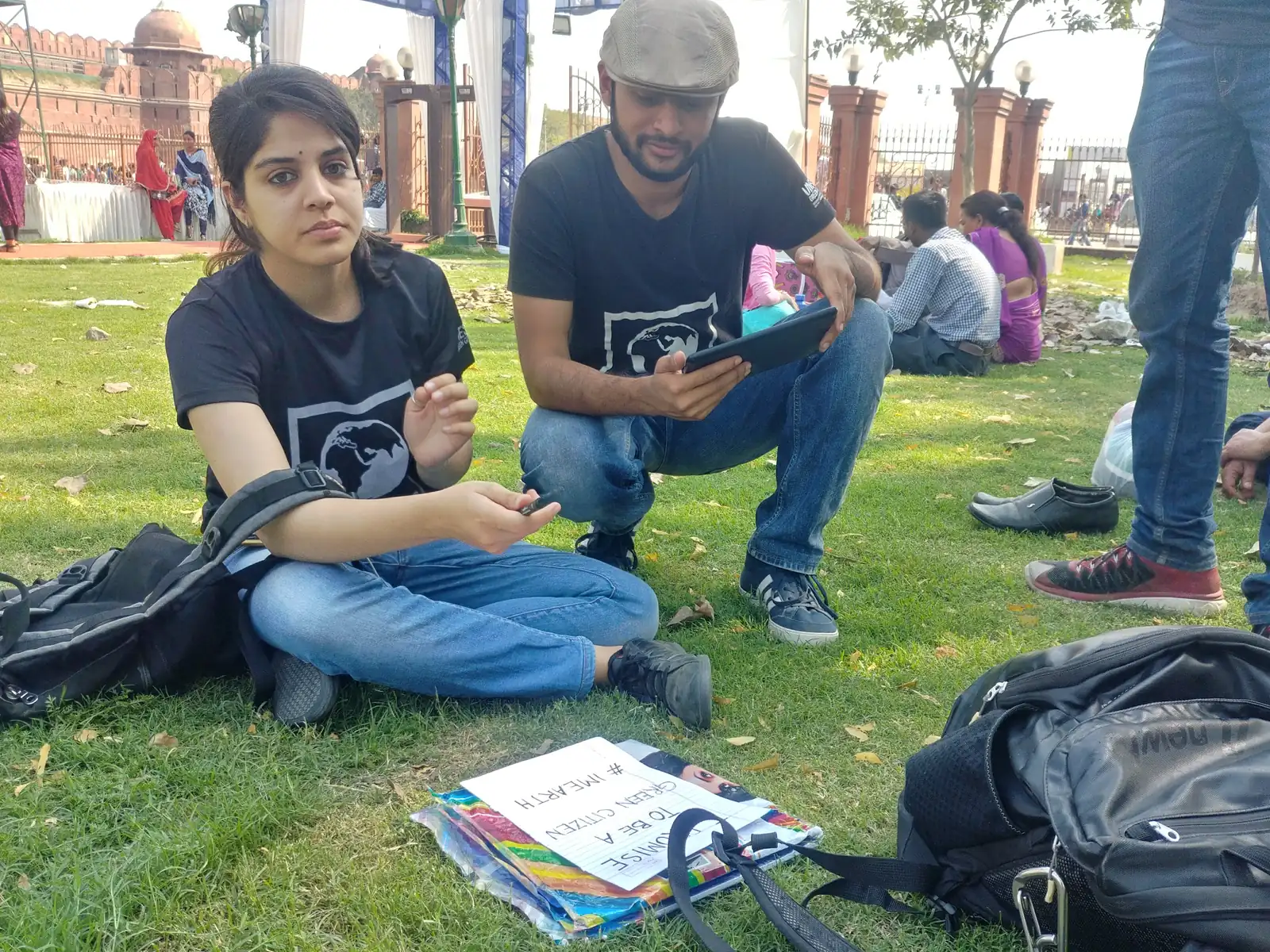
A Class 11 student who has spent two years measuring the plastic that reaches a lake near her home, with a parent beside her on every visit, has something unusual. She has a real question, real data and a story only she can tell. That kind of climate field work does not just look good on an application. It gives her choices. And choices are exactly what a student needs on the day an offer arrives that says 100 percent scholarship in India, decide soon. This guide is about reading that offer calmly. What does 100 percent cover? Who keeps it? What does it quietly cost you? And when is it genuinely the right call?
Earth5R is a Mumbai based environmental organisation recognised by the United Nations and UNESCO, running climate and sustainability programmes across India since 2014. Through FIELDWORK by Earth5R, school students study waste, water, air and biodiversity near their homes, always with a parent or guardian present. Many of them go on to apply to universities in India and abroad. We wrote this guide because a strong profile is only useful if it is not traded away too early.
Everything below is checked. Scholarship rules are quoted or summarised from official government and university documents, linked so you can read them yourself. Student voices are quoted word for word from public Reddit posts, without usernames. We do not name or judge any particular university’s offer. The questions here apply to all of them.
In this guide
- What a 100 percent scholarship in India usually covers
- Money that only works at one address
- The opportunity cost nobody prints
- The conditions in the small print
- Challenges, masterclasses and your phone number
- When the offer is actually worth taking
- Genuine scholarships in India and abroad
- Why real field work keeps your options open
- A checklist of questions to ask in writing
- For parents
- FAQ
What a 100 percent scholarship in India usually covers
Every admissions season brings announcements like this one, paraphrased from a press release that recently crossed our desk. A private university offers a 100 percent scholarship to a few dozen Class XII students. The total value runs into crores. The route in is a challenge with masterclasses. And near the end sits a short phrase: subject to programme specific eligibility.
None of this is unusual, and none of it is necessarily wrong. A large number divided among a small group is still generous to that group. But it helps to ask one plain question first. One hundred percent of what?
In most university merit offers, the answer is tuition. Not the hostel. Not the mess. Not exam forms, books, a laptop or the train home at Diwali. Students ask about this gap all the time, even about government schemes, because the paperwork rarely says it in one line.
“What did it cover(tuition fees , hostel fees , allowances or something extra too)”
A student asking others about a national scholarship, on r/Btechtards (read the post on Reddit)
“What is your living expense even if you have a full-ride scholarship?”
A student planning a fully funded master’s abroad, on r/Indians_StudyAbroad (read the post on Reddit)
So “100 percent” can mean that a large share of the real bill is still yours. The hostel has not heard about your scholarship. Neither has the canteen. This is not a trick. It is simply what the word tuition means, and it is worth asking for the full cost of a year, in rupees, before the celebration photos.
Money that only works at one address
A single university merit scholarship is tied to that university. It cannot be carried to another campus, another city or another country. Free tuition at one university is free only at that university. This sounds obvious. It is also the whole point.
Compare that with the Central Sector Scheme of Scholarships for College and University Students run by the Ministry of Education. Its official guidelines say a student who changes college can continue receiving the scholarship if the new institution is listed on AISHE, the national higher education database. The money follows the student. That is what a portable scholarship looks like, even when the amount is modest.
A locked scholarship is not bad because it is locked. It is just a different kind of thing. It is a discount at one shop. Discounts are lovely. Nobody chooses a career by the discount.
The opportunity cost nobody prints
Opportunity cost is the value of the option you give up. Offer letters list what you gain. They rarely list what you give up, for the reasonable reason that they do not know.
For a strong Class XII student, the risk is usually not that the scholarship is fake. It is that the offer is real, small compared with the alternatives, and arrives first. The most expensive seat can be the free one, if accepting it means you stop preparing for a better one.
The IIT and public university comparison
Public institutions are often far cheaper than families assume. The IIT Madras fee circular for the 2026 admission batch lists tuition of ₹1,00,000 per semester for Indian nationals. It then states that SC, ST and PwD category Indian students are exempted from tuition fees, that General, OBC NCL and EWS students with family income below ₹1 lakh a year get full remission of tuition, and that those with family income between ₹1 lakh and ₹5 lakh get remission of two thirds of tuition. Eligible students can also use the PM Vidyalaxmi education loan scheme. These are entitlements based on rules, not prizes based on a challenge. Seats are another matter, of course. Entrance exams decide those.
The useful lesson is general. Compare the course and the college, not only the discount.
The study abroad comparison
Some of the most selective universities in the world are also the most generous, which surprises many Indian families. We cover this with official sources further down. The short version: a student with a strong profile may be choosing between free tuition at one place and need based aid at a university that admits and supports international students on the same terms as its own citizens. That is not a decision to make in forty eight hours.
The top private university comparison
Strong private universities also run merit and need based support. The fair comparison is never “free here or full price there”. It is “the full cost and the full experience here, against the full cost and the full experience there”, using each university’s own written terms.
The conditions in the small print
“Subject to programme specific eligibility” is a polite phrase. It means please read the next page. Here is what that page often contains.
Renewal rules: CGPA, attendance and rank
Many university merit scholarships are awarded for the first year or even the first semester, and continue only if the student meets a CGPA cut off and an attendance rule every year. Students describe it plainly.
“they are saying scholarship will only continue if u score 8.5+ CGPA from second year i just wanted to ask is it possible to maintain 8.5 CGPA like i was not a topper in school and jee or i am being delusional”
A first year student on r/Btechtards, just after admission (read the post on Reddit)
Some rules are stricter than a grade. A single failed paper can matter, even if you clear it later in a supplementary exam. One student, worried about one exam, asked exactly that.
“if I fail this exam, give the supplementary and clear it, will I still lose the scholarship?”
A third semester student on r/Btechtards (read the post on Reddit)
“I’m sorry but most unis have this criteria of having no backlogs.”
A reply in the same thread (read the post on Reddit)
Some renewals are tied to your rank in the batch rather than a fixed grade. That changes the game. With a fixed CGPA rule you compete with the syllabus. With a rank rule you compete with your friends. You can study harder. You cannot make them study less. Please do not try.
A scholarship renewed every semester is less a gift and more a subscription, paid in CGPA.
The fair reading is balanced. Many students do keep their scholarships. The question is what happens to your family’s budget in the years you might not. One student on Reddit described how a partial merit scholarship, won through an admission test, slipped away.
“didn’t study for the first four semesters properly and my CGPA took a very bad hit. Lost my scholarship and the hopes to even appear for the campus placements next year.”
A third year student on r/Indian_Academia (read the post on Reddit)
Programme eligibility
An offer may apply only to certain courses, campuses or entry routes. Students sometimes discover that the course they actually wanted is not on the list, or that the scholarship applies to a different campus of the same university. Ask for the exact course name and campus in the letter.
Tuition only versus living costs
Covered above, but worth repeating, because it is the most common surprise. Ask for the total cost of attendance per year, including hostel, food, exam charges, deposits and anything charged once at admission. Then ask which of those lines the scholarship touches.
Deposits and refunds
Offers sometimes ask for an admission payment or deposit to hold the seat. In India, the University Grants Commission has publicly reminded universities that, under its Redressal of Grievances of Students Regulations, 2023, delay in or denial of the refund of fees due to a student who withdraws admission within the time mentioned in the prospectus counts as a grievance. You can read the UGC public notice yourself. This does not mean every payment is refundable in every case. It means you should read the refund clause in the prospectus before you pay, and keep every receipt.
Challenges, masterclasses and your phone number
Many scholarship routes today begin with a contest, a test or a series of masterclasses. These can be genuinely good. Free teaching is free teaching. If the masterclass is interesting, enjoy it.
It also helps to know how admissions marketing works in general. A challenge that hundreds or thousands of students register for, to award a few dozen scholarships, is also a very efficient way for any institution to meet thousands of interested families. Your name, marks, phone number and parents’ email are now in a database, and the follow up calls are rarely about climate change. That is not a scandal. It is marketing, and every sector does it. The useful habit is to notice it, so that a phone call on a Sunday evening does not feel like a deadline.
- Register with a parent’s knowledge. Use an email address you check, and read what you are agreeing to share.
- Separate learning from deciding. Attending a masterclass commits you to nothing. Neither does winning a challenge.
- Ask how many will win. The ratio of registrations to scholarships tells you how to plan. If the institution will not share it, that is also information.
- Be wary of paying to compete. Be cautious of any scholarship that asks for a payment before it releases the money.
When the offer is actually worth taking
Sometimes the shiny thing is also gold. A single university merit scholarship can be the right decision, and many students have built excellent careers from exactly this starting point. It is usually worth it when most of these are true.
- It is the course you want. The scholarship sits on the course and campus you would have chosen anyway.
- The full cost works. Your family can comfortably manage the costs the scholarship does not cover, for every year of the course.
- The renewal rule is realistic. It is a fixed CGPA you can meet in a hard semester, not a rank in a small batch.
- It is written down. The letter states the course, campus, duration, renewal rule, what happens if you miss it, and the refund policy.
- You have compared. You have looked at public institutions, other private universities and need based aid abroad, and this still comes out ahead.
- You are not being rushed. You had time to ask questions and got clear answers.
If you can tick these honestly, congratulations. Take it and do brilliant work. If you cannot, the offer has not failed. It has simply not finished answering your questions.
Genuine scholarships in India and abroad
There are scholarships built around the student rather than the institution. Some follow you. Some are based on need. Some meet the full cost. Here are a few, with their official sources. Rules change, so always read the current version on the official page. The National Scholarship Portal is the main government entry point in India and lists open schemes and deadlines.
Central Sector Scheme of Scholarships (Ministry of Education)
According to the scheme guidelines, this scholarship exists “To provide financial assistance to meritorious students from poor families to meet a part of their day-to-day expenses”. It is for students above the 80th percentile in Class XII from their board, with family income up to ₹4.5 lakh a year, in regular recognised courses. Up to 82,000 fresh scholarships are offered each year, with half earmarked for girls. The rate is ₹12,000 a year for the first three years of graduation, and ₹20,000 a year after that for courses covered under the rules. Renewal requires at least 50 percent marks in the annual examination and attendance of at least 75 percent. It is modest, but it is need based, merit based and portable, as noted above.
INSPIRE Scholarship for Higher Education, SHE (Department of Science and Technology)
The DST SHE document describes 12,000 scholarships a year, each valued at ₹80,000 a year, made up of ₹5,000 a month plus a ₹20,000 summer mentorship grant. It is for students in the top 1 percent of their Class XII board, among other routes, who study natural and basic sciences at B.Sc., B.S. or integrated M.S. level. Engineering, medicine and computer science are not covered. One important update: in August 2026 ThePrint reported a written reply in the Rajya Sabha saying the scheme was temporarily halted for a redesign, not discontinued. Check the official INSPIRE portal for whether a call for applications is open in your year.
Fee remission at IITs
As quoted above from the IIT Madras 2026 circular, tuition remission for SC, ST and PwD students and for families earning under ₹5 lakh a year is a rule, not a reward. Other IITs publish their own fee circulars, so check the one for the institute you are considering.
Need based aid at universities abroad
MIT says it is one of very few institutions in the United States that is “need blind and full need” for all undergraduates, domestic and international. Its affordability page explains that need blind means MIT does not consider your ability to pay in admissions, and full need means it is committed to meeting 100% of demonstrated financial need with aid. Its page for international students repeats the commitment to meet full demonstrated need. Beginning with the 2025 to 2026 academic year, MIT says families earning under $200,000 a year typically attend tuition free. MIT frames that figure around American family incomes, and it calculates aid using a family’s full financial picture, so read the details.
Harvard’s financial aid FAQ says that from the 2025 to 2026 academic year, Harvard College is free for students from families with incomes of $100,000 or less, and tuition free for families with incomes of $200,000 or less. Its international applicants page says admissions and financial aid follow the same process for every applicant whatever their nationality, and that “A student’s chances for admission and financial aid are not affected by citizenship”.
These universities are extremely selective, and admission is never certain for anyone. But notice the structure. The aid is calculated from what your family can pay, it applies to whichever course you choose there, and it does not depend on winning a challenge. Applying costs time and care. It does not cost your options.
Why real field work keeps your options open
Here is the connection to climate work, and it is a practical one. Students feel cornered by the first shiny offer when they have nothing else to compare it with. A student who has a real body of work has a reason to apply widely, to universities in India and abroad, and a reason to wait for answers.
Real field work means a question about your own neighbourhood, studied over months or years. How much waste leaves a building each week. How clean the water in a nearby lake is after the monsoon. Which trees on your street are surviving the summer. Done honestly, with a parent or guardian present, it produces data, a write up and a story. Admissions readers tend to value that kind of sustained, specific work far more than a certificate from a single event. Our guides on starting climate field work in Class 9, climate projects students can run and building a profile beyond marks explain how.
That work then feeds every application. It gives you material for a statement of purpose and a college essay, and a mentor who can write a real recommendation letter. If you are on the CBSE track and thinking about study abroad, our guide for CBSE students applying abroad covers the timeline. None of this can promise an admission. What it does is make sure that when a scholarship offer arrives, it is one option among several, not the only door in a corridor.
A student with three years of honest field data does not need to be talked out of a scholarship offer. She simply has other things to compare it with.
A checklist of questions to ask in writing
Ask these by email and keep the replies. Verbal answers are lovely and weigh nothing.
- What exactly does 100 percent cover? Tuition only, or hostel, food, exam charges and one time admission charges too?
- What is the total cost of one year, in rupees? And what is my share after the scholarship?
- For how long? The first semester, the first year, or the full course?
- What is the renewal rule? A fixed CGPA, a rank in the batch, attendance, or all three? Is it checked every semester or every year?
- What happens if I miss it once? Is the scholarship reduced, paused or lost for good? Can it be restored?
- Which courses and campuses does it apply to? Please name them in the letter.
- How many students received it last year, and how many still hold it in their final year?
- What must I pay now, and is it refundable? Please share the refund clause from the prospectus.
- Can I combine it with a government scholarship? Some schemes, such as the Central Sector Scheme, have rules about holding other merit scholarships or fee waivers at the same time. Check both sets of rules.
- When is the real deadline? If it is before other results or offers are out, ask whether it can be extended.
- What data will you keep about me and my family, and will you call us?
A good institution will answer all of these without fuss. Most do. If the answers are vague, that is an answer too.
For parents
A scholarship offer feels like recognition, and it is. It is natural to want to say yes on the spot. A few gentle habits help.
- Celebrate first, decide later. Your child earned the offer. The decision can wait for the paperwork.
- Do the full sum. Add four years of living costs and the cost of losing the scholarship in year two. If that number would hurt, plan for it now.
- Check public options and entitlements. Fee remission and government scholarships are rules you may already qualify for. The National Scholarship Portal is a good place to start.
- Ask your child what they want to study. A free seat in the wrong course is still the wrong course.
- Keep field work going. Real projects, done together and safely, keep your child’s options open through Class XII and beyond.
Where FIELDWORK fits
FIELDWORK by Earth5R
Earth5R is a Mumbai based environmental organisation recognised by the United Nations and UNESCO, running climate and sustainability programmes across India since 2014. FIELDWORK gives school students real climate and sustainability work on waste, water, air and biodiversity near their homes, always with a parent or guardian present.
FIELDWORK is designed as a four year programme from Class 9 to Class 12. Students return each year and take on more scope and responsibility, so the work builds into a multi year record instead of a single event. Professors join conversations with students. They are not hired. Teachers and counsellors remain students’ main guides, and nobody can promise admission. What the work gives you is real material, real skills and more than one option when the offers come in.
FAQ
Is a 100 percent scholarship in India really free?
Usually it covers tuition only. Hostel, food, exam charges and one time admission charges are often still payable, and many university merit scholarships must be renewed each year through a CGPA, attendance or rank rule. Ask for the total yearly cost and the renewal rule in writing.
Can I lose a 100 percent scholarship after the first year?
Yes, if the scholarship has renewal conditions and you do not meet them. Rules differ. Some reduce the scholarship, some pause it and some end it. Ask what happens if you miss the rule once.
Are there government scholarships for Class 12 students in India?
Yes. The Central Sector Scheme of Scholarships supports students above the 80th percentile in Class XII with family income up to ₹4.5 lakh a year. The INSPIRE SHE scholarship supports top 1 percent students in natural and basic sciences, though it was reported in August 2026 to be under redesign. Check the National Scholarship Portal and the INSPIRE portal for current calls.
Is it better to take a 100 percent scholarship or wait for JEE or study abroad results?
It depends on the course, the full cost and the alternatives. Public institutions such as IITs offer tuition remission based on family income, and some universities abroad meet full demonstrated need for international students. Compare the full cost and the full experience, not only the discount.
Do universities abroad give full scholarships to Indian students?
Some do, through need based aid rather than merit prizes. MIT says it meets full demonstrated need for international students, and Harvard says citizenship does not affect admission or financial aid. Admission is highly selective, so treat these as options to apply for, not promises.
How does climate field work help with scholarships?
Field work does not win a scholarship by itself. It builds a genuine profile, with real data, a story and mentors who know your work, which helps you apply widely and compare offers rather than accept the first one out of worry.
Sources
- Ministry of Education, Central Sector Scheme of Scholarships guidelines (PDF)
- National Scholarship Portal
- Department of Science and Technology, Scholarship for Higher Education (PDF)
- ThePrint, INSPIRE SHE scholarship scheme halted for redesign, not discontinued (August 2026)
- IIT Madras, Fee structure for the 2026 admission batch (PDF)
- University Grants Commission, Public notice on non refund of fees (PDF)
- MIT Student Financial Services, Making MIT affordable
- MIT Student Financial Services, International students
- Harvard College, Financial aid expansion FAQ
- Harvard College, International applicants
Build options, not just applications
The best protection against a rushed decision is a real profile. Start one climate question near home this month, with a parent or guardian beside you, and keep going. Learn how FIELDWORK by Earth5R supports students from Class 9 to Class 12 at earth5r.org/fieldwork.