
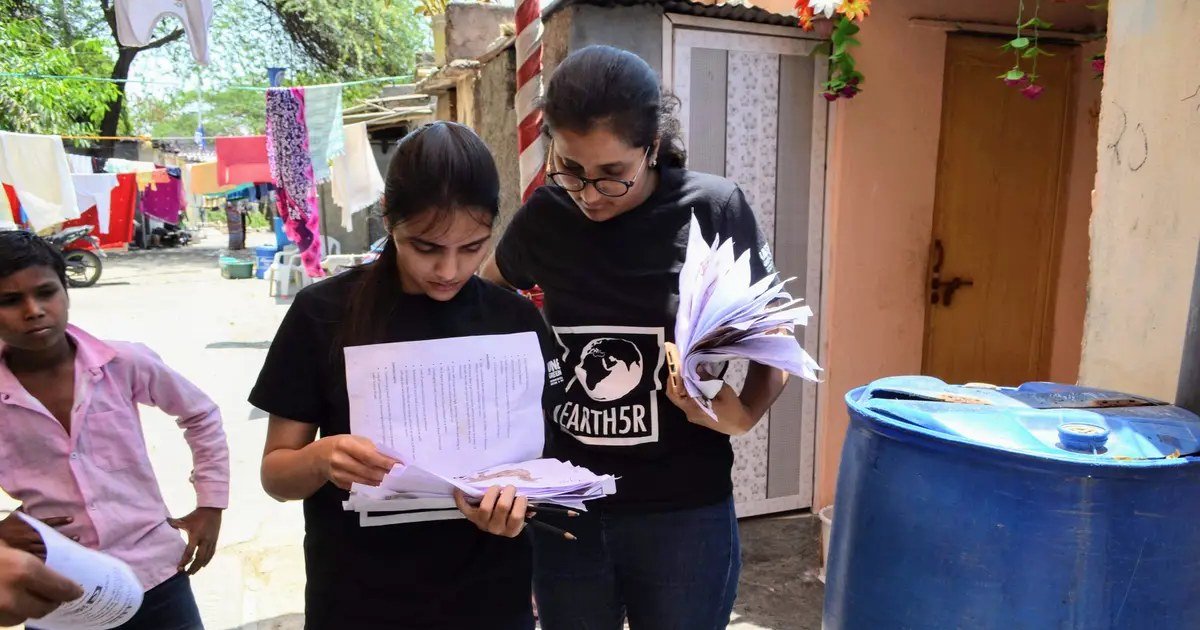
A Class 11 student who has spent Sundays measuring plastic at a lake near home, with a parent beside her on every visit, already has answers to questions that stump most applicants. Can she reuse one personal statement? What research topic is small enough to finish? How does service become more than hours? Do top schools care about class rank? This guide answers those four questions through the lens of real climate field work first, and study abroad second. The short version: marks show you can study. Climate field work for college applications gives you something only you can write.
Earth5R is a Mumbai based environmental organisation recognised by the United Nations and UNESCO, running climate and sustainability programmes across India since 2014. Through FIELDWORK by Earth5R, a research fellowship for students in Grades 9 to 12, fellows join a live Earth5R project near home, always with a parent or guardian present. Working scientists join the research conversations. The work moves through four assessed phases and becomes a permanent public record that universities can check. We wrote this because the same four questions keep appearing unanswered on public forums, while students with real field notes already have the raw material.
Everything below is checked against official guidance where it exists. UCAS rules for the 2026 personal statement, Common App guidance on essays, school profiles and class rank, and student voices quoted word for word from public Reddit posts, without usernames. We do not invent counts. We do not name private Indian institutions.
In this guide
- What students asked this week
- Can the same personal statement be used for multiple applications?
- What is an introductory research topic for senior high school students?
- What are some fun ways to get community service hours?
- Do top schools consider class rank or just GPA?
- How FIELDWORK turns local climate work into application material
- For parents
- FAQ
What students asked this week
On 29 October 2026 we checked unanswered Quora questions, Reddit RSS feeds for r/ApplyingToCollege, r/Indians_StudyAbroad and r/CBSE, and a public search on X. Questions already covered in earlier FIELDWORK guides were skipped. Four Quora questions on personal statements, research topics, community service and class rank had no answers when checked. Across the Reddit threads that were new since the previous scan, six pain point themes stood out. The quotes below are copied word for word, spelling kept as written.
Theme 1. Shopping for grade only universities
Students with thin extracurriculars look for universities that will ignore that gap, instead of building real work in the time left.
“Please recommend good unis that are mostly grade dependent and don’t care about ecs since I don’t have any not worthy ecs”
A Class 12 student on r/Indians_StudyAbroad, planning a four year budget under ₹2 crore (read the post on Reddit)
“Some extracurricular projects, nothing special”
Another applicant on the same subreddit, listing a strong mark sheet and little else (read the post on Reddit)
Theme 2. Handing big decisions to consultants
Families ask whether to use an agency or apply themselves, and sometimes accept a country because a consultant named an intake month.
“My main motive is to get a college for march/ April intake (country doesn’t matter)”
A student whose consultant suggested a computer science course abroad (read the post on Reddit)
“should I fill application theough an agency or directly go university website do everything myself”
A Class 12 student on r/Indians_StudyAbroad asking about the 2027 intake (read the post on Reddit)
Theme 3. Worry that a school outside the US will be misread
International applicants ask how to spell a school name, whether teacher changes belong in the Additional Information box, and which test scores to report.
“Would this inconsistency cause any issues?”
An international applicant on r/ApplyingToCollege, about the school name appearing in two languages (read the post on Reddit)
“my school has had trouble retaining Econ teachers”
An IB student unsure whether to explain many teacher changes (read the post on Reddit)
“Should I report all of them or only submit the 5 and 4 when applying to US colleges as an international student?”
An international applicant asking about AP scores (read the post on Reddit)
Theme 4. Budget as the first filter
Cost appears in titles and first lines before course fit. One student on the engineering thread above put the family limit plainly.
“idt it’s worth it to spend over 2cr of family money there”
From the same engineering abroad thread on r/Indians_StudyAbroad (read the post on Reddit)
Theme 5. Choosing a country on Reddit opinions alone
Some course and country decisions are still being made from a single public thread.
“I have no interest in pursuing mbbs in india so js give your opinions abt mbbs europe”
A Class 12 student on r/Indians_StudyAbroad (read the post on Reddit)
Theme 6. Basic questions left unanswered on Quora
The four questions that structure this article had zero answers on Quora when checked on 29 October 2026. On a related older question about how a high school student carries out original research in India, one of the visible answers came from an account labelled as a bot. There is open space for careful, sourced answers. That is what the rest of this guide tries to be.
Can the same personal statement be used for multiple applications?
It depends on where you are applying. The honest answer is different for the UK, the US and much of Europe.
UK: one UCAS statement for every choice
On UCAS you write one personal statement and every university on your form reads the same text. You cannot tailor it per university. From 2026 entry the format changes from one long piece of writing to three questions. UCAS sets them out on its official page for 2026 entry onwards: why you want to study this course or subject, how your qualifications and studies helped you prepare, and what else you have done outside education and why those experiences are useful. The total limit stays at 4,000 characters including spaces, with a minimum of 350 characters per answer. Admissions staff still read the three answers as one statement, so repeating the same evidence across boxes wastes characters.
The UCAS reforming admissions note is clear that the content universities expect is mostly unchanged. What changes is the scaffolding. So tailor the statement to the subject, not to one university. If you are applying for Economics at five places, write for Economics. If your choices mix two different subjects, find the real overlap, or the statement will read like you are unsure.
US: one Common App essay, many supplements
On the Common App your main essay goes to every college you send that application to. That is by design. The 2026 to 2027 essay prompts stay the same seven options, with a limit of 250 to 650 words. The tailoring happens in the writing supplements. Never copy a “why us” essay from one college to another with only the name swapped. Readers can tell in two lines. And check the college name in every supplement before you submit. It is a very common and very avoidable mistake.
Europe and many other places
Many universities ask for a separate motivation letter for each programme. Reuse your raw material. Do not paste the same letter with a new letterhead.
What actually makes a statement hard to copy
The bigger problem is usually not reuse. It is that most statements could have been written by any one of a lakh students. “I have been passionate about science since childhood” is a sentence every reader has seen thousands of times. What makes a statement impossible to copy is a specific experience only you had, told with detail: what you saw, what you tried, what failed, and what you changed your mind about.
Marks only show that you can study. Universities also look for innovation, new ideas, collaboration, leadership, real world operational capability, and soft and interpersonal skills. A statement can only show those things if you have actually done something that needed them. That is why climate field notes, failed attempts and real conversations with people near the problem make a statement easy to write and hard to copy. We have written more on turning field notes into an SOP and on college essay examples from climate and community work.
Whatever route you take, write one honest core story and let each application see the part of it that matters most to that course. That is the practical meaning of climate field work for college applications: one local problem, told carefully, reused honestly across forms.
What is an introductory research topic for senior high school students?
The best first research topic is usually one within walking distance of your home. That is not a joke.
Most students start with something huge like “climate change” or “AI in healthcare” and get stuck within a month. A good first topic passes three tests.
- You can collect your own data. Not only read articles, but measure, count, survey or observe something.
- It is small enough to finish in a few months alongside school.
- Someone nearby cares about the answer. A ward office, your school, a housing society, local shopkeepers or a farmer.
Topics that work well for a Class 11 or 12 student in India include these.
- How much of the waste in my building is actually segregated, and where does segregation break down? Survey households and walk the collection route.
- Does air quality near my school change at drop off and pick up times? Public air quality data plus your own traffic counts.
- How far do women in a nearby settlement walk for water, and has that changed? Interviews and simple mapping.
- How do small shopkeepers in my market handle plastic packaging, and what would it cost them to switch? Interviews and counts.
- Which plants survive best on the school terrace without extra watering? A simple experiment over a season.
Then follow a simple order. Observe before you propose anything. Write down what you see on the ground. Look for the root cause, not the obvious answer. Test a small fix. Write up what worked and what did not. An honest negative result is still a result.
Please avoid paying anyone to “publish” a paper for you. Admissions readers have become very good at spotting that. Small, real work done properly carries far more weight. For more starter ideas see our guide to climate projects students can run and the Class 9 starting point at how to begin climate field work early.
Start small, start local, and start this month. The topic matters less than doing the work properly. Climate field work for college applications begins with a notebook, not a template.
What are some fun ways to get community service hours?
A little honesty first. If the goal is only “hours”, you will find them anywhere, and they will mean very little on an application. Admissions readers see “100 hours of community service” all the time. What they remember is a student who noticed a problem and stayed with it.
Here is how to make service both fun and meaningful.
- Start from what you already enjoy. Love cricket? Coach younger kids in your colony every Sunday. Like coding? Build a simple website or form for a local organisation or your housing society. Love drawing? Paint waste segregation signs with your building’s housekeeping staff.
- Do it with friends. A group clean up of a lake, beach or nullah, followed by sorting and counting what you collected, is fun and also gives you real data.
- Talk to people. Interview the waste pickers, the bus conductor, the vegetable vendor. Those conversations are where real ideas come from, and they make wonderful essay material later.
- Stay with one thing. Ten Sundays on the same problem beats ten different one day events.
- Measure something. How many households, how many kilos, how many children. Numbers turn service into evidence.
Service done this way quietly builds the same things universities look for beyond marks: innovation, collaboration, leadership, real world operational capability, and soft skills. Climate and community work near home is one of the few ways a school student can practise all of them in one place, with a parent or guardian present for every field visit.
Pick one problem near you this week and give it ten Sundays. You will have more fun than you expect, and a far better story to tell.
Do top schools consider class rank or just GPA?
For most selective US universities, neither one works as a simple cutoff. They read your grades in the context of your school.
How the Common App actually asks for it
Your school sends a transcript and a school report. Ideally that packet includes a school profile that explains the grading system, the subjects offered and how students usually perform. Rank is only one possible piece of that context. Common App’s own help page on how to report class rank and GPA tells students to report their current rank and GPA, and to select “None” from the dropdown if the school does not rank. If the school calculates both weighted and unweighted values, report the weighted ones. If the school does not calculate a cumulative numerical GPA, or uses a scale the form does not list, leave the GPA field blank. It is not required to submit.
The counsellor side of the form mirrors this. Common App’s high school details information sheet lists class rank reporting options of Exact, Decile, Quintile, Quartile or None. Many schools do not rank students at all, and that is completely normal. Many Indian schools do not publish a rank, and US colleges are used to that. You are not penalised for it.
Why the school profile matters more than the number
Common App’s guide to developing a school profile describes it as a short document with student demographics, curricular offerings, grading systems, special programmes and school policies. Counselors upload it so that each school report can include it. Common App notes that more than 70 percent of applications submitted through the platform have a school profile attached, and that applications without one are more likely to come from students at small, charter, new or rural schools. For an Indian student the bigger risk is usually not rank. It is that the reader knows nothing about the school. If your school rarely sends students abroad, ask your counsellor or principal for a short school profile on letterhead explaining the board, the grading and the class size. It makes your percentage readable to someone in another country. We cover this situation in more depth in our guide for CBSE, ICSE and state board students applying abroad.
What readers actually weigh
What readers really look at is the trend (are your marks going up or down), the rigour (did you take demanding subjects for your intended major, for example Maths if you want Economics or Engineering) and how you did with the options your school actually offered. Most Indian schools do not calculate a US style GPA. Do not invent your own conversion unless a university specifically asks for one. Report your marks the way your board and school report them.
When thousands of applicants have similar numbers, the things that separate them are the ones marks cannot show. That is the argument of our companion piece on building a profile beyond marks. Keep your marks strong, make sure your school context is explained, and then give the reader something that numbers cannot show.
How FIELDWORK turns local climate work into application material
FIELDWORK by Earth5R is a research fellowship for students in Grades 9 to 12 across 38 subjects. Instead of inventing a topic from scratch, students join a live Earth5R field research project that is already running on the ground. The work moves through four phases: Observe and Map, Frame and Design, Model, and Build and Deploy. Each phase is assessed before you move on. Working scientists join the research conversations. Field visits happen with a parent or guardian present. The result becomes a permanent public record that universities can verify. It also fits IB CAS, the Extended Essay and school projects. One example from Earth5R’s work is a student project at Powai Lake in Mumbai, where plastic recovered from the lake was turned into 450 benches and desks for municipal schools, with the Swiss Air Staff Foundation. You can read the current details at earth5r.org/fieldwork.
That is how the four questions above stop being abstract. A fellow writing a UCAS statement already has outside education evidence for question three. A fellow picking a research topic is joining a live project rather than guessing. A fellow logging service hours has kilos, households and failed attempts on record. A fellow whose school does not rank still has a verified public record that does not depend on class position. None of this promises admission. It promises something rarer: material only you could have written, because only you did the work.
For parents
Three practical habits help more than any brochure.
- Sit with the official pages. UCAS and Common App publish the rules in plain language. Read them once with your child before any consultant meeting.
- Ask for a school profile. A one or two page note from the school on letterhead, covering board, grading and class size, removes a lot of confusion for foreign readers.
- Protect field time. Real climate work near home, with you or another guardian present, is safer and more useful than a rush of one day certificates in Class 12.
Budget questions are real. So is the temptation to outsource every form. The work your child does on a local problem is the one part of the application that cannot be bought or templated. Guard that time.
FAQ
Can I reuse one personal statement everywhere?
On UCAS, yes, because every choice reads the same text. On the Common App, the main essay is shared and the supplements must be written for each college. In much of Europe, write a fresh letter for each programme from the same raw notes.
Do I need a published paper as a high school student?
No. A finished local study with your own data, honest methods and a clear write up is enough. Paid “publication” packages are easy for readers to spot and easy to avoid.
My school does not give a class rank. Am I at a disadvantage?
No. Common App lets the school select “None”, and many schools worldwide do not rank. What helps is a short school profile that explains how your marks work.
Is FIELDWORK a short placement or temporary job?
No. FIELDWORK is a research fellowship. Fellows join live Earth5R projects, are assessed by phase, and build a permanent public record. Professors and scientists join research conversations. They are not hired tutors.
Does FIELDWORK promise a university place?
No. No serious programme can. What it offers is verified field work and a public record universities can check.
Sources
- UCAS, How to write your personal statement for 2026 entry onwards
- UCAS, Reforming admissions (new personal statement for 2026 entry)
- Common App, Announcing the 2026 to 2027 Common App essay prompts
- Common App member support, How do I report my class rank and GPA?
- Common App, High school details information sheet (PDF)
- Common App, Developing a school profile (PDF)
- FIELDWORK by Earth5R
- Earth5R, From field notes to statement of purpose
- Earth5R, College essay examples from climate and community work
- Earth5R, When your school has never sent anyone abroad
- Earth5R, Beyond marks: building a profile universities abroad can read
- Earth5R, Climate projects students can run
- Earth5R, Starting climate field work in Class 9
Build the story only you can tell
Start one climate question near home this month, with a parent or guardian beside you, and keep going. Learn how FIELDWORK by Earth5R supports students from Class 9 to Class 12 at earth5r.org/fieldwork.