
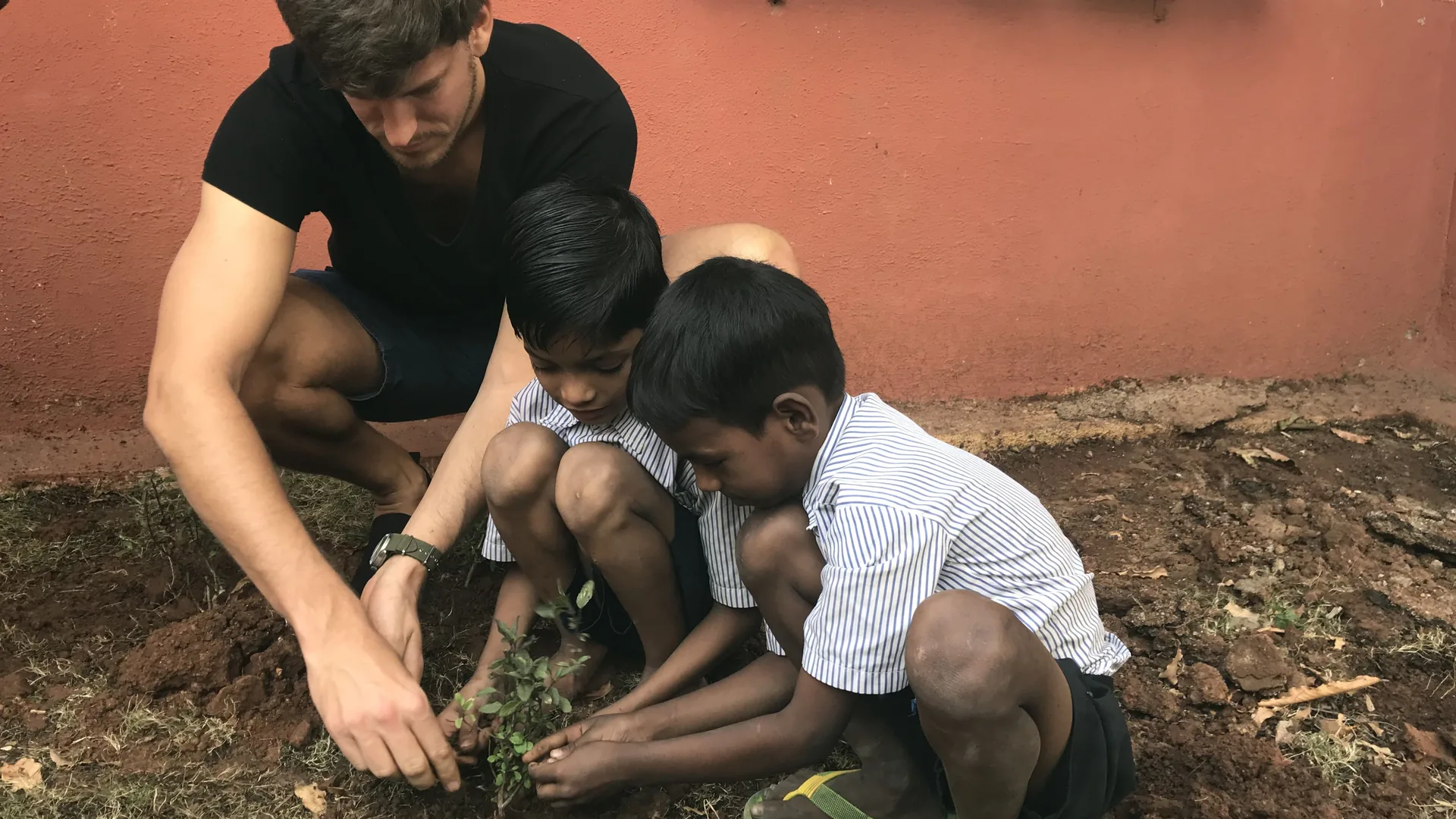
India teaches the environment to more children than any other country: 24.69 crore students in 14.71 lakh schools, under a Supreme Court order that made the subject compulsory in 1991. Eco clubs, green schools and school gardens are now spreading at national scale. The harder part is turning a chapter in a textbook into a habit at home. This brief looks at the evidence on environmental education in India, and at what a decade of Earth5R school workshops, green school projects and student field work shows about the step from knowing to doing.
Environmental education in India: the evidence at a glance
- The largest classroom in the world
- A compulsory subject since 1991
- What students actually know
- Eco clubs, green schools and gardens
- Teachers want to teach it, few feel ready
- Why doing beats telling
- Earth5R in schools since 2015
- Case study: 500 Powai students
- Case study: the Sustainable Green School
- FIELDWORK: research before university
- The five R’s in the classroom
- What schools and CSR teams can do
- Questions
Environmental education is teaching that builds the awareness, knowledge, values and skills people need to take informed action for the environment.[6] In India it runs through the school curriculum, eco clubs and campaigns, and through programmes run with schools by organisations such as Earth5R.
India’s schools hold 24.69 crore students, so environmental education in India is the largest such classroom anywhere
The UDISE+ 2024-25 report, released by the Ministry of Education in August 2025, counts 14,71,473 schools, 24,69,32,680 students and 1,01,22,420 teachers. For the first time since UDISE+ began, the number of teachers crossed one crore, a rise of 6.7% over 2022-23.[1] Government schools make up 10,13,322 of the total.[7]
Every stage of school is a crore-scale audience
Students enrolled in 2024-25 by stage, crore
Source: Ministry of Education, UDISE+ 2024-25 Key Results, Table 1. Pre-primary in anganwadis and private kindergartens is not included.[7]
The enrolment is spread almost evenly across the stages of the new curriculum structure, from about 5.2 crore children in the foundational years to about 6.5 crore in the secondary grades.[7]
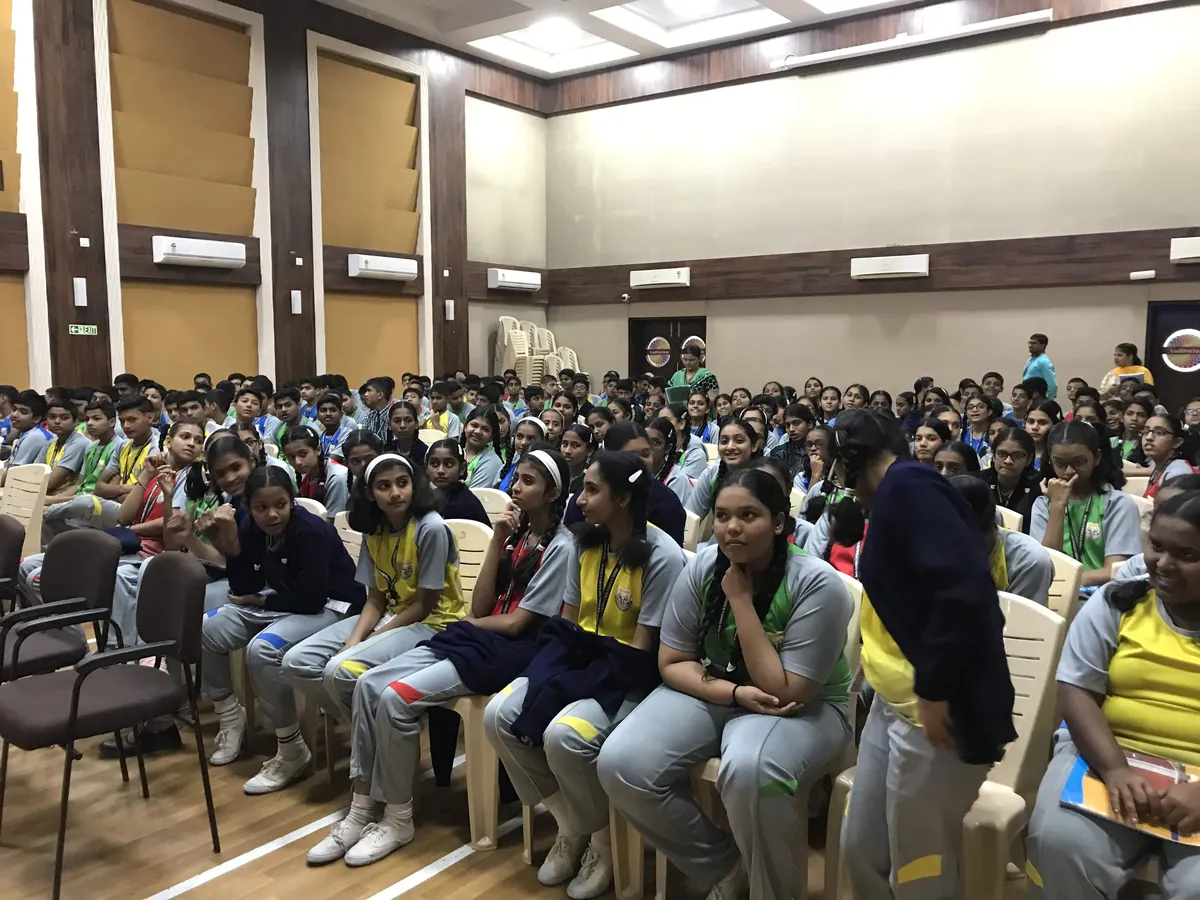
Any idea that reaches India’s classrooms reaches a quarter of a billion young people and, through them, their homes. The scale is the opportunity, and it is also why programmes must be simple enough for any school to repeat.
Environmental education has been compulsory since a 1991 Supreme Court order, and NEP 2020 and the new curriculum now give it a home
India is one of the few countries where environmental education is required at every level of formal schooling.[8] The requirement goes back to a public interest petition by the lawyer M. C. Mehta. On 22 November 1991 the Supreme Court said it accepted, in principle, that awareness of the environment and its pollution problems should be taught as a compulsory subject, and asked every state government and education board to bring this in “in a graded way”.[2]
In December 2003 the Court asked NCERT to prepare a model syllabus for Classes I to XII, and on 13 July 2004 it directed every state to adopt it, with NCERT as the nodal agency for implementation. NCERT chose an infusion approach: environmental themes woven into science, social science, languages and mathematics, with Environmental Studies as its own subject in Classes III to V.[8]
| Year | Milestone | What it changed in schools |
|---|---|---|
| 1991 | Supreme Court order in M. C. Mehta v. Union of India | Environment to be taught as a compulsory subject, in a graded way, at every level[2] |
| 2003 to 2004 | NCERT model syllabus accepted by the Court | Every state asked to adopt the Class I to XII syllabus, with NCERT supervising[8] |
| 2020 | National Education Policy | Environmental awareness, including water and resource conservation, listed among skills all students should learn[9] |
| 2022 | PM SHRI scheme approved | Exemplar schools to be developed as Green Schools, with solar panels, nutrition gardens, waste management and water harvesting[10] |
| 2023 | National Curriculum Framework for School Education | Environmental Education becomes an essential subject in Grade 10, with Sustainability and Climate Change offered in Grades 11 and 12[11] |
| 2024 to 2026 | Eco Clubs for Mission LiFE | Clubs set up in schools across the country, tracked on a national portal[12][13][3] |
The National Education Policy 2020 lists “environmental awareness including water and resource conservation, sanitation and hygiene” among the subjects, skills and capacities that every student should learn. Colleges are asked to offer credit-based environmental education courses.[9] The 2023 curriculum framework then makes The World Around Us an interdisciplinary area in the preparatory stage.[11]
The policy question is settled. Environmental education in India has a legal basis, a national policy and a curriculum slot. What remains is the craft of teaching it so that it changes what students and families do.
Grade 6 students answered 49% of questions right on The World Around Us, so environmental knowledge is still being built
The PARAKH Rashtriya Sarvekshan 2024, run by NCERT for the Ministry of Education, tested students at the end of Grades 3, 6 and 9 at district level. Grade 6 was assessed in language, mathematics and The World Around Us, the subject that covers the natural and social environment.[4] The national averages were 57% in language, 49% in The World Around Us and 46% in mathematics.[14]
The environment subject sits in the middle of the scorecard
Average share of questions answered correctly, PARAKH Rashtriya Sarvekshan 2024
Source: PARAKH, NCERT, National Report, and Ministry of Education figures as reported in July 2025.[4][14]
Girls scored better than boys in The World Around Us, and students in urban schools scored higher than those in rural schools, according to the national report.[4] By Grade 9, where environmental themes are infused into science and social science, average scores in both subjects were 40%.[14]
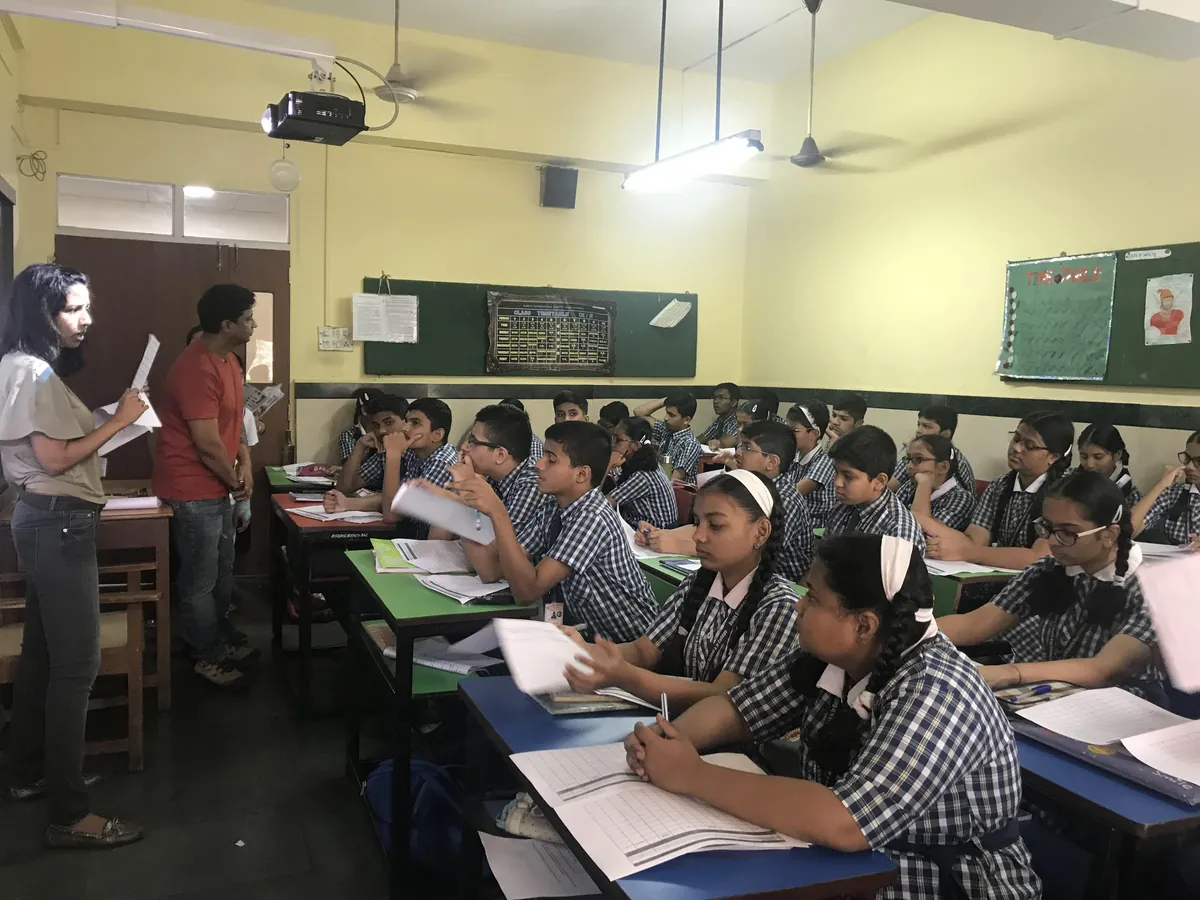
A score near one in two is a starting point, not a verdict. It shows that environmental concepts are taught but not yet secure, which is exactly where hands-on, local projects help, because students remember what they have measured themselves.
Eco clubs have grown from about 1 lakh to more than 12 lakh, and green schools and nutrition gardens are spreading with them
School eco clubs are not new in India. Under the National Green Corps programme of the Ministry of Environment, Forest and Climate Change, more than 1 lakh eco clubs were formed in schools and colleges, running plantation drives, cleanliness drives and waste segregation.[15] The Ministry of Education’s Eco Clubs for Mission LiFE took the idea to every school. After an Eco Clubs for Mission LiFE Day during Shiksha Saptah in July 2024, schools had by 11 November 2024 set up 1.46 lakh new clubs and more than 1 lakh School Nutrition Gardens, and planted 5.18 crore saplings under Ek Ped Maa Ke Naam with 6.75 crore students, teachers and community members taking part.[12]
In June 2025 the Ministry launched a portal to record club activities across more than 14.7 lakh schools, aligned with the seven themes of Mission LiFE.[13] By July 2026, the Ministry of Environment reported more than 12 lakh Eco Clubs for Mission LiFE.[3]
PM SHRI green schools are close to their target
PM SHRI schools selected as of July 2026, against a target of more than 14,500
Source: Press Information Bureau, PM SHRI press note, September 2026, and the PM SHRI scheme brief, 2022.[16][10]
The PM SHRI scheme, approved in September 2022 with an outlay of ₹27,360 crore over five years, is building more than 14,500 exemplar schools. Each is to be developed as a Green School with solar panels and LED lights, nutrition gardens with natural farming, waste management, plastic-free campuses and water harvesting.[10] As of July 2026, 13,092 schools had been selected across 36 states and union territories, about 90% of the target.[16]
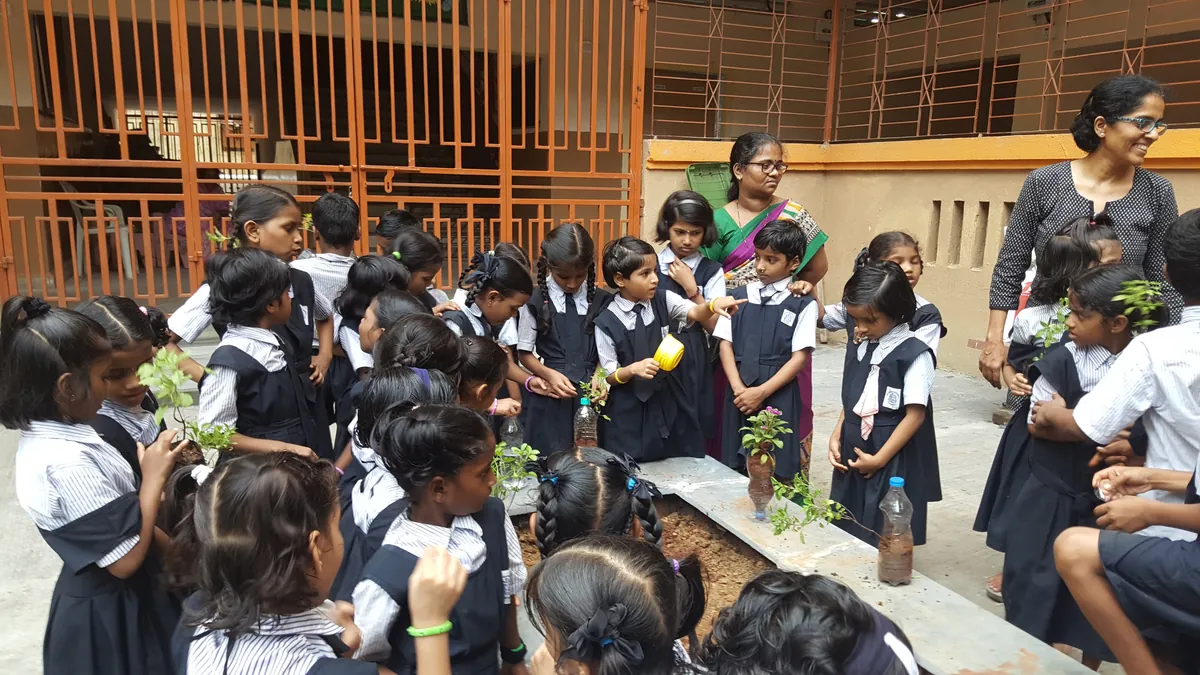
The infrastructure for school-based environmental action now exists at national scale. Every club, garden and green school is a ready-made place for a project with real data, which is where partners can add the most value.
Nearly every teacher wants to teach climate change, but only about one in five can explain well how to act on it
A 2021 UNESCO review found that nearly half (47%) of the national curriculum frameworks of 100 countries made no reference to climate change, and where it did appear the depth was usually minimal.[17] India’s curriculum is ahead on paper, with environmental themes from the earliest grades and a dedicated Grade 10 subject.[11] The bottleneck India shares with others is teacher confidence.
The gap between caring and confidence
Share of teachers in a UNESCO survey, 2021
Source: UNESCO, Getting every school climate-ready, 2021, key findings. Values marked “under” or “about” are shown at the level UNESCO reports.[17]
In UNESCO’s survey of teachers, about 95% said it is important or very important to teach about the severity of climate change, but fewer than 40% were confident teaching it, about one-third could explain well its effects on their own region, and only about one-fifth could explain well how to take action. Only 55% had received any training on climate change and sustainable lifestyles, and fewer than half said their school had a climate action plan.[17]
This is where outside partners fit. A teacher with a full syllabus rarely has time to design a waste audit or arrange a lake visit. A partner who brings the method and the follow-up lets the teacher lead without starting from zero.
The weakest link in environmental education is not the textbook but the “how do we act” part of the lesson. Support for teachers, through ready-to-run projects and people who can help on the ground, closes that gap fastest.
Programmes that are local, hands-on and measured are the ones that show real results, and children carry them home
One of the most thorough reviews of the evidence, led by Nicole Ardoin of Stanford University with Alison Bowers and Estelle Gaillard, examined 105 studies of environmental education published in 51 journals. Almost all (98%) reported positive or mixed results. But most measured intentions, not actions.[6]
Most studies measure intentions, few measure the environment
Share of 105 environmental education studies reporting each type of outcome
Source: Ardoin, Bowers and Gaillard (2020), Biological Conservation, as summarised by NAAEE.[6]
The 56 studies that did report direct results, such as completed cleanups, observed behaviour or measured ecological change, shared a common design. They focused on a local issue, worked with scientists or resource managers, built in action such as cleanups, citizen science or project work, and planned how they would measure and report outcomes.[6]
Children also teach their parents. In an experiment with 238 middle school students and 292 parents in North Carolina, children who followed a climate curriculum raised their own concern by 2.78 points on a 17-point scale. Their parents’ concern rose by 3.89 points, against 1.37 for parents whose children were not taught. The effect was strongest among fathers and parents of daughters.[18][19]
When children learn, parents follow
Rise in climate concern on a 17-point scale, before and after a school climate curriculum
Source: Lawson et al. (2019), Nature Climate Change, results as reported by North Carolina State University.[18][19]
Young Indians are ready for this. In a survey of 10,000 people aged 16 to 25 in ten countries, 68% of respondents in India said they were very or extremely worried about climate change, among the highest shares in the study, after the Philippines.[5][20] A project that lets a student measure a problem near home and act on it turns that worry into agency.
Knowing about waste is common. Sorting it every day for a month, and persuading your family to keep going, is what environmental education is for.
The research points to the same design every time: a local problem, a real partner, an action and a measurement. School programmes built this way do more than raise awareness, and they reach the family dinner table.
Earth5R has run school workshops from Mumbai to Hyderabad and Gandhinagar since 2015, and the best ones leave something behind
Much of Earth5R’s early school work took the form of EarthTalks: short, practical sessions run by volunteer teams in their own cities. Before going to a municipal school, the Mumbai team had already given such talks at institutions including Podar International School, Mithibai College and NMIMS.[21]
At Chandivali, a team of Earth5R Mumbai volunteers, Sagar Kulkarni, Kaksha Mahudkar, Vandita Morarkar, Manish Jha, Ishan Sharma and Akshita Shah, covered cleanliness, recycling, water and plantation with flash cards, quizzes and paper crafts, and older children learned to turn used paper into bags.[21] In Hyderabad on 13 August 2015, Praneetha, Pradeep and Abhilash ran a waste management workshop with Class 8 students at ZPHS School. There was no dustbin in the classroom, so at the end the students put their sweet wrappers in their own bags rather than on the floor.[22]
The same day in Gandhinagar, the Earth5R team planted 10 neem saplings with Grade 8 students around the Sector 20 government school, then talked about the uses of neem and tulsi under a banyan tree.[23] In Mumbai, the Green School Program started a small garden with students at the Durgadevi Sharma Marathi School in Chandivali, planting into pots cut from waste plastic containers, with weekly visits aimed at adding organic gardening, composting, rainwater harvesting, solar panels and segregation dustbins one school at a time. Residents of Paradise building in Raheja Vihar donated newspapers, plastic pots and money for saplings. Local children helped the team find the wild plants, from tulsi and ginger to papaya and mango, that went into the beds.[24]
Earth5R figures on this page, such as the number of students, saplings or schools, are programme-reported in the Earth5R case studies linked in the references. They have not been independently audited and describe individual activities, not national outcomes.
A talk is the cheapest part of environmental education. What makes it last is a physical trace, a garden bed, a bin, a bag of paper made from waste, and an adult team that comes back.
Case study: 500 Powai students segregated waste at home for a month, and some of their housing societies began planning recycling
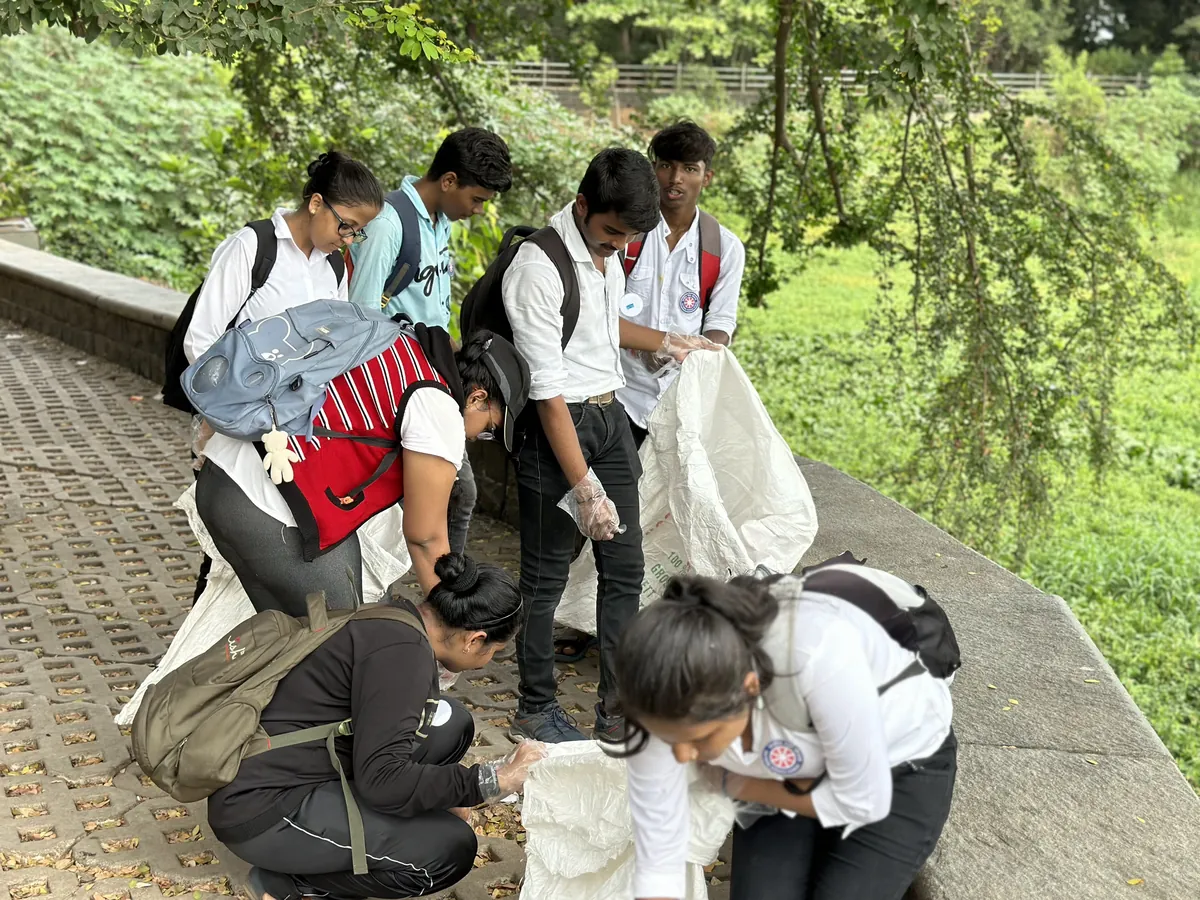
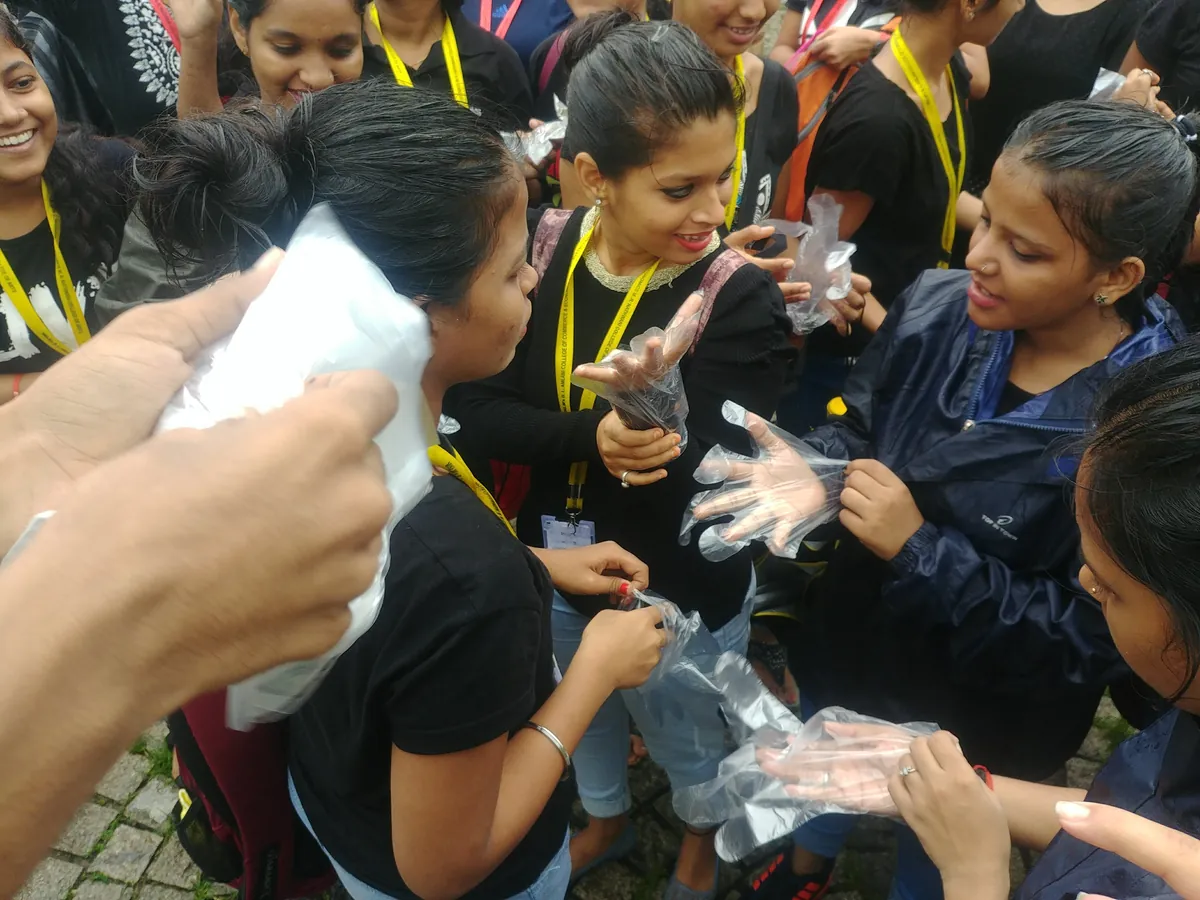
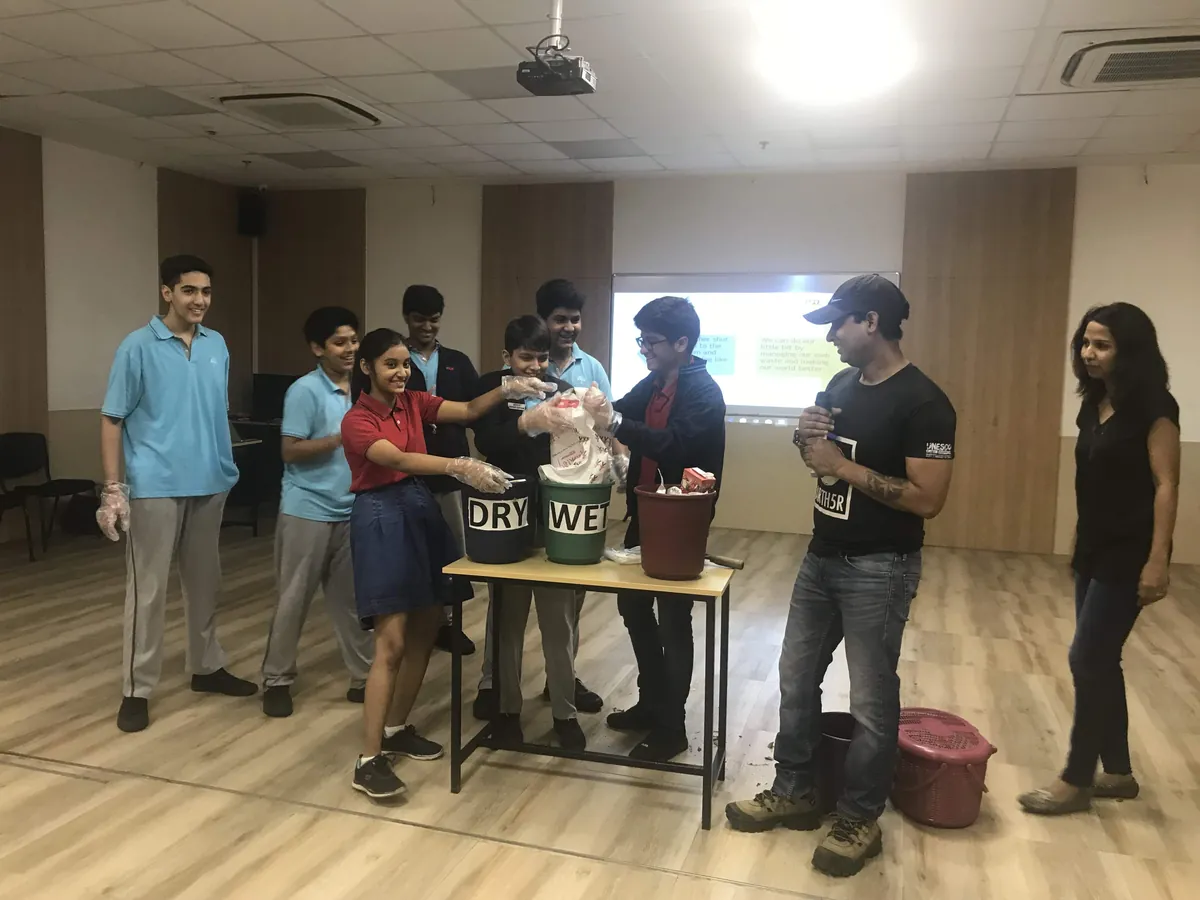
Powai, a Mumbai neighbourhood of about 9 lakh people, has the upmarket Hiranandani area on one block and the Hanuman Nagar settlement on the next. Under its ACT programme, Earth5R ran an environment awareness and waste segregation workshop for 500 students of a local Powai school in the school auditorium. The mentors were Saurabh Gupta, Jahaan Gupta, Kshama Vighe, Preena Jaswal, Marya Lanewala and Camille Lafouresse.[25]
The workshop moved straight into practice. Students learned to separate wet waste, dry or recyclable waste and trash, and were introduced to composting and to pelletisation of recyclable waste. Then each of the 500 took a pledge to sort their household waste into those three streams every day for a month, while keeping real-time records of the number and types of recyclables.[25]
Students were encouraged to sell their recyclables to local waste pickers, putting value in the hands of the city’s sorters. The data sheets showed each student how much they had kept out of the landfill. Several students persuaded their housing societies to start segregating, members of some societies began planning recycling units in their buildings, and many parents carried on after the month ended. Six students who went furthest were recognised as Earth Warriors.[25]
The project predates the Solid Waste Management Rules, 2026, which from 1 April 2026 ask every household and institution to segregate into four streams: wet, dry, sanitary and special care waste.[26] A school project of this kind is one of the simplest ways to rehearse that change in thousands of homes at once.
Five hundred students sorting every day for a month is 500 households practising a new habit, with data to prove it. When children own the record, parents and building committees start to act on it.
Case study: the Sustainable Green School Project turned a lake cleanup into benches, bags and clean water for a Mumbai municipal school
Earth5R runs the Sustainable Green School Project with the Swiss Staff Foundation for Children in Need, a foundation supported by voluntary payroll contributions from employees of the airline SWISS. The project plan started from a municipal school in Mumbai where about 1,400 children shared a single water filter and had too few benches, and where leaking pipes meant that 80% of the children drank unfiltered tap water.[27][28]
The project was built as a circular economy model. Children and families helped collect plastic waste, which was recycled into benches, desks and water-resistant school bags, giving women in the community a livelihood. Water filters, coolers and rooftop solar panels were part of the plan, and children built eco-brick gardens and compost stations for food waste from school meals.[27][28] At an upcycling workshop at a municipal school in Sangarsh Nagar, Chandivali, children learned to pack cleaned plastic into bottles to make eco-bricks.[28]
According to Earth5R’s report, students at the Powai municipal school who once sat on the floor now sit on benches made from recycled plastic, and every student received a good school bag. Volunteers taught the children about waste types with picture guides, and the children in turn taught their parents. The children of the locality began calling themselves Friends of Earth.[28]
Students learn the circular economy fastest when they sit on it. A bench made from the plastic they collected is a lesson, a piece of furniture and a reason to keep sorting, all at once.
FIELDWORK gives students in Grades 9 to 12 real, verified environmental research near home before they leave school
Workshops reach whole classes. Some students want to go further and do research of their own. Earth5R’s FIELDWORK programme is a fee based, mentored research fellowship for students in Grades 9 to 12, offered across 38 subjects from environmental science and climate change to economics, design and public health.[29]
Students work near home, with a parent or guardian present at every self-guided activity. They audit litter on their school grounds or a local park and count it by item and brand, map trees and green cover around their campus or neighbourhood, or audit their school canteen’s waste for a week. They log photographed, geo-tagged records on the Earth5R app, which Earth5R checks before the data goes into the student’s project report.[29] Earth5R collects this kind of data in more than 150 Indian cities.[29]
Students also take part in research conversations with professors and researchers from MIT, Oxford, Cambridge and LSE, and receive a letter of recommendation from an Earth5R mentor.[30] Fellowships run from one month to a multi-year track from Grade 9 to Grade 12, and each ends with a certificate, a project report and a verified profile on earth5r.org. Earth5R has no admissions arrangement with universities, and admission decisions rest with each university.[29]
See how it works on the FIELDWORK programme page or the environmental science fellowship.
FIELDWORK follows the design the research rewards: a local problem, a mentor, real action and checked data. Its output is a record a student can show and a dataset a city can use.
The five R’s in the classroom start with Respect, because a child who knows a place will care for it
Earth5R’s name carries its method. In the words of founder Saurabh Gupta, “The 5R in Earth5R comes from a sequence we have taught since 2014: Respect, Reduce, Reuse, Recycle, Restore. The order matters. Respect comes first, respect for nature, for communities and for the limits of growth. A programme that starts at Recycle has skipped the three most important steps.”[31] In schools it maps onto lessons a child can do.
| R | What it means in a school | Evidence and Earth5R work |
|---|---|---|
| Respect | Start from the place and the people: local plants, the lake, the waste pickers and the limits of what a neighbourhood can absorb. | Local children knew where to find wild tulsi, ginger, papaya and mango for a Chandivali school garden.[24] Gandhinagar students learned the uses of neem and tulsi under a banyan tree.[23] |
| Reduce | Measure waste before cutting it, from a canteen audit to a household data sheet. | FIELDWORK students can audit a school canteen for a week and build a plan that cuts waste and costs.[29] Powai students recorded the recyclables their homes produced every day for a month.[25] |
| Reuse | Give materials a second life before they are thrown away. | Children made paper bags from used paper at Chandivali and planted saplings in pots cut from waste plastic.[21][24] Eco-bricks packed with cleaned plastic became garden borders.[28] |
| Recycle | Close the loop and return value to the people who collect and sort. | Powai students sold recyclables to local waste pickers.[25] Plastic from cleanups became benches, desks and school bags.[27][28] |
| Restore | Rebuild what is damaged: green cover, soil and lakes, and the trust that comes from honest, checked data. | Schools planted 5.18 crore saplings in 2024.[12] FIELDWORK records are checked by Earth5R before they enter a report.[29] |
A school that teaches only recycling teaches the last step first. Starting with Respect, the local place and the people in it, gives the other four R’s a reason that students feel.
What schools, CSR teams and parents can do to make environmental education in India stick
Practical steps, each linked to the evidence above.
- Give every eco club one measured project. The research rewards local action with a measurement plan.[6] A month of home segregation, as in Powai, or a litter count on the school grounds produces data a club can upload to the national portal.[25][13]
- Use the school garden as a compost classroom. More than 1 lakh School Nutrition Gardens were set up in 2024.[12] Food waste from school meals can feed them, as the eco-brick compost stations in Earth5R’s green school project were designed to do.[27]
- Prepare for four-stream segregation. Teach wet, dry, sanitary and special care waste now that the SWM Rules, 2026 are in force.[26]
- Support teachers with ready-to-run kits and people. Only about one in five teachers in UNESCO’s survey could explain well how to take climate action.[17] Companies can fund kits, visits and follow-up rather than one-off talks.
- Turn employee volunteering into school mentoring. Volunteers who return weekly, as in the Green School Program, achieve more than a single visit.[24] Our employee volunteering guide shows how.
- Measure outcomes, not attendance. Count bins in use, kilograms segregated and saplings alive a year later.
- Encourage older students to do real research. Students in Grades 9 to 12 can take on verified field projects through FIELDWORK, which is fee based.[29]
Earth5R partners with companies on school and community programmes across India. Explore Earth5R’s CSR and ESG projects.
Frequently asked questions about environmental education in India
- Is environmental education compulsory in India?
- Yes. In M. C. Mehta v. Union of India, the Supreme Court in 1991 accepted that awareness of the environment should be taught as a compulsory subject, and in 2004 it directed every state to adopt NCERT’s Class I to XII syllabus.[2][8]
- How is environmental education taught in Indian schools?
- Through infusion into subjects such as science, social science and languages, with Environmental Studies in the primary grades. Under the National Curriculum Framework 2023, The World Around Us covers the preparatory stage and Environmental Education is an essential subject in Grade 10.[8][11]
- What does NEP 2020 say about environmental education?
- NEP 2020 lists environmental awareness, including water and resource conservation, sanitation and hygiene, among the skills all students should learn, and asks colleges to offer credit-based courses on climate change, pollution, waste management and sustainable living.[9]
- What are Eco Clubs for Mission LiFE?
- School clubs set up under the Ministry of Education that run activities on the seven themes of Mission LiFE, such as saving water and energy and reducing waste. More than 12 lakh such clubs were reported in July 2026.[13][3]
- Does environmental education change behaviour?
- It can, when it is local, hands-on and measured. A review of 105 studies found that programmes with direct results focused on local issues, worked with experts, built in action and planned measurement.[6]
- How does Earth5R work with schools?
- Earth5R runs workshops, school gardens, segregation projects and green school projects with partners, such as the 500-student segregation project in Powai and the Sustainable Green School Project in Mumbai.[25][28] Students in Grades 9 to 12 can join FIELDWORK, a fee based research fellowship.[29]
Related reading on Earth5R
References
- Ministry of Education (2025). Ministry of Education releases report on Unified District Information System for Education Plus (UDISE+) 2024-25 on school education of India. Press Information Bureau, 28 August 2025, with the UDISE+ 2024-25 Key Results report. pib.gov.in
- Supreme Court of India (1991). M. C. Mehta v. Union of India, judgment of 22 November 1991, (1992) 1 SCC 358, AIR 1992 SC 382, direction that awareness of the environment be taught as a compulsory subject. api.sci.gov.in
- Ministry of Environment, Forest and Climate Change (2026). LiFE Movement and Climate Action Initiatives. Reply to Lok Sabha Unstarred Question 80, answered 20 July 2026. sansad.in
- PARAKH, NCERT (2025). PARAKH Rashtriya Sarvekshan 2024: National Report. Department of School Education and Literacy, Ministry of Education, July 2025, Grade 6 and Grade 9 results. parakh.ncert.gov.in
- Thompson, T. (2021). Young people’s climate anxiety revealed in landmark survey. Nature 597: 605, 30 September 2021, country results of the 10,000-person survey. nature.com
- Ardoin, N. M., Bowers, A. W. and Gaillard, E. (2020). Environmental education outcomes for conservation: a systematic review. Biological Conservation 241: 108224, summarised by the North American Association for Environmental Education. eepro.naaee.org
- Department of School Education and Literacy (2025). UDISE+ 2024-25: Key Results, All India, Table 1, National Highlights, enrolment by stage. Ministry of Education, Government of India. udiseplus.gov.in
- Global Environmental Education Partnership (2024). Compulsory Environmental Education in India. Case note on the Supreme Court orders of 18 December 2003 and 13 July 2004, the NCERT model syllabus and the infusion approach. thegeep.org
- Ministry of Human Resource Development (2020). National Education Policy 2020. Government of India, paragraphs 4.23 and 11.8. static.pib.gov.in
- Ministry of Education (2022). PM Schools for Rising India (PM SHRI Schools) Scheme. Scheme brief released with the Cabinet approval, September 2022, key features including Green Schools. static.pib.gov.in
- NCERT (2023). National Curriculum Framework for School Education 2023. Ministry of Education, Part C, Chapter 7, Education in Interdisciplinary Areas. ncert.nic.in
- Ministry of Education (2024). Year End Review 2024: Department of School Education and Literacy. Press Information Bureau, December 2024, sections on Eco Clubs for Mission LiFE, School Nutrition Gardens and PM SHRI. pib.gov.in
- Ministry of Education (2025). Ministry of Education launches Eco Clubs for Mission LiFE portal and Ek Ped Maa Ke Naam modules. Press Information Bureau, 5 June 2025. pib.gov.in
- ETEducation (2025). Only 53% of students in Class 6 know tables up to 10: Education ministry survey. The Economic Times, July 2025, reporting PARAKH Rashtriya Sarvekshan 2024 subject averages. economictimes.indiatimes.com
- Ministry of Environment, Forest and Climate Change (2022). Activities of Environment Education, Awareness and Training (EEAT). Press Information Bureau, 12 December 2022. pib.gov.in
- Press Information Bureau (2026). PM SHRI: building exemplar schools for a future-ready India. Press note, September 2026, selection status as of July 2026. pib.gov.in
- UNESCO (2021). Getting every school climate-ready: how countries are integrating climate change issues in education. UNESCO, Paris, ED-2021/WS/35, key findings. uncclearn.org
- Lawson, D. F., Stevenson, K. T., Peterson, M. N., Carrier, S. J., Strnad, R. L. and Seekamp, E. (2019). Children can foster climate change concern among their parents. Nature Climate Change 9: 458 to 462, with results as reported by North Carolina State University on phys.org, 6 May 2019. nature.com
- North Carolina State University (2019). Climate education for kids increases climate concerns for parents. Phys.org, 6 May 2019. phys.org
- Hickman, C., Marks, E., Pihkala, P., Clayton, S., Lewandowski, R. E., Mayall, E. E. et al. (2021). Climate anxiety in children and young people and their beliefs about government responses to climate change: a global survey. The Lancet Planetary Health 5(12): e863 to e873. thelancet.com
- Shah, A. (2024). Environmental education for children at Municipal School, Mumbai. EarthJournal, Earth5R, report of the EarthTalk of 28 August 2015 at Chandivali, Powai. earth5r.org
- Earth5R (2024). Waste management workshop at ZPHS School, Hyderabad. EarthJournal, report of the class 8 workshop of 13 August 2015. earth5r.org
- Earth5R (2024). Educating children and plantation at Gandhinagar. EarthJournal, report of the Sector 20 government school drive of 13 August 2015. earth5r.org
- Yanaba, T. (2024). Green School Program at Mumbai. EarthJournal, Earth5R, report of the first visit to Durgadevi Sharma Marathi School, Chandivali. earth5r.org
- Earth5R (2024). Environmental leadership workshop for Mumbai school children. EarthJournal, report of the 500-student waste segregation project in Powai under the ACT programme. Programme-reported. earth5r.org
- Earth5R (2026). SWM Rules 2026: India’s four-stream waste segregation shift. EarthJournal, April 2026. earth5r.org
- Earth5R (2024). Mumbai School Project: in partnership with Swiss Staff Foundation for Children in Need. EarthJournal, project design for benches, bags, water filters, eco-brick gardens and compost. Programme-reported. earth5r.org
- Earth5R (2024). Educating children in circular economy: Sustainable Green School Project in partnership with Swiss Staff Foundation for Children in Need. EarthJournal. Programme-reported. earth5r.org
- Earth5R (2026). FIELDWORK: high school environmental science internship and research fellowship, Grades 9 to 12. Programme page. earth5r.org
- Earth5R (2026). Research programmes for high school students. EarthJournal, section on FIELDWORK and verified field work. earth5r.org
- Gupta, S. (2026). AI and Sustainability: Planetary Limits. EarthJournal, Earth5R. Section on the Earth5R method, Respect, Reduce, Reuse, Recycle, Restore. earth5r.org
How to cite this article
Earth5R (2026). Environmental Education in India: What Earth5R’s School Workshops, Green Schools and Student Field Work Show. EarthJournal, Earth5R, 13 November 2026. https://earth5r.org/environmental-education-india/
Figures are taken from the sources cited and were current on 13 November 2026. Official programme counts, such as eco clubs, come from different schemes and dates and are not a single series. One lakh is 100,000 and one crore is 10 million. Earth5R figures are programme-reported and link to the case studies they come from. Children in Earth5R photos appear with consent and are not named.