
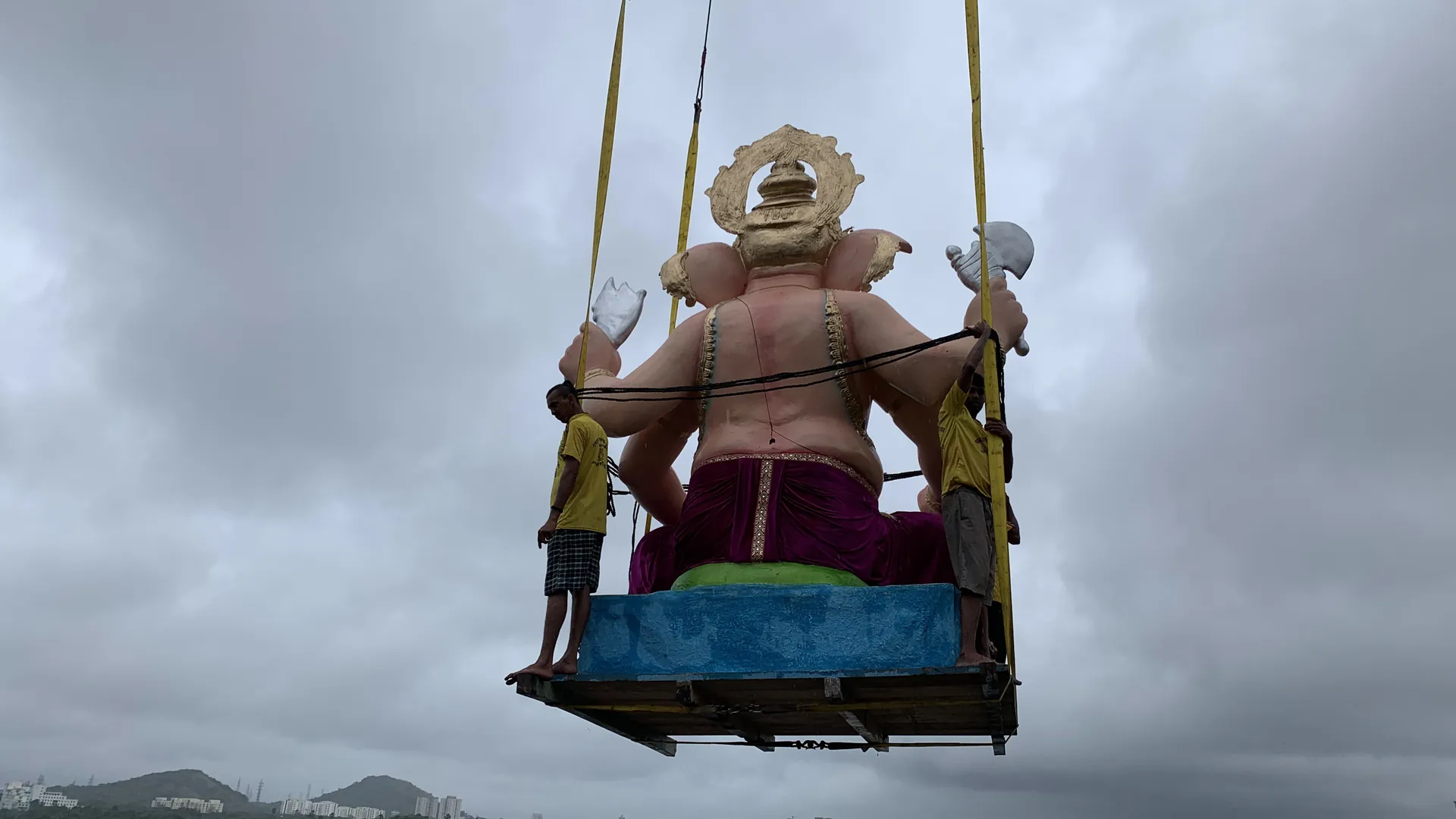
Mumbai sent 97.27% of its Ganesh idols to artificial ponds this September, and then lifted 2,754.85 tonnes of idol remains that still need a scientific use. Kolkata immersed about 5,000 Durga idols in the Hooghly a week ago. Diwali falls on 8 November. Festival waste in India is no longer a question of whether cities act; they do, at enormous scale. It is a question of what happens to the flowers, the plaster and the plastic after the crowds go home. This brief sets out the latest data, and what a decade of Earth5R lake cleanups, clay idol workshops and Diwali pledges taught about the part that happens before the waste reaches the water.
Festival waste in India: the evidence at a glance
- Mumbai moved its idols to ponds
- The 2,754 tonne question
- Flowers are the biggest stream
- What immersion does to a lake
- Kolkata’s bamboo comes back
- Diwali’s smoke and wrappers
- The rulebook already exists
- What Earth5R found at the lakes
- Case study: the Mithi model
- The five R’s for festivals
- What a festival CSR programme should measure
- Questions
97.27%
Mumbai sent 97.27% of its Ganesh idols to artificial ponds in 2026, and almost two in three of them were still plaster of Paris
The Brihanmumbai Municipal Corporation (BMC) set up 383 artificial ponds for Ganeshotsav 2026, on open plots, in gardens and on grounds, so that families could immerse their idols close to home.[1] Every idol up to six feet tall, whether plaster of Paris (PoP) or clay, had to go to an artificial pond, in line with Bombay High Court directions.[3] Taller idols were permitted at 67 designated natural sites, made up of 44 beaches and jetties and 23 natural lakes.[8]
The result, according to BMC figures, was that 1,92,237 idols went into artificial ponds and 5,382 into natural water, a 97.27% share for the ponds.[1][2]
Where Mumbai’s Ganesh idols went in 2026
Idols immersed during Ganeshotsav 2026, by material and site, BMC figures
Source: BMC figures reported by Lokmat Times, Mid-day and Free Press Journal, 30 September 2026.[2][1][3]
The material split matters as much as the site. Of the idols in artificial ponds, 1,22,391 were PoP and 69,846 shadu clay. At the natural sites, 5,259 of the 5,382 tall idols were PoP.[2] Before the festival the BMC gave idol makers more than 940 tonnes of shadu clay free of cost, along with 25,400 litres of eco-friendly paint, and deployed more than 25,000 staff for immersion days.[2]
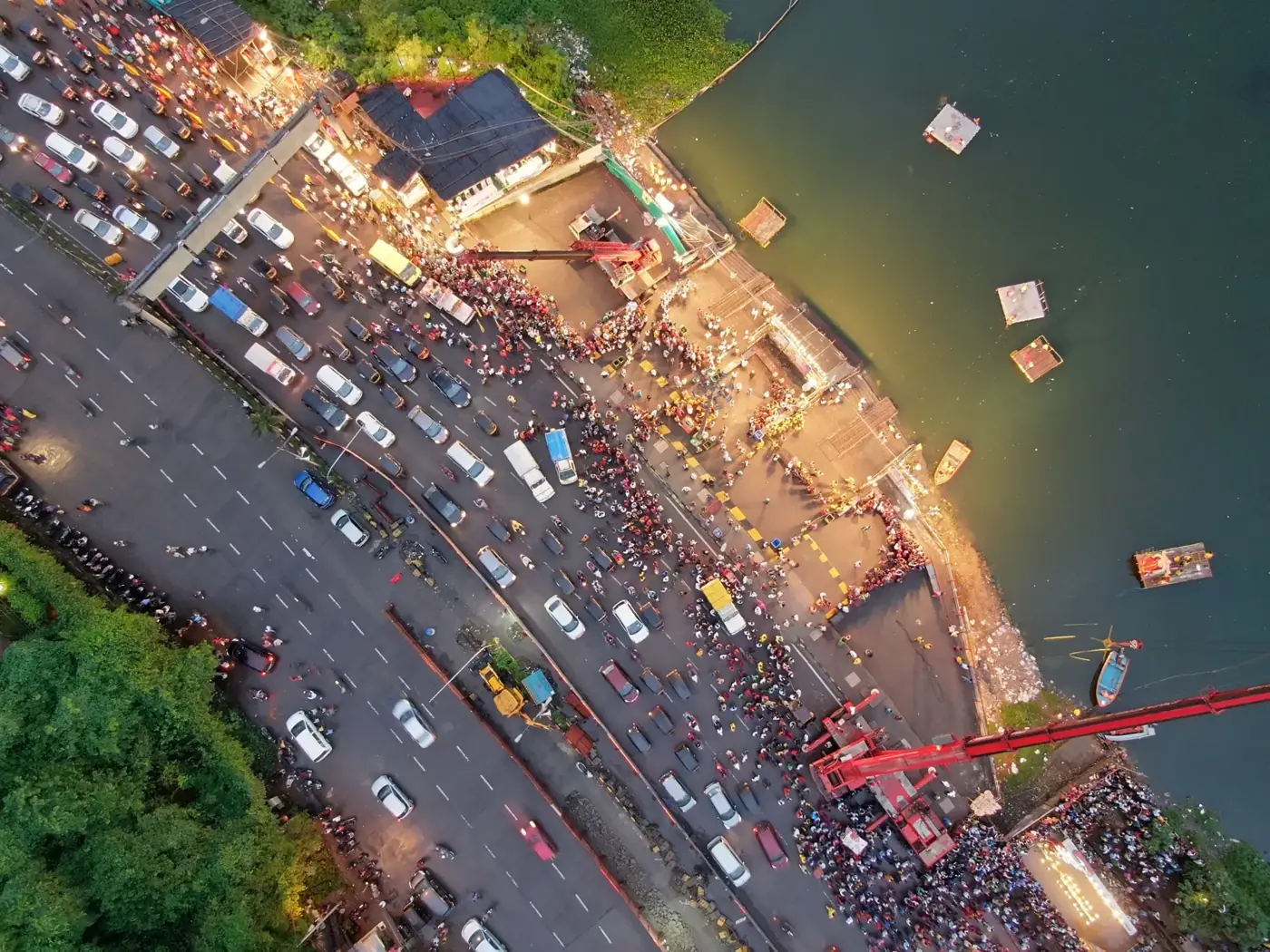
The site problem is close to solved in Mumbai. The material problem is not. A plaster idol in a pond is far better than a plaster idol in the sea, but it is still plaster that someone must collect, store and process. The next gain comes from what idols are made of.
2,754.85 t
The idols come out of the water, and 2,754.85 tonnes of remains are now waiting for a scientific use
A day after Ganeshotsav 2026 ended, the BMC retrieved 2,754.85 tonnes of immersed idol remains and moved them to a plot in Mulund for storage and processing. That is more than 250 tonnes above the previous year. The 2,500 tonnes retrieved in 2025 are stored at the same plot, also awaiting scientific disposal.[3]
Idol remains in storage, in tonnes
Ganesh idol remains handled by the BMC after the 2025 and 2026 festivals
Source: Free Press Journal, 30 September 2026, citing BMC.[3]
The way forward has been mapped. A state-appointed expert committee has suggested two methods: biological disintegration of PoP waste using chemicals, or calcination, a heat treatment carried out by wet or dry process. In 2025 the BMC processed 10 tonnes on a pilot basis and made benches and other items, but found it too expensive to run at scale, so it has invited expressions of interest from companies and extended the deadline for responses.[3] In 2025, the BMC had retrieved 1,982 tonnes of PoP by 2 pm on the Sunday after the final immersion, following its own standard operating procedure for retrieval.[9]
Mumbai has built the collection system. What it is asking for now is an industry that can use what it collects.
This is an opening for industry, not a failure of the city. A company that can take thousands of tonnes of clean, segregated PoP each October has a supply chain waiting for it, and an expression of interest already open.
47.5%
Flowers are the largest single stream: nearly half the waste counted at nine Varanasi ghats, and 508 tonnes in one Mumbai festival
Floral offerings, called nirmalya in Maharashtra, are the easiest part of festival waste to put to use. During Ganeshotsav 2025 the BMC collected 508 tonnes of nirmalya from natural water bodies and more than 290 artificial ponds, as 1,97,114 idols were immersed.[4] That was 42 tonnes less than the 550 tonnes collected in 2024.[10]
The best measured picture of everyday religious waste comes from Varanasi. A Banaras Hindu University team measured the waste at nine of the city’s most prominent ghats and found 1,880.7 kg a day. Flowers made up 893.4 kg, or 47.5%, followed by plastic at 26.55% and paper at 16.22%.[5]
What a day of ghat waste is made of
Solid waste per day at nine prominent ghats of the Ganga in Varanasi, by type
Source: Krishna, Maurya, Soren and Gupta, Indian Journal of Environmental Protection 41(9), 2021.[5]
The authors list the uses waiting for those flowers: vermicompost and compost, natural dyes, essential oils, biogas, incense sticks, rose water and handmade paper.[5]
Navi Mumbai shows the pathway
Navi Mumbai collected 63,695 kg of nirmalya during the ten days of Ganeshotsav 2025, with the highest single day, 24 tonnes, on Gauri Visarjan. Collection urns and vehicles were placed at all 22 natural lakes and 143 artificial ponds, and volunteers guided devotees to the urns instead of the water. The flowers were sent for scientific composting, with the compost going to city gardens and public spaces.[11]
Published national estimates of India’s floral waste vary so widely that we do not use them here.[12] City counts from collection drives are the more reliable guide.
Flowers are the part of festival waste with a ready answer. They compost cleanly and can be counted at the urn. What stops it is plastic mixed in at the source, which is why the volunteer beside the urn matters more than the truck.
0.89 mg/L
In three Nagpur lakes, dissolved oxygen fell as low as 0.89 mg per litre after immersion, and sulphate roughly tripled
Why ponds rather than lakes? A study of Futala, Gandhisagar and Ambazari lakes in Nagpur measured water quality before and after Ganesh immersion. Dissolved oxygen, the clearest sign of whether fish can breathe, fell from 4.09 to 5.29 mg per litre before immersion to 0.89 to 2.34 mg per litre after.[13] Sulphate, which the authors link to plaster of Paris, rose from 43.9 to 69.2 mg per litre before to 144.5 to 187.3 after, though it stayed below the national drinking water limit.[13]
Oxygen in the water
Dissolved oxygen, mg per litre, three Nagpur lakes; bars show the highest reading, labels the range
Source: Giripunje and others, SpringerPlus 3: 669, 2014.[13]
Sulphate in the water
Sulphate, mg per litre, same lakes; bars show the highest reading, labels the range
Source: Giripunje and others, SpringerPlus 3: 669, 2014.[13]
Lead, cadmium, copper, iron and manganese also rose in the water after immersion, and Tilapia fish from Gandhisagar carried lead at 0.83 µg/g and cadmium at 0.47 µg/g.[13] The Central Pollution Control Board notes that the dyes used on idols may contain mercury, cadmium, arsenic and lead.[14] Hyderabad’s Hussain Sagar faces the same seasonal load, as Earth5R’s Hussain Sagar restoration blueprint sets out.[15]
The case for artificial ponds is not about appearances. A lake whose oxygen falls below a few milligrams a litre for weeks after a festival is hard on its fish, and what does not dissolve settles into the sediment. Every idol that goes to a lined pond instead is a direct gain for the lake.
5,000
Kolkata immersed about 5,000 Durga idols in the Hooghly this month, and the bamboo frames go back to the artisans
Durga Puja immersions in Kolkata ended on Saturday 24 October 2026. About 5,000 idols were immersed in the Hooghly between Metiabruz and Dakshineswar, with around 700 more in ponds across the city. On Dashami alone, about 2,800 idols were immersed in the river and ponds.[6][16]
This year the Kolkata Municipal Corporation added conveyor belts, mechanised trolleys and rail-mounted systems at major ghats such as Babughat, Nimtala and Baghbazar, to carry idols to the water and bring the structures back to the bank.[17][16]
The kathamo economy
The most useful finding in this year’s reporting is an old practice. Along the Hooghly, the kathamo, the bamboo and straw framework on which an idol is sculpted, is routinely salvaged after immersion. Many go back to the artisans of Kumartuli, who dry, repair and reuse them for the next puja. “Reusing kathamos reduces the demand for fresh bamboo and other materials,” an environmentalist told the newspaper, adding that flowers, synthetic decorations and plastic must still be segregated before they reach the river.[6]
Reuse is already part of the festival economy. The bamboo frame has a second life because an artisan values it. The task is to give cloth, decorations and clay the same value.
345
Diwali adds smoke to the waste: Delhi’s Diwali-day AQI was 345 in 2025, against 218 in 2023
Diwali 2026 falls on Sunday 8 November, with Chhath Puja following from 13 to 16 November. Diwali’s waste is different from immersion waste: packaging, diyas, cracker shells, gift wrap and decorations, and smoke that lands on north India’s early winter air.
Delhi’s 24-hour average air quality index on Diwali day was 345 in 2025, in the “very poor” band, the highest in four years. It was 330 in 2024, 218 in 2023, 312 in 2022 and 382 in 2021, according to Central Pollution Control Board data. Weather matters too: in 2025, a former CPCB air laboratory head said, a depression in the Bay of Bengal brought calm winds that held pollutants over the city.[7]
Delhi’s air on Diwali day
24-hour average AQI on Diwali day, Central Pollution Control Board data
Source: CPCB data reported by India Today and PTI, 21 October 2025.[7]
In October 2025 the Supreme Court allowed the sale of green crackers in the National Capital Region for a limited period, noting a Union report that green crackers are 30% less polluting than regular ones, and allowed their use on Diwali only in fixed hours, including 8 pm to 10 pm.[18] Our briefs on stubble burning and air pollution in India explain why these weeks are hard for Delhi’s air.
A campaign built on Reduce, Reuse and Recycle
The Ministry of Housing and Urban Affairs ran its “Swachh Diwali Shubh Diwali” campaign from 28 October to 3 November 2024. It set up RRR centres, for Reduce, Reuse and Recycle, to collect old items before the festival, and encouraged a single-use-plastic-free Diwali, local products, “waste to art” and cleanliness drives after the festival.[19] The Swachhata Hi Seva 2025 theme, “Swachhotsav”, carried the same idea of clean, green festivities.[20]
Earth5R’s own Diwali work started small. On 30 October 2015, two volunteers in Bengaluru made a “No Cracker Diwali Pledge” board from an old cardboard sheet and took it round their college. The city had seen noise levels rise 34% on Diwali 2014 compared with a normal day.[21] The story is on our no cracker Diwali pledge page.
Diwali’s answer sits mostly at home: fewer crackers, less packaging, clay diyas and segregated waste the morning after. Housing societies and offices can make that a habit.
The rulebook already exists: CPCB’s idol immersion guidelines cover the idol, the offerings and the cleanup within 24 hours
The Central Pollution Control Board’s Revised Guidelines for Idol Immersion of May 2020 are the national reference. Much of what they ask can be done by a mandal, a housing society or a company volunteer team.[14]
| Stage | What the guidelines ask | Who can act |
|---|---|---|
| The idol | Natural clay and natural, non-toxic colours; plaster of Paris idols banned; smaller, low-height idols encouraged; single-use plastic and thermocol decorations not permitted | Idol makers, mandals, families |
| The offerings | Flowers, leaves, cloth and decorations removed before immersion and put in separate collection bins | Mandals, volunteers, urban local bodies |
| The water | Temporary lined ponds or tanks near homes, including inside housing society campuses; movable tanks for societies | Resident welfare associations, households, cities |
| The cleanup | Waste collected within 24 hours of immersion; liners removed within 24 hours; reusable clothes to orphan homes; biodegradables composted | Urban local bodies with NGOs and schools |
| The community | Eco clubs, NGOs, institutions and schools involved in awareness; awards for clay idol makers | Schools, NGOs, companies |
The new Solid Waste Management Rules, 2026 add a household duty that suits festivals well: segregation into four streams, wet, dry, sanitary and special care, with flowers named under wet waste. Bulk waste generators, defined to include any entity producing 100 kg of solid waste a day or more, must process wet waste on site or buy Extended Bulk Waste Generator Responsibility certificates.[22] For a large housing society or campus that hosts a festival, that makes the flower urn and the compost pit a compliance tool as well as a good idea.
The rules exist. The shared work is carrying them out in every society, mandal and office, where the idol is chosen and offerings are sorted, and that is where volunteers and CSR budgets help most.
What Earth5R found at the lakes after festivals: puja waste is a habit, and habits change face to face
Festival waste has turned up in Earth5R’s community work since its early years, usually at the water’s edge.
Yeoor Lake, Thane: the men with the puja bags
On 15 December 2015 an Earth5R team led by founder Saurabh Gupta cleaned Yeoor Lake at the foot of the Yeoor hills in Thane. They found everything from puja waste to alcohol bottles. As they were leaving, a few men walked towards the lake carrying puja waste. The team stopped to explain how dumping harms the lake’s plants and animals and how to dispose of the offerings safely. The men agreed not to throw waste there again and promised to tell others in their locality.[23] The Yeoor Lake cleanup showed that the best moment to stop festival waste is just before it is thrown.
Powai Lake: framed pictures, earthen pots and floating plastic
At an ACT Powai cleanup on 10 June 2018, volunteers found an abundance of religious waste on the banks of Powai Lake, including framed religious pictures and earthen pots, along with plastic floating on the water.[24] Earth5R’s report, Religious waste near Powai Lake: why does it matter?, noted that much of it contains plastic that rain washes into the water.[24]
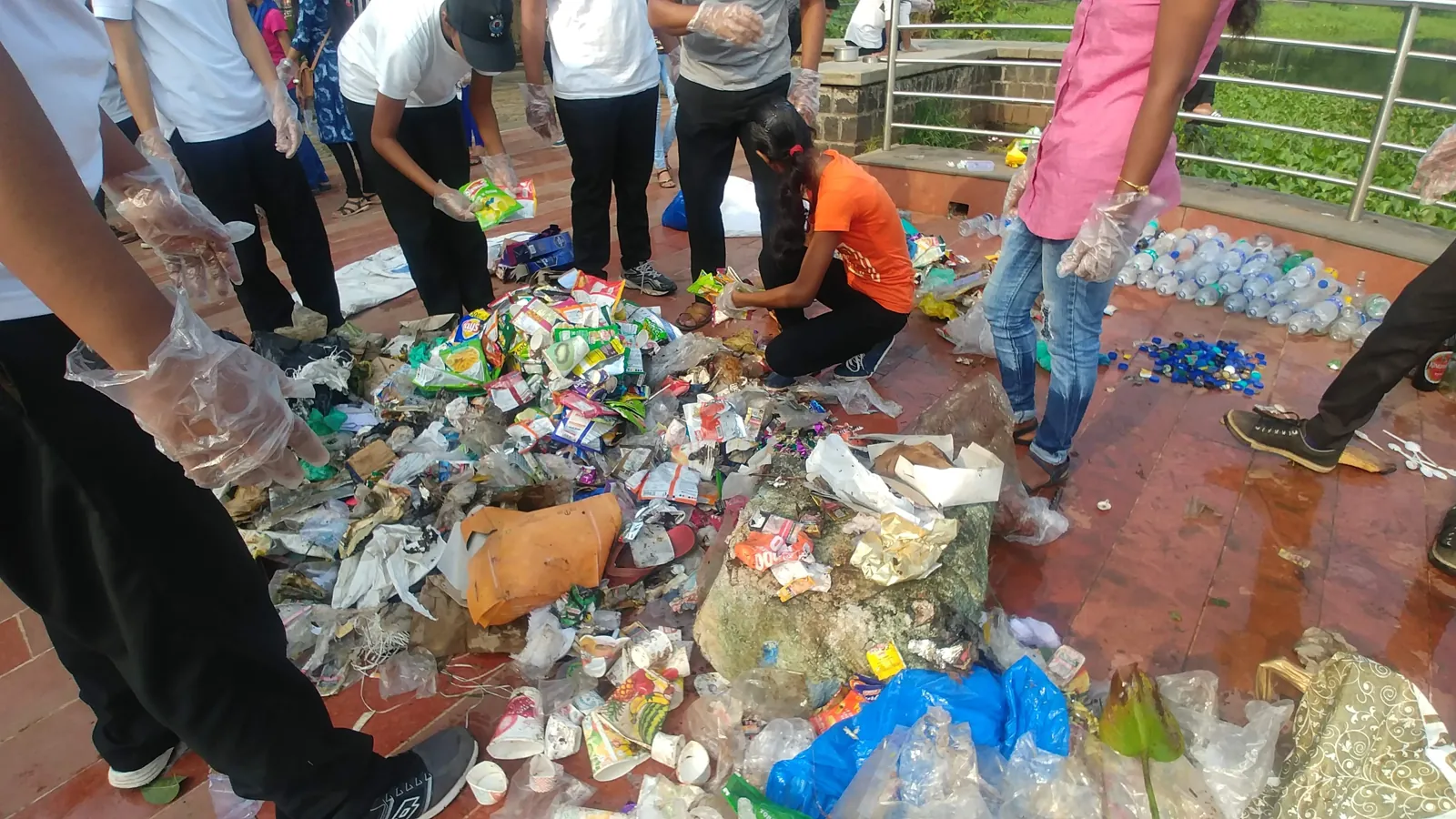
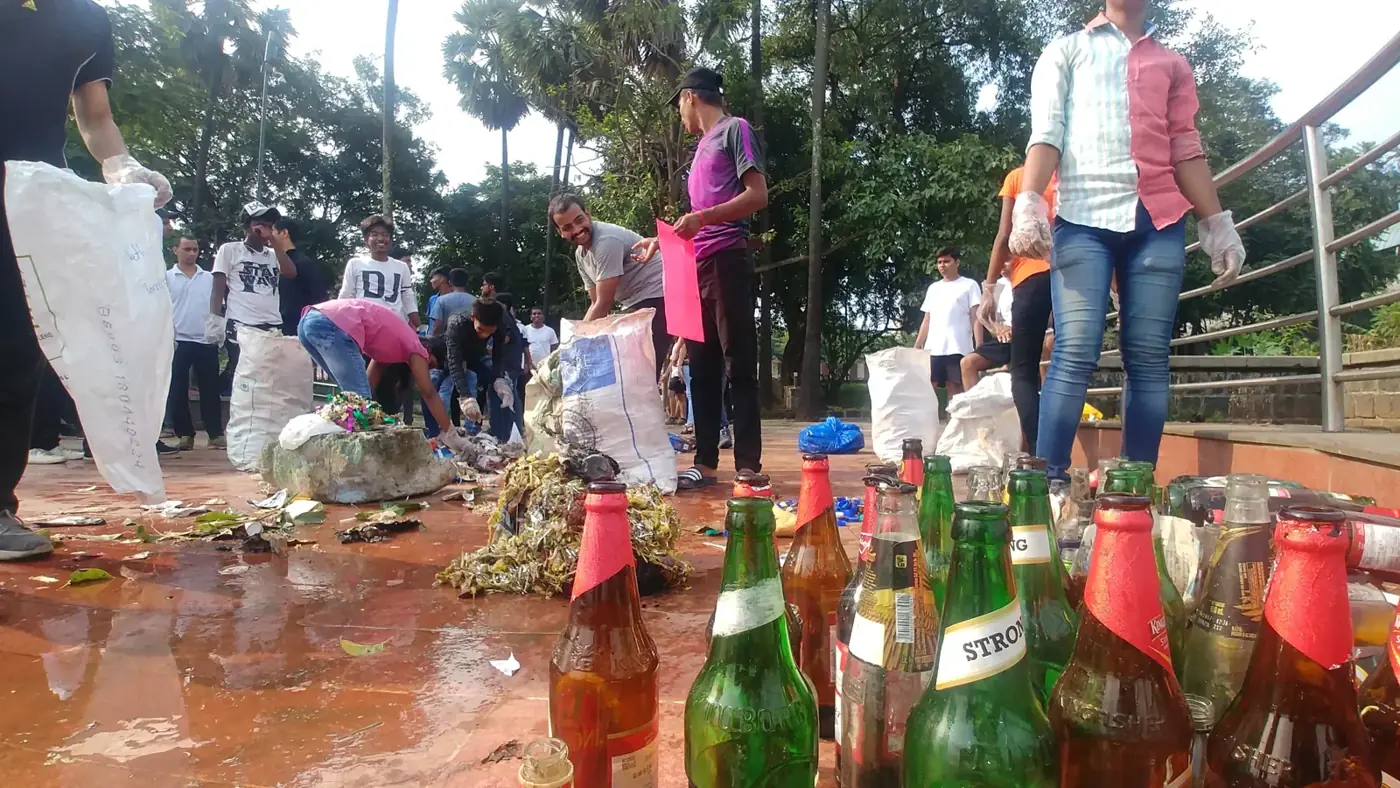
The Powai cleanups became a weekly project, and the focus moved from picking up to processing. Earth5R connected local waste pickers and recyclers with residential buildings so that plastic would be collected and recycled rather than sent to landfill.[25] By the 14th ACT Powai cleanup on 21 July 2018, the team reported about one tonne of plastic recycled over 13 weeks, and 85% of that day’s waste recycled.[25] On World Environment Day 2023, volunteers at Powai Lake used the Earth5R App to sort about 15 kg of waste into HDPE, LDPE, PET, paper, glass, medical waste and e-waste, with the app estimating a 52.5 kg carbon offset.[26]
Anant Chaturdashi 2018: sorting and composting on the day itself
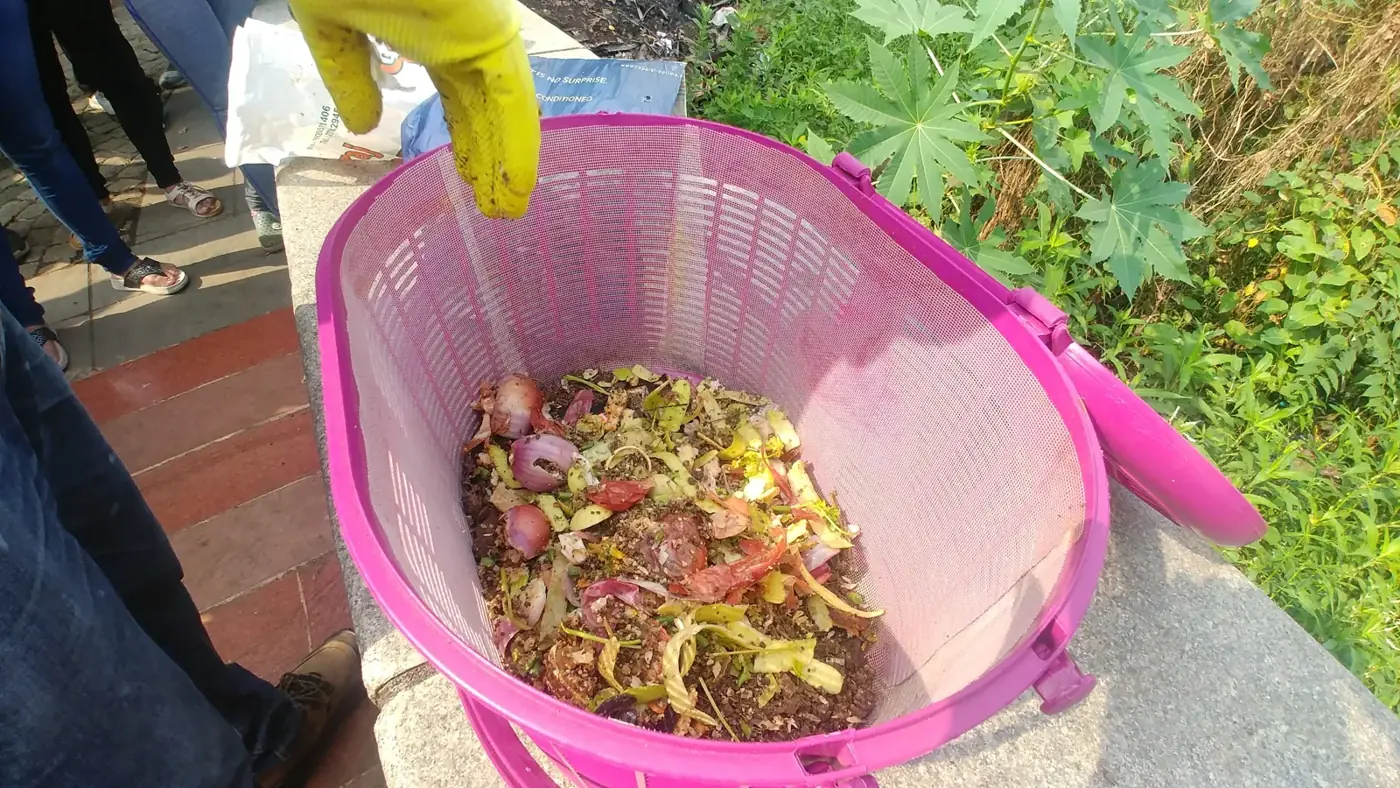
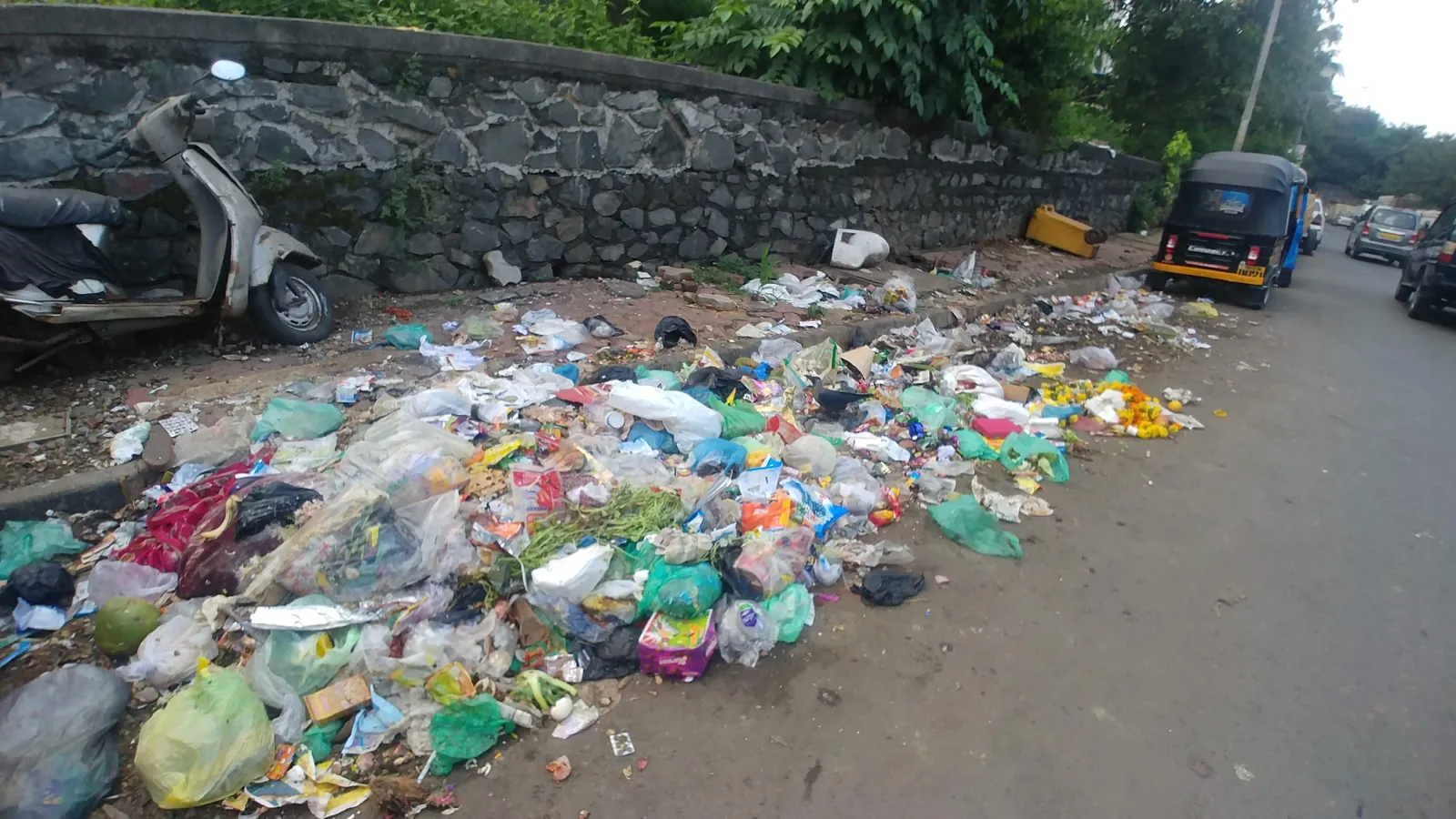
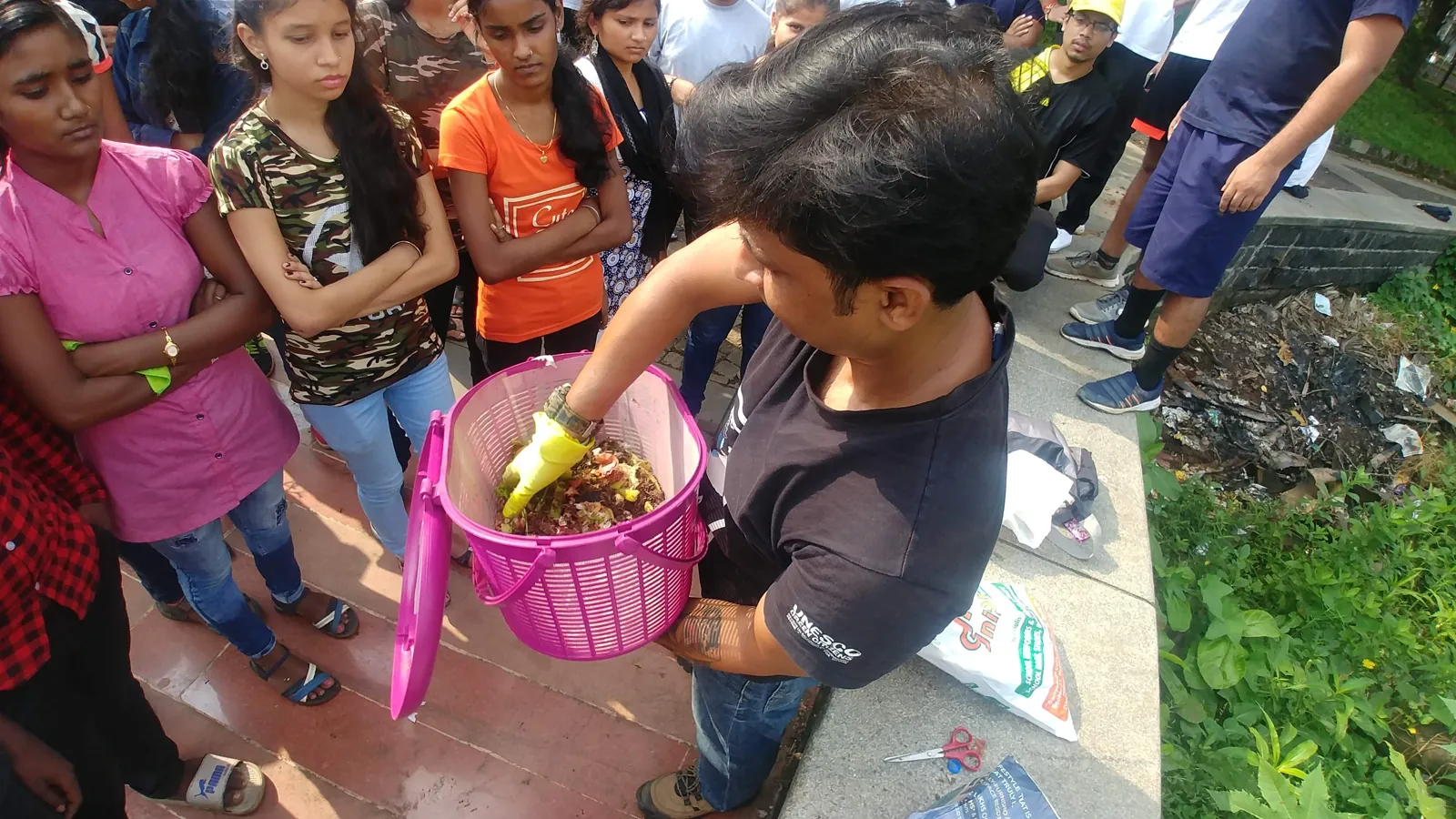
The photographs here come from the morning of Anant Chaturdashi, 23 September 2018, on a Mumbai lakeside promenade, where Earth5R volunteers sorted mixed heaps, lined up glass for recycling and showed residents how flowers and peels compost.
Juhu after the immersions
On International Coastal Cleanup Day, about 37 employees of Hexaware Technologies joined the Earth5R team at Juhu, a beach that after the Ganesh immersions “could be mistaken for a dumping ground”. They worked in four teams through rain, as our Juhu cleanup report records.[27] Our beach cleanup brief has the wider coastal data.
Hyderabad: clay Ganeshas made by children
On 12 September 2015, Earth5R’s Hyderabad team ran an environment friendly Ganesha workshop at Sri Satya Sai Krupa Orphanage in Bharat Nagar. The 45 children worked in 15 batches with two volunteers each and made 46 clay idols, which the orphanage gave to other orphanages to celebrate an eco-friendly Ganesh Chaturthi.[28]
Earth5R figures in this section, such as one tonne of plastic recycled, 85% of waste recycled and a 52.5 kg carbon offset, are programme-reported on Earth5R’s own pages and have not been independently verified. They describe individual events, not citywide results.
Festival waste is a habit formed at the water’s edge, and it changes when someone is there to explain, sort and show the compost. Collection systems handle the volume. People handle the choice.
Case study: the Mithi programme shows that the catchment, not the shoreline, decides how much waste reaches the water
Festival waste reaches lakes and rivers that already carry everyday waste. Earth5R’s largest water programme, on Mumbai’s Mithi River, ran from October 2020 to November 2024 with UN Technology Innovation Labs. A solar-powered recovery unit, developed with RiverRecycle, intercepted floating waste in the channel, and the bank-side system segregated, washed and shredded it for recycling.[29]
The part that matters most for festivals happened in the catchment. Earth5R trained 10,000 families and 500 businesses in waste segregation and composting. Residents were paid for segregated plastic, and households learned to upcycle waste into paper bags, lamps and handicrafts. Lamps made from waste are a fitting product for a city about to celebrate Diwali. The programme recovered 4,440 tonnes of plastic and estimates 6,660 tonnes of CO₂e avoided, with no carbon credits issued or claimed.[29] The full record is in the Mithi River case study.
The same logic runs through Earth5R’s community composting initiative in Mumbai, which engaged about 10,500 families in segregating kitchen waste and turning it into compost for gardening.[30] The flower urn at a festival is the same idea, scaled to one week of the year.
Mithi and composting figures are programme-reported by Earth5R for its own projects. Avoided emissions are estimates, and no carbon credits were issued or claimed by any party.
A recovery unit treats what has already entered the water. The volume is decided in households, mandals and markets, so programmes that change what families buy and sort shrink the cleanup itself.
Earth5R’s five R’s, applied to festival waste in India
Earth5R’s name comes from a sequence it has taught since 2014: Respect, Reduce, Reuse, Recycle, Restore. “The order matters,” Saurabh Gupta writes. “Respect comes first, respect for nature, for communities and for the limits of growth.”[31] Festivals are where that order is easiest to see, because faith and the water body are both things people already hold sacred.
| The R | What it means for a festival | Where it shows up on the ground |
|---|---|---|
| Respect | Respect the devotion behind the offering, and the lake or river that receives it. Persuasion works because it starts from faith, not against it. | The Yeoor Lake team talking to men carrying puja waste, who agreed not to dump it[23] |
| Reduce | Smaller, clay idols with natural colours; fewer crackers; less single-use plastic and thermocol in decoration.[14][18] | 940 tonnes of free shadu clay in Mumbai; 46 clay idols made by children in Hyderabad; the Bengaluru pledge board[2][28][21] |
| Reuse | Bamboo frames back to artisans, reusable cloth to orphan homes, steel plates and utensil banks in place of disposables.[6][14] | Kumartuli artisans repairing salvaged kathamos for the next puja[6] |
| Recycle | Nirmalya composted; segregated plastic and glass sold to recyclers; plaster of Paris processed instead of stored.[11][3] | Navi Mumbai’s 63,695 kg of nirmalya composted; ACT Powai’s recyclers linked to buildings[11][25] |
| Restore | Lakes whose oxygen and fish recover once immersion moves to ponds, and shorelines that stay clean after the crowds leave.[13] | Powai Lake cleanups under ACT Powai, from religious waste to segregated recycling[24][25] |
A festival waste CSR programme should be judged on what never reached the water, not on bags lifted the morning after
Cities now run the heavy logistics of immersion: hundreds of ponds, urns, cranes and tens of thousands of staff.[8] Company programmes add most on the shared gaps that remain: what idols are made of, what is sorted at the source, and who buys the material afterwards.
| Question | Post-festival cleanup only | Festival waste programme |
|---|---|---|
| Headline number | Bags or tonnes collected from the shore | Clay idols adopted, kilograms of nirmalya composted, and waste diverted before immersion[11] |
| Unit | A beach or a lake edge | Housing societies, mandals and offices, including those that are bulk waste generators under the SWM Rules 2026[22] |
| Material afterwards | Mixed waste to a dump | Flowers to compost, glass and plastic to recyclers, PoP to a processor[25][3] |
| Claims | A carbon figure with no method | Measured weights by stream, programme-reported figures labelled as such, no unverified credits[29] |
What to ask for in a festival waste proposal
- An idol plan: which idol makers and mandals will switch to clay and natural colours, and how the switch will be counted.[14]
- A flower plan: urns at every immersion point, a volunteer beside each, and a named composting site.[11]
- A segregation plan: the four SWM 2026 streams on immersion days, with weights recorded by stream.[22]
- A buyer plan: the recycler for glass and plastic, and a route for plaster of Paris.[3]
- A people plan: employee volunteers trained to talk with families at the water’s edge, as the Yeoor team did.[23][27]
Earth5R designs CSR and ESG projects for lakes, rivers and neighbourhoods, with field data that can be reported.
Frequently asked questions about festival waste in India
- What is festival waste in India made of?
- Mostly flowers and other offerings, plastic, paper, cloth and glass, plus idol material such as plaster of Paris, clay and paint after immersions. At nine Varanasi ghats, flowers were 47.5% of 1,880.7 kg of daily waste and plastic 26.55%.[5]
- How many Ganesh idols were immersed in artificial ponds in Mumbai in 2026?
- According to BMC figures, 1,92,237 idols up to six feet tall were immersed in 383 artificial ponds, 97.27% of the total. Another 5,382 taller idols were immersed at 67 natural sites.[1][2]
- What happens to plaster of Paris idols after immersion?
- In Mumbai, the BMC retrieves the remains and stores them for scientific processing. It retrieved 2,754.85 tonnes after Ganeshotsav 2026. An expert committee has suggested biological disintegration using chemicals or calcination, and the BMC has invited companies to take up the work.[3]
- What can be done with temple and festival flowers?
- They can be composted or vermicomposted, or used for natural dyes, incense sticks, essential oils, biogas and handmade paper. Navi Mumbai composted 63,695 kg of nirmalya from Ganeshotsav 2025 for its city gardens.[5][11]
- Does idol immersion harm lakes?
- A study of three Nagpur lakes found dissolved oxygen fell to 0.89 to 2.34 mg per litre after immersion, from 4.09 to 5.29 before, while sulphate and metals such as lead and cadmium rose. That is why guidelines favour lined artificial ponds.[13][14]
- How can a housing society or company celebrate Diwali with less waste?
- Choose clay diyas and low-packaging gifts, burst fewer crackers and only within permitted hours, set up collection for reusable items in the spirit of the RRR centres, and segregate the morning-after waste into wet and dry streams.[19][18][22]
Related reading on Earth5R
References
- Mid-day online correspondent (2026). Ganeshotsav 2026: Mumbai recorded 97.27 per cent idol immersion in artificial ponds, says BMC. Mid-day, 30 September 2026. mid-day.com
- Lokmat Times Desk (2026). Mumbai Ganesh Visarjan 2026: 1.92 lakh idols immersed in 383 artificial ponds. Lokmat Times, 30 September 2026, citing BMC figures. lokmattimes.com
- Bhujbal, D. (2026). Mumbai records 97.27% eco-friendly Ganpati immersions as nearly 2 lakh idols shifted to artificial ponds. Free Press Journal, 30 September 2026. freepressjournal.in
- Press Trust of India (2025). Ganesh festival: BMC collects 508 tonnes of floral offerings in post-immersion drive. NewsDrum, 7 September 2025. newsdrum.in
- Krishna, V., Maurya, S. S., Soren, C. and Gupta, T. (2021). Generation, composition and management of waste generated along the riverfronts (ghats) of River Ganga in Varanasi city, India. Indian Journal of Environmental Protection 41(9): 1046 to 1053. e-ijep.co.in
- Bandyopadhyay, K. (2026). 5,000 Durga idols immersed in Hooghly, KMC, police work overtime to clean up ghats. The Times of India, 25 October 2026. timesofindia.indiatimes.com
- India Today and PTI (2025). Delhi air pollution hits 4-year high on Diwali. India Today, 21 October 2025, citing Central Pollution Control Board data. indiatoday.in
- Mid-day online correspondent (2026). Ganeshotsav 2026: Mumbai civic body sets up 383 artificial ponds, 67 natural immersion sites. Mid-day, 18 September 2026. mid-day.com
- Times News Network (2025). Over 36k Ganpati idols immersed in Mumbai on last day of festival. The Times of India, September 2025. timesofindia.indiatimes.com
- Pudhari News Network (2025). Nirmalya collection: 508 metric tonnes collected this year (in Marathi). Pudhari, 8 September 2025, citing BMC figures.
- Free Press Journal (2025). Navi Mumbai collects 63 tons of nirmalya during Ganeshotsav, converts waste into organic fertiliser. 8 September 2025. freepressjournal.in
- Atal, H. L. (2022). Sustainable management of floral waste to produce bioenergy and valuable products. Journal of Indian Association for Environmental Management, CSIR-NIScPR.
- Giripunje, M. D., Fulke, A. B. and Meshram, P. U. (2014). Effect of idol immersion on water quality and Tilapia fish in Futala, Gandhisagar and Ambazari lakes of Nagpur, India. SpringerPlus 3: 669. pmc.ncbi.nlm.nih.gov
- Central Pollution Control Board (2020). Revised Guidelines for Idol Immersion. Ministry of Environment, Forest and Climate Change, 12 May 2020. mpcb.gov.in
- Earth5R. Hussain Sagar Lake: reviving Hyderabad’s heartbeat through sustainable restoration. EarthJournal, BlueCities. earth5r.org
- Ray, S. (2026). KMC wraps up immersions as puja organisers send off over 4,000 idols. The Times of India, 24 October 2026. timesofindia.indiatimes.com
- Statesman News Service (2026). Conveyor belts to be used for Durga idol immersion instead of cranes. The Statesman, 8 October 2026. thestatesman.com
- Supreme Court of India (2025). M.C. Mehta v. Union of India, Writ Petition (Civil) No. 13029 of 1985, order of 15 October 2025 on green crackers. sci.gov.in
- Ministry of Housing and Urban Affairs (2024). Union Minister rolls out “Swachh Diwali Shubh Diwali” campaign from 28 October to 3 November 2024. Press Information Bureau, 28 October 2024. pib.gov.in
- Ministry of Housing and Urban Affairs (2025). “Swachhotsav”: fortnight of Swachhata Hi Seva campaign to be rolled out by MoHUA and DDWS, with a focus on clean green festivities. Press Information Bureau, 9 September 2025. pib.gov.in
- Earth5R. No cracker Diwali pledge in Bangalore, 30 October 2015. EarthJournal. earth5r.org
- Earth5R (2026). SWM Rules 2026: India’s four-stream waste segregation shift. EarthJournal, 31 March 2026. earth5r.org
- Earth5R. Yeoor Lake cleanup by Earth5R, 15 December 2015. EarthJournal. earth5r.org
- Earth5R. Religious waste near Powai Lake: why does it matter? EarthJournal, ACT Powai cleanup of 10 June 2018. earth5r.org
- Earth5R. Lake cleanup and recycling at Mumbai: the 14th ACT Powai cleanup, 21 July 2018. EarthJournal. Programme-reported. earth5r.org
- Earth5R. Empowering change: Powai Lake cleanup event, World Environment Day, 5 June 2023. EarthJournal. Programme-reported. earth5r.org
- Shah, A. (reporter). Juhu beach cleanup: a collaborative effort by Earth5R and Hexaware. EarthJournal, Earth5R. earth5r.org
- Sai Pradeep, B. V. (reporter). Environment friendly Ganesha workshop, Earth5R Hyderabad, 12 September 2015. EarthJournal, Earth5R. earth5r.org
- Gupta, S. (2025). Mithi River plastic waste cleanup: what 11,100 tonnes actually took. Case study, October 2020 to November 2024. Earth5R. Programme-reported. earth5r.org
- Earth5R (2024). Community composting initiative, Mumbai. EarthJournal, 25 November 2024. Programme-reported. earth5r.org
- Gupta, S. (2026). AI and Sustainability: Planetary Limits. EarthJournal, Earth5R. Section on the Earth5R method, Respect, Reduce, Reuse, Recycle, Restore. earth5r.org
How to cite this article
Earth5R (2026). Festival Waste in India: Idols, Flowers and Diwali Smoke, and What Earth5R Learned at the Lakes. EarthJournal, Earth5R, 30 October 2026. https://earth5r.org/festival-waste-india/
Figures are taken from the sources cited and were current on 30 October 2026. Mumbai 2026 idol totals differ slightly between reports; we use the BMC breakdown by material and site. Kolkata figures are approximate, as reported. Indian figures use lakh and crore. Earth5R figures are programme-reported and labelled as such.