
India’s cities have dug out close to two thirds of the 26 crore tonnes of old waste piled on 2,482 dumpsites, and nearly 9,000 acres of land is back in use. The harder part is what comes next: the last, largest mounds, the methane that satellites can now see from space, and the 1.62 lakh tonnes of fresh waste that arrives every day. This brief sets out what the latest data on landfills in India shows, and what a decade of Earth5R work with housing societies, slum communities and the Mithi River teaches about keeping a cleared dumpsite from filling up again.
Landfills in India: the evidence at a glance
- How much waste India makes
- The legacy dumpsites, counted
- The last 214 sites
- What reclaimed land becomes
- Methane seen from space
- Landfills in the climate inventory
- Below the mound: leachate and heat
- The SWM Rules, 2026
- The global waste bill
- Earth5R at the source
- Case study: the Mithi River
- The five R’s for landfills
- What companies and cities can do
- Questions
Urban waste in India is 40 to 60% organic material, the fraction that rots into methane in a dumpsite.[5] That is why this brief builds on our earlier research on food waste in India, and why the answer starts in kitchens long before waste reaches a landfill.
1.62 lakh t
Urban India makes about 1.62 lakh tonnes of waste a day, and four fifths of it is now processed instead of dumped
A landfill is the end of a chain that starts in homes, shops and offices. As reported by states on the Swachhatam portal, urban India generates 1,62,468 tonnes of municipal solid waste a day, of which 1,30,484 tonnes, or 80.31%, is processed in 7,783 facilities, from material recovery and composting to bio-methanation and waste-to-energy.[2]
That processing figure is the result of a decade of building. In 2014, about 16% of urban waste was processed. By May 2026 the figure was 81%, and 97% of wards had door-to-door collection.[1]
Share of urban waste processed in India
Per cent of municipal solid waste processed, as reported by states
Source: Ministry of Housing and Urban Affairs, Lok Sabha reply of 3 April 2025 and national review of 20 May 2026.[6][1]
The Central Pollution Control Board’s annual figures show where waste went. In 2021-22, India generated 1,70,339 tonnes a day, collected 1,56,449 tonnes, processed or treated 91,511 tonnes and landfilled 41,455 tonnes.[7]
Where urban waste went in 2021-22
Lakh tonnes a day, CPCB annual reports from 36 states and union territories
Source: Ministry of Environment, Forest and Climate Change, Lok Sabha reply, 5 August 2024, citing CPCB.[7]
The volume is still growing. The government’s own projections put total waste generation at 165 million tonnes by 2030 and 436 million tonnes by 2050.[8]
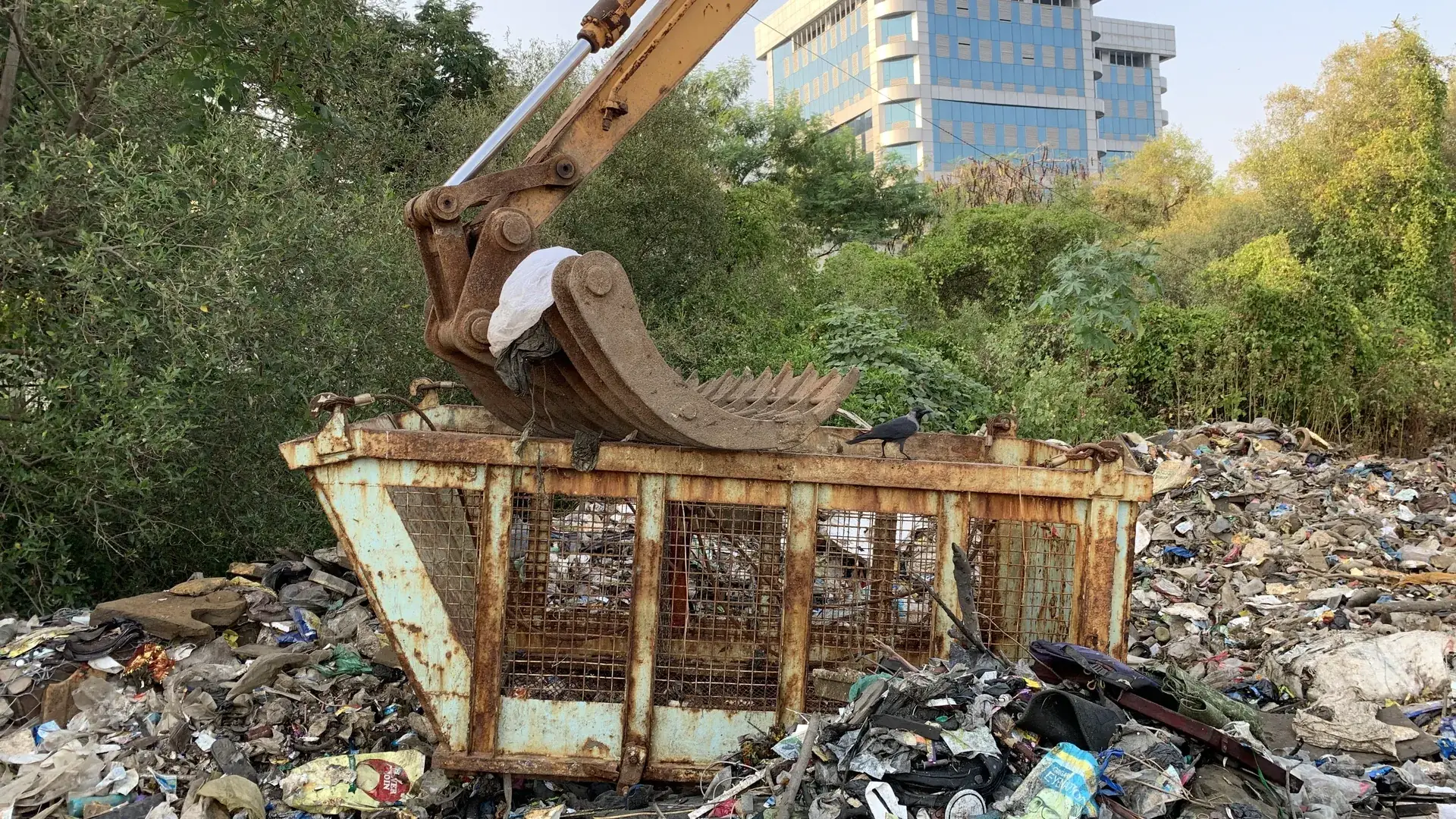
Processing capacity has risen fivefold in a decade. Every tonne that arrives at a plant segregated is a tonne that plant can actually process, which is why the source of the waste, not the size of the plant, now decides how much reaches a landfill.
65%
India’s legacy dumpsites held about 26 crore tonnes of old waste, and close to two thirds of it has already been dug out
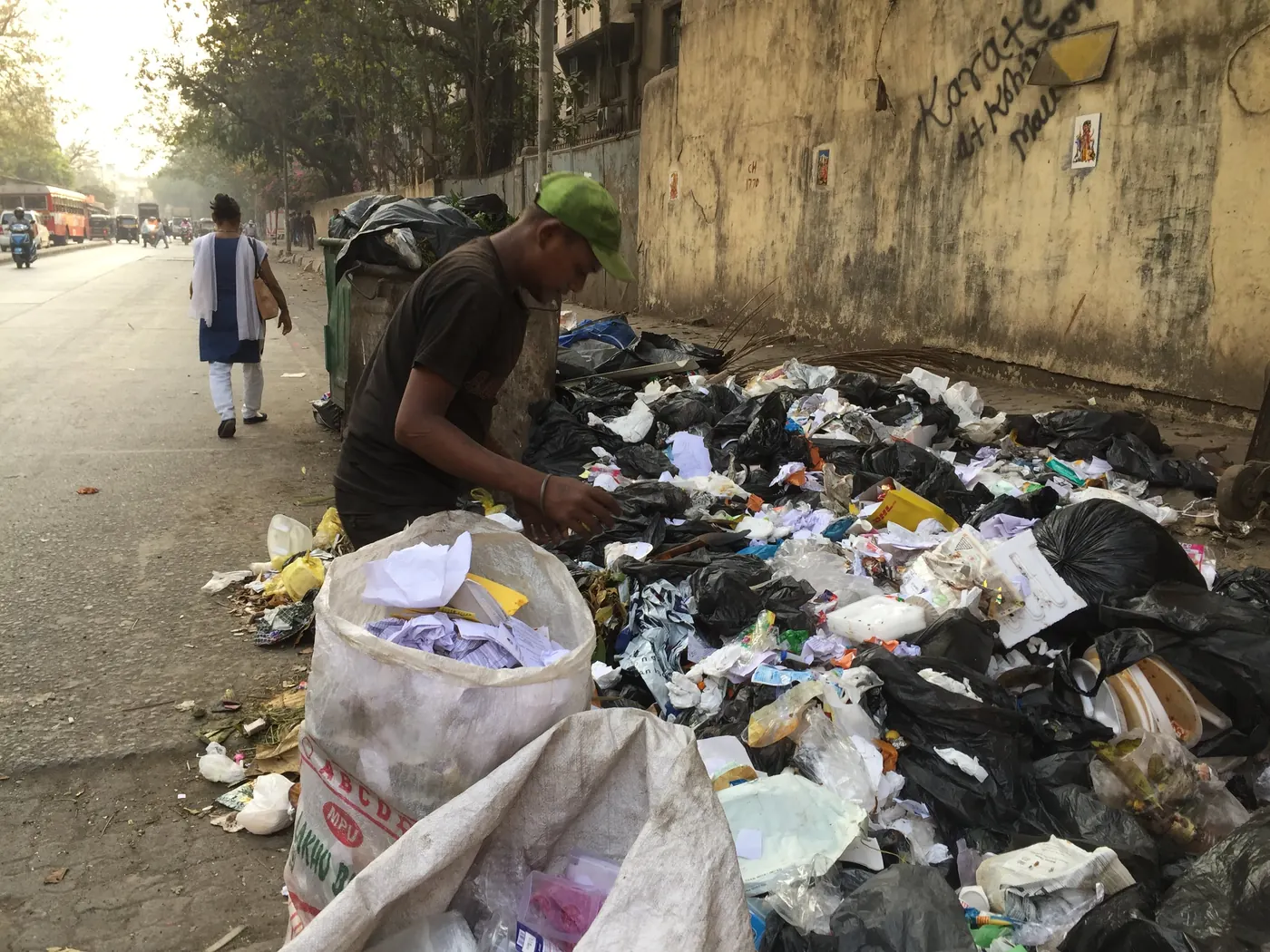
Legacy waste is the waste that piled up over years on open dumpsites before cities had the means to process it. When Swachh Bharat Mission-Urban 2.0 began in October 2021, it identified 2,476 dumpsites holding this kind of waste.[9] The register now counts dumpsites with more than 1,000 tonnes of waste each, and the national total is about 25 to 26 crore tonnes spread across nearly 15,000 acres.[10][8]
Progress has been steady. By November 2025, 14.33 crore tonnes had been remediated and about 7,580 acres reclaimed.[9] By January 2026, 1,138 dumpsites were fully remediated, 1,020 were in progress and 15.51 crore tonnes, or 62%, had been processed, with 8,484.15 acres reclaimed.[10] At the national review in May 2026, the figure stood at 65% of 26 crore tonnes across 2,482 dumpsites, with nearly 9,000 acres back in use.[1]
Status of India’s legacy dumpsites
Share of 2,488 identified dumpsites, January 2026
Source: Ministry of Housing and Urban Affairs, 29 January 2026. The not-yet-started figure is calculated by subtraction.[10]
Remediation usually means biomining: excavating and screening the mound into soil-like fines, recyclables, refuse-derived fuel (RDF) and inert material. Inert material goes into roads, embankments and low-lying land, and RDF to cement plants and waste-to-energy units.[9]
The first two thirds of legacy waste came off the smaller and medium sites. What remains is concentrated, which makes the last stretch both more visible and more demanding, and it is where partnerships with companies and communities can add the most.
214 sites
Just 214 dumpsites hold about 80% of the legacy waste that is left, which is why India has given them their own programme
In November 2025 the Ministry of Housing and Urban Affairs launched the Dumpsite Remediation Accelerator Programme (DRAP), a one-year, mission-mode push under the goal of Lakshya Zero Dumpsite. About 80% of the remaining legacy waste sits on 214 sites in about 200 urban local bodies, holding roughly 8.6 to 8.8 crore tonnes between them.[9][8]
Projects worth ₹6,700 crore were approved for these 214 sites at launch.[9] Across all legacy sites, central financial assistance of ₹4,206 crore has been extended for projects worth ₹10,308 crore, benefiting 2,489 urban local bodies in 29 states and union territories. An IT module tracks progress site by site.[10]
The ministry notes that the largest sites, such as Deonar in Mumbai and Ghazipur in Delhi, may need longer because of their scale.[9] It has asked every city to forge partnerships with companies, public sector undertakings and non-profit organisations for financing, logistics, technical support and community engagement.[10]
The national plan explicitly invites corporate and community partners into dumpsite work. For CSR teams, that is an opening to fund what a city cannot easily buy on its own: segregation in the wards that feed a site, livelihoods for the people who sort, and long-term care of the reclaimed land.
40 acres
Reclaimed dumpsites in India are becoming parks, forests and working waste plants
The clearest evidence that remediation works is what stands on the land afterwards. In Gorakhpur, Uttar Pradesh, a 40-acre mound that had been the city’s main disposal site for seven years was biomined at about 400 tonnes a day. It is now the Kachre Se Kanchan Rapti Eco Park, with lawns, walking tracks and solar lighting. A women-led self-help group runs a restaurant there, and the park draws around 500 visitors a day.[11]
In Delhi, biomining has run in mission mode at the 70-acre Bhalswa dumpsite since July 2022. By May 2026 more than half the site had been reclaimed, and by 31 July 2026, 99.07 lakh tonnes of legacy waste had been remediated, with fire prevention and leachate management around the site.[11]
In Nagpur, more than 10 lakh tonnes of legacy waste at the Bhandewadi dumping yard were processed and about 55 acres reclaimed. The site now runs as an integrated waste processing facility.[12] In Raichur, Karnataka, about 62,252 tonnes were processed at the Yakalaspura dumpsite, reclaiming nearly 22 acres, part of which now holds a Miyawaki forest of about 5 to 7 acres where around 60,000 bamboo and native saplings are being planted.[11]
These are the outcomes behind Earth5R’s model for turning garbage dumps into green zones: land a city can use again, and a community with a stake in keeping it clean.
A reclaimed site is only as permanent as the waste system feeding it. Gorakhpur and Nagpur succeeded because fresh waste stopped arriving at the old mound. The same test applies to every site still under remediation.
41.4 t/h
Satellites now see methane rising from Indian landfills, and India’s observed total was the highest of any country in a 2025 study
When food, paper and garden waste rot without oxygen inside a mound, they produce methane. Solid waste is the third largest source of human-caused methane worldwide.[3] Globally, about 20% of anthropogenic methane comes from the waste sector, most of it from final disposal at landfills and dumpsites.[13] Over 20 years, methane traps around 86 times more heat than carbon dioxide.[14]
Hyperspectral satellites now measure landfill methane directly. A 2025 study in Environmental Science and Technology quantified emissions from 38 strongly emitting disposal sites worldwide. India stood out with the highest national total, 41.4 tonnes of methane an hour, give or take 5.0, from 10 landfills.[3] Carbon Mapper, which has surveyed more than 10,000 waste sites by satellite, detected super-emitters at 371 of them in 71 countries, and India had the second highest count, 32, with Mumbai among the cities with the most.[13]
Landfill methane hotspots seen by satellite in 2025
Methane emission rate, tonnes per hour, selected sites from the global top 25
Source: UCLA Stop Methane Project analysis of Carbon Mapper data, as reported by The Hindu and The News Minute, April 2026.[15][16]
A 2025 ranking by the Stop Methane Project at the University of California, Los Angeles placed the Jawahar Nagar site near Hyderabad fourth in the world and a Mumbai landfill 12th.[15][16] A source emitting about five tonnes of methane an hour has a warming effect comparable to a 500-megawatt coal-fired power plant.[14]
Methane keeps leaving a mound long after waste arrives, and site emissions are expected to fall over time once organic waste stops arriving. Diverting wet waste is the most direct climate action a city or a housing society can take on its landfill, and satellites can now help verify the result.{r(“cm”)}
2.76%
Waste is a small slice of India’s greenhouse gas inventory, but its emissions have grown by half since 2005
India’s First Biennial Transparency Report to the UNFCCC puts waste sector emissions at 93.84 million tonnes of CO2 equivalent in 2022, up 51% from 62.06 million tonnes in 2005, as population, cities and waste grew. Waste made up 2.76% of national emissions excluding land use and forestry.[4]
Greenhouse gas emissions from India’s waste sector
Million tonnes of CO2 equivalent, national inventory years
Source: India, First Biennial Transparency Report to the UNFCCC, Table 1.4.[4]
The waste sector includes sewage and wastewater as well as solid waste. For solid waste alone, India’s Fourth Biennial Update Report estimates that 912 gigagrams (about 9.1 lakh tonnes) of methane were produced from 51,527 thousand tonnes of municipal solid waste received at landfills in 2020.[5] The government’s explainer on Lakshya Zero Dumpsite warns that, without timely remediation and scientific processing, greenhouse gas emissions from municipal solid waste could reach 41.09 million tonnes of CO2 equivalent by 2030.[8]
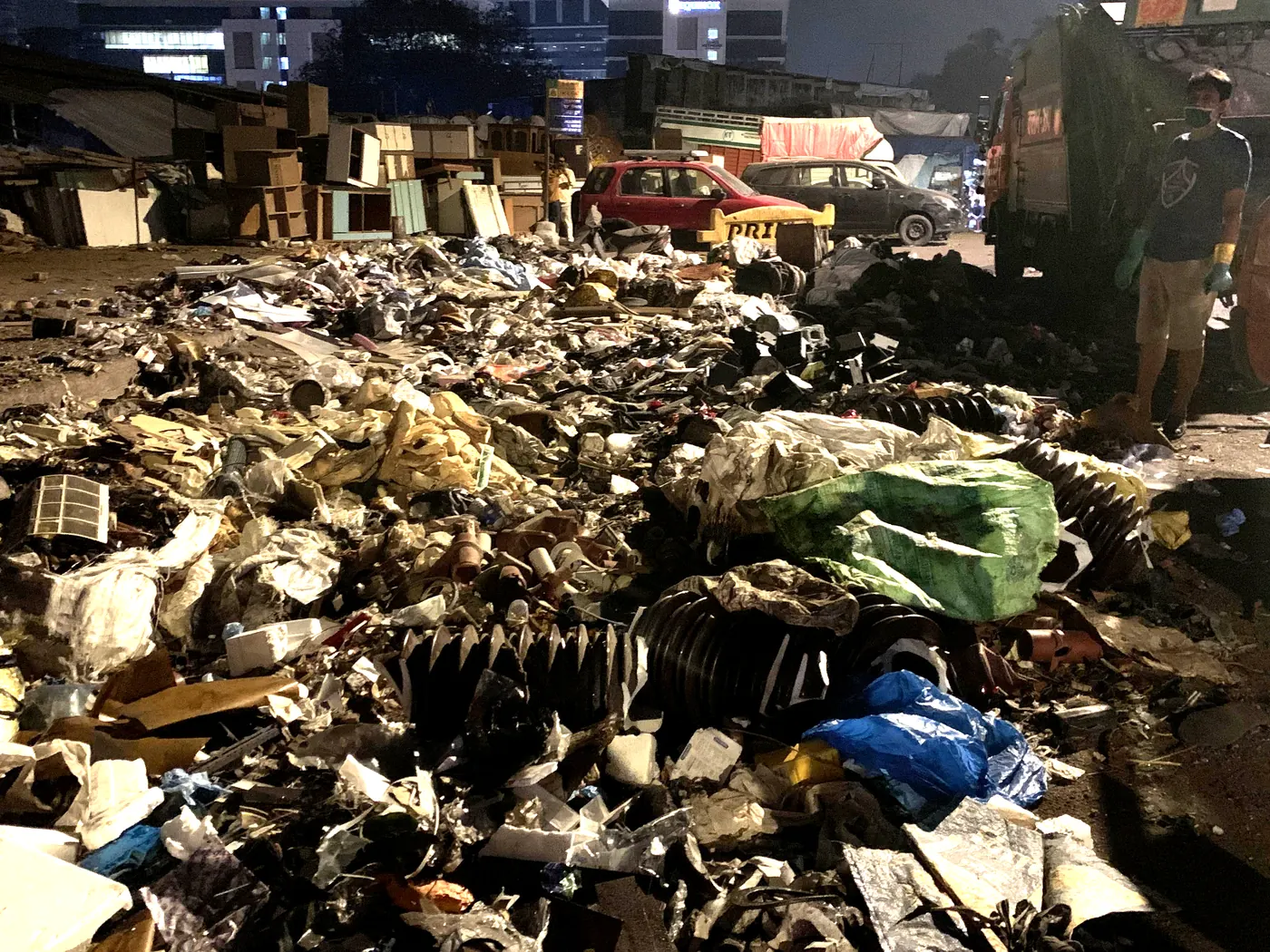
Open burning of waste adds particulate pollution to the carbon, a link we traced in our briefs on stubble burning in India and climate change in India.
For companies reporting Scope 3 emissions, waste sent to landfill is a category with real methane behind it. Measuring and cutting it is cheaper than most decarbonisation, and the SWM Rules, 2026 now encourage local bodies to generate carbon credits from better waste management.
60 to 70°C
Below a landfill mound, leachate seeps into groundwater and heat builds up deep inside the waste
Rain draining through a dumpsite picks up salts, organic matter and metals as leachate. A 2024 study in Scientific Reports examined Delhi’s Ghazipur landfill, in use since 1984 and more than 65 metres high by 2019, with no liner, leachate collection or gas collection.[17]
Leachate sampled in 2021 carried 22,690 to 34,525 mg/L of dissolved solids and chemical oxygen demand of about 7,998 mg/L. Nearby groundwater exceeded desirable limits for dissolved solids, chloride, hardness and alkalinity at almost every hand pump, with a water quality index of 537.3, unfit for drinking, and contamination fell with distance from the mound.[17]
The same study recorded temperatures of 60 to 70°C at depths of 30 to 50 metres, classifying Ghazipur as an elevated temperature landfill. The authors also record repeated fire and smouldering incidents at the site, with nearby residents reporting breathing difficulty and eye irritation.[17] The ministry’s DRAP plan lists cleaner air, safer groundwater and fewer fires among the gains from remediation, and fire prevention and leachate management are part of the work now under way at Bhalswa.[8][11]
Leachate and heat are reasons to finish remediation and to stop new organic waste reaching a mound. They are also reasons for companies with sites near a dumpsite to test groundwater and include it in their water risk assessments.
1 April 2026
The SWM Rules, 2026 turn segregation into the front line of landfill policy in India
The Solid Waste Management Rules, 2026, notified in January and in force since 1 April 2026, are built around a clear idea: a landfill should only receive what cannot be recycled, composted or burnt for energy.[18] We covered them in detail in our guide to four-stream waste segregation under the SWM Rules, 2026. The provisions that bear most directly on landfills are set out below.
| Provision | What it requires | Effect on landfills |
|---|---|---|
| Four-stream segregation | Wet, dry, sanitary and special care waste kept separate at source[18] | Wet waste goes to composting or bio-methanation, dry waste to material recovery facilities |
| Landfill restriction | Only non-recyclable, non-energy-recoverable and inert waste may be landfilled[18] | Organic waste, the source of methane and most leachate, is kept out |
| Higher landfill fee | Fee for unsegregated waste set above the cost of segregating and processing it[18] | Makes dumping the expensive option for local bodies |
| Bulk waste generators | Sites over 20,000 sq m, 40,000 litres of water a day or 100 kg of waste a day must process wet waste on site where possible or hold an EBWGR certificate[18] | Bulk generators produce nearly 30% of solid waste |
| Refuse-derived fuel | Cement and other solid-fuel users to raise RDF substitution from 5% to 15% over six years[18] | A market for the combustible fraction of biomined waste |
| Legacy dumpsites | Mapping and assessment of all dumpsites, time-bound biomining and quarterly online reporting, plus annual landfill audits[18] | Progress is tracked site by site on a central portal |
The rules move responsibility upstream, to the households, campuses, offices and housing societies that create waste. A company that segregates and composts on site is not just compliant. It is directly reducing the methane and leachate a landfill will produce for years.
US$640 bn
The world’s municipal waste bill could reach US$640 billion a year by 2050, and prevention is the cheapest way to cut it
The UN Environment Programme’s Global Waste Management Outlook 2024 projects that municipal solid waste will grow from 2.3 billion tonnes in 2023 to 3.8 billion tonnes by 2050. In 2020 the direct global cost of waste management was about US$252 billion, rising to US$361 billion once the hidden costs of pollution, poor health and climate change are counted. Without urgent action, that annual cost could reach US$640.3 billion by 2050.[19]
A circular economy model, which decouples waste from economic growth, could instead deliver a net gain of US$108.5 billion a year.[19] The cheapest landfill is the one that never needs to be built.
Waste prevention is the scenario with the lowest cost to economies, which is why investors increasingly treat landfill exposure as a risk, as we set out in our review of why landfills are a growing ESG risk.
10,500 families
What keeps a dumpsite from growing back: Earth5R’s work on landfills in India starts in kitchens, lanes and housing societies
Remediation clears what is already on a mound. Keeping it clear depends on the waste that leaves homes tomorrow, which is where Earth5R works: training residents, housekeeping staff and volunteers to segregate at source and process wet waste where it is produced.
The Community Composting Initiative, Mumbai. Earth5R’s Community Composting Initiative trained about 10,500 families across Mumbai to separate kitchen waste. Buildings chose compost pits, drums and tumblers, or automated units for larger complexes, and about 4,500 families adopted manual composting. The programme reports diverting about 5,250 kg of organic waste a day from landfills, around 1.89 million kg a year, and producing about 1,89,000 kg of compost a year for gardens and urban farming.[20]
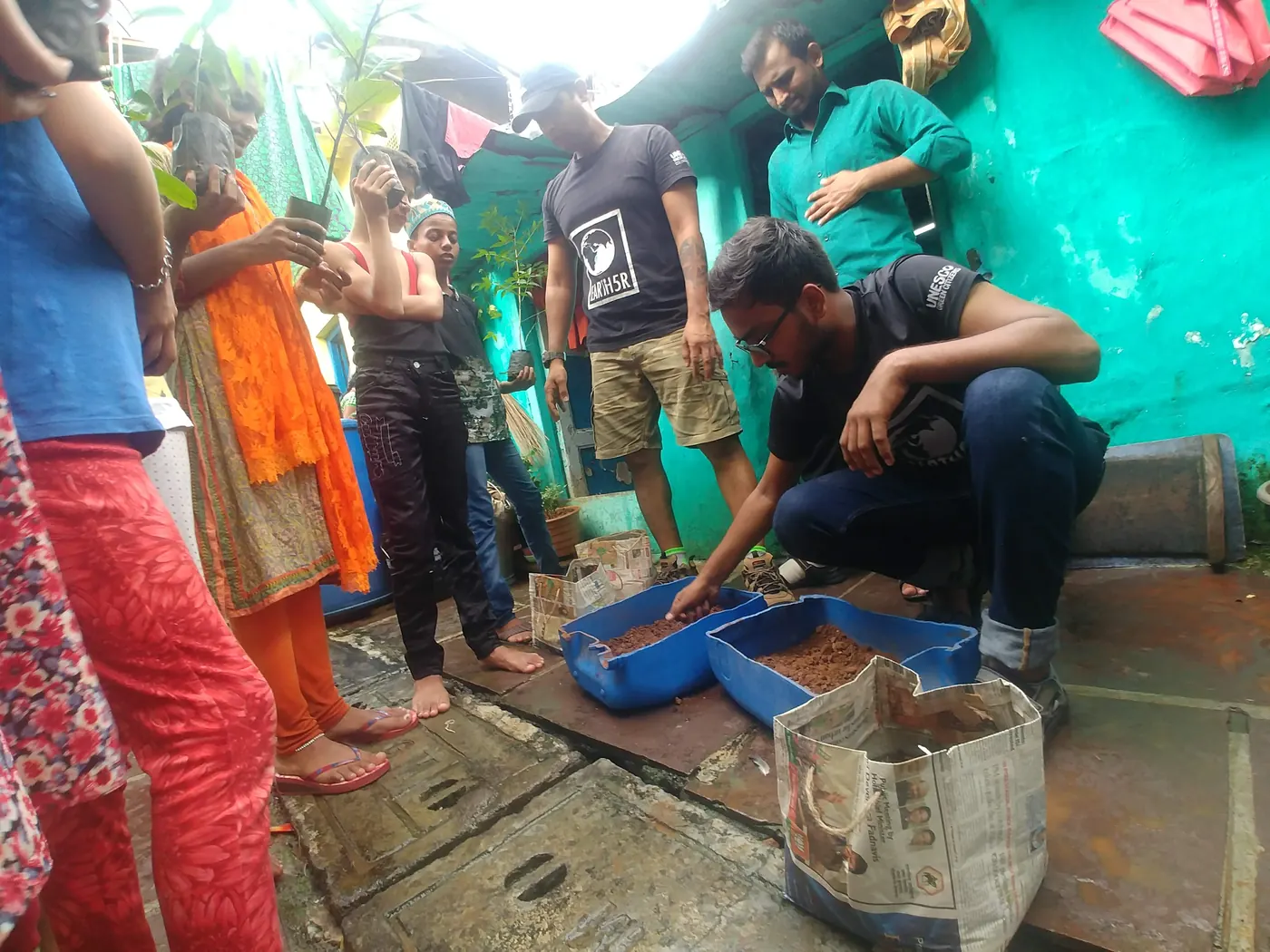
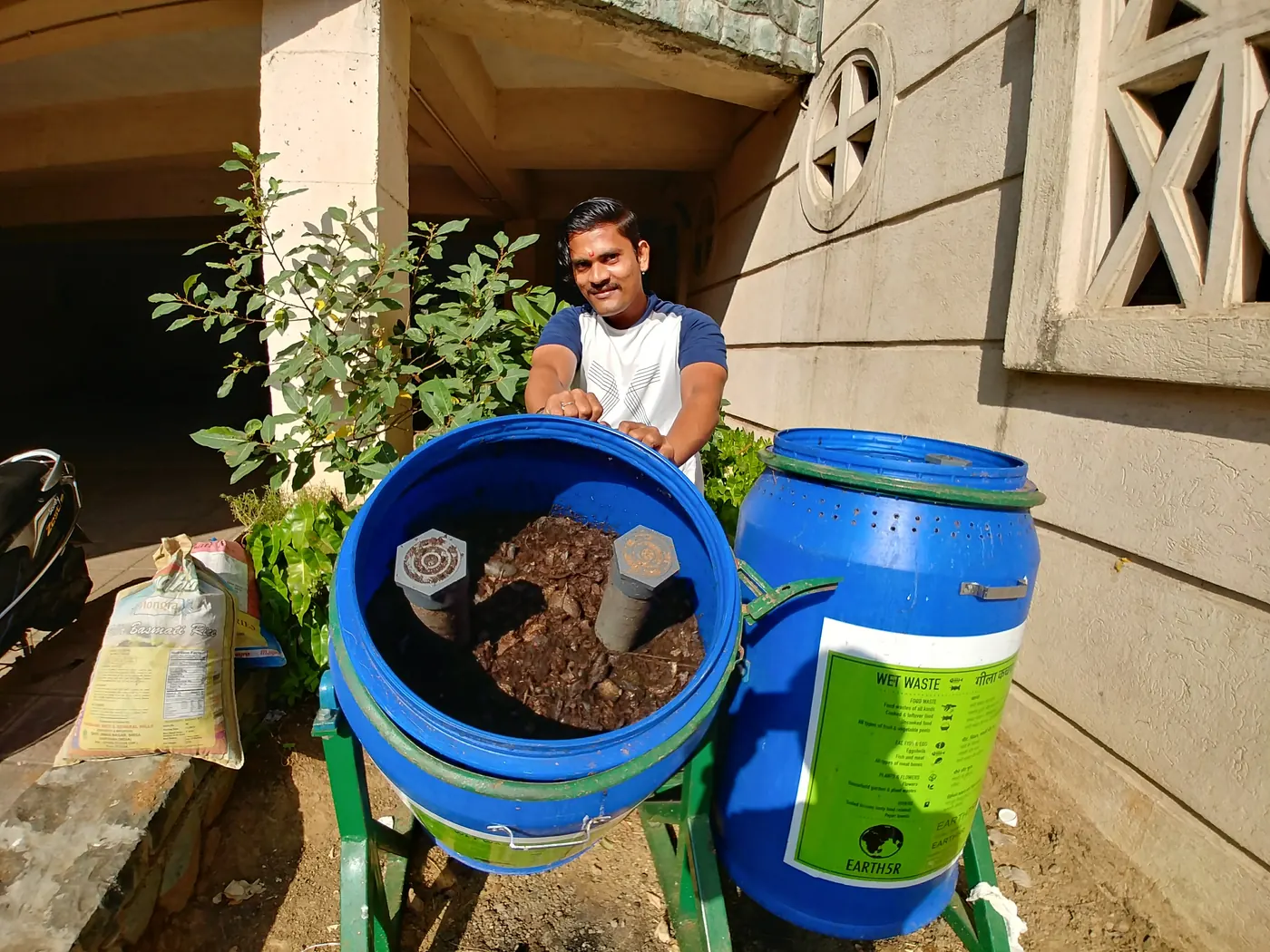
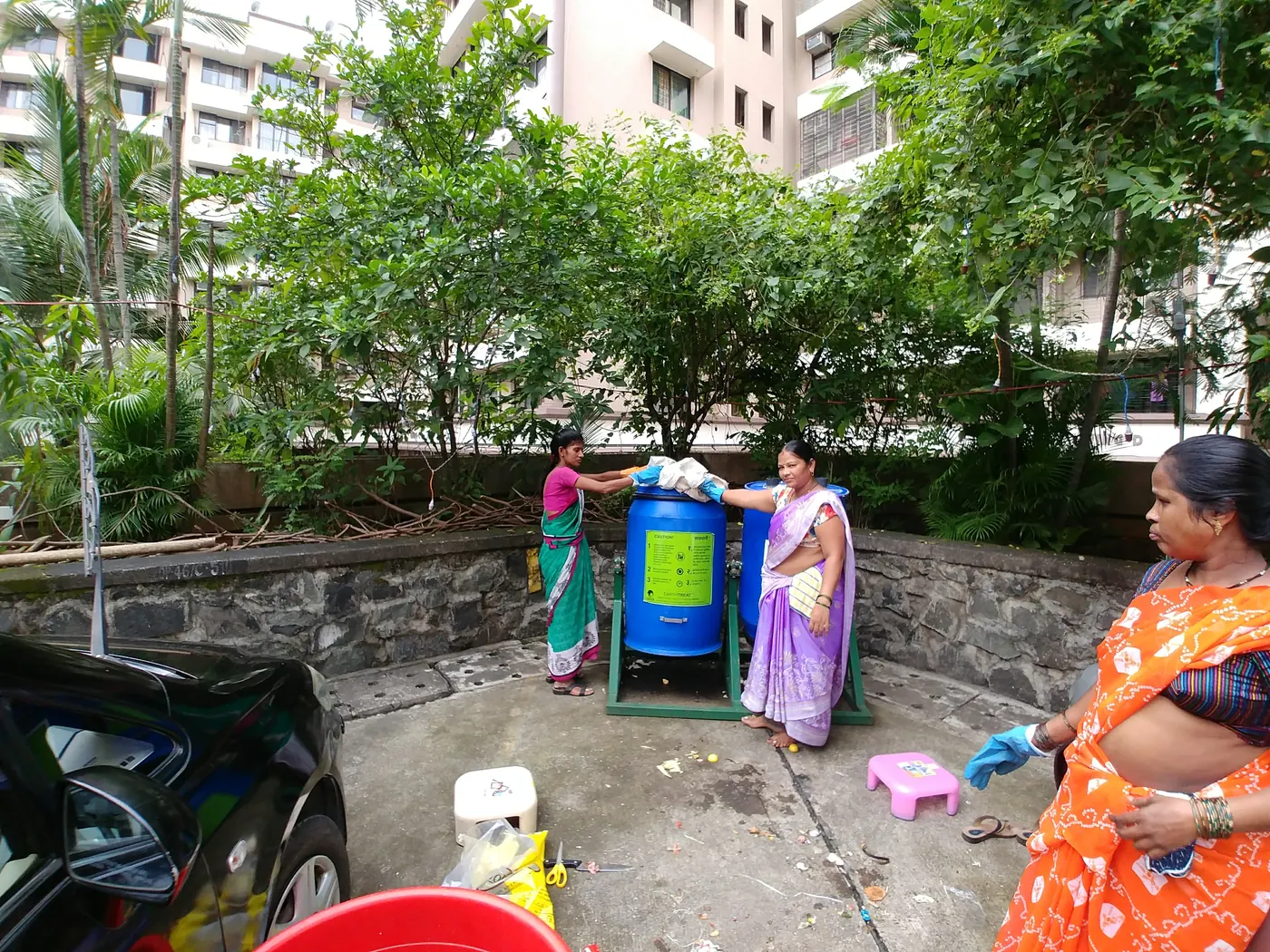
The ACT Powai Zero Waste programme. Under ACT Powai, Earth5R set up composting units in housing societies around Powai. At Parvati Heritage society in Ghatkopar, Project Manager Ketul Patel trained residents and housekeeping staff to separate recyclable, biodegradable and reject waste, and to run the composter. Compost not used in the society’s own gardens went to farmers in Aarey Colony.[21] At the Silver Crest building in Raheja Vihar, Chandivali, residents stopped handing their organic waste to the municipality and began processing it on site in compost tumblers able to handle about 1.5 tonnes of organic waste, after a Green Citizens workshop led by Saurabh Gupta. Residents Mr. Rajesh Verma and Mr. Mukundan are named in Earth5R’s report as the citizen leaders who drove the change.[22]
Slum communities and livelihoods. In Kurla, Vikhroli, Powai and Andheri, Earth5R volunteers trained families in segregation, composting and making saleable products from discarded plastic, cloth and paper, to keep waste out of the streets, the river and landfills. About 4,500 families attended over 60 days.[23]
Programme figures in this section are reported by Earth5R on its own pages and have not been independently audited. Daily diversion figures are programme estimates based on average organic waste per family. Read them as indicators of scale, not as measured landfill reductions.
Residents and employees can join this work through the Earth5R App, which carries waste hotspot surveys and training on segregation and the five R’s.
Every family that composts at home removes wet waste from the truck, the transfer station and the mound. At city scale, this is the cheapest way to make sure a reclaimed dumpsite stays reclaimed.
11,100 t
Case study: on the Mithi River, Earth5R designed recovery so that waste taken out of the water did not end up on a landfill
Between October 2020 and November 2024, Earth5R’s Mithi River programme in Mumbai removed 11,100 tonnes of waste from the river, averaging about 10 tonnes a day. Of that, 4,440 tonnes was plastic routed to recycling or pyrolysis. In the catchment, 10,000 families and 500 businesses were trained in segregation and circular practice, including composting organic waste at home and upcycling waste into paper bags, lamps and handicrafts.[24]
“Without a route for the residual fraction, recovered material returns to landfill and the cleanup becomes a relocation.” Saurabh Gupta, Mithi River case study[24]
Partners were United Nations Technology Innovation Labs, Huhtamäki, RiverRecycle and the Municipal Corporation of Greater Mumbai, around a solar-powered recovery unit developed by Earth5R with RiverRecycle. Recycling the plastic is estimated to have avoided about 6,660 tonnes of CO2e. Earth5R has since handed operations to the delivery partners.[24]
Mithi River figures cover October 2020 to November 2024 and are programme-reported by Earth5R. The avoided emissions figure uses a stated factor of 1.5 tonnes of CO2e per tonne of plastic recycled and is reported as avoided emissions, not as carbon credits.
A river cleanup, a dumpsite remediation and a housing society compost drum share one test: where does the material go next. Programmes that answer that question before they start are the ones that reduce landfill, not relocate it.
The five R’s for landfills in India: a dumpsite is what is left when the first four R’s are skipped
In the words of founder Saurabh Gupta, “The 5R in Earth5R comes from a sequence we have taught since 2014: Respect, Reduce, Reuse, Recycle, Restore. The order matters. Respect comes first, respect for nature, for communities and for the limits of growth. A programme that starts at Recycle has skipped the three most important steps.”[25] Landfills show what happens at the end of that sequence when the earlier steps are missing.
| R | What it means for landfills | Evidence and Earth5R work |
|---|---|---|
| Respect | Start from the limits of land, groundwater and the people who live beside a mound. A landfill is a neighbour, not a destination. | Groundwater near Ghazipur was unfit for drinking.[17] Remediation is returning about 9,000 acres to cities.[1] |
| Reduce | Cut what is thrown away, starting with food and wet waste, the fraction that turns into methane and leachate. | Earth5R’s Community Composting Initiative reports diverting about 5,250 kg of organic waste a day in Mumbai.[20] |
| Reuse | Give materials a second life before they become waste: containers, cloth, paper and the soil-like fines recovered from biomining. | Earth5R’s livelihood training turns discarded plastic, cloth and paper into products families sell.[23] |
| Recycle | Send clean, segregated dry waste to material recovery and recyclers, and return value to the people who sort it. | The Mithi programme routed 4,440 tonnes of plastic to recycling or pyrolysis instead of landfill.[24] The SWM Rules, 2026 send dry waste to material recovery facilities.[18] |
| Restore | Rebuild the land and the trust: finish remediation, green the reclaimed site and keep monitoring it with communities. | Raichur’s reclaimed dumpsite now holds a Miyawaki forest.[11] Earth5R’s green zones model puts communities at the centre of that care. |
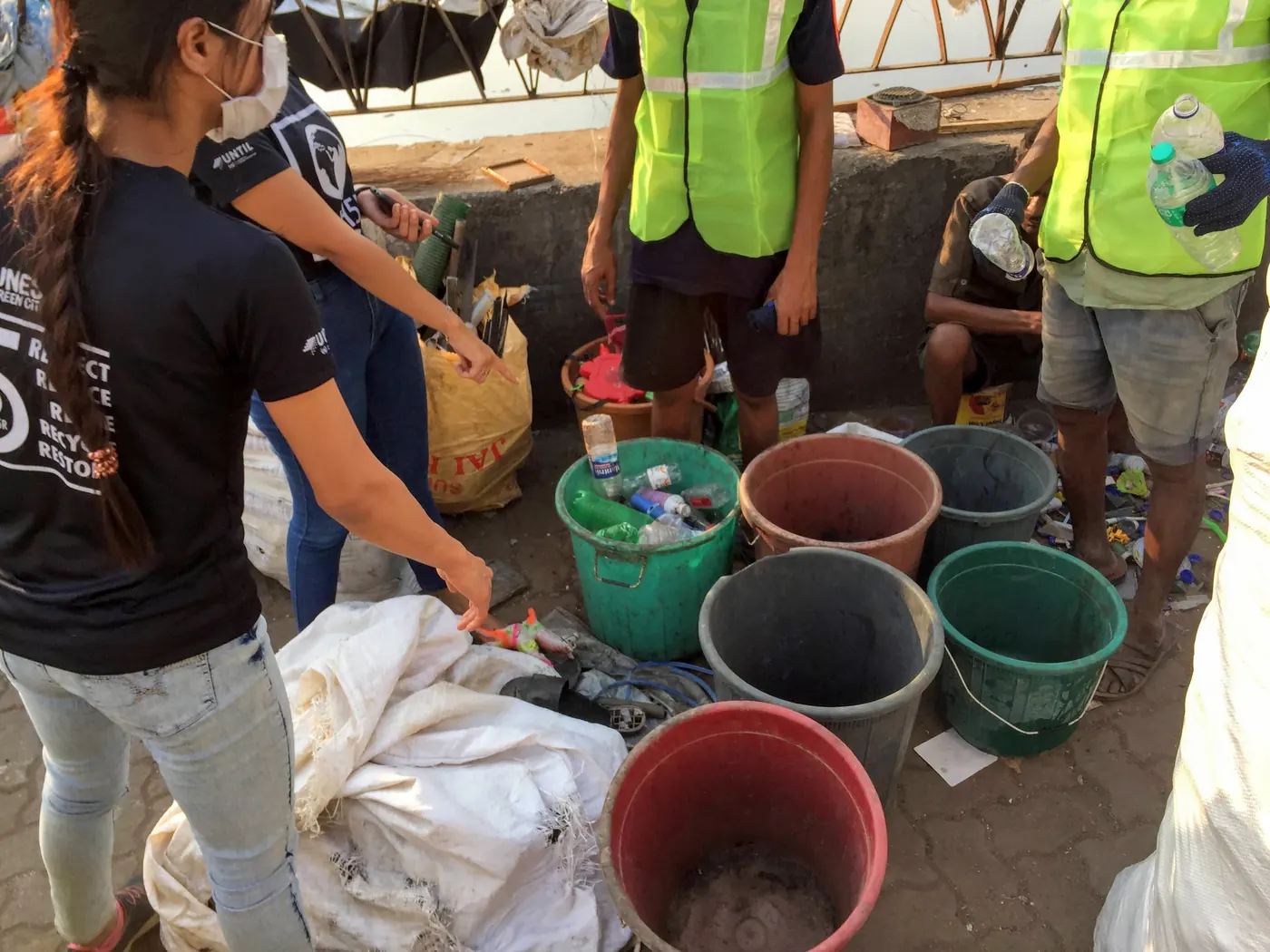
Recycle and Restore are where most landfill money goes today. Respect, Reduce and Reuse are where the volume of future landfill is decided, and they cost the least.
What companies, housing societies and cities can do to keep waste out of landfills in India
Most organisations will never own a landfill, but nearly all of them send waste to one.
- Treat wet waste as the priority. Organic waste is 40 to 60% of urban waste and the source of landfill methane.[5] On-site composting at campuses, canteens and housing societies is now expected of bulk waste generators under the SWM Rules, 2026.[18]
- Know your landfill exposure. Report waste to landfill separately from waste recycled or composted in BRSR and Scope 3 disclosures. Our ESG and BRSR reporting services help teams build that data trail.
- Partner on a dumpsite catchment. The national DRAP plan invites companies, PSUs and non-profit partners to support cities with financing, logistics and community engagement.[10] The most durable help is segregation in the wards that feed a site.
- Buy what remediation produces. Cement makers and other solid-fuel users must lift RDF use from 5% to 15% over six years, and inert material is going into roads and embankments.[18][9]
- Fund livelihoods in sorting. Programmes that pay collectors and train families, as on the Mithi River, keep material in use.[24]
- Plan for the long term. Earth5R’s CSR and ESG projects combine baseline surveys, community training and monitoring so results can be verified.
For packaging producers, landfill diversion is also an EPR obligation. Our microplastics brief shows what happens to plastic that escapes collection, in microplastics in India.
Talk to Earth5R about a zero waste programmeRead the Plastic Waste and EPR Guide
Frequently asked questions about landfills in India
- How many landfills and dumpsites are there in India?
- Under Swachh Bharat Mission-Urban 2.0, India identified 2,482 urban dumpsites holding more than 1,000 tonnes of legacy waste each, about 26 crore tonnes in total. By May 2026, 65% of that waste had been remediated and nearly 9,000 acres reclaimed.[1]
- What is legacy waste and how is it remediated?
- Legacy waste is old municipal waste that built up on open dumpsites over years. It is usually remediated by biomining: excavating, drying and screening the mound into soil-like fines, recyclables, refuse-derived fuel and inert material, which go to filling, recycling, cement plants and road building.[9][11]
- How much waste does India generate every day?
- Urban India generates about 1,62,468 tonnes of municipal solid waste a day, of which about 80% is processed, as reported by states on the Swachhatam portal.[2]
- Why do landfills in India emit methane?
- Food, paper and garden waste rot without oxygen inside a mound and produce methane. A 2025 satellite study found 41.4 tonnes of methane an hour from 10 Indian landfills, and in 2025 a site near Hyderabad and one in Mumbai were among the world’s top methane-emitting waste sites.[3][15]
- What do the SWM Rules, 2026 say about landfills?
- Landfills may receive only non-recyclable, non-energy-recoverable and inert waste. Unsegregated waste attracts a higher landfill fee than the cost of segregating it, all legacy dumpsites must be mapped and biomined on a time-bound plan, and landfills face annual audits.[18]
- What is Earth5R doing to reduce landfill waste?
- Earth5R trains families and housing societies to segregate and compost at source. Its Community Composting Initiative engaged about 10,500 families in Mumbai, and its Mithi River programme routed 4,440 tonnes of recovered plastic to recycling or pyrolysis instead of landfill.[20][24]
Related reading on Earth5R
References
- Ministry of Housing and Urban Affairs (2026). Two day National Review Meeting for Swachh Bharat Mission-Urban 2.0 in New Delhi. Press Information Bureau, 20 May 2026. pib.gov.in
- Ministry of Housing and Urban Affairs (2025). Implementation of Swachh Bharat Mission-Urban: written reply in the Lok Sabha. Press Information Bureau, 11 December 2025. pib.gov.in
- Zhang, X., Maasakkers, J. D., Roger, J., Guanter, L., Sharma, S. et al. (2025). Global identification of solid waste methane super emitters using hyperspectral satellites. Environmental Science and Technology 59(34): 18134 to 18145. doi.org/10.1021/acs.est.4c14196
- Ministry of Environment, Forest and Climate Change (2024). India: First Biennial Transparency Report to the UNFCCC. Section 1.5.5, Waste sector, and Table 1.4. December 2024. unfccc.int
- National Institute of Urban Affairs (2025). India Fourth Biennial Update Report (BUR-4): how does it focus on GHG emissions from solid waste? NIUA blog. niua.in
- Ministry of Housing and Urban Affairs (2025). Waste to energy projects: written reply in the Lok Sabha. Press Information Bureau, 3 April 2025. pib.gov.in
- Ministry of Environment, Forest and Climate Change (2024). Electricity from garbage: written reply in the Lok Sabha, citing CPCB annual reports for 2021-22. Press Information Bureau, 5 August 2024. pib.gov.in
- Press Information Bureau (2026). Lakshya Zero Dumpsite: India’s Drive to Eliminate City Dumpsites Under Swachh Bharat Mission. Explainer, 31 January 2026. pib.gov.in
- Ministry of Housing and Urban Affairs (2025). Launch of Dumpsite Remediation Accelerator Programme (DRAP). Backgrounder, Press Information Bureau, November 2025. static.pib.gov.in
- Ministry of Housing and Urban Affairs (2026). Dump Site Remediation Acceleration Plan: written reply in Parliament. Press Information Bureau, 29 January 2026. pib.gov.in
- Press Information Bureau (2026). Reclaiming the Land Beneath the Waste: Transforming India’s Legacy Dumpsites. Press note, 21 September 2026. pib.gov.in
- Ministry of Housing and Urban Affairs (2026). Bhandewadi’s urban facelift: turning legacy waste into opportunity. Press Information Bureau, 22 July 2026. pib.gov.in
- Carbon Mapper (2025). Methane waste super-emitters: an opportunity for global action in the waste sector. Insight brief, 25 June 2025. carbonmapper.org
- Roy, P. (2026). Satellite data shows Secunderabad and Mumbai among world’s biggest methane-emitting landfill sites in 2025. Down To Earth, 22 April 2026, reporting the UCLA Stop Methane Project analysis of Carbon Mapper data. downtoearth.org.in
- The Hindu (2026). Jawahar Nagar dump site is world’s fourth in methane emissions, study finds. 22 April 2026. thehindu.com
- The News Minute (2026). Hyderabad’s Jawaharnagar landfill world fourth in methane emissions. 23 April 2026. thenewsminute.com
- Alam, P., Khan, A. H., Islam, R., Sabi, E., Khan, N. A. and Zargar, T. I. (2024). Identification of prevalent leachate percolation of municipal solid waste landfill: a case study in India. Scientific Reports 14: 8910, 17 April 2024. doi.org/10.1038/s41598-024-58693-5
- Ministry of Environment, Forest and Climate Change (2026). New Solid Waste Management Rules notified; to come into force from April 1, 2026. Press Information Bureau, 28 January 2026. pib.gov.in
- UN Environment Programme (2024). World must move beyond waste era and turn rubbish into resource: UN report. Press release on the Global Waste Management Outlook 2024, 28 February 2024. unep.org
- Earth5R. Community Composting Initiative: organic waste management in Mumbai. EarthJournal. Programme-reported. earth5r.org
- Mukhopadhyay, A. and Griffin, E. (reporters). Zero waste and compost units in Ghatkopar. EarthJournal, Earth5R, ACT Powai Zero Waste programme. earth5r.org
- Patel, K. (reporter). Composting and organic waste management at Mumbai. EarthJournal, Earth5R, Silver Crest building, Raheja Vihar. Programme-reported. earth5r.org
- Siril, S. (reporter) and Dani, R. (editor). Earth5R conducts community training in slum areas of Mumbai: waste management, composting and livelihood. EarthJournal, Earth5R. Programme-reported. earth5r.org
- Gupta, S. Mithi River plastic waste cleanup: what 11,100 tonnes actually took. Case study, October 2020 to November 2024. Earth5R. Programme-reported. earth5r.org
- Gupta, S. (2026). AI and Sustainability: Planetary Limits. EarthJournal, Earth5R. Section on the Earth5R method, Respect, Reduce, Reuse, Recycle, Restore. earth5r.org
How to cite this article
Earth5R (2026). Landfills in India: 26 Crore Tonnes of Legacy Waste, Methane Data and What Keeps Dumpsites from Returning. EarthJournal, Earth5R, 9 November 2026. https://earth5r.org/landfills-india/
Figures are taken from the sources cited and were current on 9 November 2026. Official waste figures come from different reporting systems (the Swachhatam portal and CPCB annual reports) and years, so they should not be combined. Satellite methane rates are snapshots of observed plumes, not annual totals. Indian figures use lakh and crore. Earth5R figures are programme-reported and labelled as such.