
More than half of what Indian cities throw away is kitchen and garden waste that could become compost. Since 1 April 2026, the Solid Waste Management Rules expect it to be sorted at home and, in larger buildings, composted on site. This brief looks at the evidence on composting in India, and at what nearly a decade of Earth5R drum composters, housing society trainings and lane workshops in Mumbai and Pune shows about making compost a daily habit rather than a one-day event.
Composting in India: the evidence at a glance
- Half the bin is organic
- From 16% to 81% processed
- Why wet waste in a dump matters
- What the 2026 rules ask
- Soil that needs the compost
- Matching method to building
- Earth5R on the ground
- Case study: Powai and Chandivali societies
- Case study: 10,500 Mumbai families
- What fails, and what fixes it
- The five R’s of composting
- What societies, companies and cities can do
- Questions
Composting is the controlled breakdown of organic matter by microbes, in the presence of air, into a dark, earthy soil conditioner.[7][8] In India it ranges from a drum on a society terrace to city plants that take hundreds of tonnes a day. For the national picture on where unsorted waste ends up, read our brief on landfills in India.
More than half of India’s urban waste is organic, so composting in India is the biggest single lever in the bin
Every serious estimate puts the organic share of Indian city waste at around half or more. The Planning Commission’s 2014 task force put the biodegradable fraction at 51%, which an ICRIER assessment called an underestimate: data from a few cities suggest 55 to 60% across a year.[9] The Centre for Science and Environment, drawing on NEERI and other studies, puts the organic fraction of urban waste at roughly 55 to 65%.[1]
The Ministry of Housing and Urban Affairs’ composting advisory plans household systems around 100 to 200 grams of organic waste per person per day, out of a total of about 400 to 450 grams.[8] Much of that is food. The UN Environment Programme’s Food Waste Index 2024 estimated that Indian households waste about 55 kg of food per person a year, some 78.2 million tonnes in all.[10]
Composting is not a side project for the green committee. It is the right destination for the largest part of what every Indian household throws away, which is why it decides whether a building, ward or city can ever approach zero waste.
Urban India now processes 81% of its waste, up from 16% in 2014, and compost plants are a large part of that build-out
As reported by states on the Swachhatam portal, urban India generates 1,62,468 tonnes of municipal solid waste a day, of which 1,30,484 tonnes is processed. That is 80.31%, against 16% in 2014, delivered through 7,783 processing facilities, from material recovery facilities and composting plants to bio-methanation and waste-to-energy.[2] At the national review of Swachh Bharat Mission-Urban 2.0 in May 2026, the figure stood at 81%, with 97% of wards covered by door-to-door collection and communities adopting two-bin, four-bin and even six-bin systems.[3]
A decade of building processing capacity
Share of urban municipal solid waste processed, India
Source: Ministry of Housing and Urban Affairs, reply in Parliament of 11 December 2025 and national review of 20 May 2026.[2][3]
Some of the largest plants show what segregated wet waste can become at city scale. Indore’s Gobar-Dhan Bio-CNG plant, opened in February 2022, was built to treat 550 tonnes a day of segregated wet waste and produce about 17,000 kg of bio-CNG and 100 tonnes of organic compost every day, with no rejects sent to landfill.[11] In villages, states had reported 895 functional community biogas plants under Swachh Bharat Mission-Grameen by April 2025.[12]
The national system is now built to process most urban waste. The quality of what reaches it is the shared challenge. Big plants work best on clean, segregated wet waste, and decentralised composting at the building gate is how cities get it.
Wet waste left in a dump rots without air and makes methane, so composting at source is a climate action as well as a cleanliness one
Organic waste behaves very differently depending on where it ends up. In a compost drum or windrow, microbes break it down with air and the product is compost. Buried in a mixed heap, it decomposes without oxygen and gives off methane, a greenhouse gas, and leachate that can seep into groundwater.[8][9]
India’s Fourth Biennial Update Report to the UNFCCC puts the waste sector at 2.56% of national greenhouse gas emissions in 2020.[13] Within it, 912 gigagrams of methane were produced from 51,527 thousand tonnes of municipal solid waste received at landfills that year, according to the National Institute of Urban Affairs’ reading of the report.[14] Food loss and waste is linked to 8 to 10% of global greenhouse gas emissions, the UN Environment Programme estimates.[10]
The government’s composting advisory lists the gains of handling organic waste close to where it is produced: shorter and cheaper collection chains, lower emissions from waste decaying in transit, less smell at storage points, no uncontrolled leachate, and better compost, because clean feedstock makes clean compost.[8]
Keeping kitchen waste out of the mixed stream is one of the few climate actions every household can take every day. Each kilogram composted with air is a kilogram that cannot rot without it in a dump.
The Solid Waste Management Rules, 2026 make wet waste a separate stream and ask larger buildings to compost it on site
The Ministry of Environment, Forest and Climate Change notified the Solid Waste Management Rules, 2026 on 27 January 2026, replacing the 2016 rules from 1 April 2026.[15] Every generator must now keep waste in four streams: wet, dry, sanitary and special care. Wet waste covers kitchen waste, vegetables, fruit peels, meat and flowers, and is to be composted or processed through bio-methanation.[4]
| Who | What the rules ask | What it means for compost |
|---|---|---|
| Every household | Segregate into wet, dry, sanitary and special care waste and hand it over separately[7] | Clean wet waste, the raw material for good compost |
| Bulk waste generators | Sites of 20,000 sq m or more, or using 40,000 litres of water a day, or producing 100 kg of waste a day must process wet waste on site as far as possible, or buy an Extended Bulk Waste Generator Responsibility certificate[4] | On-site composting or biogas becomes the default for large societies, campuses and offices |
| New bulk generators | Set up and run a wet waste processing facility big enough for all wet and garden waste they produce[7] | Composters are designed in, not added later |
| Gated communities over 5,000 sq m, RWAs, hotels and restaurants | Within one year of notification, ensure segregation and process biodegradable waste within the premises as far as possible[7] | Every RWA and larger gated community is in scope, with the window running to January 2027 |
| Urban local bodies | Use compost in parks and gardens, set up zone-wise decentralised composting units and promote home composting[7] | A local buyer for city compost |
| Department of Fertilisers | Promote co-marketing of compost with chemical fertiliser at 3 to 4 bags for every 6 to 7, and incentivise home composting[7] | A route to farms for compost made in cities |
Earth5R’s compliance guide to the SWM Rules 2026 walks through the obligations for buildings and companies, and our explainer on four-stream waste segregation covers the household side.[16]
For the first time the rules connect every link in the chain: the household that sorts, the building that composts, the city that uses compost in its parks and the fertiliser company that sells it to farmers. Housing societies that start now will be ready well before their one-year window closes.
Nearly half of India’s tested farm soils are low in organic carbon, which gives city compost a ready use
Compost matters as much for where it goes as for what it avoids. The Centre for Science and Environment’s assessment of the government’s Soil Health Card data, covering about 1.3 crore samples tested in 2023-25, found 64% low in nitrogen and 48.5% low in organic carbon.[5] Compost is one of the most direct ways to put organic matter back into soil.
Half the samples are short of organic carbon
Soil Health Card samples by organic carbon status, 2023-25
Source: Centre for Science and Environment assessment of Soil Health Card scheme data, October 2025.[5]
Policy has begun to pay for that link. In June 2023 the Union Cabinet approved Market Development Assistance of ₹1,500 a tonne for fermented organic manure from GOBARdhan biogas plants, with an outlay of ₹1,451.84 crore for 2023-24 to 2025-26.[17] By 4 March 2026, 120 biogas plants were registered on the fertiliser management portal and 44 agreements had been signed between fertiliser companies and plant operators.[18]
A growing pipeline of biogas plants
Compressed biogas and bio-CNG plants on the GOBARdhan Unified Registration Portal, 6 August 2026
Source: Press Information Bureau backgrounder on GOBARdhan, 6 August 2026.[18]
Compost from a city building and manure from a village biogas plant answer the same need: soils short of organic matter. The SWM Rules’ call for co-marketing compost with fertiliser points the same way, from the society garden to the farm.
There is no single best composter, and the right one depends on how many households a building serves
The government’s composting advisory groups on-site systems by scale and describes about 32 technologies already in use, from household bins to ward-level plants.[8] The categories give societies a simple starting point.
| Scale | Typical users | Common methods | Earth5R example |
|---|---|---|---|
| Up to 10 households | Individual homes, small apartments[8] | Pots, bins, small tumblers | Small tumblers shown to 50 families in Pune[19] |
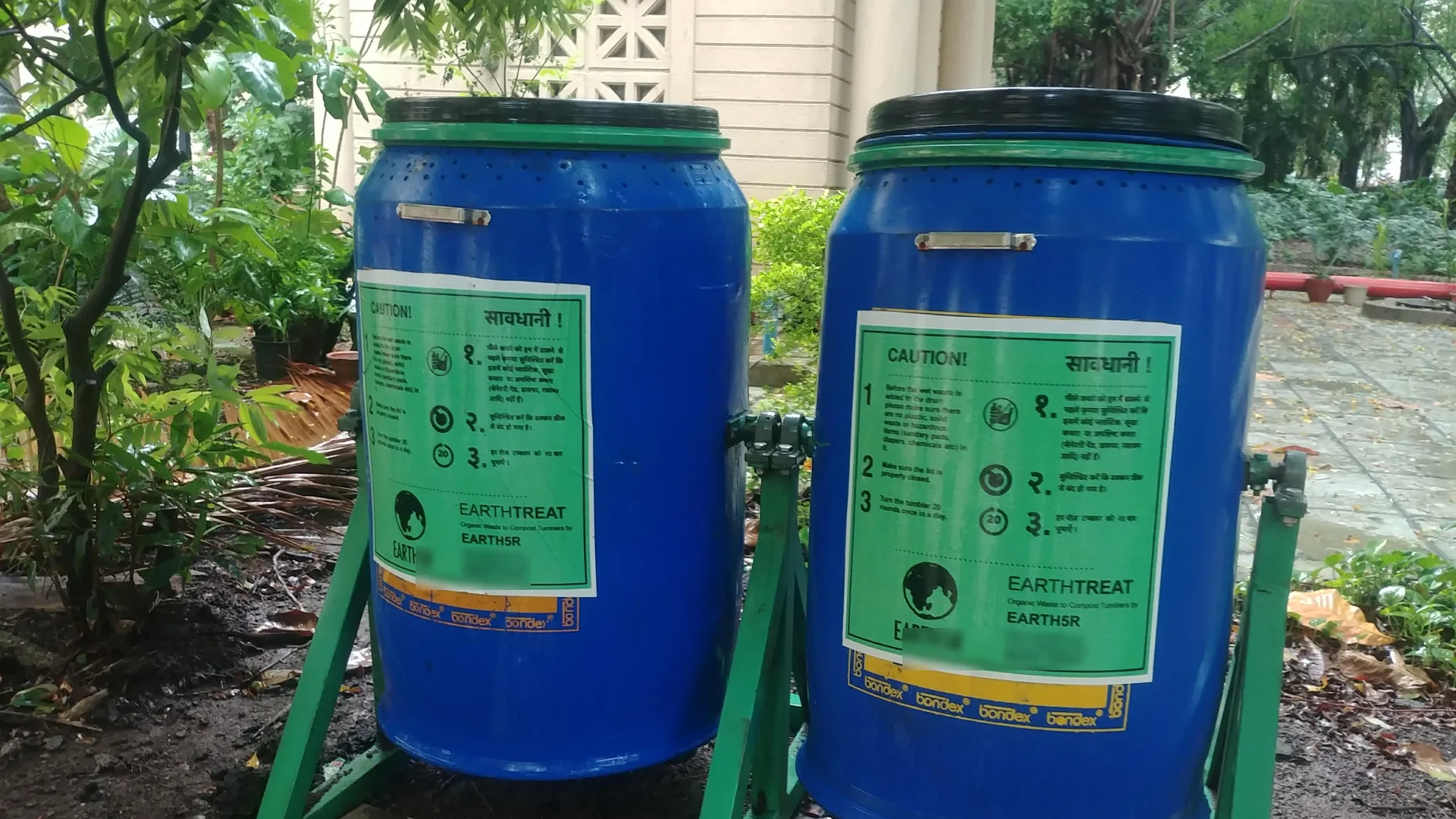
| 11 to 300 households | Medium apartments, RWAs, offices, schools, canteens[8] | Drum composters, pits, vermicomposting | Upcycled drum composters in Powai, Saki Naka and Ghatkopar[20][21][22] |
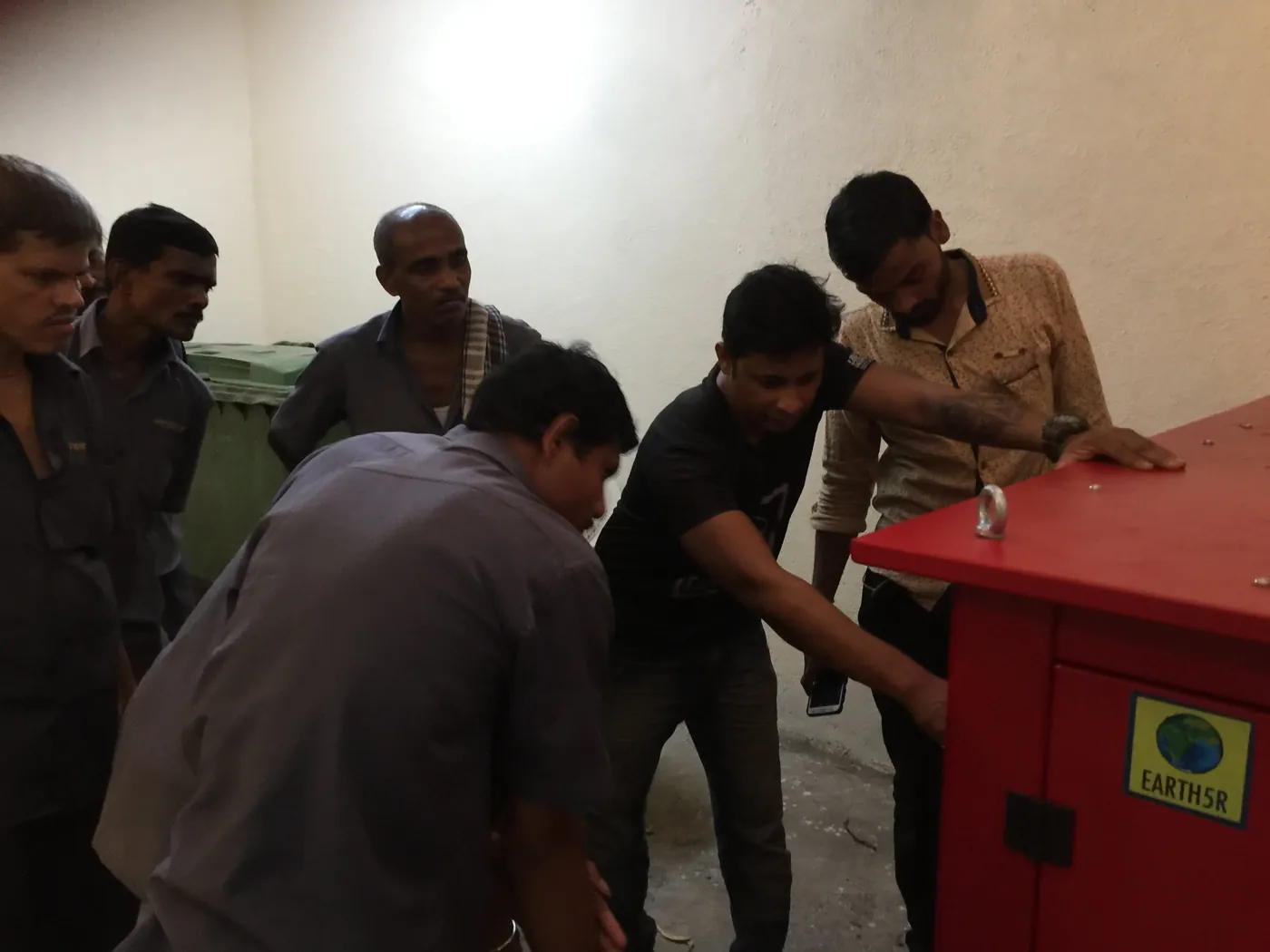
| 301 to 1,000 households | Large complexes, high-rises, large offices and hotels[8] | Mechanised and automatic composters | Automatic units for larger buildings in Mumbai[6] |
| Above 1,000 households | Decentralised plants run by local bodies or institutions[8] | Windrows, ward compost plants, biogas | Training for municipal officers in Kurla[23] |
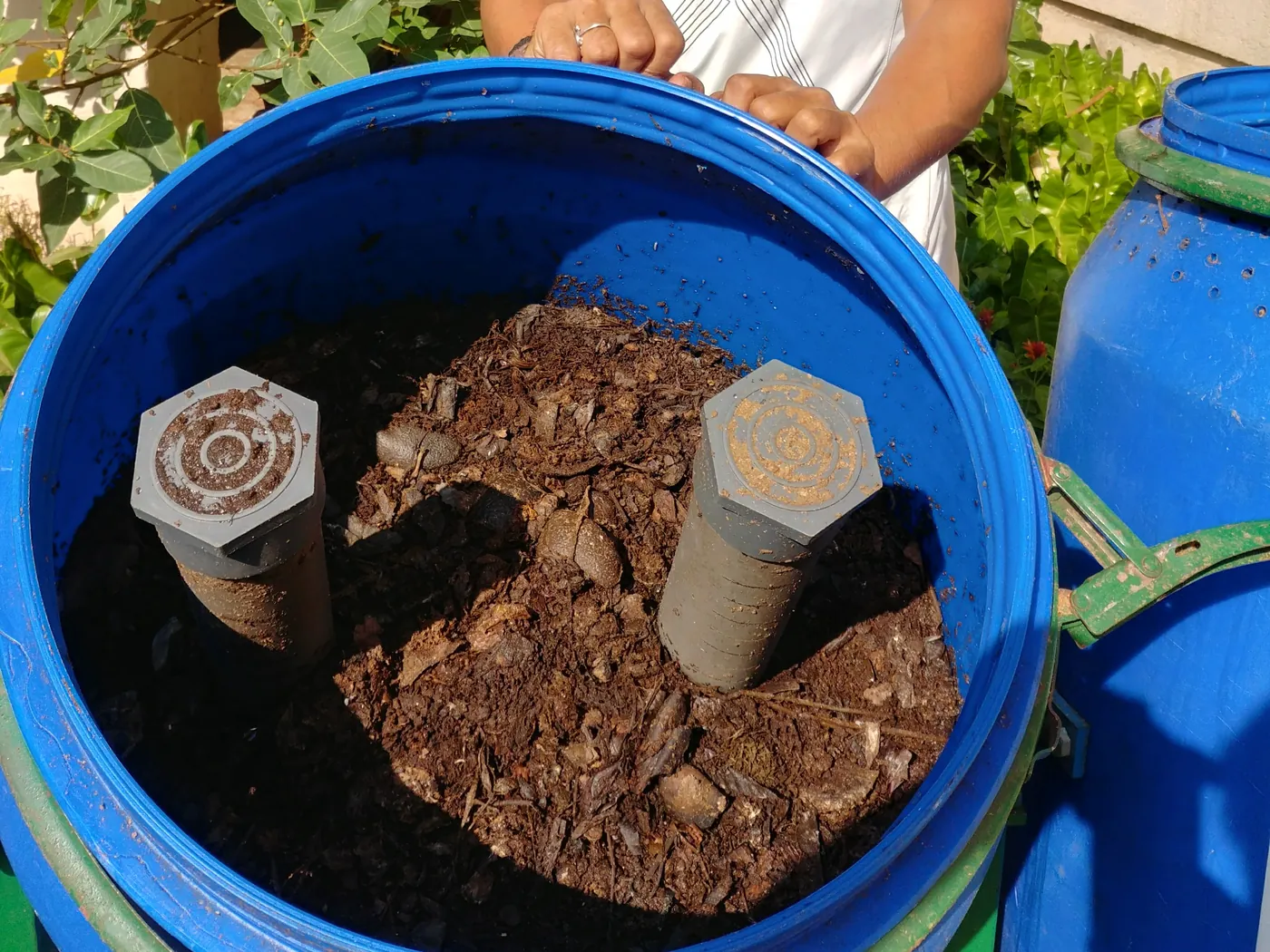
The drum is the workhorse for mid-sized buildings. A typical rotary drum set-up described by the Centre for Science and Environment uses three 200-litre drums for about five households, handles up to 5 kg of waste a day, is turned by hand once a day and finishes a batch in about 20 days. Compost comes out at roughly 20% of the weight of waste fed in.[1] Moisture is the variable most often got wrong: for aerobic composting the mix should stay at about 45 to 55%.[1]
Choosing a composter is a sizing exercise, not a branding one. Count households, measure the wet waste for a week, and pick the smallest system that a named person can run every day.
Earth5R has spent nearly a decade putting composters inside housing societies, and training the people who run them
Earth5R’s Zero Waste programme set a simple goal: make buildings zero waste by segregating and processing waste at source.[24] Under the ACT Powai programme, the Zero Waste programme took composting to residential societies in Powai, Saki Naka and Ghatkopar in Mumbai, with residents, housekeeping staff and domestic workers trained together.[22][21]
The model grew into the Community Composting Initiative in Mumbai, which reports engaging about 10,500 families in segregation and offering a choice of compost pits, manual drums and tumblers, and automatic units for larger buildings that turn organic waste into compost within 24 hours. About 4,500 families adopted drums or tumblers.[6]
The Community Composting Initiative in Mumbai
Families reached, as reported by Earth5R
Source: Earth5R, Community Composting Initiative case study. Programme-reported figures.[6]
Figures in this section and the case studies below are programme-reported in Earth5R’s case studies, linked in the references. They have not been independently audited for this article. The Community Composting Initiative’s waste and compost quantities are estimates based on an assumed 0.5 kg of organic waste per family a day and are not measured totals.[6]
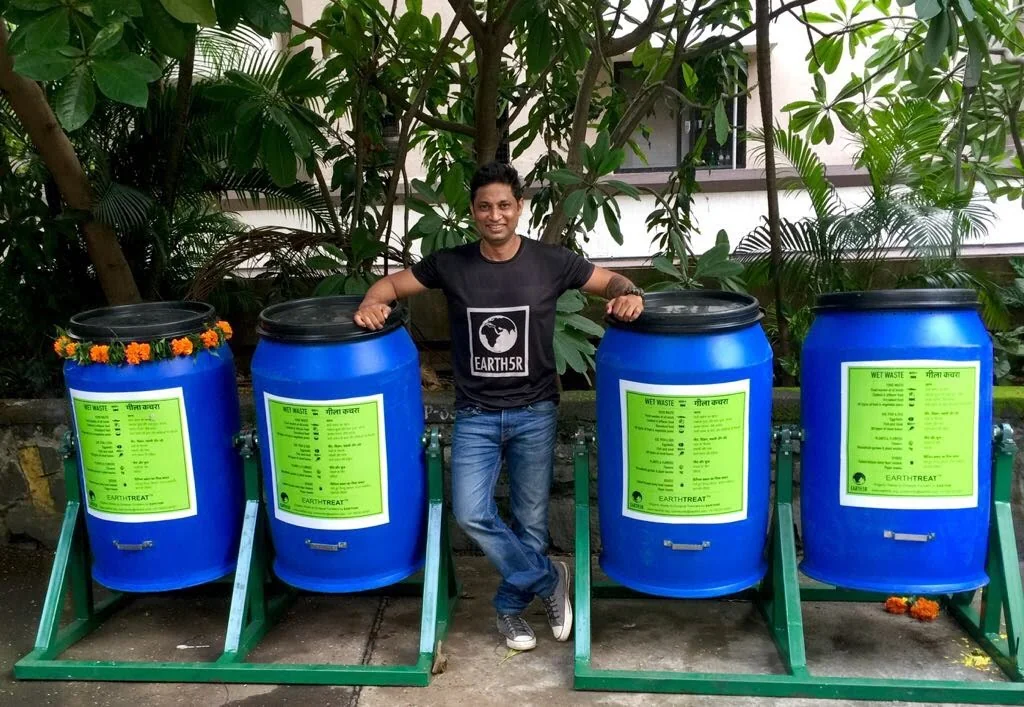
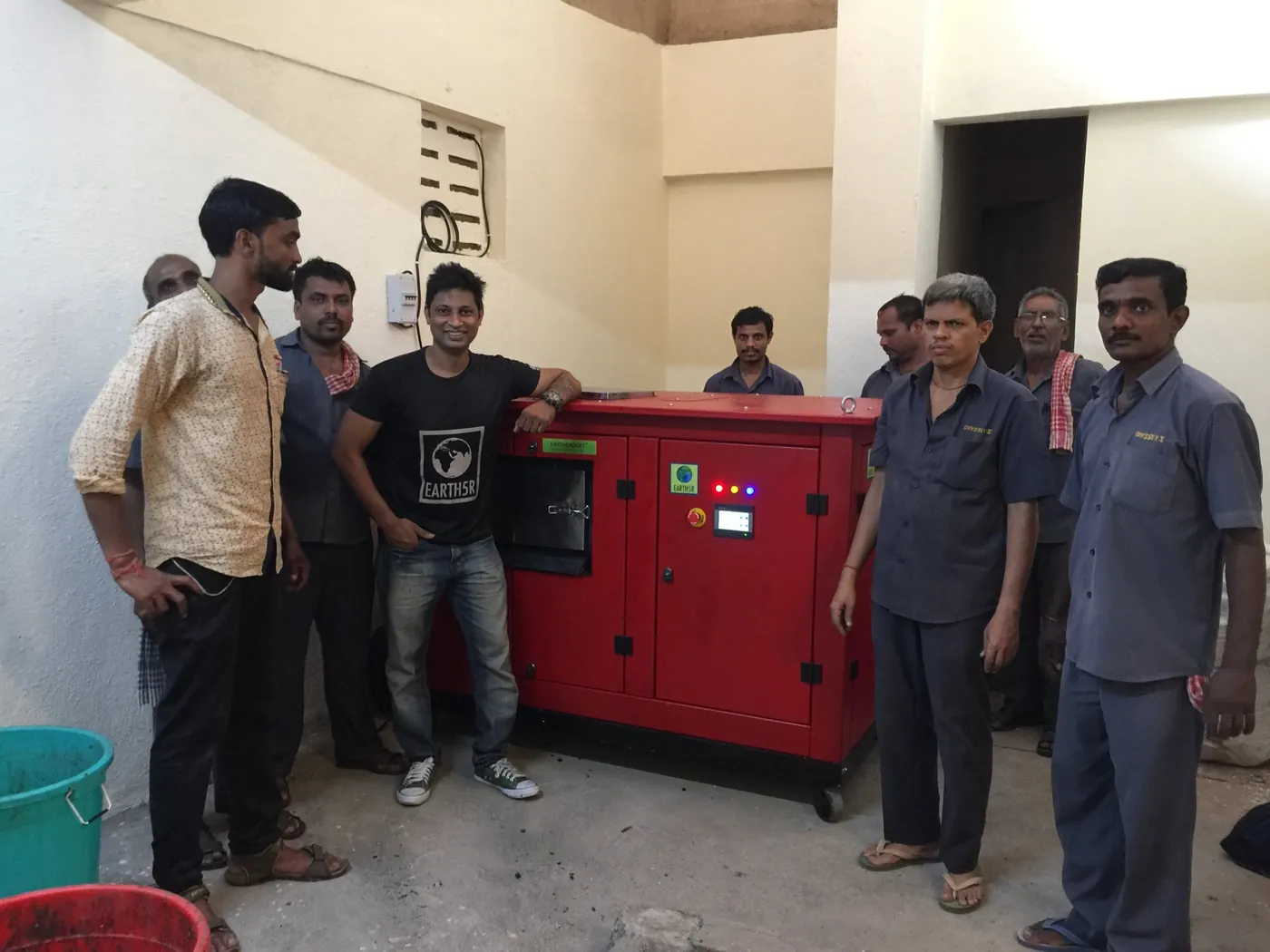
“A programme that starts at Recycle has skipped the three most important steps.” Saurabh Gupta, founder of Earth5R, on the five R’s.[25]
Earth5R’s experience is that composting succeeds as a people system with a machine attached. Every case below pairs equipment with training for residents and staff, and with follow-up visits.
Case study: Mumbai housing societies show that composting holds when residents, staff and a trainer share the work
Silver Crest, Raheja Vihar, Chandivali
Earth5R installed organic composting units at Silver Crest that can process about 1.5 metric tonnes of organic waste. The building was already segregating, and its dry waste was going to a recycler. On 26 January, Saurabh Gupta ran a Green Citizens workshop for residents on segregation, wet and dry waste, e-waste and composting, with a working demonstration of the units. The building then stopped handing its organic waste to the municipality and began processing it inside the premises with compost tumblers.[20]
The first cycle produced compost that was dark, with a rich earthy smell, and all of it went into the society garden. Residents said they were willing to give surplus compost to farmers in the next cycle. Earth5R’s report credits residents Rajesh Verma and Mukundan as citizen leaders who drove the change, with the Earth5R team supporting the building with training and inspection.[20]
Parvati Heritage, Ghatkopar
On Saturday 16 June the Earth5R team installed a composting unit at Parvati Heritage society and trained residents and housekeeping staff. Project Manager Ketul Patel took them through the household streams, recyclable, biodegradable and refuse such as medical and sanitary waste, then demonstrated how regular turning keeps the unit aerated. Compost was meant for house gardens and urban farming, with the remainder sent to farmers in Aarey Colony.[22]
Sagar Heights, Saki Naka, and Eden IV, Hiranandani
At Sagar Heights, the team trained residents, housekeeping staff and domestic workers together, and chose mechanical drum composting because it needs little space, little maintenance and no power: the unit simply has to be turned each day. Compost was to go free of cost to local farmers.[21] At Eden IV in Hiranandani, Earth5R first surveyed the building’s waste pattern before installing composting units, trained housekeeping staff on their operation, and invited Samir Deshpande, a Green Citizen from the Frangipani building, to share his own experience of composting with Earth5R units.[24]
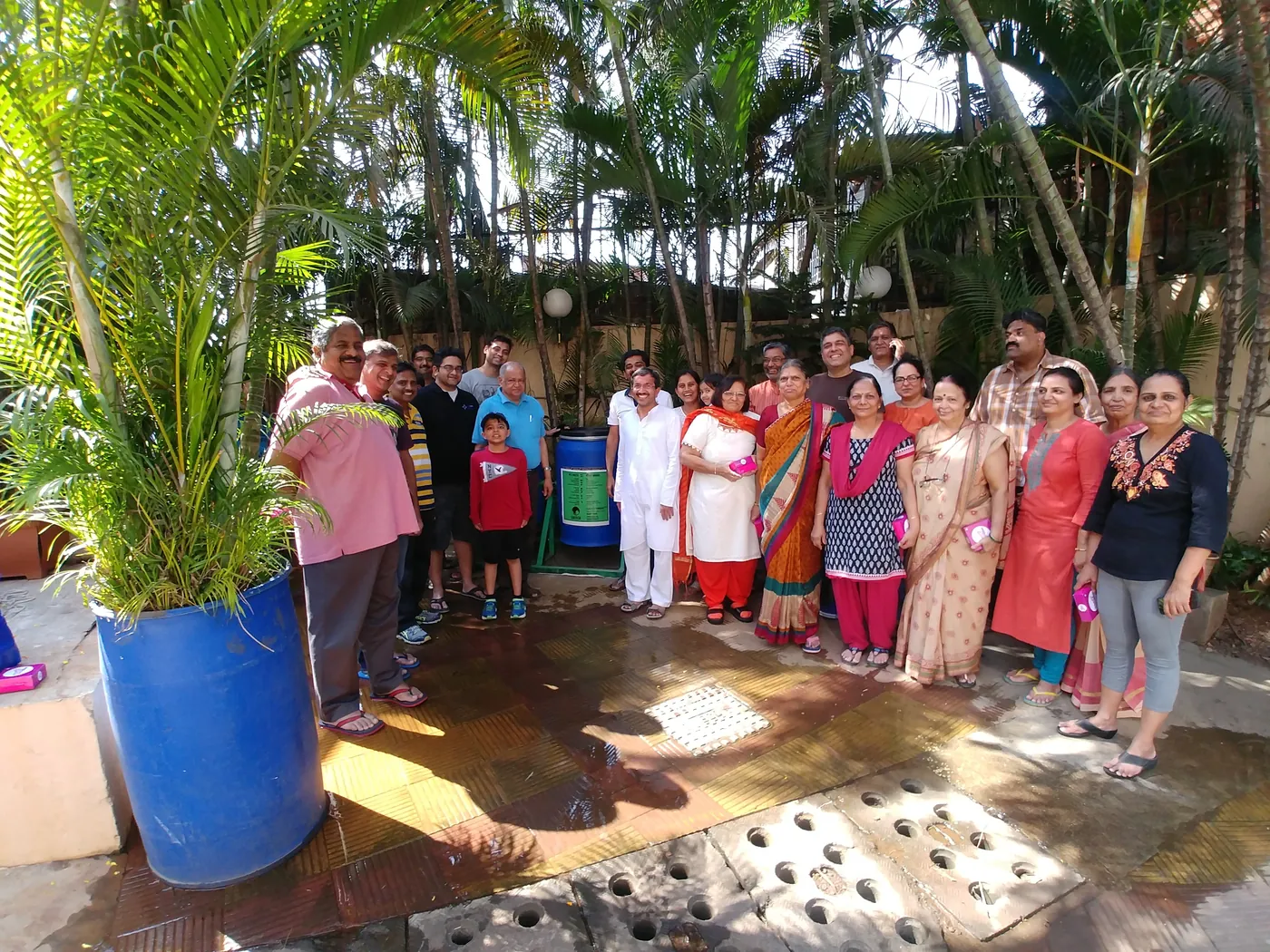
The pattern is consistent: survey first, install a system sized to the building, train the staff who will turn the drum as well as the residents who fill it, and give the compost somewhere to go. Peer voices, like a neighbour from the next building, persuade more than any poster.
Case study: from 50 families in a Pune clubhouse to 10,500 across Mumbai, scale comes from offering more than one way to compost
Earth5R’s Community Composting Initiative in Mumbai started from segregation. Families were given bins and a how-to guide so that kitchen scraps stayed free of plastic, because contaminated organic waste cannot be composted.[6] Buildings then chose among pits, manual drums or automatic units. Earth5R reports that waste workers were trained to manage and monitor the composting systems, and that the programme aims to reach 1,00,000 families by 2030.[6]
In Pune, resident Kirti Kale and her society team invited Earth5R to Marvel society in Hadapsar. On 23 May, Shriyam Jalan, Mansi Deshpande, Sonam Sengar and Saurabh Gupta went door to door, and within half an hour about fifty families had gathered in the clubhouse. Some brought their own kitchen waste, and the team showed how to separate plastic from food scraps and start compost at home with a small tumbler.[19]
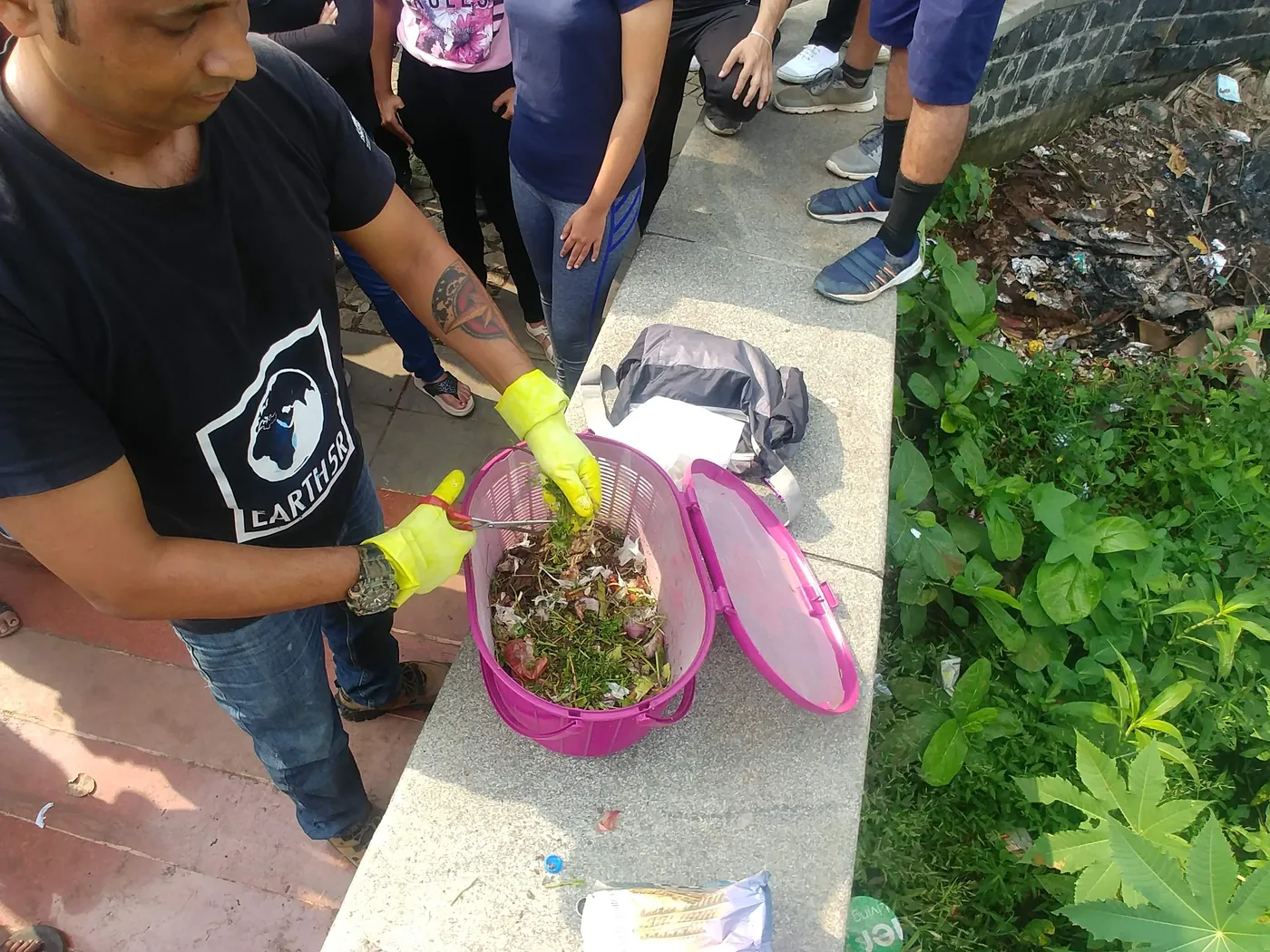
The same visit found what goes wrong. The society’s compost pit was not working because most of the leftovers in it were wrapped in plastic, and without soil, moisture, dry matter and fibre the pit had turned anaerobic. The team showed residents how to fix it.[19] Earth5R volunteers have also trained 40 municipal officers at Wadia Estate in Kurla, at the request of the Brihanmumbai Municipal Corporation, in segregation, upcycling, recycling and composting.[23] In schools, the Green School Program took composting and organic gardening to Grade 8 students at Powai Marathi Madhyamik School.[26]
Offering a choice of methods lets each building start where it can. The Pune pit is the warning: a composter that receives plastic-wrapped food will fail, however good the equipment. Segregation at the kitchen is the first and most important step.
Society composting usually fails for plain, human reasons, and each has a fix that costs little
Across Earth5R’s case studies and the government advisory, the same failure points recur, and none of them is about the equipment.
- Plastic in the wet bin. Food wrapped in plastic starves a pit of air, as the Pune society found.[19] The fix is a short, hands-on session with real kitchen waste, repeated for new residents and domestic workers.[21]
- No one owns the daily turn. Drums need turning each day and automatic units need loading.[21][1] The fix is a named operator, usually housekeeping staff, trained on the unit and recognised for the work.[24]
- Wet or dry by guesswork. Too wet and the mix smells, too dry and it stops. Keeping moisture near 45 to 55% and adding dry leaves or sawdust solves most odour complaints.[1]
- Compost with nowhere to go. Societies that use compost in their own garden and send the surplus to farmers keep going, as Silver Crest and Parvati Heritage planned.[20][22]
The equipment is the easy part. What a society really invests in is a habit: clean segregation in every kitchen and one trained person at the drum every day.
The five R’s of composting begin with Respect, for the soil and for the people who turn the drum
Earth5R’s name carries its method. In the words of founder Saurabh Gupta, “The 5R in Earth5R comes from a sequence we have taught since 2014: Respect, Reduce, Reuse, Recycle, Restore. The order matters. Respect comes first, respect for nature, for communities and for the limits of growth.”[25] Composting touches every step.
| R | What it means for composting | Evidence and Earth5R work |
|---|---|---|
| Respect | Start from the limits of the place and the people: what the building actually throws away, and who will do the daily work. | At Eden IV, Earth5R surveyed the waste pattern before installing anything, and trained housekeeping staff on the units.[24] |
| Reduce | Cut the wet waste that leaves the gate, and the food wasted before it reaches the bin. | Silver Crest stopped handing organic waste to the municipality and processed it inside the premises.[20] Indian homes waste about 55 kg of food per person a year.[10] |
| Reuse | Extend the life of materials before they are thrown away. | Earth5R’s drum composters are upcycled from industrial containers.[20] Compost goes back into the society’s own garden.[20][22] |
| Recycle | Close the loop on nutrients and on value, through proper channels. | Surplus compost was planned for farmers in Aarey Colony and near Saki Naka.[22][21] The 2026 rules ask fertiliser companies to co-market compost.[7] |
| Restore | Rebuild damaged soil, and the trust that comes from honest, checked numbers. | 48.5% of tested soil samples are low in organic carbon.[5] Earth5R labels its own figures as programme-reported.[6] |
A composting programme that starts with a machine starts at Recycle. One that starts by asking what a building throws away, and who will run the drum, starts at Respect, and lasts longer.
What housing societies, CSR teams and cities can do to make composting in India routine
Practical steps, each tied to the evidence above.
- Check where your building sits under the 2026 rules. Bulk generators, gated communities over 5,000 sq m and every RWA have composting duties, and some have a one-year window from January 2026.[7][4]
- Measure a week of wet waste before buying equipment. Size the system with the government advisory’s household categories.[8]
- Train the operator, not only the residents. Every Earth5R society case trained housekeeping staff alongside residents.[22][21][24]
- Plan where the compost goes. Society gardens first, then farmers, and city parks, which the rules now ask to use compost.[20][7]
- Use employee volunteering for the hard part. CSR teams can fund composters and send volunteers back each month to help societies through the first cycles. Our employee volunteering guide shows how.
- Report kilograms, not events. Wet waste processed on site and compost used are the numbers that matter for BRSR and CSR reporting.

Free guide · Earth5R Guides
How CSR heads build employee volunteering that lasts, with best practices, a policy template and a tracker. Free, no sign-up.
Earth5R partners with companies, housing societies and cities on zero waste and composting programmes across India. Explore Earth5R’s CSR and ESG projects or browse the field gallery.
Talk to Earth5R about a composting programmeSee Earth5R’s CSR and ESG projects
Frequently asked questions about composting in India
- How much of India’s waste can be composted?
- Roughly half or more. Estimates put the organic share of urban municipal solid waste at 51% (Planning Commission task force, 2014) to about 55 to 65% (Centre for Science and Environment).[9][1]
- Do the Solid Waste Management Rules, 2026 require housing societies to compost?
- Bulk waste generators, such as sites of 20,000 sq m or more or those producing 100 kg of waste a day, must process wet waste on site as far as possible or obtain an EBWGR certificate. Gated communities over 5,000 sq m and all resident welfare associations must ensure segregation and process biodegradable waste within the premises as far as possible, within one year of notification.[4][7]
- Which composting method suits an apartment building?
- It depends on size. The government advisory groups systems by households served: bins and tumblers for up to 10 households, drum composters, pits or vermicomposting for 11 to 300, and mechanised or automatic units for larger complexes.[8]
- How long does drum composting take, and how much compost does it make?
- A hand-turned rotary drum system finishes a batch in about 20 days, and compost comes out at roughly 20% of the weight of waste fed in, according to the Centre for Science and Environment.[1]
- Why does composting matter for the climate?
- Organic waste buried in mixed dumps decomposes without air and produces methane. In 2020, 912 gigagrams of methane came from municipal solid waste at Indian landfills, according to India’s Fourth Biennial Update Report.[14] Composting with air avoids that.
- How does Earth5R help with composting?
- Earth5R installs composters, trains residents, housekeeping staff and municipal teams, and supports buildings through the first cycles, as in its Powai, Saki Naka and Ghatkopar society programmes and the Community Composting Initiative in Mumbai.[20][21][22][6]
Related reading on Earth5R
- Food waste in India: facts on homes, farms and landfills
- Landfills in India: legacy waste, methane and what keeps dumpsites from returning
- Festival waste in India: what Earth5R learned at the lakes
- SWM Rules 2026: four-stream waste segregation
- Composting and organic waste management at Silver Crest, Mumbai
References
- Biswas, A., Tewari, S. and Parida, S. (2021). Decentralized Management of Segregated Organic Waste. Centre for Science and Environment, New Delhi, Introduction and technology sheets on drum composting. cseindia.org
- Ministry of Housing and Urban Affairs (2025). Implementation of Swachh Bharat Mission-Urban. Written reply in Parliament, Press Information Bureau, 11 December 2025. pib.gov.in
- Ministry of Housing and Urban Affairs (2026). Two-day National Review of Swachh Bharat Mission-Urban 2.0, Vigyan Bhawan, New Delhi. Press Information Bureau, 20 May 2026. pib.gov.in
- Ministry of Environment, Forest and Climate Change (2026). Solid Waste Management Rules, 2026 notified: four-stream segregation, Extended Bulk Waste Generator Responsibility and online tracking. Press Information Bureau, 28 January 2026. pib.gov.in
- Centre for Science and Environment (2025). Indian soils severely deficient in essential nutrients. Press release, New Delhi and Nimli, 27 and 28 October 2025, assessing Soil Health Card data for 2023-25. cseindia.org
- Earth5R. Community Composting Initiative: organic waste management in Mumbai. EarthJournal, Earth5R. Programme-reported. earth5r.org
- Ministry of Environment, Forest and Climate Change (2026). Solid Waste Management Rules, 2026. Gazette of India, Extraordinary, Part II, Section 3(ii), notified 27 January 2026, in force from 1 April 2026, Rules 5, 6, 15 and 25. Copy hosted by the Maharashtra Pollution Control Board. mpcb.gov.in
- Central Public Health and Environmental Engineering Organisation (2018). Advisory on On-Site and Decentralized Composting of Municipal Organic Waste. Ministry of Housing and Urban Affairs, June 2018, sections 1.5 to 1.10 and the household category table. s3waas.gov.in
- Ahluwalia, I. J. and Patel, U. (2018). Solid Waste Management in India: An Assessment of Resource Recovery and Environmental Impact. ICRIER Working Paper 356, Indian Council for Research on International Economic Relations, section on waste composition. icrier.org
- Choubey, J. (2024). India’s per capita food waste 55kg/yr, says UN. The New Indian Express, 28 March 2024, reporting the UN Environment Programme Food Waste Index Report 2024. newindianexpress.com
- Prime Minister’s Office (2022). PM inaugurates municipal solid waste based Gobar-Dhan plant in Indore. Press Information Bureau, 19 February 2022. pib.gov.in
- Ministry of Housing and Urban Affairs and Ministry of Jal Shakti (2025). Waste to energy and biogas under Swachh Bharat Mission. Written reply in the Lok Sabha, Press Information Bureau, 3 April 2025, with Annexure I on functional community biogas plants. pib.gov.in
- Ministry of Environment, Forest and Climate Change (2024). India submits its Fourth Biennial Update Report to the UNFCCC. Press Information Bureau, 30 December 2024. pib.gov.in
- National Institute of Urban Affairs (2025). India Fourth Biennial Update Report (BUR-4): how does it focus on GHG emissions from solid waste? NIUA blog. niua.in
- Ministry of Environment, Forest and Climate Change (2026). Solid Waste Management Rules, 2026 to come into effect from April 1. Written reply in the Lok Sabha, Press Information Bureau, 30 March 2026. pib.gov.in
- Earth5R (2026). Solid Waste Management Rules 2026: India compliance guide. EarthJournal, Earth5R. earth5r.org
- Cabinet Committee on Economic Affairs (2023). Cabinet approves bouquet of schemes for farmers, including Market Development Assistance of Rs 1,500 per tonne for organic fertilisers from GOBARdhan plants. Press Information Bureau, 28 June 2023. pib.gov.in
- Press Information Bureau (2026). GOBARdhan: Fuelling Clean Energy and Rural Growth. Backgrounder, 6 August 2026, sections on the MDA scheme and the GOBARdhan Unified Registration Portal. static.pib.gov.in
- Sumana K. (editor). Composting and organic gardening workshop at Pune. EarthJournal, Earth5R, Marvel society, Hadapsar. earth5r.org
- Patel, K. (reporter). Composting and organic waste management at Mumbai. EarthJournal, Earth5R, Silver Crest building, Raheja Vihar, Chandivali, Powai. Programme-reported. earth5r.org
- Griffin, E. and Mukhopadhyay, A. (reporters). Zero waste trainings and composting installations in Mumbai. EarthJournal, Earth5R, Sagar Heights, Saki Naka. earth5r.org
- Mukhopadhyay, A. and Griffin, E. (reporters). Zero waste and compost units in Ghatkopar. EarthJournal, Earth5R, Parvati Heritage society, ACT Powai Zero Waste programme. earth5r.org
- Dani, R. (reporter). Waste management training at Mumbai: Earth5R trains communities for the Mumbai Municipality. EarthJournal, Earth5R, Wadia Estate, Kurla. Programme-reported. earth5r.org
- Patel, K. (reporter). How to become a zero waste building. EarthJournal, Earth5R, Eden IV, Hiranandani, Powai. earth5r.org
- Gupta, S. (2026). AI and Sustainability: Planetary Limits. EarthJournal, Earth5R. Section on the Earth5R method, Respect, Reduce, Reuse, Recycle, Restore. earth5r.org
- Giordano, Y. (reporter). Upcycling, gardening and composting workshop in Mumbai. EarthJournal, Earth5R, Green School Program. earth5r.org
How to cite this article
Earth5R (2026). Composting in India: What Earth5R’s Housing Societies, Drum Composters and the 2026 Waste Rules Show. EarthJournal, Earth5R, 20 November 2026. https://earth5r.org/composting-india/
Figures are taken from the sources cited and were current on 20 November 2026. Waste composition estimates vary by city, season and method and are not a single national measurement. One lakh is 100,000 and one crore is 10 million. Earth5R figures are programme-reported and link to the case studies they come from. People in Earth5R photos are not named unless an Earth5R report names them.